

Backchannel references are off-list conversations you run late in a hiring process to check a candidate’s reputation with people not on their resume. Use them, but only under three conditions: you have the candidate’s consent, your questions stay job-relevant, and you write down who you called and why. Skip any of the three and you’re not doing due diligence, you’re just gossiping with better spreadsheets.
TL;DR:
- Backchannel references should only be used with candidate consent, relevant questions, and proper documentation to avoid bias and legal issues.
- They are most valuable when used late in the process to verify consistent patterns, especially for high-impact roles like VP of Sales or CRO.
- Limit off-list calls to recent sources within five to seven years and ask structured, behavioral questions to minimize bias.
- Document all contact details, questions, and answers for legal protection and to ensure a balanced, triangulated view.
- Do not rely on a single negative anecdote; look for recurring signals from multiple sources before making a hiring decision.
Table of Contents
- Why Bother With Networking References at All?
- What Legal and Ethical Lines Can’t You Cross?
- When Should You Run Backchannel Checks?
- How Do You Run a Backchannel Reference the Right Way?
- How Much Weight Should a Backchannel Carry?
- How Cornerstone Search Runs Reference Checks
- Sources Worth Reading Next
- A Recruiter’s Honest Take on Backchannels
- Sources
- FAQ
Why Bother With Networking References at All?
Here’s the honest case for backchannel communication: it catches what interviews miss. A candidate can nail five rounds of interviews and still be a nightmare who blew up a sales floor at their last stop. I’ve seen it happen. Somebody with a great story and terrible judgment can talk their way through almost any process.
Backchannels add candid context, help you spot patterns across multiple voices, and surface reputation signals that never show up in a resume. They also help with onboarding: a peer reference who tells you a new VP needs a strong operator underneath them is worth more than any personality assessment.

Here’s the tradeoff nobody talks about enough: the Craft Ventures team has flagged that backchannels can create a bias problem when used carelessly. One loud opinion from a former boss can anchor how you read every interview that follows, even when that opinion is wrong or outdated.
The real risks:
- Bias from a single bad or biased source.
- Leaks that damage the candidate’s current job if word gets back.
- Over-weighting one dramatic anecdote over a consistent interview record.
- Legal exposure if questions stray into protected-class territory.
Save backchannels for roles where a wrong hire actually hurts: VP Sales, CRO, and other seats where one bad decision costs you a year and a territory.
What Legal and Ethical Lines Can’t You Cross?
This is where I see smart hiring managers step on a rake. Backchannel referencing is legal in the U.S. as long as you stay inside employment law and anti-discrimination rules, but sloppy execution can create real exposure, according to JRG Partners. Here’s how to stay clean.
Get explicit consent before you call anyone off the candidate’s list, especially for senior roles where a leak could cost them their current job. Implied consent is not consent. Ask directly, get a yes, and move forward.
Keep every question job-relevant. Ask about quota attainment, team management, forecast accuracy, and leadership style. Do not ask about age, health, family status, or anything that even smells like a protected category. Catalyst Legal is blunt about this: information gathered off-list must be job-relevant and documented, never used to justify a decision you can’t defend later.
Build a paper trail. Log who you contacted, when, what you asked, and how the answer factored into your decision. If you can’t produce that record in a lawsuit, you don’t have a defensible process, you have a hunch with a phone number.
- Never contact a candidate’s current employer without permission.
- Never ask leading questions designed to confirm a bias you already have.
- Loop in HR or legal before backchanneling a role above VP level.
Pro Tip: Keep a one-line consent script ready: “Before we move to final stages, I’d like to speak with a few people outside your reference list who’ve worked with you. Are you comfortable with that, and is there anyone you’d rather I avoid?” It takes ten seconds and it protects you.
When Should You Run Backchannel Checks?
Timing is where most hiring managers blow it. Run backchannels too early and you poison the process before the candidate ever gets a fair interview.
- Wait for final stages. For senior and high-impact roles, hold off until you’re down to your last one or two candidates. The BCV field guide is direct on this: obtain explicit consent and run off-list checks late in the process, not before.
- Never lead with a backchannel. An early, negative comment from a former boss can shift how you read every subsequent interview, even a strong one. Craft Ventures calls this the “emotional center of gravity” problem, and it’s real.
- Stay inside a five to seven year window. Old grudges and outdated impressions do you no favors. Pick sources who worked with the candidate recently enough to speak to who they are now.
Use backchannels to confirm a decision you’re close to making, not to make the decision for you.
How Do You Run a Backchannel Reference the Right Way?
Here’s the protocol I’d hand any hiring manager who wants to do this without blowing up their process or their reputation.
- Pick your sources carefully. Target two or three former managers or peers who worked directly with the candidate in the last five to seven years. Skip anyone with an obvious grudge or an obvious incentive to inflate.
- Vet the source before you trust the answer. Ask yourself why this person left that company, how close they actually worked with the candidate, and whether they have a reason to shade the truth.
- Ask structured, behavioral questions. Skip “were they good?” That gets you nothing. Ask: “Walk me through how they handled a quarter they missed.” “How did their team perform under them a year after they left?” “Would you hire them again for a bigger seat?” That last question is the tell. People hesitate when the answer is no.
- Protect confidentiality on both sides. Never reveal who else you’ve spoken with. Never share what one source said with another. And never tell the source anything about your internal deliberations, salary range, or timeline.
- Document everything. Who you called, what you asked, what they said, and how it weighed against your interview notes. This isn’t busywork, it’s your defense file if anyone ever questions the hire.
- Triangulate before you act. One comment is an anecdote. Two independent comments pointing the same direction is a pattern.
Pro Tip: If two backchannel sources you didn’t know were connected both raise the same concern independently, that’s the signal worth acting on. Coincidence stops being coincidence at two.
How Much Weight Should a Backchannel Carry?
A single anecdote from one former colleague should never override a structured process. That’s outsourcing your judgment to a stranger on the phone, and it’s exactly the trap Craft Ventures warns hiring managers about.
Think of it as three inputs, not one verdict:
- Structured interviews carry the most weight. They’re consistent, comparable, and built around the job.
- Formal references confirm the basics and add a bit of color.
- Backchannel references extend and stress-test what you already believe. They should shift your decision only when they show up more than once, independently.
If a backchannel surfaces something negative, don’t bury it and don’t panic. Get a second independent source before you treat it as fact. If it holds up, give the candidate a direct, respectful chance to respond before you make a call. Then write down your reasoning, what you heard, how you verified it, and why you decided what you decided. That record protects the candidate and protects you.
How Cornerstone Search Runs Reference Checks
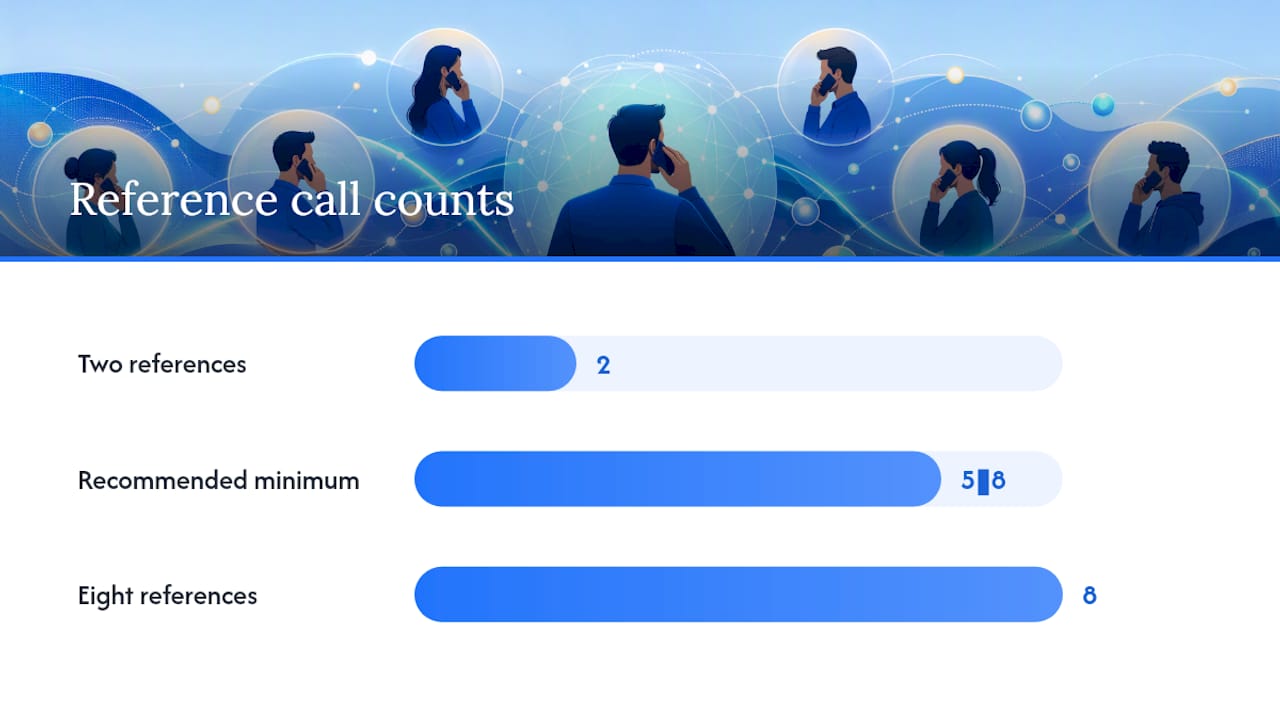
I’ve run this process on more than 1,200 sales and executive placements since 1996, and here’s the version that holds up. Call 5 to 8 references minimum for a senior sales leader, not two. Two references tell you what the candidate wants you to hear. Eight tell you the truth.
For VP Sales candidates specifically, score across key dimensions such as quota attainment, team-building, forecast accuracy, executive presence, and how they handle setbacks. Wait until late stage, always with consent, always documented.
- Get consent before any off-list call, every time.
- Ask the same five-question script across every source so you can compare answers.
- Log every call: who, when, what was asked, what was said.
- Never let one loud opinion override a pattern across six other conversations.
This isn’t theory. It’s what separates a slam-dunk search from a hire that quietly wrecks a sales floor for a year. If you’d rather have someone else run this process with the same rigor, Cornerstone Search’s executive search team handles the whole thing, backchannels included, and does it fast.
Sources Worth Reading Next
For deeper reading, the Bain Capital Ventures field guide covers process and timing well. Catalyst Legal has the sharpest legal checklist on consent and discrimination risk. Craft Ventures and Sonar Partners both offer sharp practitioner takes on when backchannels help and when they backfire.
A Recruiter’s Honest Take on Backchannels
I’ve watched a backchannel call flip a hire that looked perfect on paper. Three peers, unprompted, described the same blind spot the interviews never surfaced. That’s not luck, that’s the process working.
My rule: if you wouldn’t want the candidate to know you made the call, don’t make it. Backchannels done right build trust. Done sloppy, they just make you feel smart while you break the law.
— Rich Rosen
Sources
Yes, it’s standard once you’ve cleared several interview rounds and are among the final candidates. If a company plans to call people outside your submitted list, an ethical employer will tell you and ask for your consent first.
- BCV Field Guide: Reference Checks and Backchannels to Navigate the Last Mile of Hiring
- Are Backchannel References Legal in Hiring: What Employers and Job Seekers Should Know – Catalyst Legal
- References, Backchannels, and the risk of outsourcing judgment — Craft Ventures
- Backchannel references in executive hiring — Sonar Partners
FAQ
Do Recruiters Actually Contact References?
Yes, and good ones contact more than the two or three names on the candidate’s list. For senior sales roles, calling 5 to 8 references including off-list contacts is standard practice for a serious search.
Can I Lose a Job Offer Because of a Reference?
Yes, a negative or inconsistent reference can cost you an offer, especially at the executive level where backchannel checks are common. Multiple independent sources raising the same concern carry far more weight than one bad call.
At What Stage Do Employers Check References?
Most formal references get checked mid-process, but backchannel checks belong at the final stage, right before an offer. The BCV field guide recommends waiting until the last mile so early opinions don’t skew the interview process.