

You own a candidate only when you can prove a written introduction with a timestamp attached. Memory doesn’t hold up in a fee dispute. A gut feeling doesn’t either. If you can’t produce a dated email, an ATS entry, or a signed submission form, you have an opinion, not a claim. Start logging every submission today, before you need it.
TL;DR:
- Having documented proof of candidate introduction, including timestamps and consent, is essential to establish ownership and avoid disputes.
- Effective cause, demonstrated through significant work beyond initial submission, often outweighs first-to-introduce in legal and client evaluations.
- Contract clauses should specify clear definitions of introduction, ownership duration, fee basis, and include language covering affiliates and prior knowledge.
- Rapid, consistent logging of submissions and candidate consent, along with scopes of responsibility, minimizes the risk of overlapping claims from multiple recruiters.
- Disputes are more likely when clients withhold information about other agencies or candidates, so collecting written agreements and proactive notices prevents conflicts.
Table of Contents
- What Candidate Ownership Recruiting Actually Means
- The Contract Clauses That Actually Enforce Ownership
- What To Do When Two Recruiters Claim The Same Candidate
- Sample Clause Language and a One-Page Audit
- Daily Habits That Stop Ownership Fights Before They Start
- How Cornerstonesearch Handles Ownership In Real Searches
- Rich Rosen’s Blunt Take On Candidate Ownership
- Skip The Ownership Headaches With Cornerstone
- Sources
- FAQ
What Candidate Ownership Recruiting Actually Means
Candidate ownership recruiting comes down to one question: who introduced this person to this job first, and can they prove it? That’s the whole game. Everything else, the fee splits, the lawsuits, the ugly phone calls between agency owners, flows from that single fact pattern.
An introduction isn’t a text message saying “hey, check this guy out.” It’s a documented submission: a resume sent by email with a timestamp, an entry in the client’s applicant tracking system, or a signed candidate consent form tied to a specific job requisition. If you can’t show a date and a paper trail, you don’t have an introduction. You have a story.
Protection windows set how long your claim on that candidate lasts after you submit them. The industry standard runs 6 to 12 months, and most agreements pick a number in that range and stick to it. Shorter windows favor high-volume contingency shops moving fast on transactional roles. Longer windows fit executive search, where a search can drag on for months and a client might circle back to a candidate you found nine months ago.
Every solid ownership clause carries a prior-knowledge exception. If the client already had that candidate in their own pipeline, through a referral, an inbound application, or a prior recruiter relationship, your “introduction” doesn’t count. Clients hate paying twice for someone they already knew. Build this exception into your contract instead of fighting about it later.
Here’s where it gets interesting, and where a lot of recruiters get burned — understanding staffing and recruitment best practices can help avoid these pitfalls:
- First to introduce is the simple rule: whoever submitted the resume first wins the fee, period.
- Effective cause is the messier, more legally defensible standard: the fee goes to whoever did the substantive work that actually caused the hire, interview scheduling, reference checks, offer negotiation, closing the deal.
Courts and savvy clients increasingly lean toward effective cause over pure first-to-introduce. Translation: sending a resume and then vanishing for three months while another recruiter drives the whole process to close is a weak claim, even if your timestamp is earlier. Document your activity, not just your submission.
The Contract Clauses That Actually Enforce Ownership
A handshake and good intentions get you nothing when a client tries to backdoor a hire through a subsidiary. You need language on paper, and it needs to be specific. Here’s the checklist I run through on every agreement before I sign it:
- Right-to-represent clause. State plainly that you have permission to submit this candidate to this client for this role. No permission, no fee, no matter how good the match is.
- Introduction definition. Spell out exactly what counts: written resume submission, email with candidate details, or ATS log entry with a timestamp. Vague language here is where disputes are born.
- Ownership window. Name the number. Six months for contingency, twelve for retained executive search is a common split, and both sides should agree on it before you send a single resume.
- Fee basis. Tie the fee to annual guaranteed compensation, not base salary alone if there’s a meaningful bonus or commission structure. Say it in the contract, not in a side conversation.
- Payment terms. Net 14 or net 30 from start date, spelled out, with a late payment penalty clause. Daily interest on overdue invoices isn’t aggressive. It’s normal.
- Subsidiary and affiliate language. Cover every related entity, parent companies, subsidiaries, portfolio companies under the same private equity umbrella. Clients love routing a hire through a sister company to dodge a fee. Close that door in writing.
- Guarantee and confidentiality cross-references. Link your ownership clause to your guarantee period and confidentiality terms so they don’t contradict each other buried in different sections.
Recruitment agreement templates from sources like Document consistently bundle these elements together for a reason: they’ve all been tested in real disputes.
Pro Tip: Never rely on a verbal “yes, go ahead and submit them” from a hiring manager. Get the written submission confirmation, even a one-line email reply, before you consider the candidate locked in.
Documentation standards matter as much as the clause language itself. A submission with no date, no specific job requisition attached, and no candidate consent on file is a submission you’ll lose an argument over. Build the habit of attaching all three every single time, and this whole section becomes a formality instead of a fire drill.
What To Do When Two Recruiters Claim The Same Candidate
This happens more than anyone likes to admit, especially on multi-agency searches where nobody scoped the lanes clearly upfront. Here’s the order of operations, and skipping steps here costs you money.
First, pull your evidence before you say a word to anyone:
- Timestamped submission (email header or ATS entry, not a memory of “I definitely sent that on a Tuesday”)
- Candidate-signed consent or acknowledgment of representation
- Interview and communication logs showing what work you actually did after the submission
- Any written confirmation from the client acknowledging receipt
Once you have that stacked up, negotiate before you escalate. A fee split between the two agencies is common and often the fastest path to getting paid something instead of nothing after a drawn-out fight. Some agencies agree to a priority rule in advance: first documented submission wins outright, unless the second recruiter did the effective-cause work that actually closed the deal.
Mediation or legal action is the last resort, and you should run the math before you go there. A mid-size placement fee rarely justifies attorney hours unless the client relationship is worth protecting long-term or the fee itself is six figures on an executive search. Most disputes settle faster and cheaper with a direct call between agency principals than with a demand letter.
While the dispute plays out, don’t let the client’s hiring process bury your claim. Send written notice to the client the moment you spot a competing submission, stating your ownership window and your documented introduction date. Clients generally don’t want to get caught in the middle, and a clear written notice often pushes them to resolve it between the agencies rather than just paying whoever screams loudest. Silence during a live hiring process is how legitimate claims quietly disappear.
Sample Clause Language and a One-Page Audit
You don’t need a lawyer to draft your first ownership clause. You need language that’s been tested and a checklist to catch gaps before they cost you a fee. Clause banks like LawInsider publish workable starting language for exactly this.
Here’s stripped-down sample text you can adapt:
- Introduction clause: “A candidate is deemed introduced upon written submission via email or applicant tracking system, including full name, resume, and date of submission.”
- Ownership window clause: “Ownership of an introduced candidate extends for [6/12] months from the date of introduction, subject to the prior-knowledge exception below.”
- Prior-knowledge exception: “This agreement does not apply to candidates already known to Client through internal pipeline, referral, or direct application prior to introduction.”
- Affiliate clause: “This agreement extends to all parent companies, subsidiaries, and affiliated entities of Client for the duration of the ownership window.”
- Fee trigger clause: “Fee is earned upon hire of an introduced candidate into any role at Client or its affiliates within the ownership window, regardless of role change from originally submitted position.”
Run this before your first submission on any new client relationship:
| Checklist item | Why it matters |
|---|---|
| Signed agreement with ownership window defined | No signed terms means no enforceable claim |
| Introduction definition matches your submission method | Prevents “that doesn’t count” arguments later |
| Fee basis tied to total annual compensation | Avoids fee disputes over bonus or commission structure |
| Affiliate and subsidiary language included | Blocks backdoor hires through related entities |
| Prior-knowledge exception explicitly stated | Protects the client relationship from bad-faith fee claims |
Retained search agreements can afford longer windows and higher minimum fees since the relationship is exclusive. Contingency agreements need tighter, faster language since you’re often competing with other agencies on the same role. Tailor the window length to the model, not the other way around.
Daily Habits That Stop Ownership Fights Before They Start
Contracts protect you after a fight starts. Process stops the fight from starting. Here’s what actually works day to day.
- Decide exclusivity upfront. A single-recruiter search with real exclusivity avoids the whole mess. If the client insists on multiple agencies, scope each firm’s lane clearly in writing, by function, level, or geography, before anyone submits a resume.
- Standardize your submission format. Every submission needs candidate name, resume, date, job requisition ID, and a note on how the candidate was sourced. Log it in your ATS the same day, not the same week.
- Ask clients about other agencies on the search. If a client won’t disclose whether other recruiters are working the same role, that’s a signal to get your ownership terms in writing before you submit anyone.
- Get candidate consent before submission. A quick written acknowledgment that the candidate agrees to representation for this specific role protects you and respects the candidate’s own job search.
Pro Tip: If a client runs multi-agency searches as standard practice, ask for a scoped-responsibility document before you agree to participate. It takes five minutes and saves you from months of fee arguments.
How Cornerstonesearch Handles Ownership In Real Searches
We run both retained and contingency work at Cornerstonesearch, and the ownership approach shifts depending on which model a client picks. Retained searches get exclusivity and longer windows because the client is paying for our full attention. Contingency work gets tighter documentation because speed and proof matter more when other recruiters might be circling the same candidate.
Every submission gets logged the moment it happens, resume, timestamp, requisition, candidate consent. No exceptions, no “I’ll log it later.” That habit alone has saved more fee disputes than any clause we’ve ever written. Rapid intake matters too. The faster you move a candidate from first conversation to documented submission, the less window there is for a competing agency to claim the same person.
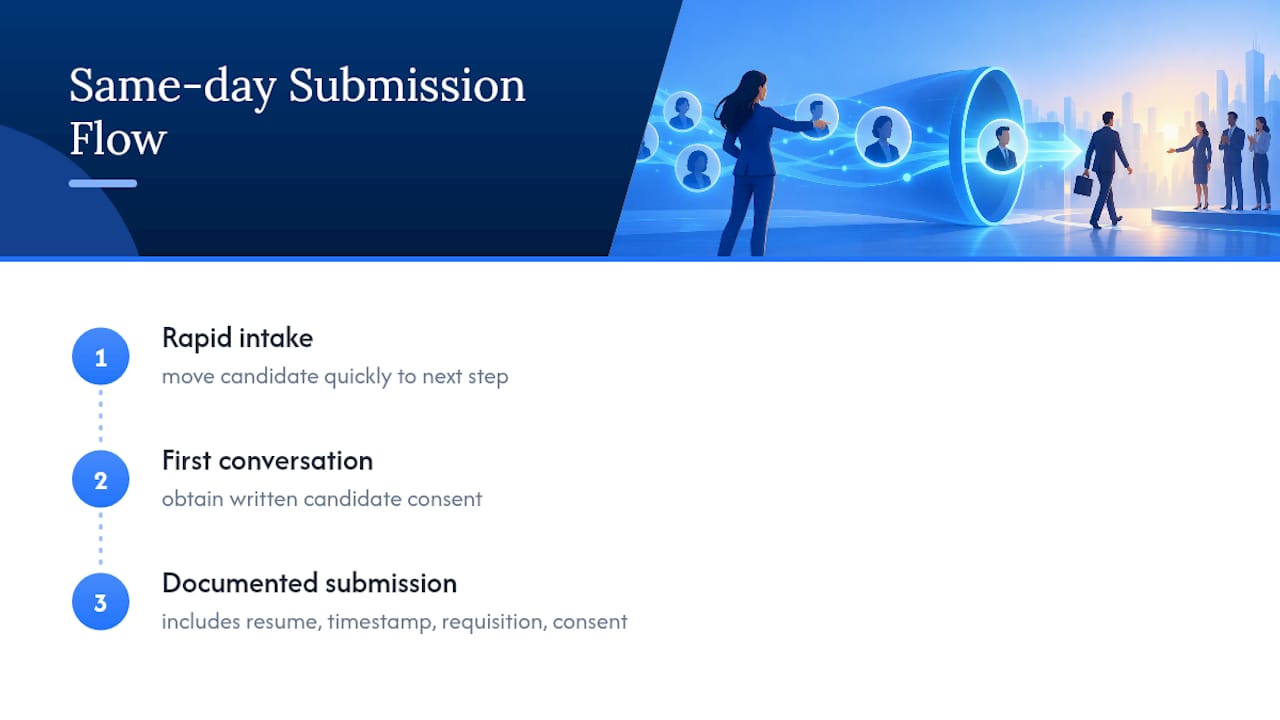
If you’re building your own process, steal two things: log every submission the same day, and get candidate consent in writing before you send a resume anywhere. Those two habits alone will resolve most disputes before they ever become disputes.
Rich Rosen’s Blunt Take On Candidate Ownership
Three rules, no exceptions. One: if it’s not written down, it didn’t happen. Two: speed beats cleverness, the recruiter who documents fastest usually wins the argument. Three: effective cause beats first-to-introduce every time a client actually looks closely, so don’t just submit and disappear.
Two client moves kill fees constantly: running five agencies on one role with no scope, and “forgetting” to mention a candidate was already in their pipeline. Watch for both.
My favorite negotiating line when a client gets cute about ownership: “Happy to discuss, once you show me your internal pipeline records with a date on them.” That usually ends the conversation fast.
— Rich Rosen
Skip The Ownership Headaches With Cornerstone
Cornerstonesearch offers a recruiting approach that emphasizes speed and thorough documentation to simplify fee and candidate ownership issues. Handling documentation and candidate consent is an integrated part of the process. Faster search closings help reduce overlaps and potential ownership disputes.

If you’re a SaaS or software company tired of managing multiple agencies and untangling who gets credit for which candidate, our software sales recruitment service runs as a single, accountable search from day one. For leadership hires where exclusivity and a longer runway make more sense, our executive search recruitment model builds ownership clarity into the retained agreement from the start. Reach out and we’ll walk you through exactly how a clean, single-agency search protects your timeline and your candidate relationships.
Sources
- LawInsider – Candidate Ownership Sample Clauses
- Document
- Recruitment Robin – Who Gets The Fee? Candidate Ownership When Using Multiple Recruitment Agencies
FAQ
What Are Red Flags For Recruiters To Watch For?
Watch for clients who won’t disclose other agencies working the same role, vague verbal-only agreements with no written ownership terms, and candidates who show hesitation about being represented, often a sign they’re already talking to the client directly.
What Are The 5 C’s Of Recruitment?
Definitions vary across the industry, but a common version covers candidate, culture fit, competency, cost, and communication. There’s no single official standard, so treat any version as a general framework rather than a fixed rule.
What Is The 70/30 Rule In Hiring?
This isn’t a standardized industry term with one agreed definition, and different recruiters use it to mean different things, from time spent sourcing versus screening to weighting skills against culture fit. Treat any specific version you hear with caution rather than as an established rule.
What Is The 80/20 Rule In Recruiting?
Most recruiters apply this as a rough version of the Pareto principle: roughly 80% of your placements and revenue tend to come from about 20% of your clients or roles. It’s a general pattern recruiters use to prioritize accounts, not a precise measured statistic.
How Long Does A Candidate Ownership Window Typically Last?
Standard practice runs 6 to 12 months from the date of a documented introduction, with contingency searches often on the shorter end and retained executive searches on the longer end. The exact window should always be spelled out in your signed agreement, not assumed.