

Most founders hire their first customer success leader too late, then hire the wrong profile in a panic. Churn shows up in the board deck, someone says “we need a VP of CS,” and a six-figure offer goes out to a person with nothing to run. I have placed 1,200+ sales and go-to-market leaders since 1996. The pattern is the same every time: the stage is misread, the role is vague, and the interview rewards good storytellers. Fix those three things and the hire gets a lot safer.
We run searches for customer success leaders as part of our SaaS recruiting work, and we finish the average search in about 21 days from kickoff to accepted offer. Speed only helps if you know who you are looking for. That is what this page is for.
TL;DR
- Hire your first CS leader when you can no longer say off the top of your head which customers are at risk and why. For many SaaS companies that lands around $1M to $3M in ARR.
- Hire for stage. A Head or Director who builds the playbook and still owns accounts beats a VP with no team to run.
- Give the role a revenue number: retention, renewals and ideally expansion. Otherwise CS becomes overhead.
- Interview with the same questions, a written scorecard and real work samples. Do not let a great save story carry the room.
- Run the search with someone who knows how CS leaders really get hired, so a bad hire does not cost you a year.
Table of Contents
- When to hire a customer success leader
- What the role should own
- Match the leader to your stage
- How to interview a CS leader
- Mistakes I see again and again
- How we approach it
- Work with us on the search
- FAQ
- Sources
When to hire a customer success leader
The honest answer: earlier than feels comfortable. One Forbes Tech Council piece makes the point that churn is a lagging signal. A non-renewal in Q4 usually reflects a customer who checked out in Q1. The better trigger is behavioral. If you cannot confidently name your at-risk accounts and the reason, you are ready.
If you want numbers, one ARR-based hiring guide puts the trigger at $1M to $3M ARR, when three or more CSMs are fighting fires and nobody designs the system. It lists these readiness signals:
- Monthly churn above 2%
- Three or more CSMs with no manager
- NPS below 30
- Expansion revenue below 5% of ARR
That same guide runs the churn math. Fifty customers paying $500 a month at 2% monthly churn means roughly $72,000 of ARR lost per year. A Head of CS paid $110,000 who cuts churn to 1% saves about $36,000 in ARR annually before compounding. Treat those as a rough model, not a promise. The point is that the math starts to favor the hire fast.
Wait for the pain to be obvious and you are not building a function. You are running a rescue.
What the role should own
Write the job before you write the posting. A CS leader should own:
- Onboarding design and time to first value
- Managing the CSM team
- Customer health scoring
- Renewal forecasting
- Expansion motions
The same guide is blunt about what the role does not own: support ticket volume and product feedback collection. If your draft job description reads like a support manager with a nicer title, stop.
Give it a number
The reporting line gets all the arguments. It matters less than what the team owns. Measured Success argues that a CS team that owns renewals, and ideally expansion, is treated as part of the revenue engine. A team that only owns satisfaction gets treated as overhead. Its suggestion: report to the CRO when CS owns revenue, and to the CEO or COO while CS is still building foundations.
The 2024 Customer Success Leadership Study, which surveyed 1,027 CS leaders, found 33% of CS teams reported to the CRO in 2024, up from 24% in 2023. Many companies are moving CS closer to revenue.
Whatever line you pick, nail these four things before the offer goes out:
- CS owns a revenue number.
- Retention is defined the same way by CS and Finance.
- CS sits in the same forecast meeting where Sales presents new business.
- The leader can talk to a customer and to a CFO.
How do you judge success? Use a short list of retention and adoption metrics. Gross revenue retention, net revenue retention, time to first value, adoption and forecast accuracy are a solid start. Net revenue retention can take up to a year to read, so a16z recommends leading indicators such as a health score that predicts renewals. Benchmarks help you set expectations. SaaS Capital’s 2025 survey of more than 1,000 private B2B SaaS companies puts median gross revenue retention around 90% to 91% for most contract values. Compare your own numbers against the latest published tables, not a number from a blog post.
If retention is the headline problem, practical ways to improve customer retention can help you decide which levers this leader should pull first.
Match the leader to your stage
This is where most searches go sideways. A candidate from a $500M company with 200 CSMs sounds great. They have also never built anything from nothing.
Rework’s hiring guide sorts leaders into three types:
| Type | Best fit | What they do |
|---|---|---|
| Builder-Owner | $3M to $15M ARR, 50 to 250 accounts, team of 2 to 5, no playbook | Builds the motion and owns accounts while doing it |
| Scaler-Operator | $20M+ ARR, 300+ accounts, team of 8+ | Runs a large team and a mature system |
| Farmer | Late stage with a playbook in place | Handles strategic enterprise relationships |
The guide’s warning is simple: do not hire a Scaler at $5M ARR.
Player/coach first
For a company building CS from zero, Help Scout recommends a player/coach. That is someone senior enough to shape the function and close enough to customers to own early accounts while they build the journey, milestones, metrics and playbooks. Then you hire CSMs into a working motion.
Practical CSM adds a good test. Look for a leader who “owned the bus, not borrowed the keys.” That means they wrote the playbook, not just ran someone else’s. It also says go-to-market fit beats domain expertise. A product-led, tech-touch motion is a different job from a sales-led, high-touch one. Forum Ventures makes a similar case: project your next 12 to 24 months of ARR, customers, deal size and CSM count, then hire someone who has built at that stage.
One more thing. Customer success is a young function, so most chief customer officers come from support, services, sales or business development. Do not screen on a job title. Screen on whether the person can make the leap and has the core skills: listening systems for customers, tying CS to net revenue retention, segmenting customers, using product and NPS data, and hiring and scaling a team.
Head or VP?
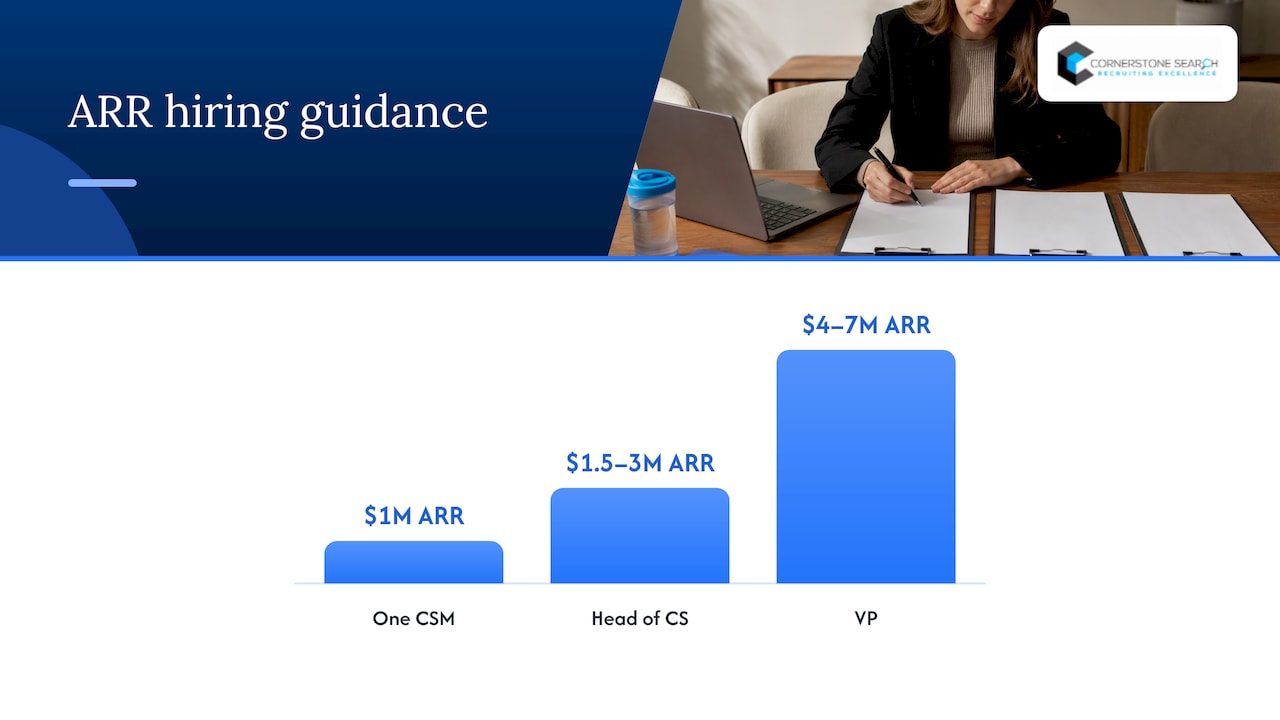
The most common mistake is the VP too early. At $1M ARR with one CSM, a VP spends most of their time doing individual-contributor work, according to the same ARR guide. That guide suggests a Head of CS at $1.5M to $3M ARR and a VP at $4M to $7M. It also says VPs hired too early tend to leave within 18 months. Treat those ranges as a rule of thumb. Your motion and account count matter more than one ARR number.
If you are also weighing CS against a sales hire, our customer success vs sales hiring playbook walks through the five stages.
How to interview a CS leader
Here is where good people lose to charming people. A candidate tells a great story about saving a $400K account. Everyone nods. Nobody asks what system would have caught the risk six months earlier.
Rework puts it well: a person who tells great stories about saving accounts is not the same as one who builds the system that prevents accounts from needing saving. Its suggested exercise is a churn post-mortem. An operator writes about the system that should have flagged the risk. A relationship-heavy candidate writes about relationship failures. Both answers tell you something.
Structure the process
Use the basics of a structured interview, which the Behavioral Scientist guide draws from US Office of Personnel Management guidance:
- Same questions, same order for every candidate.
- One anchored rating scale, with the acceptable answer agreed before the first call.
- Follow-up questions written in advance, since improvised ones are how interviewers lead people.
- Each interviewer scores alone before the debrief, so the most senior voice does not set the tone.
- Record the evidence behind every score. If you can’t check it a week later, it is an opinion.
- Call a random selection of former coworkers, not only the references the candidate hands you.
Work samples beat talk. Ask for past work products first, like a health score model, an onboarding plan or a QBR. A short set task is the fallback.
Questions worth asking
Jason Lemkin’s SaaStr checklist for a first Head of Customer Success covers the right ground. These are my picks, adapted:
- What KPIs matter at our stage, and why?
- How do CS and Sales work together on renewals and expansion?
- How would you staff this team on a tight budget?
- Tell me about your top three lost customers. What did you miss?
- How do you size an account for expansion?
- Walk me through a QBR you built. What did the customer do after?
The checklist also has a hard pass rule: if the candidate’s top priority for the first 30 days is not meeting with dozens of customers, pass.
Mistakes I see again and again
Hiring for the title. You want a VP because the board says so. Then you have a VP with no team.
Falling for empathy alone. First Round Review quotes a CS leader who names three common reasons these hires fail: customer aversion, trouble balancing customer and business interests, and difficulty taking feedback. She screens for speed, curiosity, clear communication and a bias for action, and warns against leaning on empathy alone.
No charter. Gartner’s research finds that a missing customer success charter causes misalignment and duplicated work across functions. Write what CS owns before you recruit.
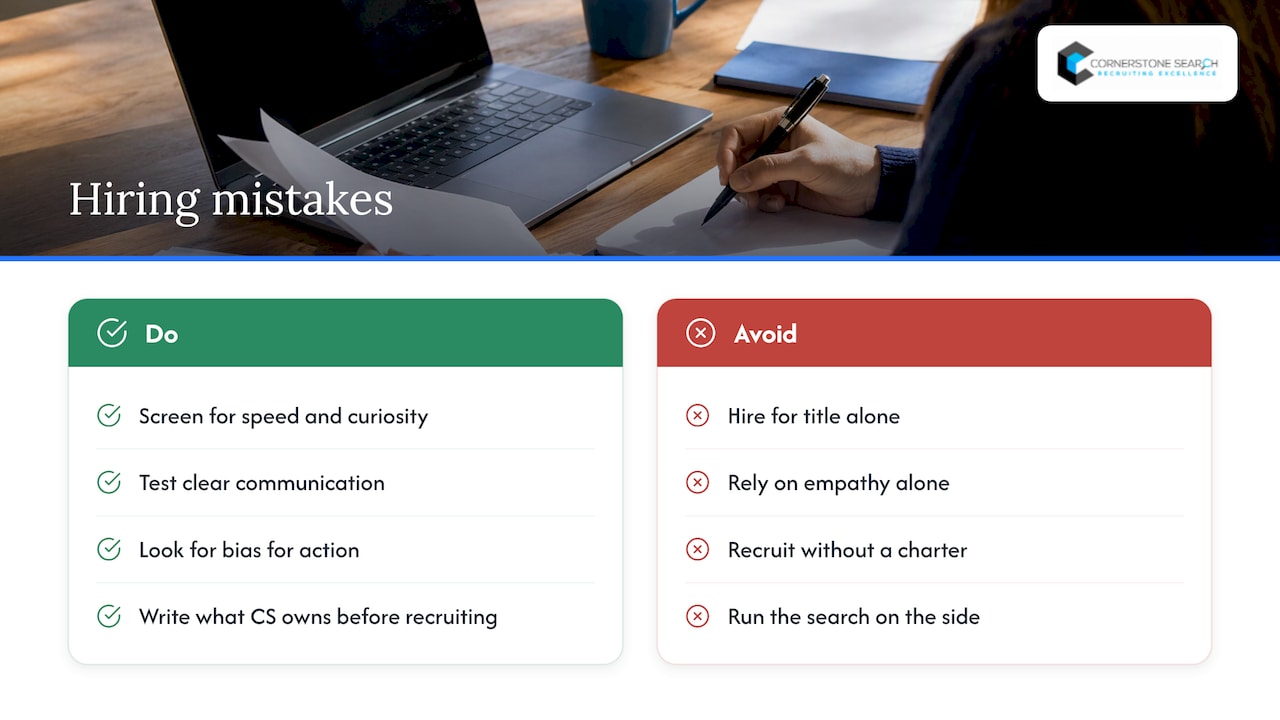
Running the search on the side. Your head of talent has forty open reqs. You have a board meeting. The search drifts for three months while your at-risk accounts keep drifting too. Timelines matter, and our page on how long a SaaS sales search takes shows what a well-run one looks like.
How we approach it
We have been placing SaaS go-to-market people since 1996, and the same thing keeps showing up. Customer success hires fail for the same reason sales hires fail: nobody agreed on the job before the search started.
So we start with intake. I run it myself. What is your ARR? How many accounts? What does the CS team own today, and what will it own in a year? Is this person building the motion or scaling one? Those answers decide the profile. A resume does not.
Then we go after people who have done the job at your stage, not people who look good on paper. We have placed more than 1,200 sales professionals, and our placements have a 93% one-year retention rate. We do that because a bad leadership hire costs you a year, not a recruiting fee.
Speed matters, too. Our average from kickoff to accepted offer is 21 days. That only works when the intake is sharp and the scorecard is written before the first call.
If CS reports to your CRO, or sits next to sales, we know how those roles interact. That is how we screen: for judgment, not polish.
Rich Rosen
Work with us on the search
If you are hiring a customer success leader, a CRO, or a full revenue team, we can run the search for you through our executive search recruitment service. It covers contingent and retained search for SaaS and software companies, and a founder-led intake comes first. If you are a startup or venture-backed company, our SaaS industries recruitment page shows how we work with companies at your stage.
Not sure whether retained or contingent fits this role? Our guide on how retained search differs from contingency will help you choose.
FAQ
What does a customer success leader do?
They own the system that keeps customers and grows them. That means onboarding design, managing CSMs, health scoring, renewal forecasting and expansion motions. They do not own support ticket volume. The best ones carry a revenue number tied to retention and expansion.
Should I hire a Head or a VP of Customer Success?
At early stages, a Head or Director who builds the playbook and still handles some accounts is usually the better fit. A VP fits once you have a team and a working motion to scale. Match the choice to your ARR, account count and CSM headcount rather than the title.
Who should the customer success leader report to?
There is no single right answer. When CS owns renewals and expansion, reporting to the CRO makes sense. When CS is still building foundations, the CEO or COO works. What matters more is that CS owns a revenue number and sits in the same forecast meeting as Sales.
How long does it take to hire a customer success leader?
It depends on how clear the profile is and how much time your team can give the search. Our average from search kickoff to offer acceptance is 21 days when intake is sharp. Unclear scope is the biggest cause of delay.
Sources
- When to Hire Head of Customer Success SaaS
- When Is The Right Time To Build A Customer Success Team
- Where Should Customer Success Report?
- Customer Success Leadership Study 2024
- Hiring a Chief Customer Officer
- VP of Customer Success Role
- How to increase customer retention
- CS Leader Hiring Guide
- SaaS Customer Success: Do You Need It and How to Build It
- Hiring a CS Leader at $1M to $10M ARR
- Your First SaaS Customer Success Hire
- Structured Interviews: Example Questions, Scorecards
- 9 Questions To Ask Candidates for Your First Head of Customer Success
- The Founder’s Guide to Building a V1 of Customer Success
- Use These 4 Pillars to Build a Sustainable Customer Success Foundation