

Sales brings new customers; customer success keeps and grows them. That’s the whole ballgame. Sales owns acquisition and lives on quarterly quota. Customer success owns retention and expansion and lives on the customer’s timeline. Treat them as one blob with one scorecard and you’ll bleed net revenue retention. The fix isn’t picking a winner. It’s giving each function its own metrics, comp, and a handoff that doesn’t drop the customer on the floor.
TL;DR:
- Clear handoff processes should include detailed context, success criteria, stakeholder maps, and contractual commitments to reduce early churn effectively.
- Customer success teams must be measured on retention and expansion metrics like net revenue retention, not new ARR, to align their goals with long-term growth.
- Compensation plans need to match roles’ influence, with AEs focused on new bookings and CSMs rewarded for renewals and expansion, avoiding mixed incentives.
- Hiring decisions should prioritize judgment and relationship skills over charisma, as these qualities better predict long-term success in sales and customer success roles.
- Most early churn stems from handoff gaps rather than product issues, highlighting the importance of a structured, well-communicated transition for new customers.
Table of Contents
- Customer Success vs Sales: What Each Job Actually Is
- Sales vs Customer Success: The Real Differences That Matter For Hiring
- Can A Salesperson Become A Customer Success Manager?
- The Sales-CS Alignment Maturity Model: Where Does Your Team Stand?
- The Handoff Checklist That Actually Stops Early Churn
- Comp And Metrics: Paying For NRR, Not For Chaos
- When To Hire A CSM, Add An AE, Or Build A Pod
- What I’ve Learned Screening 1,200+ Sales And CS Candidates
- Ready To Hire The Right Sales Or CS Leader?
- Sources
Customer Success vs Sales: What Each Job Actually Is
Let’s clear up the confusion first, because half the job descriptions I see are a mess.
Sales is a hunting job. It runs on a funnel: SDRs qualify and book meetings, AEs run the deal cycle and close it. The finish line is new ARR. That’s it. Once the contract is signed, the AE’s quarter resets and they’re chasing the next name on the list. Sales focuses on acquisition, and everything about how you pay and manage an AE should reflect that single obsession.
Customer success is a farming job, and I mean that as a compliment. A CSM inherits the account the day the ink dries and owns onboarding, adoption, renewal, and expansion from there. Their job is to make sure the customer actually uses the thing they bought, hits the outcome they were promised, and renews without a fight. Customer success exists to prevent churn and grow the account over years, not weeks.
Here’s where it gets tricky. These two roles touch at exactly one moment: the handoff. That single point of contact is where most SaaS companies quietly torch their retention numbers. Sales says “the deal is closed, I’m done.” CS says “I don’t know why this customer bought or what they were promised.” Nobody’s lying. Nobody’s lazy. The process just has a hole in it, and the customer falls through.
If your org chart draws a hard line between “sales stuff” and “CS stuff” with no defined overlap, you’ve created a gap. The boundary between these functions needs to be explicit, documented, and assigned to a responsible owner.
Sales vs Customer Success: The Real Differences That Matter For Hiring
Forget the fluffy mission statements. Here’s what actually separates these two jobs when you’re building scorecards, writing job descriptions, or figuring out why your last CSM hire flamed out.
Time horizon and goals. Sales thinks in quarters. Quota resets, pipeline resets, everyone’s anxiety resets. CS thinks in the customer’s lifecycle, which might be three years long. That mismatch alone explains half the friction between the two teams. An AE wants a signature by Friday. A CSM wants the customer to actually succeed by month six, because that’s what gets renewed in month twelve.
Metrics. Sales gets measured on new ARR, win rate, and quota attainment. CS gets measured on churn, gross revenue retention (GRR), net revenue retention (NRR), and expansion revenue. If you’re running a sales dashboard for your CS team, you’re grading the wrong test.
Daily grind. An AE’s day is discovery calls, demos, proposal wrangling, negotiation, forecast calls with their manager. A CSM’s day is onboarding check ins, usage data reviews, QBRs, renewal conversations, and playing therapist when a champion leaves the company mid contract.
Skills and interview signals. AEs need transactional instincts. Can they read a buying committee? Can they create urgency without lying? Can they close? CSMs need product depth and relationship stamina. Can they explain a feature to a confused end user without condescending? Can they spot a churn risk three months before the renewal date instead of the week before?
Compensation. This is where most companies get it backwards.
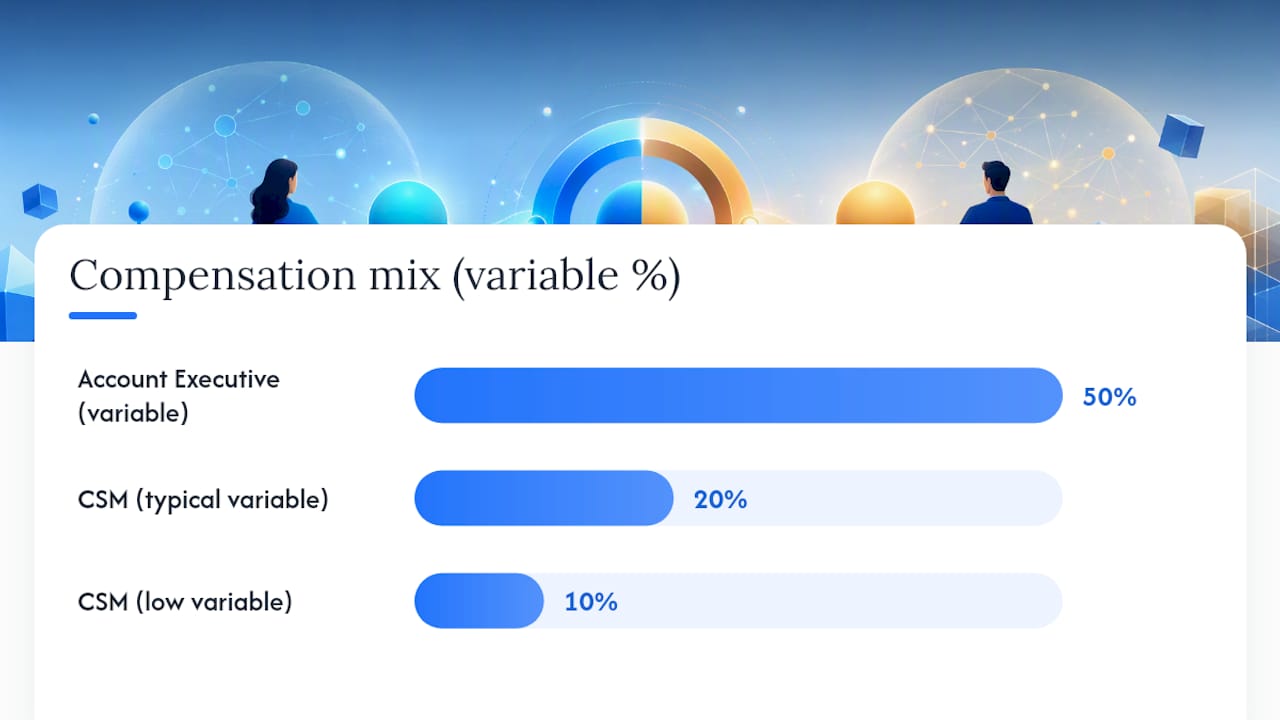
- AEs commonly run a 50/50 base to variable split, tied to closed new business.
- CSMs typically run 80/20 or 90/10 base to variable, with variable tied to retention or expansion, not new logos.
- OTE for AEs varies wildly by deal size and market, but the variable component should always map to something the AE can actually control: closed revenue.
- CSM variable should map to renewal and expansion, never to raw new bookings, or you’ll turn your retention team into a second sales team and lose the trust that makes them effective in the first place.
Get the comp wrong and you get the behavior you paid for, not the behavior you wanted. I’ve watched companies pay CSMs like AEs and then wonder why customers feel “sold to” during a renewal call that should have felt like a check in.
Can A Salesperson Become A Customer Success Manager?
Yes, and it happens constantly. The reverse happens too, just less cleanly. Here’s how the moves actually play out.
- AE to CSM works more often than people expect. A good AE already understands the deal, the buyer, and the promises made during the sale. Moving into CS lets them cash in that relationship equity instead of starting cold with a new prospect every time.
- CSM to AE is harder and slower. CSMs are used to nurturing, not closing. The instinct to protect the relationship can clash with the instinct to push for a signature. It works when the CSM has strong product instincts and genuinely enjoys the chase, not when they’re just burned out on support tickets.
- Ramp expectations differ by direction. Give an AE moving into CS about 60 to 90 days to unlearn “always be closing” and learn patience. Give a CSM moving into sales more like 90 to 120 days, because cold pipeline generation is a different muscle entirely.
- Screen for the switch honestly. In interviews, ask the AE candidate how they’d handle a customer who’s angry but not leaving. Ask the CSM candidate to walk you through negotiating a price increase. If either one flinches, they’re not ready for the switch yet.
- Onboard switchers with a buddy system. Pair them with someone who’s already made the same jump. Book theory doesn’t cut it here. Judgment does.
The Sales-CS Alignment Maturity Model: Where Does Your Team Stand?
Most leaders think their sales and CS teams are aligned because they have a Slack channel and a shared spreadsheet. That’s not alignment. That’s a truce.
The Sales-CS Alignment Maturity Model lays out five stages, and the NRR ranges attached to each stage should scare you into action if you’re honest about where you land.
- Stage 1 is marked by chaotic handoff with typically lower net revenue retention.
- Stage 2 introduces a handoff template but inconsistent enforcement, with improved retention.
- Stage 3 sees better process but compensation and data alignment issues causing a performance plateau.
- Stage 4 features joint KPIs and account reviews, aligning compensation and improving retention.
- Stage 5 represents revenue partnership with fully integrated sales and CS teams achieving top-tier net revenue retention.
Pro Tip: If your handoff template has been unchanged for two years and nobody can tell you the last time sales and CS reviewed an account together, you’re stuck at Stage 3, not Stage 4. Templates don’t fix comp, and comp is usually the real blocker.
That Stage 3 plateau is the most common trap I see, and it’s the most fixable one. Teams believe the handoff document solved the problem, but they’re still leaving 5 to 10 points of NRR on the table because nobody touched compensation or decided who owns the customer data.
Moving up a stage in 90 days doesn’t require a reorg. It requires three concrete moves: start joint account reviews for your top tier accounts, put one shared NRR number on both the sales and CS leadership scorecards, and enforce a written acceptance step where the CSM has to sign off on the handoff before the account officially transfers. Companies that build this kind of shared ownership around retention metrics consistently report faster revenue growth and stronger retention than companies running sales and CS as separate silos.
The Handoff Checklist That Actually Stops Early Churn
Most churn that happens in the first 90 days isn’t a product problem. It’s a handoff problem. The customer bought one thing, expected another, and nobody bridged the gap before the CSM showed up asking “so, what are we working on together?”
A strong handoff transfers real context, not just a Salesforce record with a stage change. Here’s what has to be in it, every time, no exceptions:
- Why they actually bought. Not the feature list. The business reason, in the buyer’s own words if possible.
- Success criteria. What does the customer consider a win in 90 days? In 12 months?
- Stakeholder map. Who’s the champion, who’s the skeptic, who signs the renewal check.
- Timeline commitments. Anything the AE promised about go live dates or implementation speed.
- Known risks. Budget concerns, internal politics, a competitor still in the picture.
- Contractual commitments. Custom terms, SLAs, anything that isn’t standard and will bite you later if forgotten.
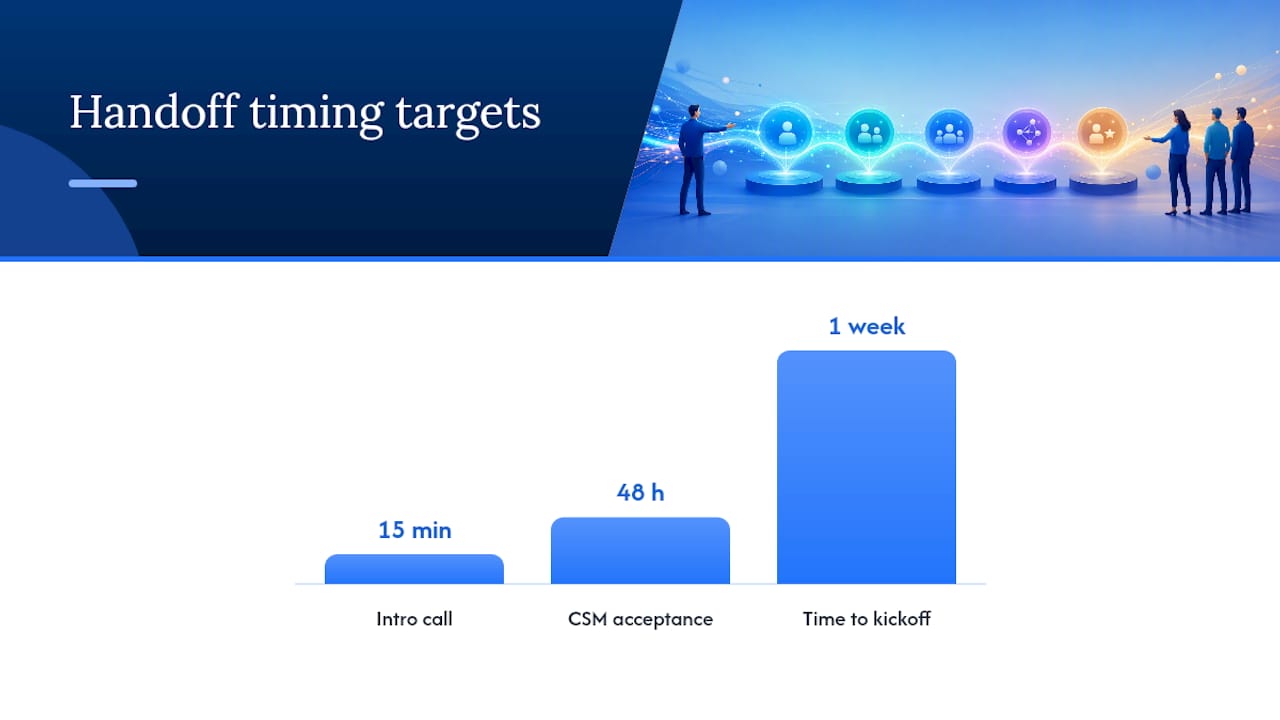
Get the CSM involved before the deal closes, not after. Even a 15 minute intro call during the final contract stage changes everything, because early CSM involvement reduces rework during onboarding and gets the customer to first value faster. The kickoff should happen jointly, with sales still in the room, and the CSM should have to formally accept the handoff within 48 hours, sign off, no info missing, or it bounces back to sales.
Track time to kickoff, onboarding completion rate, and time to first outcome on a RevOps dashboard every week. These are your smoke detectors. If time to kickoff creeps past a week, you’ve got a process leak, and it will show up as churn six months from now.
Comp And Metrics: Paying For NRR, Not For Chaos
GRR tells you how much revenue you kept without any expansion counted. NRR tells you how much revenue you kept plus how much you grew from upsells and cross-sells. If your CS leader only reports GRR, they’re hiding the expansion story, good or bad.
Comp should map cleanly to whichever metric the role actually controls.
- AEs run on new bookings, typically a 50/50 base to variable split tied to closed revenue.
- CSMs should start with a retention-heavy plan, 80/20 or 90/10 base to variable, and only add expansion commission once your forecasting is solid enough to trust the numbers.
- Never let a CSM’s variable pay hinge on a metric they don’t directly influence, like total company NRR, without a clear line from their actions to that number.
- Audit churn attribution quarterly. If sales overpromised and CS gets blamed for the resulting churn, your comp plan is punishing the wrong team.
- Time expansion payouts to actual renewal cycles, not calendar quarters, or you’ll pay commission on revenue that hasn’t actually landed yet.
Building this out from scratch gets a lot easier with a real KPI framework for your revenue teams instead of guessing at what to measure.
When To Hire A CSM, Add An AE, Or Build A Pod
Rough rule of thumb: hire your first dedicated CSM once you cross somewhere around $1 million to $2 million in ARR, or earlier if your average contract value is high enough that losing even a handful of accounts would gut your revenue.
Below that threshold, shared or fractional CS coverage usually works fine. Above it, dedicated coverage pays for itself in avoided churn alone.
Once you’ve got distinct account tiers, pair an AE with a CSM in a pod model for your enterprise accounts, where relationship continuity matters most, and keep pooled CS coverage for smaller accounts where scale matters more than a dedicated point of contact. Expect a new CSM to need 60 to 90 days before they’re managing a full book of accounts independently. Rush that ramp and you’ll see it in your churn numbers a year later.
What I’ve Learned Screening 1,200+ Sales And CS Candidates
Everybody wants to hire a “closer” for their AE seat and a “people person” for their CSM seat. Both instincts are lazy, and both get companies in trouble.
I care less about charisma and more about judgment. Can the AE tell the difference between a real buying signal and a prospect being polite? Can the CSM tell the difference between a customer who needs hand holding and one who’s quietly shopping a competitor? That’s the skill that actually shows up in the numbers six months later.
Since 1996 we’ve placed over 1,200 sales, presales, and executive candidates, and the pattern never changes: the hires that fail almost always fail on judgment, not skill. The AE could pitch. The CSM knew the product cold. Neither one could read a room. Fix your interview process to test for judgment under pressure, not just competence on paper, and your ramp times and retention numbers will both improve.
— Rich Rosen
Ready To Hire The Right Sales Or CS Leader?
Here’s the truth nobody puts in a job posting: a bad AE hire costs you a quarter of pipeline you’ll never get back, and a bad CSM hire costs you renewals you won’t see slipping until it’s too late. Our recruiting firm specializes in SaaS and software sales talent, from AEs and sales engineers to senior sales leadership and customer success leaders who keep the revenue you already closed. Speed matters when a bad hire is quietly costing you a quarter every month the seat stays wrong.
If you’re building or fixing a revenue team and don’t want to gamble on the next hire, start with our sales recruitment guide or go straight to our software sales recruitment services to talk through your next search.
Sources
For the five-stage alignment framework and NRR benchmarks, see the Sales-CS Alignment Maturity Model. For handoff mechanics, read Sales to customer success handoff. For comp plan data, check the customer success comp plans report, and for retention tactics beyond hiring, see proven customer retention strategies.