

TL;DR:
- Before hiring a sales role, define success with a clear scorecard based on validated deals and a repeatable playbook. Hiring should be based on precise role needs, aligned with your ICP, AOV, sales cycle, and stakeholder complexity, not gut feel. Cornerstone Search reduces hiring risk through rigorous role definition, structured interviewing, and quick placement within 21 days.
Stop. Before you post that job description, answer one question: can you write down, in one sentence, what success looks like for this role in 12 months? If you can’t, you’re not ready to hire. The single most important thing you can do to define a sales role before hiring is build a one-page job scorecard — mission statement and measurable outcomes, after the founder has closed 5–10 deals and documented a repeatable playbook. Without those two things in place, you’re not hiring a salesperson. You’re hiring a very expensive experiment.
Draft the scorecard this week. Validate your ICP, your average deal size, and your sales cycle length before you talk to a single candidate. Then hire.
Table of Contents
- Which sales role does your business actually need right now?
- How to define any sales role before you recruit
- What does a job scorecard actually look like?
- How to write the job description, set KPIs, and structure compensation
- How to interview and evaluate sales candidates without relying on gut feel
- What does ramp actually cost, and how long does it take?
- How Cornerstone Search Associates reduces hiring risk in practice
- Legal and compliance considerations for sales roles
- Key Takeaways
- The rules I’ve learned the hard way
- Cornerstonesearch gets you to the right hire faster
- Useful sources and templates
Which sales role does your business actually need right now?
Hiring the wrong profile is the most common and most expensive mistake in SaaS sales. A closer who can’t prospect is useless if you have no inbound pipeline. An SDR is a waste of money if your messaging isn’t locked. Here’s a plain-language breakdown of each role, what it actually does, and when to pull the trigger. For a deeper look at titles and responsibilities, the types of SaaS sales roles guide is worth bookmarking.
SDR / BDR
- Generates qualified pipeline through outbound prospecting and inbound qualification.
- Books meetings; does not close.
- Owns activity metrics: calls, emails, sequences, meetings booked.
Hire when: pipeline generation is the documented bottleneck, your ICP is clear, and your messaging is proven. Hiring an SDR before you have repeatable messaging is burning money.
Bad first hire: an SDR hired before the founder has validated the pitch. They’ll book meetings nobody can close.
Account Executive (AE)
- Runs discovery, demos, negotiation, and close.
- Full-cycle AEs also prospect; closing-only AEs work a handed-off pipeline.
- Owns quota, pipeline coverage, and forecast accuracy.
Hire when: the founder has closed enough deals to see a pattern and needs someone to replicate it. Early AEs should be builders: comfortable prospecting, demoing, and closing without a support crew.
Bad first hire: a pure enterprise closer from a big company who needs three SDRs, polished case studies, and a dedicated sales engineer. They’ll stall out fast.
Account Manager (AM)
- Manages and grows existing accounts post-close.
- Owns renewal rates, expansion revenue, and upsell pipeline.
- Works closely with CS and product.
Hire when: you have enough customers to justify dedicated expansion coverage and churn is becoming a revenue risk.
Customer Success Manager (CSM)
- Drives adoption, retention, and renewal.
- Owns health scores, QBRs, and risk escalation.
- Acts as the voice of the customer internally.
Hire when: churn starts threatening growth. Earlier than most founders think. The first CSM protects the revenue you’ve already earned.
Sales Engineer (SE)
- Handles technical discovery, proof-of-concept, and demo depth.
- Bridges product and sales for complex or technical buyers.
- Owns technical win rates and POC success.
Hire when: deals are stalling at the technical evaluation stage and AEs are losing on product depth, not on price or fit.
Sales Ops / Enablement
- Owns CRM hygiene, pipeline reporting, forecasting, and process documentation.
- Builds playbooks, onboarding materials, and training content.
Hire when: you have three or more reps and your data is a mess. A pipeline full of “maybe” deals with no next steps is not a forecast.
Head of Sales / VP Sales / CRO
- Scales a working system: hiring, coaching, forecasting, and process.
- Does not invent the sales motion from scratch.
Hire when: at least two reps are consistently hitting or approaching quota and you have enough revenue momentum to justify management leverage. Hiring a VP of Sales before $1–2M ARR with proven repeatability shows a high failure rate. A VP accelerates a working system. They don’t create one.
The right hiring sequence for early-stage SaaS: founder-led → senior AE → second AE or SDR → manager once 2+ reps hit quota → sales ops as volume justifies.
How to define any sales role before you recruit
This is the sequence. Run it this week, in this order, before you write a single word of a job description.

Step 1: Validate the motion. Has the founder personally closed 5–10 deals? Is there a documented playbook a smart rep can follow without carrying the founder around? If no, stop. Go close more deals.
Step 2: Map your ICP. Who exactly buys? Company size, industry, tech stack, buyer title, and the pain they’re solving. Vague ICP produces vague candidates.
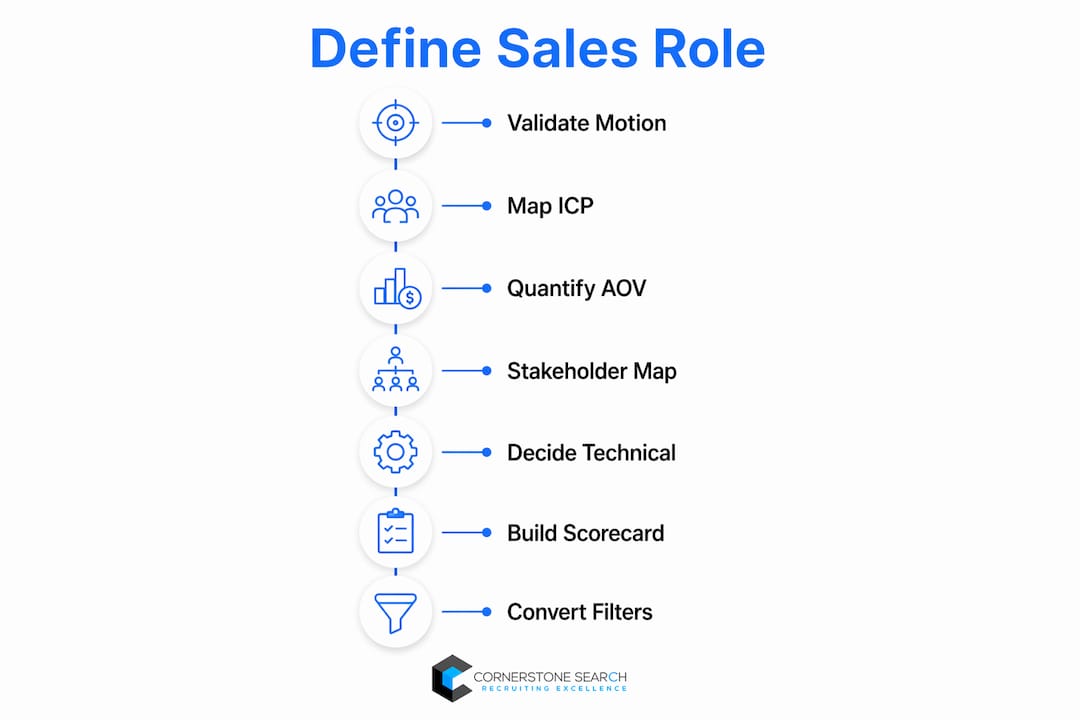
Step 3: Quantify AOV and sales cycle. Your average order value and cycle length determine whether you need a transactional rep or a consultative one. A $5K deal closing in two weeks needs a different profile than a $150K deal with a six-month committee buy.
Step 4: Map stakeholder complexity. How many people are in the buying decision? One champion or a six-person committee? This tells you how much enterprise navigation skill the role requires.
Step 5: Decide technical depth. Does the rep need to run a technical demo solo, or will an SE support them? This filters your candidate pool fast.
Step 6: Build the scorecard. One-sentence mission. Three to five measurable 12-month outcomes. Weighted competencies. Environmental context. 30/60/90 milestones. More on the exact template below.
Step 7: Convert to sourcing filters. Each scorecard field becomes a screening question. “Describe the last deal you closed where the AOV was above $X” is a filter, not a conversation starter.
Before you post the role, loop in product, marketing, and CS. Product tells you what technical depth the rep actually needs. Marketing tells you what ICP is converting and what messaging is working. CS tells you what the best customers look like so you hire someone who can replicate them.
Pro Tip: Keep the scorecard to one page. If it runs longer, you’re writing a wish list, not a role definition. Weight coachability highest when you’re unsure about any other dimension. Coachable reps significantly outperform resistant peers in hitting quota.
What does a job scorecard actually look like?
The scorecard replaces the generic job description. A JD lists tasks. A scorecard defines success. Here are the five dimensions every scorecard must cover, plus a fill-in-the-blanks template you can copy right now.
| Scorecard Dimension | What to Define | Example |
|---|---|---|
| Target Buyer (ICP) | Company size, industry, buyer title, pain point | Mid-market SaaS, VP Engineering, 200–1,000 employees |
| Average Order Value (AOV) | Expected deal size range | — |
| Sales Cycle Length | Median days from first meeting to close | 60–90 days |
| Stakeholder Complexity | Number of decision-makers, buying committee structure | 3–5 stakeholders, economic buyer + champion + IT |
| Technical / Product Depth | Solo demo capability vs. SE-supported | Must run full technical demo independently |
| Role Mission | One sentence: what does winning look like? | Close $1.2M in new ACV in year one from a defined territory |
| 12-Month Outcomes (3–5) | Measurable results, not activities | 1) $1.2M ACV closed; 2) 4x pipeline coverage maintained |
| Competency Weights | Ranked by importance for this role | Coachability highest, with Discovery, Business Acumen, Resilience, and Technical Fluency weighted appropriately |
| 30/60/90 Milestones | Leading indicators of ramp success | 30: ICP mastered, first 3 discovery calls logged; 60: 2 deals in late stage; 90: first close or near-close |
A few notes on weighting. Coachability sits at the top for a reason. A rep who can’t absorb feedback after a live role-play will not improve, no matter how good their resume looks. Business acumen matters more as AOV and stakeholder complexity rise. Technical fluency only needs heavy weighting if the rep is running solo demos.
The 30/60/90 milestones are your early warning system. If a rep hasn’t logged three discovery calls by day 30, you have a problem. Don’t wait until month six to find out.
How to write the job description, set KPIs, and structure compensation
The scorecard is internal. The job description is external. They should match, but they’re not the same document.
What goes in the JD: role mission (one sentence), the three to five outcomes you expect in year one, a realistic day-in-the-life paragraph, non-negotiables (must-haves), and nice-to-haves. Leave the detailed competency weights for the interview loop.
What to leave out: a laundry list of 22 bullet-point responsibilities. Nobody reads them, and they attract the wrong candidates.
KPIs and quota in measurable terms: don’t write “responsible for revenue growth.” Write “carry a $1.2M ACV quota in year one with a ramped target of $600K in H1.” List pipeline coverage expectations (4x is a common benchmark), activity metrics during ramp (calls per week, demos per month), and renewal or expansion targets if the role touches post-sale.
Compensation basics: structure OTE as base plus variable, with variable tied directly to quota attainment. For a SaaS sales job description to attract strong candidates, the OTE must be competitive for the market and the role level. Ramped quota is standard: expect to pay full OTE during ramp while the rep builds pipeline, then step the quota up at 90 or 180 days depending on your sales cycle.
A sample JD paragraph that ties it all together: “You’ll own a defined territory of mid-market SaaS companies (200–1,000 employees) and carry a $1.2M ACV quota. In your first 90 days, you’ll master our ICP, run 10 discovery calls, and move at least two deals into late stage. OTE is $180K ($90K base / $90K variable), with a ramped quota of $600K in H1. We expect full quota attainment by month seven.”
That paragraph tells a candidate exactly what they’re walking into. It also filters out anyone who isn’t ready for it.
Ramp timelines matter here. A rep selling a $10K product with a 30-day cycle can be productive in 60 days. A rep selling a $200K enterprise deal with a 9-month cycle may need 9–12 months before they close anything meaningful. Budget accordingly, and set leadership expectations before the hire starts, not after.
How to interview and evaluate sales candidates without relying on gut feel
Gut feel is how you end up with a rep who interviews great and sells nothing. A structured interview loop with scored competencies and panel calibration removes most of the bias.
- Recruiter screen (30 minutes). Confirm motion fit: buyer, deal size, sales cycle, quota, lead source. If the motion doesn’t match your scorecard, stop here.
- Hiring manager interview (60 minutes). Go deep on outcomes: specific deals, specific numbers, specific losses and what they learned. Ask for evidence, not stories.
- Role-play with live feedback (45 minutes). Run a discovery call scenario based on your actual ICP. Then give the candidate direct, critical feedback mid-session and watch how they respond. Coachability shows up here in real time, not on a resume.
- Panel interview (60 minutes). Two to three interviewers, each assigned a specific competency from the scorecard. No overlap. Each interviewer scores independently before the calibration call.
- Structured reference checks. Call the references yourself. Ask about quota attainment, activity hygiene, how they handled a losing streak, and whether the manager would rehire them. Score the references against the same outcomes on the scorecard.
Sample questions by competency:
- Coachability: “Tell me about a time a manager gave you feedback you disagreed with. What did you do?” Listen for whether they changed behavior or just nodded.
- Discovery instinct: “Walk me through the last complex deal you closed. What questions did you ask to uncover the real business pain?”
- Resilience: “Describe your worst quarter. What caused it and what did you do to get out of it?”
- Business acumen: “How did you prioritize your territory last year? What was your logic?”
Scoring rubric: use a 1–5 scale. Require each interviewer to write one sentence of evidence for every score they give. A “5” with no evidence is not a 5. Set an advancement threshold — a weighted average of 3.8 out of 5 is a reasonable bar — and enforce it. Calibration conversations where interviewers defend their scores are often more revealing than the scores themselves.
Red flags that predict early failure:
- Can’t accept live feedback during the role-play without getting defensive.
- Inconsistent performance across multiple roles with no clear explanation.
- Vague answers about their own quota numbers (“I was around plan”).
- Poor CRM hygiene in past roles (ask directly; it matters).
- Blames every loss on product, pricing, or marketing.
For a full list of SaaS sales interview questions mapped to scorecard competencies, Cornerstonesearch has a curated set built for hiring managers.
What does ramp actually cost, and how long does it take?
Nobody budgets ramp correctly. Here’s what it actually looks like.
| Role | AOV / Sales Cycle | Productive Ramp | Full Quota Attainment |
|---|---|---|---|
| SDR | N/A / 30-day cycle | 30–45 days | 60–90 days |
| AE (transactional) | Under $20K / under 60 days | 60–90 days | 90 days |
| AE (mid-market) | $20K / 60 days | 90 days | 120 days |
| AE (enterprise) | Over $100K / 6 months | 180 days | 270 days |
| VP Sales / CRO | N/A | 90 days to hire and onboard team | 12 months for full impact |
Cost line items to budget for a single AE hire:
- Recruitment fee (contingent or retained search).
- Full OTE during ramp, even at partial quota.
- Manager time: plan for 20–30% of a sales manager’s bandwidth during the first 90 days.
- Enablement content: playbooks, demo scripts, competitive cards.
- Lost-opportunity cost of a mis-hire: if a rep fails at month six, you’ve lost six months of quota contribution plus the cost of starting over.
Early success metrics to watch: activity leading indicators in the first 30 days (calls, emails, meetings booked) tell you whether the rep is working the motion. Outcome measures at 60 and 90 days (deals in late stage, pipeline coverage ratio) tell you whether the motion is converting. If activity is high but pipeline is thin, the problem is usually discovery or qualification. If activity is low, the problem is urgency or fit.
For founders running the hiring process without an HR team, the founder’s guide to sales hiring walks through the practical steps without assuming you have a full recruiting function behind you.
How Cornerstone Search Associates reduces hiring risk in practice
Most hiring mistakes aren’t random. They’re predictable. A vague role definition produces a vague candidate pool. A gut-feel interview loop produces a confident mis-hire. A rushed reference check produces a surprise at month three.
Cornerstonesearch’s process is built around exactly this sequence: narrow the scorecard first, then source against it. Every search starts with a role-definition session before a single candidate is contacted. The structured interview loop, role-play assessment, and panel calibration are built into every engagement, not bolted on at the end.
The proof points are straightforward. Cornerstonesearch has placed over 1,200 sales professionals since 1996, with an average time from search kickoff to offer acceptance of 21 days. For a SaaS company burning cash during an open headcount, 21 days versus the industry average of 45–60 days is a real difference in pipeline coverage and revenue timing.
When does it make sense to use an external recruiter? A few clear signals: you’re at $1–2M ARR and need your first senior AE or sales leader, you have two reps hitting quota and need to scale fast, or you have an urgent need for a technical sales hire (SE, pre-sales) where the candidate pool is narrow. Running the search internally when you don’t have a recruiting function or a strong network in SaaS sales usually costs more in time and mis-hires than the search fee.
For early-stage founders specifically, a retained search short-circuits the risk of hiring a clone of the founder instead of a complement. The first sales hire should broaden the company’s go-to-market capability, not mirror the founder’s instincts. An experienced recruiter who has seen this mistake a hundred times will push back on that tendency before it costs you six months.
Legal and compliance considerations for sales roles
Sales roles carry specific legal exposure most hiring managers underestimate. Get these right before the offer goes out.

Commission agreements. Every commissioned sales role needs a written commission plan, signed before the rep starts. Verbal agreements on OTE are not enforceable in most U.S. states. The plan should specify quota, attainment tiers, payment timing, clawback provisions (if any), and what happens to in-flight deals if the rep leaves. Several states, including California, Illinois, and New York, have specific commission protection statutes that require written agreements and govern when earned commissions must be paid.
Employment classification. Misclassifying a sales rep as an independent contractor when they function as an employee creates significant liability under IRS rules and state labor laws. If you control how the rep works, not just the outcome, they’re likely an employee. Get this right from day one.
Non-compete and non-solicitation clauses. Enforceability varies dramatically by state. California bans most non-competes outright. Other states enforce them with varying standards of reasonableness. Non-solicitation clauses (protecting customers and employees) are more broadly enforceable but still state-specific. Have an employment attorney review any restrictive covenants before you include them in an offer letter. For founders navigating the legal side of early hires, founder agreement considerations are worth reviewing alongside your employment counsel.
Quota and OTE documentation. The compensation plan is a legal document. Ambiguous language around accelerators, draw provisions, or territory changes creates disputes. Write it plainly, have legal review it, and get a signature before the start date.
Background checks and EEOC compliance. Any pre-employment screening must comply with the Equal Employment Opportunity Commission guidelines and applicable state laws (some states restrict criminal history inquiries). Apply the same screening process consistently across all candidates for the same role.
Key Takeaways
Hire only after you can define measurable success, confirm the sales motion is repeatable, and build a scorecard that drives every step from sourcing to onboarding.
| Point | Details |
|---|---|
| Validate before you hire | Founder must close 5–10 deals and document a repeatable playbook before the first sales hire. |
| Scorecard over job description | Define ICP, AOV, cycle length, stakeholder complexity, and technical depth before writing a single job post. |
| Weight coachability first | Coachable reps are roughly 2x more likely to hit quota; make it the top-weighted competency on every scorecard. |
| Budget ramp realistically | Mid-market AEs need several months to reach full quota; enterprise reps often need a longer ramp period. |
| Cornerstonesearch shortens the cycle | With 1,200+ placements and a 21-day average time to offer, Cornerstonesearch reduces mis-hire risk for SaaS companies. |
Three actions to run this week:
- Draft your one-page scorecard (mission, three outcomes, five competency weights).
- Run one role-play with a candidate and give live feedback to test coachability.
- Set your 30/60/90 success metrics before the offer goes out, not after the rep starts.
The biggest single hiring mistake? Hiring a clone of yourself instead of a complement. Your first sales hire should broaden what your go-to-market can do, not simply replicate what you already do.
The rules I’ve learned the hard way
Most hiring advice on this topic is written by people who have never had to call a founder and explain why their $200K VP of Sales isn’t working out at month four. Here’s what actually holds up after placing over 1,200 sales professionals across SaaS and software companies.
Hire a full-stack AE first. Not a pure closer. Not a junior SDR. A senior AE who can prospect, demo, and close independently. This profile survives the ambiguity of an early-stage company. A closer without pipeline is just an expensive spectator.
Weight coachability above everything else. I’ve seen reps with mediocre resumes outperform polished candidates because they absorbed feedback and adjusted. The role-play with live feedback isn’t a gimmick. It’s the most predictive thing you can do in an interview.
Never hire a manager before two reps are hitting quota. A manager with nothing to manage is a very expensive meeting organizer. Wait until you have something worth scaling.
Founders: stop disappearing from the revenue process the moment a rep starts. Co-sell for the first few months. The rep needs your product depth and your customer relationships to close early deals. Disappearing is how you set a good rep up to fail.
The clone trap is real. Founders consistently want to hire someone who thinks and sells like they do. The problem is the company already has one of those. The first hire should fill a gap, not echo the founder’s instincts. Push back on yourself here.
The companies that get this right share one trait: they define the role before they recruit, not during. The scorecard isn’t paperwork. It’s the difference between a hire who hits quota and one who burns six months of runway.
Cornerstonesearch gets you to the right hire faster
If you’ve read this far, you know what a well-defined sales role looks like. The harder part is finding the right person for it, fast, without burning your team’s time on candidates who look good on paper and stall in the role-play.
Cornerstonesearch specializes in exactly this: SaaS sales recruiting for companies that need the right hire quickly and can’t afford a six-month search. The engagement starts with a role-definition session (the scorecard work above, done with you), moves into targeted sourcing against a network built over 30 years in SaaS sales, and delivers a shortlist of pre-screened, role-play-tested candidates. Average time from kickoff to offer acceptance: 21 days. Over 1,200 placements since 1996. The process works because the role is defined before the first candidate is contacted, not after.
If you’re ready to hire your next AE, SE, or sales leader, start with a conversation about what the role actually needs to accomplish. That’s where every successful search begins.
Useful sources and templates
- Sales Hiring Sequencing Decision Framework — The clearest breakdown of when to hire each role and in what order for early-stage SaaS. Use it to validate your hiring sequence before you post.
- How to Define a Sales Role: The Job Scorecard — Detailed walkthrough of the five scorecard dimensions with examples. Good companion to the template in this article.
- Sales Hiring Scorecard That Predicts Rep Performance — Practitioner-level guidance on weighting competencies, setting advancement thresholds, and running panel calibration. Worth reading before you design your interview loop.
- Cornerstone SaaS Sales Role Types Guide — A reference for common SaaS sales titles, responsibilities, and hiring triggers. Useful when you’re deciding between an AE and an AM or an SE and a solutions consultant.
- Cornerstone SaaS Sales Interview Questions — A curated question set mapped to scorecard competencies. Copy the discovery and coachability questions directly into your interview loop.
- Sales Hiring Without an HR Team — Practical steps for founders running the search without a recruiting function. Covers the process from scorecard to offer without assuming you have HR support.
- Hiring Your First Head of Sales: 8 Mistakes Founders Make — Honest breakdown of the most common founder mistakes, including the clone trap. Read it before you write the job description for a senior hire.