

Dynamic executive search is a disciplined, adaptive approach to identifying and placing senior leaders rapidly and reliably, combining structured methodology, stakeholder alignment, and technology to reduce mis-hire risk. The standard industry term for this practice is retained executive search, and the most effective firms apply it with the rigor of a formal operating system, not a loosely defined process. Business leaders and recruiters who treat leadership hiring as a repeatable discipline consistently outperform those who rely on networks and intuition alone. Cornerstonesearch has built its entire model around this principle, placing over 1,200 sales professionals since 1996 with an average time from search kickoff to offer acceptance of just 21 days.
What is dynamic executive search and why does methodology matter?
Methodology-focused executive search firms achieve significantly higher placement success than firms relying on fast process or network relationships alone. The difference is discipline at every workflow stage, not just a checklist of steps. A firm that applies rigorous evaluation frameworks produces defensible recommendations that hold up under board-level scrutiny.
The AESC Professional Practice Standards define six dimensions that separate elite search from average practice: client focus, candidate management, confidentiality, conflict of interest, professional development, and quality execution. Each dimension requires specific behaviors, including structured candidate evaluation and off-list referencing for finalists. Firms that operationalize these standards reduce mis-hire risk and improve placement outcomes measurably.

Assessment tools matter here. Structured behavioral interviews using the STAR method, personality instruments like Hogan, and competency frameworks like KF4D each add a layer of signal that a conversational interview cannot produce. No single tool is sufficient on its own. The combination creates a multi-dimensional picture of how a candidate actually performs under pressure, not just how they present in a room.
Off-list references provide 40–60% deeper candor than candidate-supplied references, reducing late-stage surprises after placement. This matters because candidates naturally curate their reference lists toward advocates. Off-list work captures decision-making signals, conflict patterns, and leadership blind spots that would otherwise surface only after the hire.
Methodology-driven vs. intuition-only search: a direct comparison
| Dimension | Methodology-driven search | Intuition-only search |
|---|---|---|
| Candidate evaluation | Structured rubrics, STAR, Hogan, KF4D | Conversational interviews |
| Reference work | Off-list protocols for finalists | Candidate-supplied references only |
| Brief alignment | Locked intake with all decision-makers | Informal scope discussion |
| Placement success rate | 80–95% | Near 50% |
| Governance readiness | Defensible under board scrutiny | Difficult to document |
Pro Tip: Before any search begins, require every decision-maker to sign off on a written brief that includes the pay band, must-have competencies, and a ranked list of success criteria. This single step prevents the majority of mandate failures.
How to implement adaptive leadership principles in executive search
Adaptive leadership addresses the non-technical challenges in search that structured rubrics alone cannot solve. The concept, developed through the work of Ronald Heifetz at Harvard, distinguishes between technical problems with known solutions and adaptive challenges that require shifts in beliefs, priorities, and behavior. Executive search regularly surfaces adaptive challenges when clients discover mid-process that their original success criteria no longer fit the business reality.
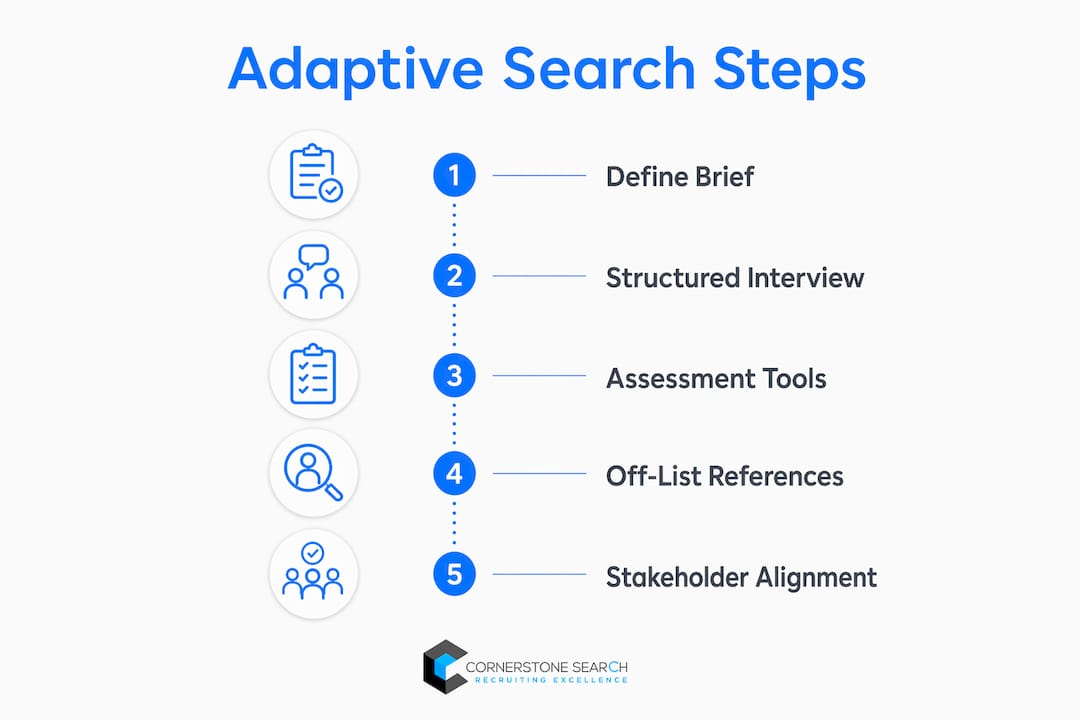
Effective search integrates stakeholder recalibration to match evolving strategic and cultural needs. This means the search lead must do more than source candidates. They must facilitate honest conversations among hiring committee members who often hold conflicting views about what the next leader needs to accomplish.
Practical steps for applying adaptive leadership principles in a live search include:
- Map stakeholder beliefs early. Interview each decision-maker separately before the brief is locked. Surface disagreements about culture, authority, and success metrics before they derail a finalist presentation.
- Reframe the success criteria collaboratively. When a CFO and a CEO disagree on whether the next VP of Sales needs enterprise experience or startup agility, the search lead must facilitate resolution, not pick a side.
- Test candidates against the adaptive challenge, not just the job description. Ask finalists how they have changed an organization’s beliefs about what good looks like. This reveals whether they can lead through resistance.
- Revisit alignment at each stage gate. Stakeholder consensus shifts as the candidate market becomes visible. Build a formal check-in after the longlist presentation to confirm the brief still reflects reality.
Pro Tip: When a search stalls at the finalist stage, the root cause is almost always an unresolved adaptive challenge among stakeholders, not a weak candidate market. Diagnose the committee before you expand the search.
Best practices for accelerating executive searches without sacrificing quality
Speed in executive search depends on decisions made before sourcing begins. Locking the brief with structured intake involving all decision-makers prevents the process restarts that kill timelines. A search that launches with an ambiguous scope will stall the moment a strong candidate surfaces and the committee cannot agree on fit.
The following sequence compresses search cycles without cutting corners:
- Lock the brief completely before sourcing. Confirm pay band, must-haves, and the offer approval chain in writing. Any ambiguity here costs weeks later.
- Widen sourcing channels beyond the obvious. Rank candidates by fit against the brief, not by availability or how quickly they respond. The best candidates are rarely the first to raise their hands.
- Build the longlist in parallel, not sequentially. Waiting to complete one sourcing channel before opening another adds unnecessary weeks to the timeline.
- Establish a feedback loop with a 48-hour turnaround. Systematic follow-up and clean data management prevent pipeline stalls. Candidates who go dark for a week are usually responding to a lack of momentum on the client side.
- Prepare the offer strategy before the finalist stage. Know the approval chain, the flexibility on comp, and the decision timeline before the finalist conversation happens. Negotiation delays after a verbal offer are a leading cause of candidate withdrawal.
- Protect confidentiality at every stage. Leaks about an active search damage the client’s reputation and cause strong candidates to disengage. Confidentiality is not just an ethical requirement. It is a competitive advantage.
Understanding why executive searches fail almost always points back to misaligned briefs and absent stakeholder consensus on role criteria. Fixing the front end of the process delivers more speed than any sourcing technology.
How should AI be used responsibly in executive search?
AI enhances research efficiency, consistency, and quality in executive search, but it must operate within confidentiality and bias mitigation governance. The AESC has developed AI training programs with Epistemy specifically to help search professionals apply AI tools without compromising judgment or ethical standards. This is the right model: AI as a support layer, not a replacement for human evaluation.
The practical roles where AI adds genuine value in a search include:
- Market mapping and research. AI tools accelerate the identification of potential candidates across industries, geographies, and functional backgrounds far faster than manual research.
- Template consistency. AI helps standardize position specifications, candidate summaries, and progress reports so clients receive uniform quality regardless of which team member drafts the document.
- Bias checks in job descriptions. AI can flag gendered or exclusionary language in briefs before they reach the market, widening the candidate pool.
- Interview scheduling and communication tracking. Automating logistics reduces administrative drag and keeps the search team focused on evaluation work.
Governance controls are non-negotiable. Candidate data must remain confidential, AI outputs must be reviewed by a human before they reach a client or candidate, and any scoring or ranking produced by an AI tool must be auditable. Shortlists now face heightened governance scrutiny, and defensible diligence requires that every recommendation can be explained in human terms.
Pro Tip: Never allow an AI tool to produce a final candidate ranking without a human review step. AI is excellent at surfacing patterns, but it cannot assess the interpersonal dynamics that determine whether a leader will succeed in a specific culture.
Key Takeaways
Dynamic executive search succeeds when structured methodology, stakeholder alignment, and disciplined technology use combine to produce fast, defensible placements rather than relying on intuition or network alone.
| Point | Details |
|---|---|
| Methodology over intuition | Firms applying AESC-standard rubrics achieve 80–95% placement success vs. near 50% for intuition-only approaches. |
| Lock the brief first | Structured intake with all decision-makers before sourcing prevents the majority of mandate failures and timeline restarts. |
| Off-list references are critical | Off-list reference work delivers 40–60% deeper candor than candidate-supplied references, reducing post-placement surprises. |
| Adaptive leadership closes gaps | Stakeholder recalibration at each stage gate resolves the hidden conflicts that stall finalist decisions. |
| AI supports, not replaces | AI tools add research speed and consistency, but every output requires human review before reaching a client or candidate. |
What I have learned after decades of watching executive searches succeed and fail
The most common mistake I see business leaders make is treating executive search as a procurement exercise. They define a spec, send it to a firm, and wait for candidates to appear. When the process stalls or the hire fails, they blame the market. The market is rarely the problem.
The real issue is almost always operational discipline. Searches that succeed share three characteristics: a locked brief that every decision-maker has genuinely agreed to, a search partner who manages the adaptive challenges among stakeholders rather than just sourcing candidates, and a governance structure that protects confidentiality and produces defensible recommendations. Searches that fail are missing at least one of these.
I am also direct about AI. The firms that will use it well are those that treat it as a research and consistency tool, not as a judgment engine. The AESC’s work with Epistemy on AI governance is the right direction. The firms that skip governance controls to move faster will eventually face a placement failure they cannot explain or defend.
The executive search process has not fundamentally changed in its core logic. What has changed is the speed at which the market moves and the governance expectations that boards and investors now apply to leadership appointments. The firms that adapt to both pressures simultaneously are the ones worth working with.
— Rich Rosen
Cornerstonesearch: built for the speed and precision this market demands
Cornerstonesearch specializes in placing top sales and revenue leadership for SaaS and software companies, where the cost of a slow or wrong hire is immediate and measurable. The methodology behind every search combines structured intake, rigorous candidate evaluation, and off-list reference work to deliver results in a fraction of the time most firms require.

With over 1,200 placements since 1996 and an average search cycle of 21 days from kickoff to offer acceptance, Cornerstonesearch has the track record to back its approach. Whether you are filling a VP with Sales role at a growth-stage startup or a Chief Revenue Officer position at an established software firm, the sales recruitment fundamentals that drive placement success are the same. Explore Cornerstonesearch’s software sales recruitment services to see how the methodology applies to your specific hiring challenge.
FAQ
What is dynamic executive search?
Dynamic executive search is a disciplined, adaptive approach to placing senior leaders that combines structured methodology, stakeholder alignment, and technology-enabled research to reduce mis-hire risk and compress search timelines.
How does structured methodology improve executive search outcomes?
Firms that apply formal evaluation frameworks, including structured interviews, assessment tools, and off-list reference protocols, achieve placement success rates of 80–95% compared to near 50% for intuition-based approaches.
Why do most executive searches fail?
Executive search failure most commonly results from misaligned briefs where decision-makers have not reached genuine consensus on role scope, pay band, and success criteria before sourcing begins.
What role does adaptive leadership play in executive search?
Adaptive leadership helps search professionals recalibrate stakeholder expectations and resolve hidden conflicts about what the next leader needs to accomplish, preventing finalist-stage breakdowns that have nothing to do with candidate quality.
How can AI be used responsibly in executive search?
AI adds value in market research, template consistency, and bias detection in job descriptions, but every AI output must pass a human review step before reaching a client or candidate to meet confidentiality and governance standards.