

That is the core profile. Everything else in your process exists to verify those three things are real.
Here is the quick screening checklist. Use it before you schedule a single phone call.
- Minimum 3 years of enterprise B2B sales experience (not mid-market dressed up as enterprise.
- Average deal size of $100K+ ACV with at least one deal above $250K closed in the last 24 months
- Quota attainment history with actual percentages, not just “exceeded quota”
- Named accounts book of 15–50 accounts, not a high-volume territory
- Multi-stakeholder evidence: can name the economic buyer, champion, procurement lead, and security/legal contacts from a real deal
- Sales cycle experience of 6+ months with documented mutual action plans or close plans
- Named methodology familiarity: MEDDIC, MEDDPICC, Challenger Sale, or SPIN Selling
- References from a direct manager who can speak to quota math and deal specifics
If a resume clears all eight, move to a phone screen. If it clears fewer than six, pass unless there is a compelling reason to dig deeper.
Key Takeaways
Hiring a qualified enterprise AE requires verified quota math, multi-stakeholder deal evidence, and a structured role-play before any offer goes out.
| Point | Details |
|---|---|
| Set hard numeric thresholds | Require $100K+ ACV, 80%+ quota attainment for 2+ years, and 3+ years of enterprise B2B experience before advancing any candidate. |
| Run the role-play every time | A short executive discovery role-play reveals judgment gaps faster than any behavioral question. |
| Verify quota math in writing | Ask for attainment percentages by year and confirm them in the reference check before the final round. |
| Set ramp milestones before the offer | Enterprise AEs typically reach full quota at month 9–12; build that timeline into the offer and comp plan. |
| Use a scorecard for every candidate | Score all candidates on the same seven dimensions to remove gut-feel bias from the final debrief. |
| Consider a specialist recruiter | Cornerstonesearch delivers pre-screened enterprise AE candidates with an average 21-day time to offer acceptance. |
Table of Contents
- What does an enterprise AE actually own, and why does it change your hiring criteria?
- What qualifications should you require, and how do you verify them?
- Which skills matter most, and how do you spot them in a real enterprise deal?
- How should you structure the interview process for enterprise AE candidates?
- How do you score candidates objectively and spot automatic disqualifiers?
- How do you screen resumes and run reference checks that actually tell you something?
- How should you write the job posting to attract the right candidates?
- What ramp timeline and first-year milestones should you set?
- What red flags predict failure, and what do you do when you spot them late?
- When does it make sense to use a specialist recruiter?
- Legal and compliance considerations when hiring enterprise AEs
- DEI considerations when hiring enterprise AEs
- How do you assess cultural fit without making it a vague excuse?
- Onboarding practices that reinforce what you hired for
- The single biggest hiring mistake I see managers make
- Cornerstonesearch finds enterprise AEs faster than you can post the job
- Sources
What does an enterprise AE actually own, and why does it change your hiring criteria?
The enterprise Account Executive role is not a bigger version of a mid-market job. The scope is fundamentally different, and if you hire someone without understanding the difference, you will spend six months watching a perfectly good mid-market rep drown.
An enterprise AE owns a named account book, typically 15–50 accounts. The job is not to work a high-volume pipeline. It is to penetrate complex organizations, build relationships across multiple business units, and close large, multi-year contracts. New logo acquisition and expansion revenue usually split somewhere around 60/40 or 70/30 depending on the company stage, but both motions require the same underlying skill: navigating a buying committee.
Enterprise sales cycles commonly run for many months over a long sales period, and buying committees typically include 6–12 stakeholders. Procurement, security, and legal are not obstacles. They are participants. A candidate who has only sold to a single economic buyer in a 60-day cycle has never done this job, regardless of what their resume says.
Two activities illustrate how scope shapes hiring priorities. First, security RFP orchestration: an enterprise AE at a cybersecurity SaaS company may spend three months coordinating responses across the prospect’s CISO, IT infrastructure lead, and procurement team while managing internal SE and legal resources. Second, executive business review preparation: the AE owns the relationship with the C-suite contact and must build a business case tied to the customer’s strategic priorities, not just product features. Neither of these activities shows up in a mid-market role. Both are table stakes at the enterprise level.

Pro Tip: Ask candidates to describe the internal team they coordinated on their last enterprise deal. A real enterprise AE names specific people, their roles, and the decisions each one owned. A mid-market rep dressed up as enterprise gives you a vague answer about “working cross-functionally.”
What qualifications should you require, and how do you verify them?
Gut feel is not a qualification. Here is what to require, what evidence to accept, and what to reject.
Must-have qualifications
- 3+ years of enterprise B2B SaaS or software sales in a direct quota-carrying role. Overlay roles, solutions consulting, and sales engineering do not count toward this threshold.
- Average contract value of $100K+ ACV, with at least one deal above $250K in the last two years. Quota ranges for enterprise AE roles commonly run $800K to $2M+ annually, so a candidate who has never closed a deal above $75K has not operated at this level.
- Documented quota attainment: ask for attainment percentages by year, not just “exceeded quota.” You want two or more consecutive years at or above 80%. One great year surrounded by misses is a yellow flag.
- Multi-stakeholder deal evidence: the candidate should be able to name the stakeholder map from a recent closed-won deal without hesitation.
- Sales cycle experience of 6+ months with a documented close plan or mutual action plan.
Nice-to-have qualifications
- Industry or vertical match (fintech, healthcare, manufacturing). Helpful, but process skills transfer more reliably than vertical knowledge. A candidate with strong enterprise process in an adjacent vertical usually outperforms a vertical specialist with weak process discipline.
- Existing relationships in your target account list.
- Experience selling to the C-suite at Fortune 1000 accounts.
Verification questions for your initial screen
- “Walk me through your quota for each of the last three years and your attainment percentage.”
- “What was the largest deal you closed in the last 24 months? What was the ACV, and how many stakeholders were involved?”
- “How many accounts were in your named book at your last company?”
- “What methodology did your team use? Give me an example of how you applied it to a specific deal.”
If a candidate hedges on the quota math or cannot give you a specific deal example with numbers, that is your answer.
Which skills matter most, and how do you spot them in a real enterprise deal?
Raw talent gets you to the first meeting. Process execution drives repeatable quota attainment. The skills below are the ones worth testing, and each one has a visible behavioral signal you can look for.
Core competencies and their behavioral signals
Executive presence: the AE can hold a peer-level conversation with a CFO or CIO without reverting to product pitching. In an interview, watch how they frame business problems. Do they lead with outcomes and financial impact, or do they default to features?
Multi-threading: the AE actively builds relationships across multiple stakeholders simultaneously, not just with their champion. Ask them to draw the stakeholder map of their last enterprise deal from memory. Count the names.
Qualification rigor: MEDDIC and MEDDPICC are the gold standards here. A candidate who can map Metrics, Economic Buyer, Decision Criteria, Decision Process, Identify Pain, Champion, and Competition to a specific closed deal has enterprise process muscle. Look for MEDDIC or MEDDPICC usage as evidence of repeatable qualification discipline. Candidates who can walk through each element against a real deal are the ones worth moving forward.
Challenger Sale and SPIN Selling are also worth probing. Challenger-trained reps know how to reframe a prospect’s thinking and lead with commercial insight. SPIN-trained reps know how to develop implication and need-payoff questions that surface executive-level pain. Neither methodology is a magic bullet, but familiarity signals a rep who has been coached and invested in their craft.
Negotiation and commercial discipline: can the candidate describe a deal where they held price under pressure? What was the concession they made, and what did they get in return? Weak negotiators give discounts to close. Strong ones trade value.
Account planning: the ability to build a multi-quarter account plan with whitespace analysis, stakeholder mapping, and expansion roadmap is a differentiator at the enterprise level. Ask for a sample account plan or have them build one as part of the process.
Pro Tip: Watch for false signals. A candidate who says “we” for every win and “I” for every loss has a self-awareness problem. A candidate who says “I” for every win and “we” for every loss is probably exaggerating their individual contribution. The best enterprise AEs describe their specific actions and the team context without conflating the two.
How should you structure the interview process for enterprise AE candidates?
A five-round process sounds like a lot. It is not, for a role carrying a $1M+ quota. Typical staged processes for enterprise AE roles include a recruiter screen, hiring manager interview, role-play or discovery exercise, account-plan presentation, and a leadership final round. Here is how to run each one.
Round 1: Recruiter screen (30 minutes)
Verify the non-negotiables. Quota math, deal size, stakeholder count, methodology. If the numbers do not check out, do not advance. Use the SaaS sales interview questions framework to keep this screen consistent across candidates.
Round 2: Hiring manager deep dive (60 minutes)
Go deep on one or two deals. Force specificity.
- “Tell me about the largest deal you closed. Walk me through the stakeholder map, the decision process, and the moment the deal almost fell apart.”
- “What was your quota last year? What was your attainment? What drove the gap, if there was one?”
- “Describe a deal where you lost. What would you do differently?”
Round 3: Role-play and discovery exercise (45 minutes)
Give the candidate a one-paragraph scenario: they are calling on a VP of Operations at a 5,000-person manufacturing company that recently had a supply chain failure. Their job is to run a 20-minute discovery call. You play the VP.
Score on: quality of opening, business-problem questions versus feature questions, ability to identify economic impact, and whether they attempt to map next steps and a mutual action plan at the close. A short role-play that tests executive discovery and a mutual action plan exposes weak candidate judgment faster than a long whiteboard session.
What good looks like: the candidate asks about business impact before product fit, surfaces a financial consequence, identifies the economic buyer, and proposes a specific next step with a date.
What a fail looks like: the candidate pitches features within the first five minutes, never asks about budget or decision process, and closes with “I’ll send you some information.”
Round 4: Account plan presentation (45 minutes)
Give the candidate a named account (a real prospect or a disguised version of one) and 48 hours to prepare a 15-minute account plan. Ask them to cover: why this account, who they would target first, what the business problem is, and what the 90-day plan looks like.
Round 5: Leadership final (30 minutes)
Culture and judgment fit. Not a re-interview. Ask about how they have handled a CRO or VP of Sales who disagreed with their deal strategy. Ask what they need from leadership to succeed.
Pro Tip: Have candidates prepare 5 short, metric-backed stories before the process starts. Tell them upfront you will ask for specific numbers on every deal example. Candidates who cannot produce metrics-backed stories in a structured process will not produce them in front of a CFO either.
How do you score candidates objectively and spot automatic disqualifiers?
Gut feel after five rounds is still gut feel. Use a scorecard. Here is one you can reproduce.
A candidate who scores below the pass threshold on experience, quota attainment, or multi-threading is a no-hire regardless of their score on other dimensions. Those three are load-bearing. The others are adjustable.
Automatic red-flag fails
- Cannot name the economic buyer on their last three deals
- Quota numbers change between the recruiter screen and the hiring manager interview
- References decline to speak or give vague, non-specific answers
- No example of a deal that took longer than six months to close
Borderline scores on executive presence or methodology can be addressed in onboarding. Borderline scores on quota math or deal size cannot.
How do you screen resumes and run reference checks that actually tell you something?
Most reference checks are useless. You ask softball questions, the reference gives you a glowing answer, and you learn nothing. Here is how to fix both the resume screen and the reference check.
Resume screen checklist
- Does the resume show quota attainment percentages, or just “exceeded quota”? Vague claims are a flag.
- Are deal sizes mentioned? If not, ask in the screen.
- Is the account book size listed (named accounts vs. territory)?
- Are company names recognizable as enterprise-grade buyers, or are all the logos SMB?
- Is there a gap between the most recent role and the current date? Ask about it directly.
- Does the candidate list methodology training (MEDDIC, Challenger, SPIN)?
Phone screen script (5 questions)
- “What was your quota for each of the last three years, and what did you attain?”
- “What was the average ACV of your closed-won deals? What was the largest single deal?”
- “How many stakeholders were typically involved in your enterprise deals? Can you name the roles?”
- “What methodology did your team use? Walk me through how you applied it to a recent deal.”
- “Why are you looking? What would need to be true about this role for it to be the right move?”
Keep the screen under 30 minutes. You are verifying facts, not building rapport.
Reference check questions
Ask references these specific questions, not “Would you rehire them?”
- “What was their quota and attainment during the time you worked together?”
- “Describe a specific enterprise deal they owned. What was their role in getting it closed?”
- “How did they manage relationships with multiple stakeholders, including executives?”
- “How long did it take them to ramp? When were they producing at full capacity?”
- “What would you coach them on if they were joining your team again?”
When a reference gives vague answers or redirects to personality traits instead of deal specifics, document it and flag it to the hiring manager. That pattern usually means the reference is protecting the candidate, not endorsing them. EEOC guidance applies here too: keep reference questions focused on job-relevant performance and avoid anything touching protected characteristics.
How should you write the job posting to attract the right candidates?
A vague job posting attracts vague candidates. If your posting says “competitive compensation” and “opportunity to grow,” you will get a pile of resumes from people who have no idea what they are applying for.
Posting checklist
- Job title: “Enterprise Account Executive” with the vertical if relevant (e.g., “Enterprise Account Executive, Financial Services”)
- Quota: state the annual quota range explicitly ($800K–$1.5M, for example)
- OTE range: publish it. Job postings with explicit quota, OTE, average deal size, and support resources attract higher-quality, better-aligned applicants
- Average deal size: “$150K–$500K ACV” tells candidates whether they are qualified
- Sales cycle length: “6–18 month enterprise cycles” sets expectations
- Account book size: “Named account territory of 30–50 accounts”
- Ramp timeline: “Full quota at month 9, ramped quota in months 1–8”
- Support resources: SE support, SDR coverage, marketing programs
- Must-have vs. nice-to-have: separate them clearly in the posting
On compensation, a typical North American enterprise AE OTE runs $200K–$350K+ depending on company stage, quota size, and vertical. Base-to-variable splits commonly land at 50/50 or 60/40. Equity is standard at Series A and later. Publish the OTE range. Candidates who are a fit will self-select in. Candidates who are not will self-select out, saving everyone time.
What ramp timeline and first-year milestones should you set?
Enterprise AEs do not ramp in 90 days. Anyone who tells you otherwise has never hired one. Set realistic milestones or you will fire a good hire at month six for underperforming against an impossible standard.
| Milestone | Timeline | Target |
|---|---|---|
| Product and process fluency | Day 30 | Completed enablement, shadowed 5+ customer calls, built first account plan |
| First pipeline activity | Day 60 | 3–5 qualified opportunities created, first discovery calls completed |
| Pipeline at 2x quota coverage | Day 90 | Active pipeline sufficient to support first-year close targets |
| First closed-won deal | Day 120 | At least one deal closed, regardless of size |
| 50% of annual quota | Month 9 | On track for full-year attainment |
| Full quota attainment | Month 12 | 80%+ of annual quota closed or contracted |
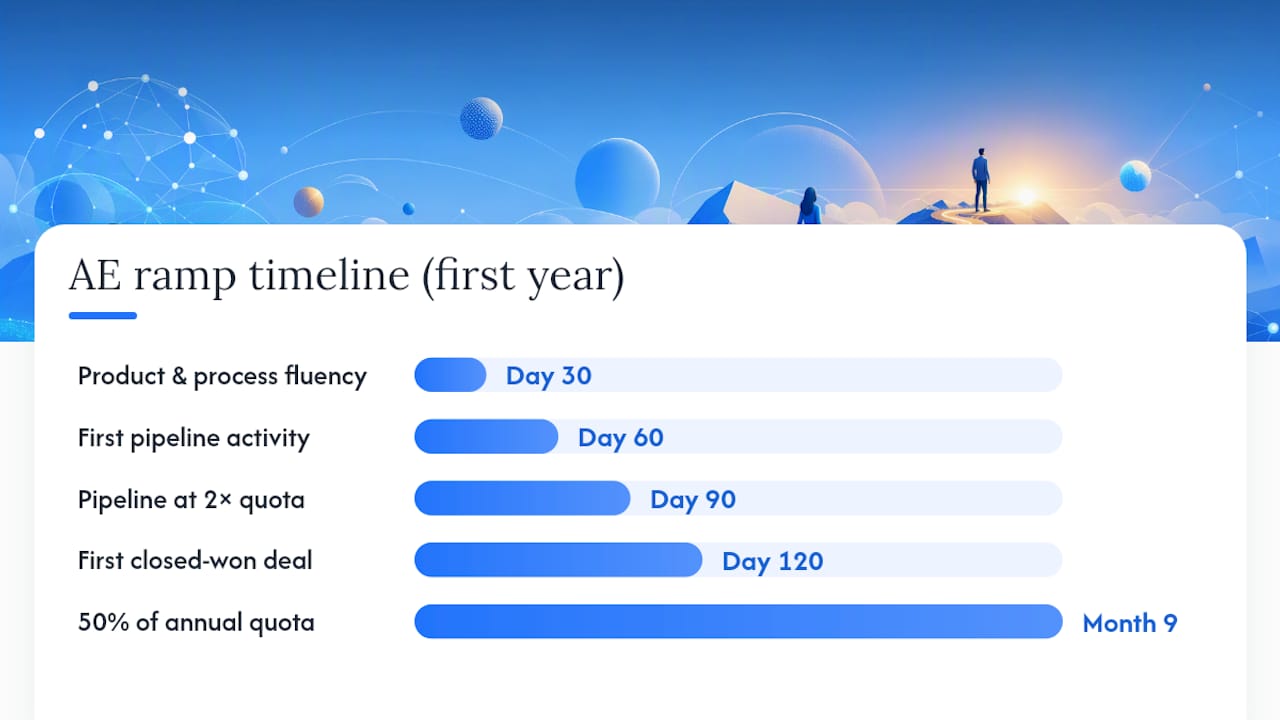
The 30-day mark is about learning, not selling. The 90-day mark is about pipeline creation. The 180-day mark is about first revenue. Holding an enterprise AE to full quota in year one is a setup for failure and a fast path to turnover.
Onboarding checklist
- Account research completed for top 10 named accounts before week two
- Stakeholder introductions made with existing customers in the first 30 days
- Internal enablement on product, competitive positioning, and pricing completed by day 21
- Shadowing schedule with senior AEs and SEs in the first 60 days
- First account plan reviewed with manager by day 45
The account research process for each named account should be a structured exercise, not a Google search. Map the org chart, identify the likely economic buyer and champion, and document the business problems the account has publicly discussed.
What red flags predict failure, and what do you do when you spot them late?
Some red flags are obvious. Others hide behind a polished interview performance. Here are the ones worth knowing.
- Quota inflation: the candidate’s attainment numbers change between conversations, or they cannot explain the math when you push. Mitigation: ask for a W-2 or commission statement. Most candidates who are inflating will back down when you ask.
- Single-threaded deals: every closed-won story involves one contact, one relationship, one champion. No procurement. No security. No legal. This candidate has never navigated a real enterprise buying committee. Re-interview question: “Tell me about a deal where your champion left the company mid-cycle. What happened?”
- Weak or evasive references: a reference who says “great person, very motivated” and cannot name a single deal is protecting the candidate. Escalate to the hiring manager and consider a second reference from a different manager.
- ACV mismatch: the candidate has closed deals, but the largest was $40K. Your average deal is $300K. The gap is not a coaching problem. It is a structural mismatch in how they have been trained to sell.
- Methodology name-dropping without substance: the candidate says “I use MEDDIC” but cannot walk through each element against a real deal. Knowing the acronym is not the same as using the framework.
- No examples of a lost deal: a candidate who has never lost a deal is either lying or has never been in a competitive enterprise process. Ask for a loss story. How they talk about it tells you more than any win story.
When a red flag surfaces late in the process, do not rationalize it away. Go back to the scorecard. If the flag touches one of the three load-bearing dimensions (experience, quota, multi-threading), it is a no-hire. If it touches a secondary dimension, decide whether a structured onboarding plan can address it and document that decision.
When does it make sense to use a specialist recruiter?
Three situations make a specialist recruiter the faster, safer choice.
First, when the role is critical and the cost of a mis-hire is high. An enterprise AE carrying a $1.5M quota who fails to ramp costs you the quota gap, the OTE paid during ramp, and the time to re-hire. That is a six-figure problem. Second, when the founding team or sales leader does not have time to run a full search. A five-round interview process for a role with a six-month ramp requires real sourcing, screening, and coordination. Third, when the search is confidential, such as replacing an underperforming incumbent before the transition is announced.
Cornerstonesearch has placed over 1,200 SaaS sales professionals since 1996, with an average time from search kickoff to offer acceptance of 21 days. Every enterprise AE candidate goes through quota math verification, a structured role-play, and reference triangulation before a hiring manager sees them. The result is a shorter list of better-qualified candidates, not a pile of resumes to sort through.
Cornerstonesearch’s specialized sales recruiter advantage is vertical depth. The network is built specifically for SaaS and software sales, which means candidates are pre-screened against the enterprise AE hiring criteria in this guide before you ever see them.
Legal and compliance considerations when hiring enterprise AEs
Hiring is a legal process, not just a business one. A few things to keep straight.
At-will employment is the default in most U.S. states, but offer letters, commission plans, and quota agreements are contracts. Have legal review them before you send. Background checks are permissible in most states but must be applied consistently across all candidates for the same role. Some states and cities have “ban the box” laws restricting when you can ask about criminal history. Check your jurisdiction before adding a background check requirement to your process.
Interview questions must stay on job-relevant topics. EEOC guidance prohibits questions about age, national origin, religion, disability, pregnancy, marital status, and other protected characteristics. This applies to reference checks as well. Stick to job performance, deal specifics, and work behaviors.
Pay transparency laws now apply in California, Colorado, New York, and Washington, among other states. If your role is remote or the candidate is in one of those states, you are likely required to publish the OTE range in the posting. Do it anyway. It improves candidate quality.
DEI considerations when hiring enterprise AEs
Diverse enterprise sales teams consistently outperform homogeneous ones, and the hiring process is where that outcome is won or lost.
Structured interviews with consistent scoring criteria reduce the influence of unconscious bias more than any training program. Use the scorecard in this guide for every candidate, not just the ones you are uncertain about. Vary your sourcing channels. If every candidate in your pipeline looks the same, your sourcing is the problem, not the talent pool.
Avoid proxy criteria for enterprise experience. “Sold into Fortune 500” is a valid criterion. “Went to a top-10 university” is not. The first measures relevant experience. The second measures access to opportunity, which is not the same thing.
Blind resume review, where you remove names and schools before the first screen, reduces demographic bias in the initial pass. It is a simple process change with a measurable impact on pipeline diversity.
How do you assess cultural fit without making it a vague excuse?
“Cultural fit” is the most abused phrase in hiring. Used carelessly, it becomes a way to hire people who look and think like the existing team. Used correctly, it identifies candidates who will thrive in your specific operating environment.
Define your culture in behavioral terms before you start interviewing. “We move fast” means nothing. “We expect AEs to run their own discovery calls without SDR support in the first 60 days” means something. “We value collaboration” means nothing. “Our AEs co-present with SEs on every technical evaluation” means something.
Ask behavioral questions tied to your actual operating model. If your company has a long approval chain for discounts, ask: “Tell me about a time you needed executive approval to close a deal. How did you manage the timeline?” If your team is remote-first, ask about how they have built relationships with customers and internal stakeholders without in-person access.
The traits of top SaaS sales executives worth screening for in a cultural fit context include coachability, accountability for losses, and comfort with ambiguity. Those three show up in how candidates talk about their worst quarter, not their best.
Onboarding practices that reinforce what you hired for
Hiring criteria and onboarding criteria should match. If you hired for MEDDIC discipline, your onboarding should include a MEDDIC deal review in week three. If you hired for executive presence, your onboarding should include a shadowed executive call in the first 30 days.
The biggest onboarding failure is treating the first 90 days as a training period with no accountability. Enterprise AEs need structure and feedback, not just product demos and slide decks. Assign a peer mentor who is a top performer. Schedule weekly pipeline reviews with the hiring manager starting in week four. Review the first account plan together and give specific, written feedback.
Ramp quota should be tied to activity milestones in the first 90 days, not just revenue. Pipeline creation, discovery calls completed, and account plans submitted are leading indicators. Revenue is a lagging one. Manage the leading indicators and the revenue follows.
The single biggest hiring mistake I see managers make
It should be the reverse.
Past performance matters, and you should verify it rigorously. But the reason most enterprise AE mis-hires happen is not because the manager failed to check quota numbers. It is because they never tested how the candidate thinks in a live enterprise situation. The role-play gets skipped because it feels awkward. The account plan presentation gets cut because the process is running long. The reference check gets delegated to HR and comes back with three glowing answers and no deal specifics.
Here is what to change in your process starting tomorrow:
- Run the role-play. Every time. No exceptions.
- Do the reference check yourself, or have your recruiter do it with the specific questions in this guide.
- Ask for the quota math in writing before the final round, not after the offer.
- Score every candidate on the same scorecard before you debrief as a team.
- Set the ramp milestones before the offer goes out, not after the hire starts.
The best enterprise AE you will ever hire is probably not the most polished interviewer in the room. They are the one who asks the sharpest questions, maps the stakeholders without being prompted, and tells you exactly what they need to succeed. Hire for judgment. Verify the numbers. Do not skip the role-play.
Cornerstonesearch finds enterprise AEs faster than you can post the job
Running a five-round enterprise AE search while managing a quota, a pipeline, and a team is a lot to ask. Cornerstonesearch specializes in SaaS and software sales recruiting and delivers pre-screened, quota-verified enterprise AE candidates with an average 21-day turnaround from search kickoff to offer acceptance.
Every candidate goes through quota math verification, a structured role-play, and reference triangulation before you see them. You get a short list of people who have actually done the job, not a stack of resumes to sort through.
Here is what a Cornerstonesearch engagement delivers:
- Sourcing from a network of 1,200+ placed SaaS sales professionals built since 1996
- Pre-screening against the enterprise AE hiring criteria in this guide
- Quota verification and reference triangulation before candidate presentation
- Average 21-day time to offer acceptance
Ready to fill your enterprise AE role without the six-month search? Start the conversation here or review the full sales recruitment approach to see how the process works.
Sources
- Complete Enterprise Account Executive job description template — Re:Work resources
- The difference between SMB, midmarket & enterprise account executives — ZoomInfo Pipeline
- Enterprise AE: What the role demands and how to succeed — Gangly Blog
- Enterprise Sales Guide 2026 | Nora AI | Nora AI Interview Guides
- EEOC Know Your Rights (screen reader PDF)