

Cornerstonesearch delivers an average time from search kickoff to offer acceptance in about three weeks, and the examples below show what happens when that speed is paired with the right screening. Three VP Sales placements. Three different stages. Three measurable outcomes.
- Series A SaaS, velocity motion: Former mid-market AE manager, placed in under three weeks, ramped in about two months, and exceeded first-year quota.
- Series B SaaS, enterprise motion: Ex-enterprise regional director with $40M ARR managed, placed in just over three weeks, ramped in about three months, and drove significant net new ARR expansion in the first year.
- Growth-stage PLG company: Former product-led growth sales lead from a $200M ARR company, placed in under three weeks, retained through year two, and rebuilt the outbound layer from scratch.
21 days. That is Cornerstonesearch’s average time from kickoff to signed offer for VP Sales searches.
These are not flukes. They are the output of a repeatable process. The rest of this article pulls back the curtain on each case, the screening logic behind them, and the post-hire KPIs you should be tracking.
Key Takeaways
The most repeatable VP Sales placements share three traits: motion fit, SaaS metrics fluency, and documented ramp reduction confirmed by references before the offer goes out.
| Point | Details |
|---|---|
| Motion fit is non-negotiable | Match the candidate’s exact prior motion (PLG, velocity, enterprise) to your current GTM stage. |
| 21-day average is achievable | Cornerstonesearch’s process moves from kickoff to signed offer in 21 days on average. |
| Ramp benchmarks vary by segment | SMB ramps in 90 days; mid-market in 120–150 days; enterprise up to 6–9 months. |
| Score for judgment, not titles | Use scorecards anchored to first-year outcomes, not seniority or company name recognition. |
| Cornerstonesearch | 1,200+ placements since 1996; SaaS-specialist recruiters; motion-matched hiring for VP Sales roles. |
Table of Contents
- Examples of successful VP Sales placements: three case studies unpacked
- What made these placements actually work?
- How Cornerstonesearch runs a VP Sales search
- How to vet a VP Sales candidate before you commit
- What does success look like in the first 180 days?
- What I would do first if I were your CRO after this hire
- Cornerstonesearch gets VP Sales searches done in 21 days
- Sources
Examples of successful VP Sales placements: three case studies unpacked
Case 1: Series A velocity SaaS, $8M ARR
| Factor | Details |
|---|---|
| Stage / ARR | Series A, $8M ARR |
| Time-to-hire | 18 days |
| Ramp to quota | about three weeks |
| First-year outcome | quota attainment exceeding targets |
The client had a working product and a small inside sales team with no real leadership. They needed someone who could run a pipeline, coach reps, and still carry a bag. Cornerstonesearch sourced a candidate who had managed a 12-person velocity team at a comparable ARR stage, owned the CRM hygiene, and had a documented history of shortening rep ramp from 90 to 55 days.
- Kickoff call: Day 1
- Market map and shortlist delivered: Day 6
- Structured interviews completed: Day 12
- Offer extended and accepted: Day 18
- Onboarding and 30-day plan submitted: Day 30
Case 2: Series B enterprise SaaS, $22M ARR
The founder needed a VP who could shift the company from founder-led deals to a repeatable enterprise motion. The candidate Cornerstonesearch placed had managed a $40M ARR territory at a public SaaS company, built a six-person enterprise team from scratch, and had direct experience with multi-stakeholder deals averaging $120K ACV. Motion fit was the deciding factor. SaaS-specific screening criteria confirm that mismatching a leader to the wrong motion is one of the most expensive hiring errors a company can make.
- Kickoff: Day 1
- Referral network activated, passive candidates engaged: Day 3
- Shortlist of four candidates: Day 8
- Final interviews: Day 15
- Offer accepted: Day 22
Case 3: Growth-stage PLG company, $35M ARR
This one was tricky. The company had grown almost entirely through product-led growth and needed a VP who could build an outbound layer without killing the PLG flywheel. Wrong hire here and you wreck the culture. Cornerstonesearch sourced a candidate from a $200M ARR PLG company who had done exactly this: built a sales-assist layer on top of a freemium product without cannibalizing self-serve conversion. The candidate’s background in sourcing passive SaaS talent and their fluency in product usage signals as a sales trigger was the differentiator.

What made these placements actually work?
Pattern recognition across successful VP Sales case studies surfaces the same signals every time. Here is what separated these hires from the ones that flame out in 90 days.
- Motion fit: Every candidate had direct experience in the client’s specific sales motion. No guessing. No “I can learn enterprise.”
- SaaS metrics fluency: Each hire could speak to pipeline coverage ratios, conversion rates, and quota attainment benchmarks without being coached.
- Documented ramp reduction: References confirmed each candidate had shortened rep ramp in a prior role, not just claimed it.
- Land-and-expand mindset: All three understood NRR as a sales metric, not just a CS metric.
- Cross-functional credibility: Each candidate had a track record of working with CS and product without turf wars.
- Interview evidence of sales judgment: Scorecards tested operating decisions, not title familiarity. Interview scorecards anchored to first-year outcomes separate real operators from polished narrators.
- Stage fit: None of these candidates were over-hired or under-hired for the ARR stage.
- Offer-stage cultural alignment: Comp and equity conversations happened early, which killed counteroffers before they started.
Pro Tip: The single most overlooked factor in VP Sales hiring is cultural framing during the offer conversation. Candidates who feel the company’s mission before the offer letter lands are far less likely to entertain a counteroffer. Cornerstonesearch surfaces this framing during the final interview stage, not after the offer goes out.
How Cornerstonesearch runs a VP Sales search
The 21-day average is not magic. It is a process. Here is how it works, milestone by milestone.
| Day | Milestone |
|---|---|
| 1 | Discovery call: ARR, GTM motion, first-year outcomes defined |
| 2–3 | Market map built; passive candidate outreach begins |
| 4–6 | Referral network activated; initial screens completed |
| 7–8 | Shortlist of 3–5 candidates delivered to client |
| — | Client interviews; structured scorecard scoring |
| 15–18 | Reference validation; comp and equity alignment |
| about 21 days | Offer extended and accepted |
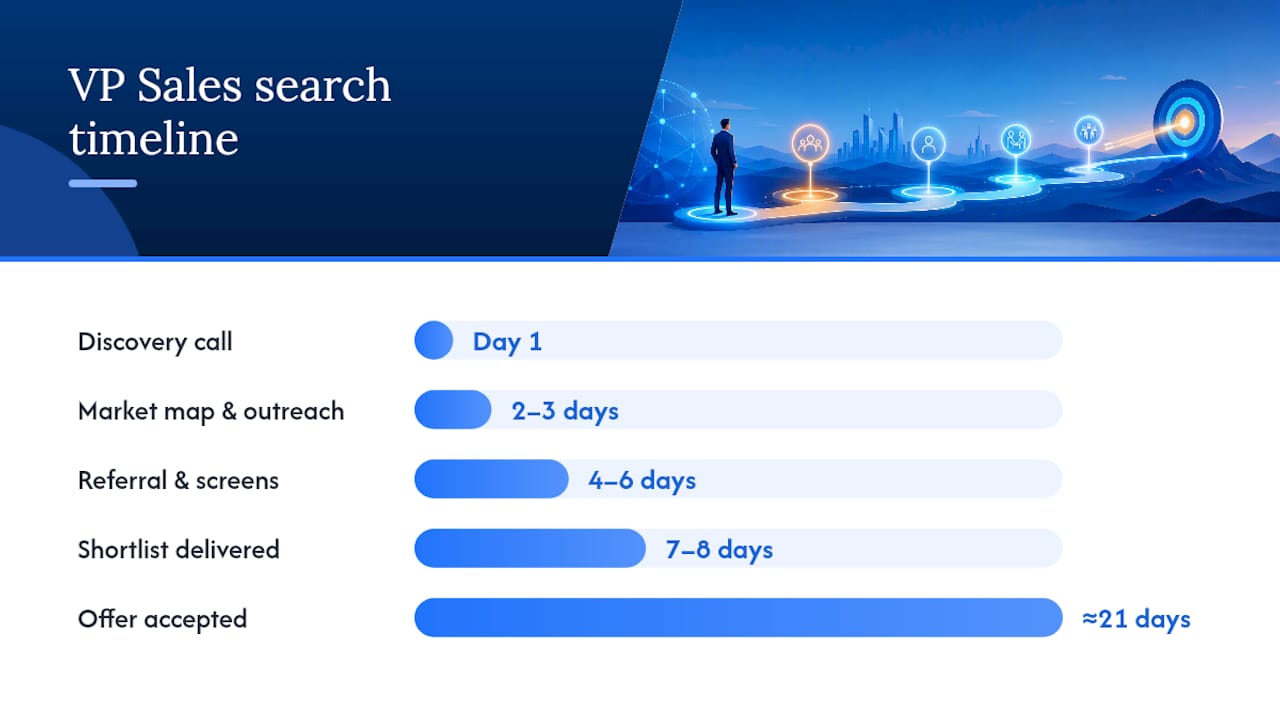
Cornerstonesearch has placed over 1,200 sales professionals since 1996, and the screening criteria for VP Sales roles are non-negotiable: motion experience, SaaS metrics fluency, documented ramp reduction, and cross-functional partnership with CS and product. The full retained and contingent search process is detailed in the search consulting guide for sales leaders.
Pro Tip: Sync comp and equity expectations in the first recruiter screen, not after the final interview. Candidates who know the range before they invest time are more committed, and you eliminate the last-minute “my current company just countered” problem.
How to vet a VP Sales candidate before you commit
Run this checklist before any candidate reaches final interviews.
- Does their motion experience match yours exactly (PLG, velocity, enterprise)?
- Can they cite specific pipeline coverage ratios and conversion rates from a prior role?
- Do references confirm ramp reduction, not just quota attainment?
- Have they managed a team at your ARR stage, not just a larger or smaller one?
- Can they describe a customer expansion play they personally drove?
Interview questions that test real operating judgment
- Walk me through how you built your pipeline coverage model at your last company.
- What was your average rep ramp, and what did you do to shorten it?
- Describe a deal you lost and what you changed in the process afterward.
- How did you partner with CS to protect NRR?
- What does your forecast cadence look like, and how did you hold reps accountable to it?
- Tell me about a time you inherited a broken sales team. What was your 90-day plan?
- How do you think about territory design at the $20M ARR stage versus $50M?
- What is your philosophy on comp plan design for enterprise reps?
- Describe a time you pushed back on a product roadmap because it was killing deals.
- What does a healthy pipeline look like to you, and how do you know when it is not?
Red flags that should stop a search cold
- No ownership of SaaS metrics: they talk about “revenue” but cannot cite ARR, NRR, or pipeline coverage.
- Vague ramp evidence: “We ramped reps quickly” with no numbers attached.
- Blame narratives: every failure is the product’s fault, the market’s fault, or the CEO’s fault.
- Title inflation: VP title at a company with two reps and no real quota.
- No CS partnership: they view customer success as someone else’s problem.
What does success look like in the first 180 days?
Ramp benchmarks for SaaS sales leaders vary by motion: 90 days for SMB, 120–150 days for mid-market, and up to 6–9 months for enterprise. Use this scorecard to track whether your placement is on track.

| Milestone | Key Metrics | Evidence to Request |
|---|---|---|
| 30 days | Pipeline coverage ratio established; forecast cadence running | First forecast report; rep 1:1 structure documented |
| about three weeks | Win rate baseline set; ramp plan for each rep documented | Pipeline review deck; rep scorecards |
| 90 days | Ramped quota % on track; first expansion deal in motion | Quota attainment by rep; NRR signals from CS |
| 180 days | ARR expansion vs. plan; team retention intact | Board-ready revenue report; headcount plan |
If milestones are missed, do not wait for the 90-day review to act. Reset the forecast cadence immediately. Pair the VP with a CS sponsor to stabilize expansion revenue. And if the ramp plan is not documented by day 30, ask for it in writing before day 31.
What I would do first if I were your CRO after this hire
The placement is done. Now the real work starts. Here is the short list.
- Align quota and ramp on day one. Not week three. Day one. Every day of ambiguity costs pipeline.
- Reset forecast cadences immediately. Weekly forecast calls with a standard template. No exceptions.
- Pair the VP with a CS sponsor. Expansion revenue is a sales metric. The VP needs a CS counterpart from the start.
- Clear the 90-day deliverables list. Three things: a rep ramp plan, a pipeline coverage model, and a territory design. Written. Shared. Reviewed.
If you want to benchmark your search or start a retained engagement, reach out for expert guidance on executive search & C-Suite recruiting to ensure the right leadership hire. Bring your ARR, your GTM motion, and your first-year outcome targets. That is all you need to get started.
Cornerstonesearch gets VP Sales searches done in 21 days
Cornerstonesearch has been placing SaaS sales leaders since 1996, with over 1,200 sales professionals placed and a 21-day average time from kickoff to signed offer. Every search is motion-matched: PLG, velocity, or enterprise. Every candidate is screened for SaaS metrics fluency, documented ramp reduction, and cross-functional credibility. No guesswork. No title-chasing.
To start a search, come prepared with three things: your current ARR, your GTM motion, and the first-year outcomes you need from this hire. Cornerstonesearch does the rest. Visit the software sales recruitment page to request a proposal or schedule a discovery call.