

An exclusive recruiting agreement means the client uses one recruiter, period, for a specific role or scope. No other agency, no internal free-for-all, no backdoor hire the recruiter never sees. Use it for senior, confidential, or hard-to-fill searches where you need focused effort. Recruiters taking exclusivity should never sign without fee protection and a hard end date. Everything else is negotiable.
TL;DR:
- Exclusivity is best suited for senior, confidential, or hard-to-fill roles like VP Sales, CRO, or C-suite positions, and less appropriate for junior positions.
- Clear scope, capped duration, and fee protection clauses are essential, with most agreements lasting 60 to 90 days and including a 90-day candidate guarantee.
- Milestones should be defined with deadlines for candidate submission, interviews, and offers, with automatic conversion to non-exclusive if milestones are missed twice.
- Red flags include open-ended exclusivity, no fee protection, lack of reporting, and client unwillingness to pause other sourcing efforts.
- Cornerstone’s approach ensures focused, milestone-driven searches, typically delivering first candidate slates within 21 to 30 days and offers around three weeks for SaaS sales roles.
Table of Contents
- What Makes Exclusive Recruiting Agreements Different From Contingency and Retained Search
- When Should You Accept or Offer Exclusivity?
- The Clause-Level Checklist: Terms You Cannot Leave Vague
- Negotiation Checklist and the Red Flags That Should Stop You Cold
- Sample Clause Language You Can Adapt
- How Cornerstone Runs Exclusive Searches to Cut Risk
- How to Terminate or Modify an Exclusive Recruiting Agreement
- Confidentiality and Intellectual Property in Recruiting Contracts
- Communication and Reporting Standards During an Exclusive Search
- Managing Conflicts of Interest in Exclusive Mandates
- Author Perspective: The Hard Rules I Insist On
- Ready to Run an Exclusive SaaS Sales Search That Actually Closes?
- Templates and Guides Worth Reading Before You Sign
- Sources
- FAQ
What Makes Exclusive Recruiting Agreements Different From Contingency and Retained Search
Three models, three completely different incentive structures. Get this wrong and you’ll wonder why your search stalls or your fee disappears.
Contingency (non-exclusive) means multiple agencies race for the same role. Nobody gets paid until somebody places a candidate. Fast for volume roles. Terrible for anything that needs depth, because every recruiter is sprinting instead of digging.
Exclusive (non-retained) means one agency, no competitors, but payment still happens on placement. The recruiter commits real hours because nobody else is going to beat them to it. This is the sweet spot for most VP Sales and senior AE searches.
Retained search goes further. The client pays upfront, usually in stages, and the recruiter commits dedicated time and market-mapping resources before a single candidate shows up. A retained search agreement locks in fees, timeline, and confidentiality terms from day one.
Here’s how the incentives shake out:
- Contingency: speed over depth, best for high-volume or backfill roles.
- Exclusive: focused effort, no retainer risk, best for VP-level and confidential searches.
- Retained: full commitment, upfront cost, best for C-suite and board-level mandates.
I’ve seen founders try to run a CRO search on contingency and burn three months chasing recruiters who never called their best people. Exclusivity fixes that. Retained fixes it faster.
When Should You Accept or Offer Exclusivity?
Not every role deserves exclusivity. Here’s the fast filter I use before signing anything.
- Check the role. C-suite, VP Sales, CRO, or a sensitive replacement (someone getting fired quietly) all justify exclusivity. A junior AE role does not.
- Check the client’s commitment. Are they willing to pause LinkedIn blasts and internal referral chaos while you work? If not, you’re exclusive in name only.
- Check the budget. Exclusive and retained mandates cost more. If the client balks at a retainer or fee protection, that’s a signal, not a negotiation starting point.
- Check your own bench. Do you actually have depth in this market, or are you exclusive because nobody else wanted the search? Exclusive recruitment fits confidential searches, senior roles, and hard-to-find specialist profiles; everything else fits contingency better.
- Check your cash flow. If you’re a small shop taking exclusivity with no upfront retainer, you’re carrying all the risk for none of the guarantee.
If two or more boxes don’t check, walk away from exclusivity. Convert it to contingency instead.
The Clause-Level Checklist: Terms You Cannot Leave Vague
This is where deals go sideways. Not in the big-picture handshake. In the fine print nobody reads until there’s a dispute.
Scope. Define the role title, seniority band, geography, and function in writing. Scope ambiguity is the number one cause of fee disputes in exclusive mandates, because “sales leader” can mean five different jobs to five different people.
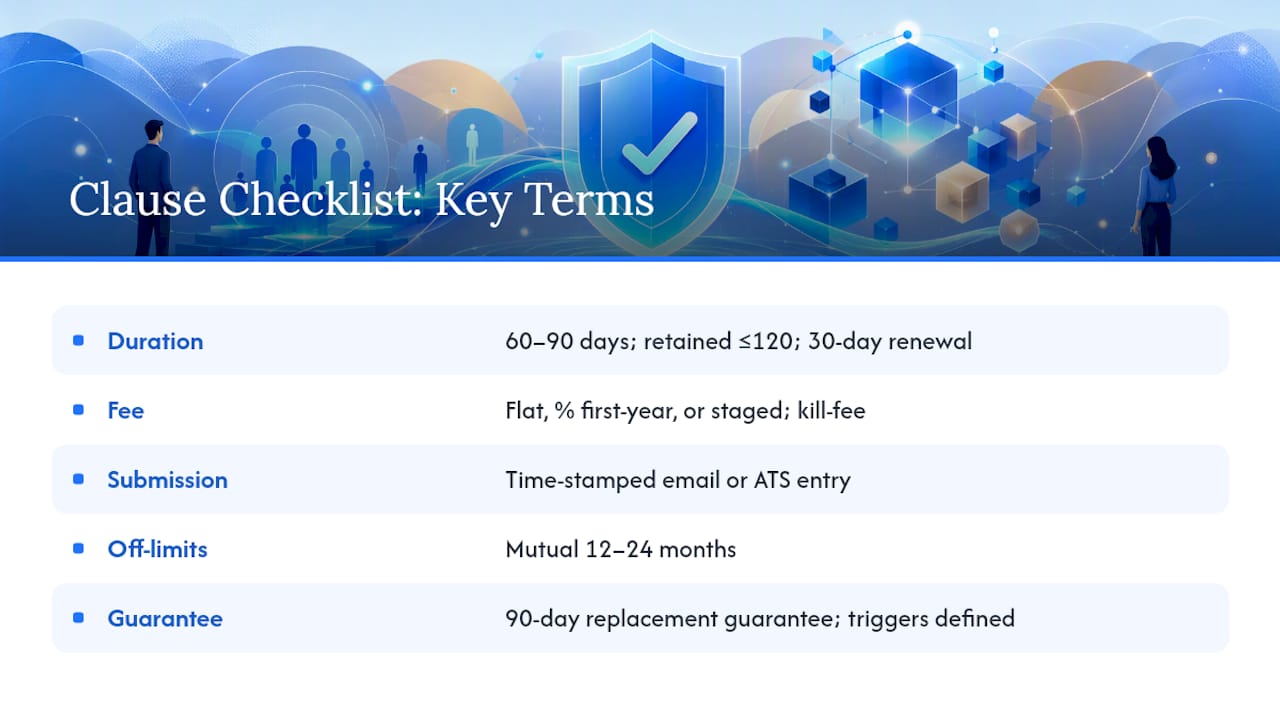
Duration. Most exclusive engagements run 60 to 90 days, with retained mandates sometimes stretching to 120. Never sign open-ended exclusivity. Cap it, and cap any auto-renewal to a single 30-day extension that requires mutual written consent.
Fee structure and protection. Decide upfront: flat fee, percentage of first-year compensation, or staged retainer payments. Then add a kill-fee clause that pays the recruiter for work completed if the client cancels the search mid-stream or fills the role internally without notice.
Candidate ownership. Define exactly what counts as a submission. A time-stamped email or ATS entry, not a verbal mention in a meeting. Without this in writing, fee disputes are nearly inevitable the moment a candidate resurfaces through another channel.
Off-limits and non-solicit. Standard off-limits windows run 12 to 24 months and should be mutual. The client shouldn’t be free to poach the recruiter’s bench either.
Guarantee period. Most agreements include a 90 day replacement guarantee if the hire fails or quits, with a defined trigger (voluntary exit vs. termination for cause) and a clear remedy (free replacement search vs. partial refund).
Pro Tip: Get the “what counts as an introduction” clause in writing before you send a single resume. This single line prevents more lawsuits than any other paragraph in the contract.
Negotiation Checklist and the Red Flags That Should Stop You Cold
Before you sign anything exclusive, ask these questions on the intake call. If the answers are mushy, so is your search.
- “Who else is sourcing for this role right now?” If HR, the hiring manager, and three LinkedIn recruiters are all running parallel efforts, exclusivity is fiction.
- “What’s your internal hire posture?” Get it in writing that internal candidates get flagged before the search starts, not after you’ve submitted someone.
- “Can we agree on milestones?” Push for a first slate within 21 to 30 days, interviews scheduled by day 60, and an offer target by day 90.
- “How do we handle payment staging?” Retained deals should pay in thirds: signing, slate delivery, and placement. Never take 100% on the back end for a 90 day exclusive search.
- Watch for red flags: open-ended exclusivity with no end date, zero fee protection language, no reporting cadence, or a client who won’t commit to pausing other channels.
Build a conversion trigger into every contract: if the client misses two consecutive milestones, the agreement automatically reverts to non-exclusive. It’s the cleanest way to protect your time without burning the relationship.
Sample Clause Language You Can Adapt
Templates save time, but never copy one word for word. Every scope, duration, and fee number needs to match your actual deal.
Fee protection language should read something like this:
- If the client fills the role internally, cancels the search, or hires a candidate previously introduced by Recruiter within 12 months of contract termination, the full placement fee remains due.
- A “submission” is defined as a candidate resume or profile delivered via email or the agreed applicant tracking system, time-stamped and acknowledged by Client within 2 business days.
- If no qualified slate is delivered within 30 days, or two consecutive milestones are missed, the agreement converts automatically to non-exclusive with 5 days written notice.
Adapt the numbers. Never adapt the discipline behind them.
How Cornerstone Runs Exclusive Searches to Cut Risk
We have extensive experience in SaaS sales and executive placements, and nearly all of our senior mandates run exclusive or retained. Why? Because a VP Sales search needs full attention, not a side hustle between other assignments.
Our intake call nails down scope, compensation band, and internal hire posture before we touch a single candidate. We commit to milestone discipline, first slate fast, interviews scheduled on a clock, because vague timelines are how exclusivity turns into wasted months. Our average time from kickoff to offer acceptance typically runs around three weeks, based on our screening discipline built over years of SaaS sales searches. That’s not luck. That’s screening discipline built over three decades of SaaS sales searches.
How to Terminate or Modify an Exclusive Recruiting Agreement
Every exclusive agreement needs an exit ramp. Without one, you’re stuck in a bad marriage with no divorce clause.
Termination for cause should cover missed milestones, breach of confidentiality, or failure to pay staged fees. Spell out a cure period, typically 5 to 10 business days, before either party can walk.
Termination for convenience lets either side end the agreement early with written notice, usually 15 to 30 days. But this needs teeth: if the client terminates after receiving a qualified slate, the fee protection clause should still apply for candidates already introduced.
Modification procedures matter more than people think. Scope creep is real. A search that starts as “VP Sales, East Coast” can morph into “VP Sales, national, with a CRO fallback option” three weeks in. Require written amendments signed by both parties for any change to role scope, fee structure, or duration. A verbal “sure, widen the search” from a hiring manager is not a modification. It’s a future argument.
Automatic conversion clauses double as a soft termination tool. Instead of a hard stop, the exclusive relationship downgrades to non-exclusive if milestones slip, letting the client open other channels without a formal breakup. This keeps the relationship intact while protecting both sides from an endless, unproductive lock-in.
Put all three procedures in writing at signing. Renegotiating termination terms after a dispute has already started never goes well for either side.
Confidentiality and Intellectual Property in Recruiting Contracts
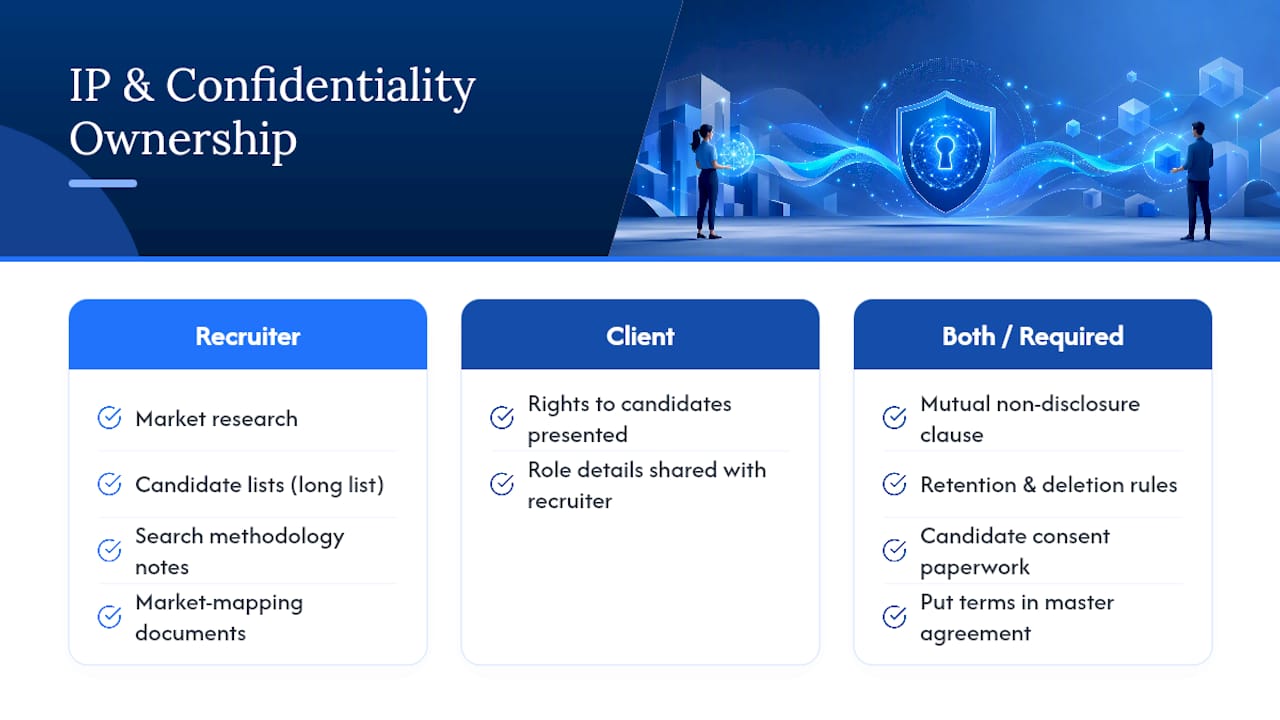
Recruiting agreements carry two IP assets that get overlooked constantly: candidate data and market research.
Candidate confidentiality should be explicit. Client information about the role, compensation, and reason for the opening (especially in a quiet-fire situation) cannot leak to the market. Add a mutual non-disclosure clause, not one-sided. Recruiters also handle sensitive candidate data, salary history, reasons for leaving, background details, and that data needs defined retention and deletion rules once the search closes.
Market research and candidate lists built during a retained search are typically the recruiter’s work product, even though the client paid for it. Spell out who owns the long list, the search methodology notes, and any market-mapping documents if the relationship ends mid-search. Most agreements grant the client rights to candidates actually presented, while the recruiter retains ownership of broader market intelligence.
Consent paperwork matters too. Preserve documentation showing candidates consented to being represented for this specific role. Without it, a candidate ownership dispute becomes a he-said-she-said mess that nobody wins.
Get these terms into the master agreement, not a side email. Verbal understandings about who owns what evaporate the moment there’s money on the table.
Communication and Reporting Standards During an Exclusive Search
Exclusivity without reporting is a black box, and black boxes breed distrust fast.
Set a reporting cadence at signing: weekly check-ins minimum, with a written summary of candidates contacted, declined, and in-process. A five-minute call every Friday beats a surprise “where are we?” email three weeks in.
Define what a status update actually includes: names in the pipeline, stage (screened, interviewed, offer-pending), and any market feedback on comp or role positioning. If candidates are rejecting the opportunity because of a comp gap, the client needs to hear that in week two, not week eight.
Agree on the communication channel upfront. Some clients want a shared tracker or ATS visibility. Others want a phone call. Nail this down before the search starts, because “I thought you knew” is not a defense when a milestone gets missed.
Both sides owe each other fast feedback on submitted candidates. A client sitting on a resume for two weeks kills momentum and burns candidate goodwill. Build a 48 to 72 hour feedback window into the agreement itself. It’s a small clause that prevents a lot of frustration.
Managing Conflicts of Interest in Exclusive Mandates
Exclusivity creates trust, but it also creates blind spots if nobody names the conflicts upfront.
The recruiter’s conflict: running a competing search for a rival company in the same market. Address this directly in the agreement with a defined “no competing search” window for direct competitors, scoped narrowly so it doesn’t block the recruiter’s entire business.
The client’s conflict: running a hidden internal candidate process while the recruiter works exclusively. This is the single biggest source of bad blood in exclusive searches. The agreement should require the client to disclose all internal candidates under consideration at kickoff, with a fee-protection clause if an internal hire happens without notice.
The referral conflict: a recruiter presenting a candidate they have a financial relationship with, a referral fee from another agency, for instance, without disclosing it. This should be barred outright in the confidentiality section.
Managing these conflicts isn’t about assuming bad faith. It’s about removing the ambiguity that turns a good-faith search into a legal headache. Name the conflicts in the contract, define the disclosure obligations, and both sides sleep better.
Author Perspective: The Hard Rules I Insist On
Three rules, no exceptions: cap duration at 90 days, get fee protection in writing, and set real milestones. I’ve watched a firm burn six weeks exclusive on a CRO search with no slate deadline. The client used that silence to hire internally. Lesson: silence favors whoever holds the leverage, so don’t give it away. My intake script line: “Who signs off if we present three strong finalists and nobody’s decided in two weeks?” Ask it before you sign anything.
— Rich Rosen
Ready to Run an Exclusive SaaS Sales Search That Actually Closes?
Cornerstonesearch runs exclusive and retained mandates the way they’re supposed to work: one recruiter, full focus, milestones that mean something. We specialize in SaaS and software sales leadership, VP Sales, CRO, AEs, sales engineers, so you’re not explaining your business model to a generalist agency on week one.

Our software sales recruitment service is built for exactly the roles that justify exclusivity: senior, revenue-critical, and too expensive to get wrong. If you’re staffing a C-suite or board seat instead, our executive search recruitment practice runs the same milestone discipline for retained mandates. We’ve placed over 1,200 sales and executive professionals since 1996, with an average kickoff-to-offer window around 22 days. If you’re ready to stop chasing recruiters who never call your best candidates, start a conversation about a retained search built around a real timeline.
Templates and Guides Worth Reading Before You Sign
A few resources worth bookmarking before drafting your own agreement: the exclusivity mandate breakdown from Pepper Effect for scope and off-limits language, and the retained agreement structure guide from Curran & Daly. Customize every clause. Never sign a template’s scope, duration, or fee terms unedited.
Sources
- Exclusive vs Non-Exclusive Search Mandates: What Clients Need to Know
- Retained Search Agreements: A Guide to Hiring Top Executives
- Exclusivity: When to Say Yes (The Data-Driven Recruiter’s Guide)
- Retained Search vs Contingency vs Exclusive: Choosing the Right Recruitment Model – Kepler Search
FAQ
What Is an Example of an Exclusive Agreement?
A common example: a client hires one agency to fill a VP Sales role for 90 days, agreeing not to use other recruiters or to run parallel searches during that window, in exchange for dedicated sourcing and market-mapping effort.
Are Exclusivity Clauses Illegal?
No. Exclusivity clauses are standard, enforceable contract terms in most jurisdictions as long as they’re reasonable in duration and scope. Problems arise only when a clause is indefinite, overly broad, or lacks mutual consideration, so check the specific terms against local contract law before signing.
What Are Red Flags for Recruiters Taking an Exclusive Deal?
Open-ended exclusivity with no end date, no fee protection language, no reporting cadence, and a client unwilling to pause other hiring channels are the biggest warning signs a search will drag on without paying off.
Can You Give an Example of an Exclusivity Clause?
Yes: “Client grants Recruiter exclusive rights to source and present candidates for [role] for 90 days from the Effective Date, subject to one 30 day extension by mutual written agreement, with fee protection for any candidate introduced during this period.”
How Fast Can an Exclusive Search Actually Move?
Timelines vary by role and market, but a well-run exclusive search with clear milestones can deliver a first slate within 21 to 30 days and an offer by day 90. Cornerstonesearch’s average kickoff-to-offer window runs around 22 days for SaaS sales searches.