

A decision-ready executive search candidate slate is three to five finalists, each backed by matching structured evidence, with a clear recommendation on who to interview first. The next step is simple: schedule calibration, not another round of screening. Some firms build these slates fast because speed without evidence just means you fail quicker.
TL;DR:
- A final slate should consist of three to five finalists who have been thoroughly assessed with structured interviews, reference checks, and aligned evidence.
- Each finalist’s packet must include standardized scores, multi-source feedback, work samples, and clear ratings on core competencies to ensure comparability.
- The presentation to the committee should prioritize the strongest candidate first, include concise summaries, and openly address risks to facilitate decision-making.
- Using a structured scoring system with calibrated competencies and clear decision rules minimizes overcomplication and speeds up the hiring process.
- Avoid common mistakes like relying on unverified resumes, ignoring red flags, or selecting a diverse finalist solely for tokenism; focus on proven evidence and measurable results.
Table of Contents
- What Is an Executive Search Candidate Slate?
- How to Build a Decision-Ready Executive Slate
- What Belongs in Each Finalist’s Evidence Packet?
- How Do You Present a Slate to the Hiring Committee?
- How Should You Score and Decide on the Slate?
- Common Mistakes That Wreck a Slate
- Cornerstone Search Associates: Building Slates That Move Fast
- Hard Truths From 1,200 Placements
- Cornerstone Services: A Firm Built to Deliver the Slate, Not the Excuses
- Sources
- FAQ
What Is an Executive Search Candidate Slate?
A candidate slate is not a pile of resumes. It’s a short, curated group of finalists who’ve already cleared assessment, reference checks, and a hard look at fit. Every name on it comes with the same evidence, scored the same way, so the panel is comparing apples to apples instead of guessing.
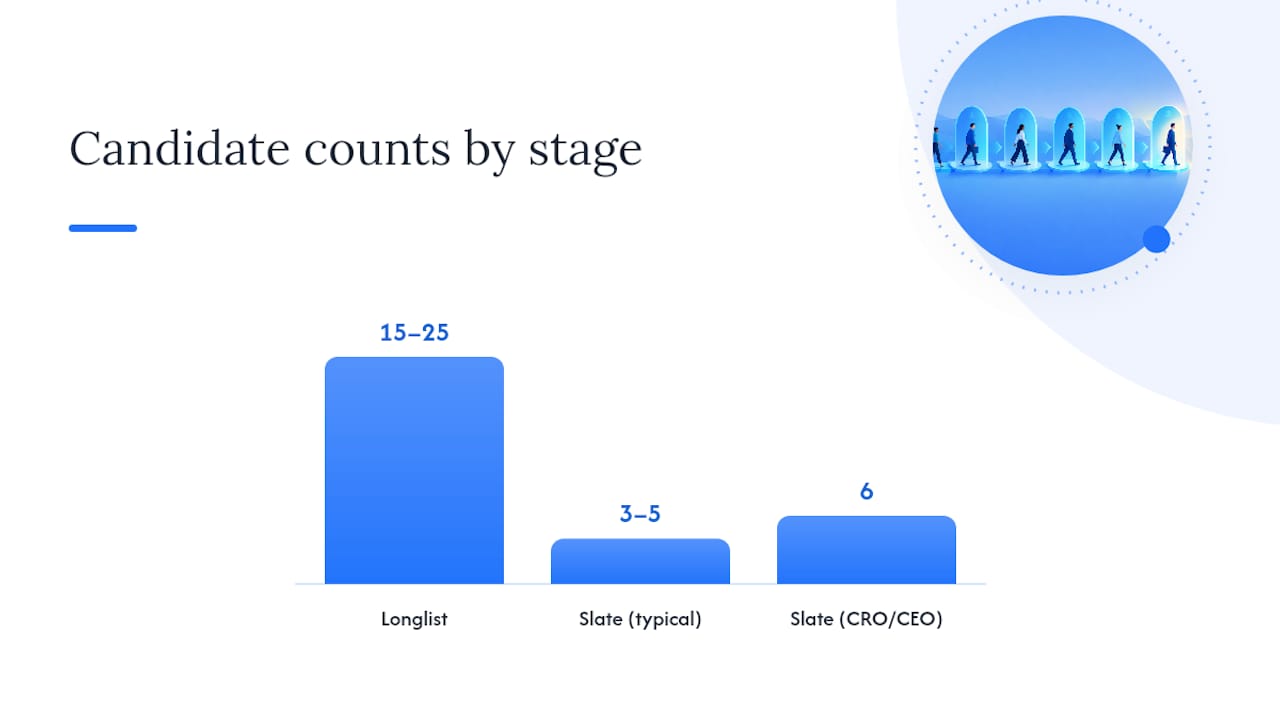
This is where most hiring teams get confused. A longlist is 15 to 25 names from initial sourcing, loosely qualified. A slate is what’s left after you’ve done the work: usually three to five finalists, sometimes six for a CRO or CEO search where the stakes justify a wider look.
Timing matters more than people think. Present the slate only after:
- Structured screens are complete for every finalist
- References are checked, not just requested
- Each candidate has said yes to the comp range and the location or travel reality
Boards and executive teams that skip this step get burned. Recent survey data show nearly a third of public company boards have no identified CEO successor lined up, and more than half call pipeline maintenance one of their biggest headaches. A slate built well ahead of the vacancy is how you avoid becoming that statistic. It’s also how you benchmark your internal bench against real outside talent instead of assuming your VP of Sales is ready just because nobody’s told them otherwise.
How to Build a Decision-Ready Executive Slate
Building a real slate is a sequence, not a vibe. Skip a step and you’ll pay for it in a bad hire six months from now.
- Intake first. Get specific on outcomes and non-negotiables before you source a single name. What number does this person need to hit in year one? What’s the deal breaker? If the hiring manager can’t answer that in the intake call, you don’t have a search yet, you have a wish list.
- Build the profile on competencies, not pedigree. Forget “must have worked at a name-brand company.” Define the four or five capabilities the job actually requires and screen against those.
- Source wide. Your default network will hand you the same 20 people every search firm already called. Push into adjacent industries, competitors’ bench strength, and functions that map to the same skill set.
- Run a real screening funnel. Phone screen for motivation and fit. Video round for communication and command of the numbers. Panel round for competency depth.
- Assess with structure. Structured interviews, work simulations, and multi source feedback beat gut feel every time.
- Select finalists by mapping evidence to priorities. Write down what each finalist proves and what’s still unknown. Don’t hide the risk. Name it.
Pro Tip: If you can’t summarize why a finalist made the slate in two sentences, they don’t belong on it yet. Go back and get the missing evidence before you put their name in front of the committee.
What Belongs in Each Finalist’s Evidence Packet?
The gap between a good slate and a bad one comes down to evidence quality. Unstructured interviews feel efficient but they’re basically an expensive coin flip. Research on hiring practices is blunt about this: structured interviews and validated assessments consistently beat ad hoc conversations at predicting who actually performs.
Each finalist’s packet should include:
- A structured interview score against the same competency rubric every other finalist got
- Multi source feedback, meaning input from people who worked with the candidate, not just their references
- A work sample or simulation tied to the actual job, not a generic case study
- A red, amber, green rating on each core competency so the panel can scan it in ten seconds
The real cost of skipping this: replacing a failed executive hire can run anywhere from roughly $750,000 into the millions once you count severance, lost productivity, and the search redo. That number alone should settle any debate about whether structured assessment is worth the extra week.
Standardize the process across every finalist. If one candidate got a simulation and another didn’t, your slate isn’t comparable, it’s just three separate opinions stapled together.
How Do You Present a Slate to the Hiring Committee?
The packet has to do the thinking for the panel before the meeting starts. Nobody should be flipping through ten pages of narrative trying to figure out who’s actually strong.
Build a one page profile per finalist with:
- A three line summary of background and why they’re on the slate
- The scorecard results, side by side with the other finalists
- Named risks, stated plainly, not buried
- A recommended next step: first interview, second interview, or pass
Order the meeting deck by recommendation strength, not alphabetically. Lead with the strongest finalist, then walk through trade-offs candidate by candidate. Say the quiet part out loud: “Candidate A has the stronger ramp story, Candidate B brings the international expansion experience you said you needed.” That’s how you move a panel to a decision instead of a stalemate.
Short video intros or a five-minute work sample clip can save the committee a full round of scheduling. A well-structured executive video interview does more to reveal command of the room than another written summary ever will.
How Should You Score and Decide on the Slate?
Executive panels overcomplicate scoring constantly. Keep it tight.
- Pick 4 to 6 competencies tied directly to the job’s real outcomes. Not culture fit. Not “executive presence.” Outcomes.
- Score each finalist 1 to 5 on each competency, tied to a written anchor example so a “4” means the same thing to every panelist.
- Run a five minute norming exercise before scoring starts. Have panelists score a sample case together first so everyone’s calibrated on the scale.
- Decide with a rule: majority vote, full consensus, or hire with conditions if there’s one open risk worth managing rather than walking away from.
- Set a pause point. If two finalists tie or a red flag surfaces, stop and get one more data point before moving to offer.
Move fast once the scoring is done. Finalists at the executive level have other conversations happening. A slow committee loses good candidates to a faster one.
Common Mistakes That Wreck a Slate
- Tokenism instead of the rule of three. One diverse finalist buried on a slate of five isn’t diversity, it’s cover. Aim for two or more diverse finalists with real shots at the job.
- Resume worship. A great LinkedIn history isn’t evidence. Insist on structured proof.
- Vague success criteria. If a score doesn’t tie to a business outcome, it’s noise.
- Ignored red flags. Missing measurable results or a shaky reference check should stop a slate cold.
Pro Tip: Before any slate goes to committee, ask: “What would make us regret this hire in year one?” If nobody can answer, you’re not done evaluating.
Cornerstone Search Associates: Building Slates That Move Fast
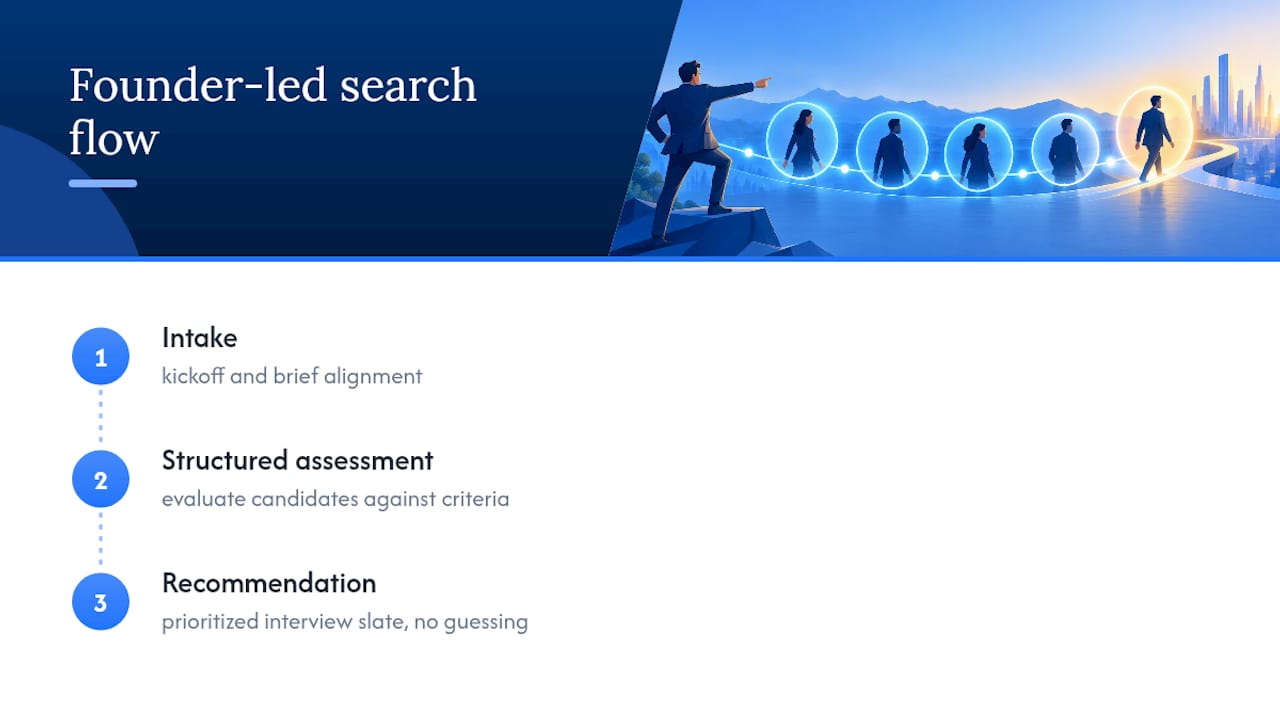
Founder-led searches, running start to finish, can achieve an average of about 21 days from search kickoff to offer acceptance. A Cornerstone packet lines up intake, structured assessment, and a straight recommendation on who to interview first, no guessing required.
[Rich Rosen’s professional bio and credentials relevant to sales recruiting]
Hard Truths From 1,200 Placements
Panels are polite. Politeness kills good hiring. Force the room to ask the uncomfortable question, not the safe one. I’ve watched committees pick the smoothest talker over the strongest operator more times than I can count. A resume tells you where someone’s been, not where they’re going. My non-negotiable for any slate: every finalist proves it, or they don’t make the cut.
— Rich Rosen
Cornerstone Services: A Firm Built to Deliver the Slate, Not the Excuses
Cornerstonesearch is the shortcut to a decision-ready executive slate without the six-month search cycle most firms run on autopilot. Our Executive Search Recruitment service is founder-led from intake to offer, built around the same 21-day average that’s placed over 1,200 sales and executive professionals since 1996. If your gap is on the sales leadership side specifically, our Software Sales Recruitment practice knows the difference between a CRO who can run a board deck and one who can actually carry quota. Need help building your own internal scorecard process instead? Talent Acquisition Consulting does that. Whatever the gap, stop burning weeks on unstructured searches. Reach out and get a slate built the right way.
Sources
- Stanford Women’s Leadership Lab — board succession findings
- Visier — Rooney Rule and diversity in hiring
- SHRM — Assessment methods and selection guidance
FAQ
What Is the Difference Between a Shortlist and a Longlist?
A longlist is the broad group of sourced candidates, often 15 to 25 names, loosely screened. A shortlist, or slate, is the final three to five candidates who’ve cleared structured assessment and reference checks and are ready for committee review.
How Many Finalists Should Be on an Executive Slate?
Most executive slates land between three and five finalists. Aim for at least two diverse finalists to follow rule of three practices and avoid tokenism.
How Long Should an Executive Search Take From Slate to Hire?
Timelines vary by firm and role complexity, but founder led searches can move fast. Cornerstone Search Associates averages 21 days from search kickoff to offer acceptance.
What Does Executive Search Cost?
Fees depend on the search scope and role level. Current pricing details for Cornerstone’s search services are available directly through the Executive Search Recruitment page.
Why Do Unstructured Interviews Fail for Executive Hiring?
Unstructured interviews rely on gut feel rather than comparable evidence, which weakens their ability to predict performance. Formal, structured assessments give panels a consistent, evidence-based way to compare finalists.