

An executive search guarantee promises a replacement search, a refund, or a credit if a placed executive fails within a set window. But the number of months on the cover page means nothing if the triggers are narrow and the exclusions are wide. Check scope before you check duration. Two firms cited here got that right: PRL International on contract scope, and one firm cited here emphasizes fast, precision placements that reduce the odds you’ll ever need the guarantee at all.
TL;DR:
- Guarantees typically cover only specific triggers like involuntary termination within a set time, often excluding misconduct and layoffs, so check contract language carefully.
- The most common guarantee window is 90 days, but longer periods of 6 or 12 months are available for senior roles, aligning protection with risk level.
- Shorter guarantees are common with contingency models, while retained searches offer longer coverage due to higher fees and deeper vetting.
- Always ensure the clock starts on the candidate’s actual start date, and clarify whether you get a full replacement or refund if issues arise.
- Clear, precise contract language and defined timelines reduce dispute risk and make guarantees more effective and reliable.
Table of Contents
- What Executive Search Guarantees Actually Cover
- How Long Should the Guarantee Run?
- Retained, Contingency, or Container: How the Model Shapes Your Guarantee
- Your One-Page Guarantee Checklist and Two Scripts to Use Right Now
- Three Rules That Stop Replacement Drama Before It Starts
- Cornerstone’s Approach: Clear Guarantees, Fast Precision Searches
- Sources
- FAQ
What Executive Search Guarantees Actually Cover
Every real guarantee has six moving parts. Miss one and you’re stuck arguing with a recruiter’s legal department six months after your VP of Sales walks out the door.
- Duration. How long the clock runs, and from what start date.
- Trigger. What kind of failure activates the guarantee (resignation, termination, poor fit).
- Remedy. Replacement search, refund, or credit toward a future search.
- Exclusions. What voids it (misconduct, layoffs, role changes).
- Client obligations. What you have to do to keep the guarantee alive.
- Replacement process. The steps and deadline once you invoke it.
Here’s where recruiters get cute. The clock often starts at offer acceptance, not the candidate’s actual start date. That can quietly shave three or four weeks off your protection before the new hire even shows up. Push back on that every time.
“Voluntary” exits are another trap. Some contracts only cover a hire who quits on their own. If you have to fire someone for missing quota, that’s often carved out as “performance related” and excluded. That’s backwards. A bad hire who fails your ramp targets is exactly the failure a guarantee should cover.
Compare two lines of contract language. One says: “Client shall receive a replacement search at no additional fee if the placed candidate’s employment terminates for any reason, voluntary or involuntary, excluding candidate misconduct, within 180 days of start date.” That protects you. The other says: “Cornerstone offers a satisfaction guarantee on all placements.” That’s a marketing sentence. It has no trigger, no remedy, and no deadline. PRL International’s contract guidance makes the same point: scope beats length every time.
How Long Should the Guarantee Run?
Guarantee windows aren’t arbitrary. Each one buys you a different kind of protection, and the shorter ones buy you less than you think.
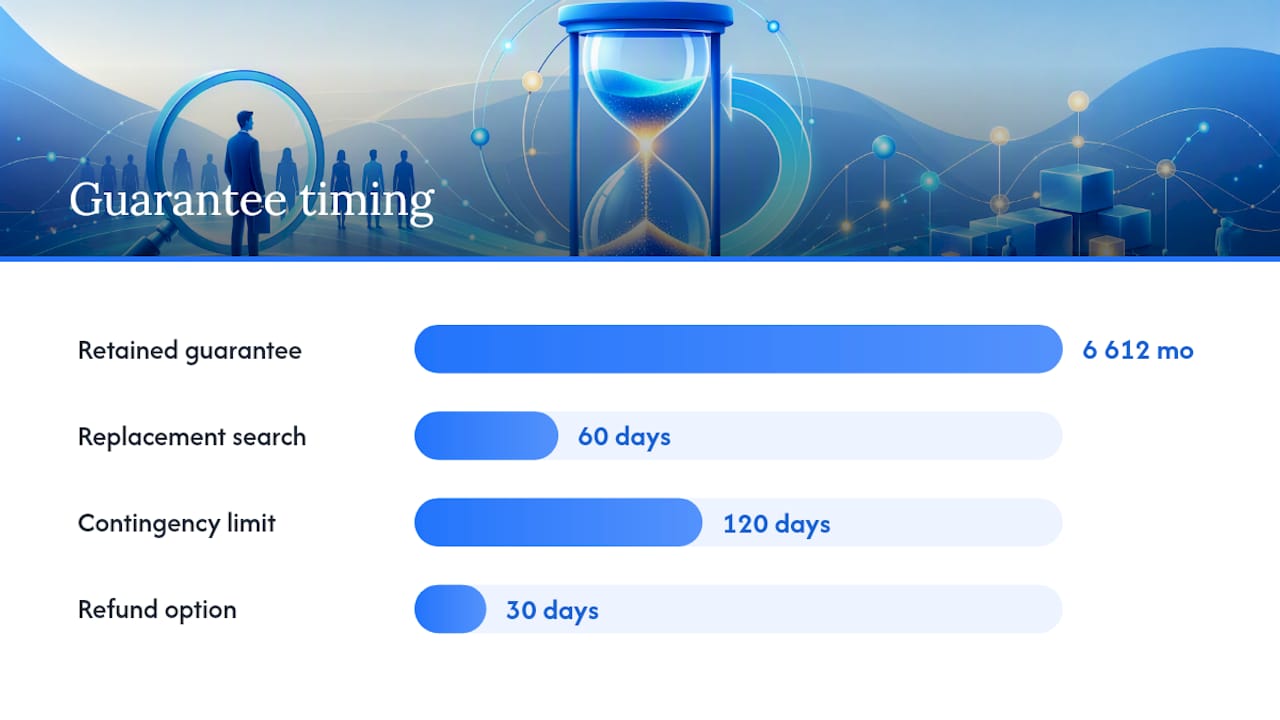
- 90 days. This is the most common window in the market. It catches the obvious disasters, the hire who lies on their resume or can’t run a discovery call. It won’t catch a VP of Sales who looks great in month two and implodes in month five once real quota pressure hits.
- 120 days. Covers a full sales cycle for most mid-market SaaS deals. If your average deal cycle runs 90 to 100 days, this window lets you see at least one closed deal, or the lack of one, before the guarantee expires.
- 6 months. This is where you start seeing real signal on leadership hires. Team morale shifts, pipeline quality changes, and forecast accuracy either holds up or falls apart. Gallup’s workplace research has long shown leadership fit problems tend to surface over 6 to 18 months, not 90 days.
- 12 months. Reserved for senior, high-stakes roles. Only a small share of retained firms offer a full year, and when they do, it usually comes with a higher fee and a more rigorous vetting process up front.
The rule of thumb: match the window to the risk. An SDR hire probably doesn’t need a 12-month guarantee. A CRO who’ll rebuild your entire go-to-market motion absolutely does.
Retained, Contingency, or Container: How the Model Shapes Your Guarantee
The engagement model you choose sets the ceiling on what guarantee you can reasonably demand. Don’t ask a contingency recruiter for a 12-month replacement promise. It’s not going to happen, and if it does, be suspicious.
- Contingency search. You pay only on placement, usually 20 to 25% of first-year pay. Guarantees run short, typically 90 days, because the recruiter’s margin is thin and they’re often working the same role for three other clients at once.
- Retained search. You pay in tranches whether or not the search closes, typically 25 to 35% of first-year compensation. That skin in the game buys longer guarantees, deeper vetting, and often higher completion rates because the firm isn’t racing four competitors to the same candidate.
- Container search. A hybrid where you pay retained-style fees in stages but get contingency-style flexibility. Guarantees land somewhere in the middle, usually 90 to 120 days, and vary a lot by firm.
You’ve got three real negotiation levers regardless of model. First, swap scope for length: if the recruiter won’t extend the window, ask them to widen the trigger definition instead. Second, push the clock to start on the candidate’s actual start date, not the offer letter. Third, ask for a client-choice remedy, meaning you pick between a free replacement search or a prorated refund, not the recruiter.
Curious how retained search actually runs day to day? Cornerstone’s guide to the retained model breaks down the mechanics in plain terms.
Your One-Page Guarantee Checklist and Two Scripts to Use Right Now
Print this before your next contract review. Confirm every line before you sign.
- Clock starts on the candidate’s start date, not offer acceptance.
- Trigger includes termination for performance, not just voluntary resignation.
- Remedy gives you the choice: replacement search or prorated refund.
- Replacement process has a hard deadline, not vague language like “reasonable effort.”
- Contract states who covers expenses on a redo search (travel, assessments, background checks).
- Your obligations are spelled out: timely interview feedback, no unreasonable delays, no ghosting candidates.
Script for a retained search: “We need a 6 to 12 month guarantee given the level of this role, or we need the flexibility to choose a prorated refund if a replacement search doesn’t land within 60 days.”
Script for a contingency search: “We’re comfortable with 120 days if the trigger covers performance-based termination, and we want a prorated refund option if you can’t fill the role within 30 days of us invoking the guarantee.”
Pro Tip: Always preserve the right to take a refund instead of a replacement search. A replacement search sounds generous until you realize it can drag on for months while your team runs without a leader. Cap the replacement deadline at 30 days from the day you invoke the guarantee, no exceptions.
Three Rules That Stop Replacement Drama Before It Starts
I’ve watched more replacement fights blow up over sloppy contract language than over bad candidates. Here’s what stops the drama.
Rule one: the clock starts on the candidate’s start date. Not the offer letter. Not the signed agreement. If a recruiter won’t budge on this, that tells you something about how they handle disputes later.
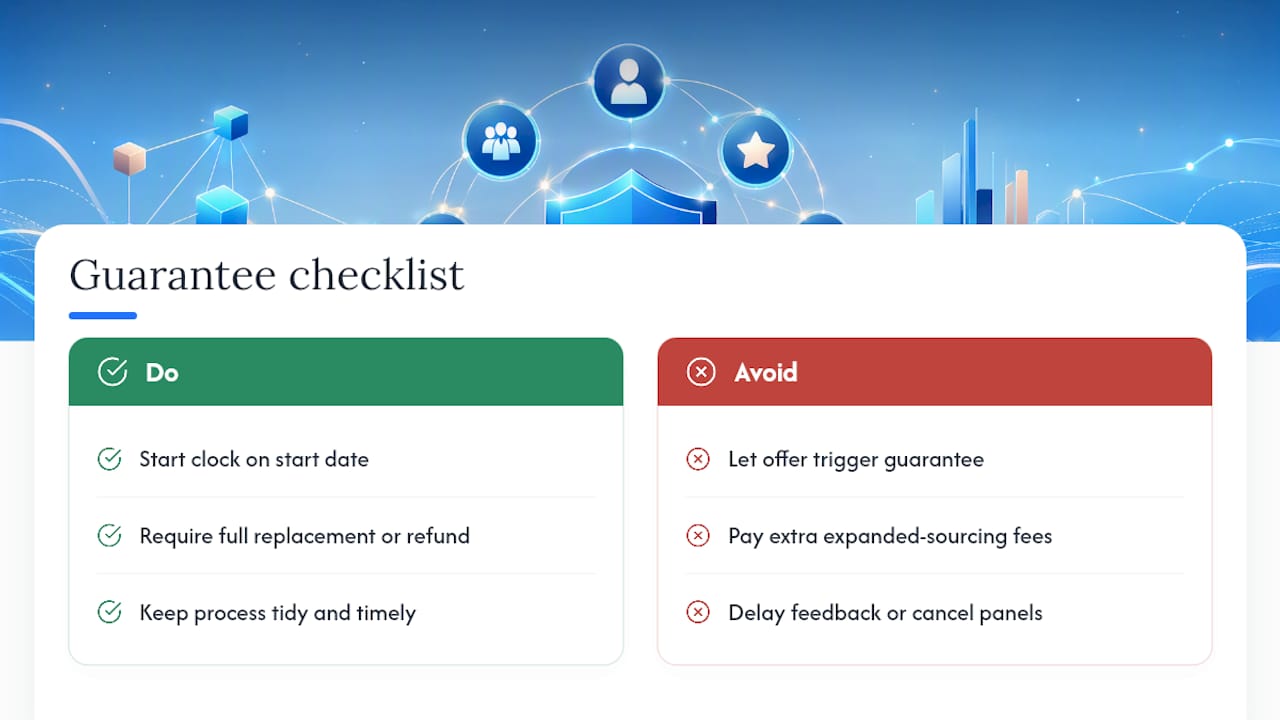
Rule two: the recruiter eats the cost of a full replacement search, or you get a prorated refund. No middle ground where you pay extra fees for “expanded sourcing.”
Rule three: keep your own process tidy. Slow feedback, ghosted interviews, and last minute panel cancellations void guarantees fast, and rightly so. A guarantee is a two way contract, not a blank check.
— Rich Rosen
Cornerstone’s Approach: Clear Guarantees, Fast Precision Searches
Most guarantee headaches start the same way: a slow, generic search that drags on so long the client forgets to check the fine print until something breaks. Cornerstonesearch runs differently. The goal is simple: hire the right leader fast enough that you rarely need to invoke a guarantee in the first place.

This service structures guarantee terms around clear triggers and defined replacement timelines, not vague satisfaction language. If you’re hiring a VP of Sales, a CRO, or building out a full go-to-market leadership team, the software sales recruitment service page walks through how the search process and guarantee terms work together. Ready to talk through role risk and what guarantee window fits your situation? Book a readiness call and get specifics before you write another job description.
Sources
For deeper reading on contract language, guarantee windows, and hiring models, these sources back the claims in this guide: PRL International’s breakdown of retained search contract terms, Pepper Effect’s comparison of retained versus contingency search, LegalClarity’s guide to recruitment guarantee periods and remedies, HireCruiting’s explainer on how executive search retainers work, and Gallup’s ongoing workplace research on leadership fit and retention timelines. If interview scheduling delays are part of your risk profile, this playbook on cutting panel scheduling time is worth a look too.
- What Should Be in a Retained Executive Search Contract?
- Retained Search vs Contingency: Which Model Fits Your Firm
- Gallup workplace research
FAQ
Who Are the Big 5 Executive Search Firms?
The market has several large global players, but firm rankings shift and “big five” lists vary by source and year. Focus less on brand size and more on whether the firm’s guarantee terms and specialization match your role.
What Is the 70/30 Rule in Hiring?
Definitions vary across the industry, and there’s no single agreed-upon standard for a “70/30 rule” in hiring. If you’ve heard this from a specific source, ask them to define it rather than assume it’s a universal framework.
Is Robert Walters a Real Company?
Robert Walters is a real, publicly known recruitment firm operating internationally. That said, this article doesn’t cover their specific guarantee terms, so check any firm’s contract language directly before assuming standard practice applies.
Will Executive Search Be Replaced by AI?
AI tools can speed up sourcing and screening, but judgment on leadership fit, sales instincts, and cultural alignment still comes down to human evaluation. Firms like Cornerstonesearch use speed and precision as a differentiator, not automation as a replacement for recruiter judgment.
What Triggers an Executive Search Guarantee?
Most guarantees trigger when a placed candidate leaves within the defined window, whether by resignation or termination, though many contracts carve out exclusions for misconduct or role changes. Read the trigger language closely since “voluntary” exits and performance-based terminations are often treated very differently.