

Expect a real retained executive search to run about two to four months, and don’t be shocked if it stretches longer. The two things that decide which end you land on: how clear your scorecard is, and how fast your leadership team makes decisions. This piece gives you the phase-by-phase milestones, a readiness checklist, and the moves that actually shorten the calendar.
TL;DR:
- Most executive searches take between 60 and 120 days, with delays caused mainly by internal process issues rather than candidate availability.
- Clear decision authority, a complete scorecard, and prompt feedback are essential to prevent prolonged timelines and avoid unexpected stalls.
- Conducting a comprehensive pre-search readiness checklist ensures critical gaps are addressed before launching, significantly reducing overall search duration.
- Speeding up the process involves locking the scorecard early, setting feedback SLAs, and actively activating internal networks alongside external sourcing.
- Longer timelines often stem from internal indecision and vague scope; fixing these issues upfront shortens search time and improves outcome reliability.
Table of Contents
- The phase-by-phase timeline: what happens and when
- Why timelines vary: the bottlenecks nobody plans for
- Pre-search readiness checklist: 10 questions before you launch
- Sample timelines by role: urgent, C-suite, and VP-level searches
- How to speed up an executive search without wrecking it
- What 1,200 placements taught me about stalled searches
- Do timelines shift by industry or region?
- How candidate market conditions change your timeline
- What to tell stakeholders at each stage of the search
- What happens after the offer goes out
- When the timeline breaks: how to get back on track
- The part of this timeline nobody wants to hear
- How Cornerstone Search gets you to offer faster
- Sources
- FAQ
The phase-by-phase timeline: what happens and when
Every retained search moves through the same phases. Skip one, rush one, or leave it vague, and you pay for it later in weeks, sometimes months.
Kickoff and scoping (1 to 2 weeks). You lock the scorecard, the comp band, and who actually has the final call. If your leadership team can’t agree on decision rights in week one, don’t expect the search to move fast. This is also where you decide if you’re running retained or contingency, and how retained search differs from contingency matters here because retained searches trade speed for exclusivity and deeper vetting.
Research and mapping (2 to 6 weeks). The recruiter builds a market map, runs passive outreach, and delivers a longlist. This is the phase most companies underestimate. Good candidates aren’t sitting on job boards. They’re employed, doing fine, and need a real reason to move.
Screening and shortlisting (2 to 4 weeks). Phone screens, recorded scorecards, and a shortlist that actually reflects your criteria, not just resumes that look good on paper.
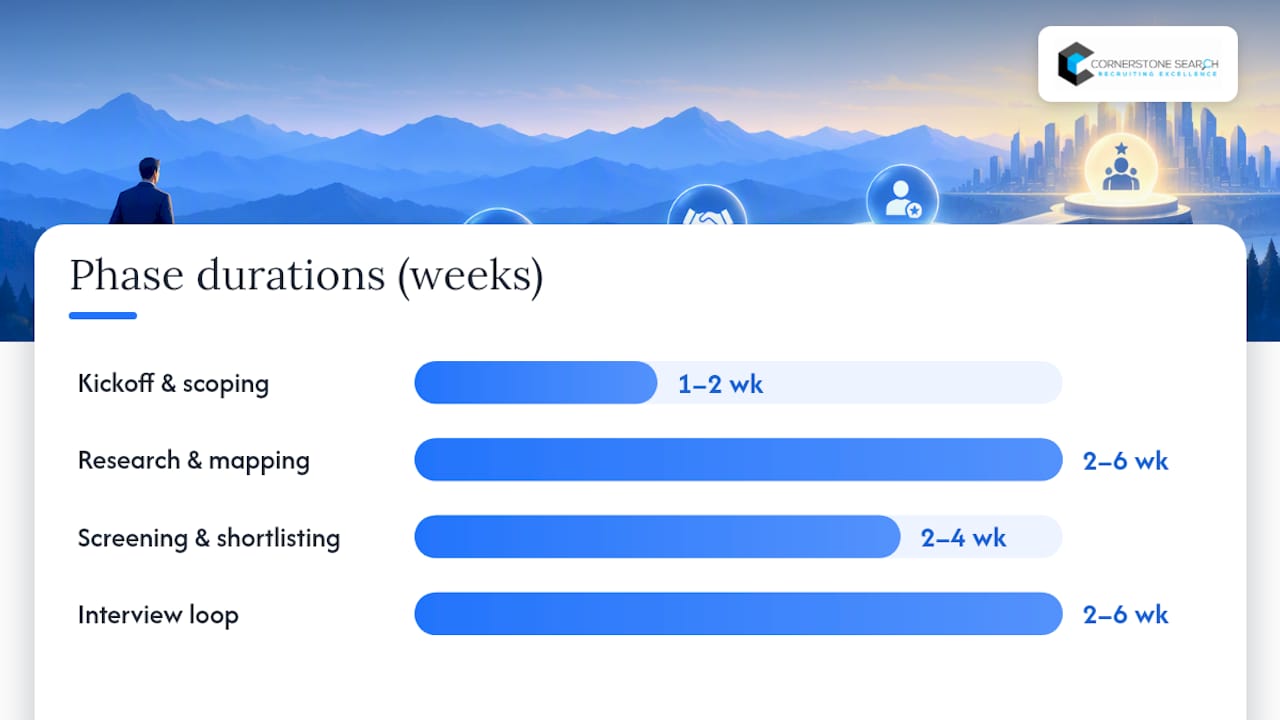
Interview loop (2 to 6 weeks). Structured 45-minute interviews, prepped interviewers, and a hard feedback deadline. This phase balloons fastest when calendars don’t cooperate.
Offer, references, background checks, onboarding plan (1 to 3 weeks). Negotiation, verification, and a 30-60-90 day plan so the hire doesn’t stall on day one.
Here’s the rundown:
- Kickoff and scoping: 1 to 2 weeks, output is a locked scorecard and comp band.
- Research and mapping: 2 to 6 weeks, output is a vetted longlist.
- Screening: 2 to 4 weeks, output is a qualified shortlist.
- Interview loop: 2 to 6 weeks, output is a ranked finalist slate.
- Offer through onboarding plan: 1 to 3 weeks, output is a signed offer and a ramp plan.
Stack those ranges and you get the 60 to 120 day baseline, with real-world drag pushing many searches past it.
Why timelines vary: the bottlenecks nobody plans for
Most delays aren’t about candidate supply. They’re about your own process falling apart mid-search.
- Decision authority is fuzzy. Nobody knows if the CEO, the board, or the hiring VP makes the final call, so every candidate gets re-litigated.
- The scorecard is weak or missing. Without one, scope creep sets in and you start interviewing for three different jobs at once.
- Comp approval crawls. Finance sits on a number for two weeks while a strong candidate takes another offer.
- Relocation gets complicated. Housing, spouse jobs, timelines, all of it adds friction fast.
- The talent pool is thin. Niche skill sets mean longer passive outreach and more no-thank-yous before you get a yes.
- Interview feedback is slow. One VP who takes 10 days to send notes can stall an entire loop.
Pro Tip: If your interview loop has no feedback deadline, you don’t have a process, you have a suggestion.
Rising executive recruiting costs track closely with these delays, and SHRM’s cost analysis ties the surge directly to longer searches, relocation complexity, and scarce niche skills.
Pre-search readiness checklist: 10 questions before you launch
Before you spend a dollar or a day on a search, answer these. Miss more than two and you’re not ready, you’re guessing.
- What does success look like for this hire at the 12-month mark?
- Who advises, who recommends, and who makes the final decision?
- Is that decision chain written down and agreed on by everyone involved?
- What’s the documented business case and expected return on this hire?
- What’s the comp range, and has finance already approved it?
- Is the scorecard complete, with behavioral risk criteria included?
- Has the interview loop been designed, not just assembled last minute?
- Are interviewers trained on the scorecard and committed to timely feedback?
- Is your network being activated alongside outside sourcing?
- Are stakeholders’ calendars actually blocked for this search?
SHRM’s own pre-search checklist covers this same ground, and the guidance is blunt: a CHRO who can’t answer at least eight of these ten questions should stop and fix the gaps before launching a C-level search. Skip that step and you’re not saving time, you’re borrowing it from three months down the road.
Sample timelines by role: urgent, C-suite, and VP-level searches
Not every search runs the same clock. Here’s how the three most common scenarios shake out.
- Urgent replacement (3 to 4 weeks): compressed sourcing, existing network activation, and interviews stacked back to back. Risk is real: you trade candidate depth for speed, and you need airtight decision authority going in or the sprint collapses.
- Standard C-suite retained (8 to 16 weeks): full market mapping, deep screening, multiple interview rounds, and board-level sign-off. This is the stages of the executive search process most companies should plan around.
- VP or senior functional leader (8 to 12 weeks): similar structure to C-suite but usually fewer stakeholders and faster internal approvals, unless comp bands aren’t set ahead of time.
The tradeoff across all three is the same: speed costs you either depth of the candidate pool, search fees, or selection risk. Pick which one you’re willing to pay for. Pretending you can have all three fast, deep, and cheap is how searches drag into month six.
How to speed up an executive search without wrecking it
Speed isn’t magic. It’s discipline applied early and enforced often.
- Set interview and feedback SLAs before the search starts, and calendar-block interviewers so a 10-day feedback gap never happens.
- Show up to kickoff with a finished scorecard and locked comp range. Half-built scorecards are the number one cause of a stalled month two.
- Standardize the interview loop. Same structure, same scorecard, every candidate, every round.
- Run parallel sourcing. Activate your own network while the search firm maps the outside market. Don’t wait on one channel.
- Budget for speed when it matters. A sourcing blitz, relocation flexibility, or paid candidate exclusivity all shorten time-to-offer, at a cost.
Pro Tip: The fastest searches aren’t lucky. They’re the ones where the client did their homework before the recruiter made the first call.
Companies willing to pay for that speed, through tighter retainer terms or relocation packages, consistently shorten time-to-offer according to SHRM’s cost research, though it usually means higher search spend.
What 1,200 placements taught me about stalled searches
Most searches don’t stall because good candidates don’t exist. They stall because the client hasn’t done the internal work. I’ve watched a scorecard get rewritten three times mid-search because nobody agreed on what the job actually was. That’s not a candidate problem. That’s a homework problem.
Our searches are founder-led, with no handoffs or junior associates learning your business on your dime. Many specialized recruiting firms place numerous sales and executive professionals annually, and top-performing searches can run as fast as around 21 days from kickoff to offer acceptance. That number holds because intake is disciplined from day one: scorecard locked, comp approved, decision rights clear, before we source a single name. That’s what you should expect from any specialist retained firm: less guessing, faster slates, fewer surprises in month three.
Do timelines shift by industry or region?
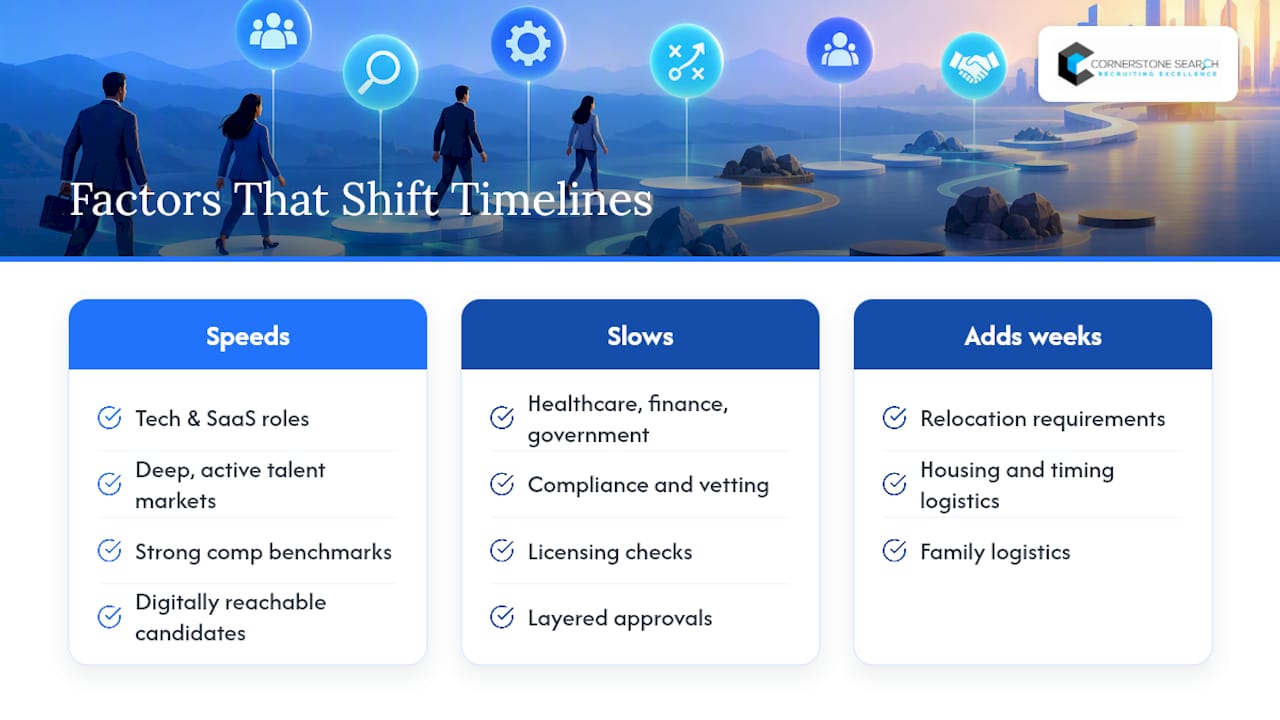
Yes, and the swing is bigger than most hiring teams expect. Tech and SaaS roles, especially sales leadership, tend to move faster than industries with heavier regulatory or credentialing requirements, because the candidate pool is more digitally reachable and comp benchmarks are better understood. Healthcare, finance, and government executive searches often run longer due to compliance vetting, licensing checks, and layered approval chains.
Geography matters too, but not the way people assume. It’s not about distance, it’s about labor market depth. A search for a VP of Sales in a market saturated with SaaS companies moves faster than the same search in a region with a thin bench of comparable talent, regardless of country or city size. Relocation requirements add weeks regardless of where the search happens, since housing, timing, and family logistics rarely move on a recruiter’s schedule.
The common thread: niche skill sets and layered approvals slow things down everywhere, while deep, active talent markets speed things up. If you’re hiring for a role with few comparable operators nearby, build extra weeks into your plan before you even kick off.
How candidate market conditions change your timeline
A tight labor market for the specific skill set you’re hiring cuts both ways. Fewer active candidates means longer passive outreach, but it also means less competition for the ones who do surface, once you find the right person, they’re often more willing to engage seriously.
A loose market, plenty of qualified people actively looking, speeds up top-of-funnel volume but can slow down decision making on your side, because more options tempt hiring teams into over-comparing instead of committing. Either condition can stretch a timeline if you’re not managing your own process discipline.
The market also affects retention risk. Candidates in high demand get counteroffers and competing processes, so a slow interview loop doesn’t just delay your hire, it can lose you the hire entirely. If you know you’re competing in a hot market for a specific skill set, that’s your signal to tighten feedback SLAs and shorten the gap between final interview and offer, not to relax your standards to move faster.
What to tell stakeholders at each stage of the search
Stakeholders don’t need daily updates. They need the right update at the right moment, and silence between those moments kills trust in the process.
At kickoff, confirm the scorecard, comp range, and decision chain in writing so nobody re-litigates it in week six. During research and mapping, a brief check-in on market conditions and early longlist themes keeps expectations grounded, especially if the pool looks thinner than hoped. When the shortlist lands, give stakeholders the reasoning behind each name, not just resumes, so interview feedback ties back to the scorecard instead of gut reactions.
During the interview loop, enforce your feedback SLA and share consolidated notes after each round rather than letting individual opinions drift. At offer stage, stakeholders need to know the negotiation status in near real time, since compensation surprises at the finish line are what blow up otherwise-good searches. Consistent, scorecard-anchored communication at each phase is what keeps a board or leadership team from second-guessing a hire six weeks after it’s decided.
What happens after the offer goes out
The offer stage isn’t the finish line, it’s usually one to three more weeks. Negotiation on comp, start date, and sometimes relocation terms can take several days on its own, especially for senior roles where equity or sign-on structure needs legal review.
Background checks and reference verification run in parallel with negotiation, not after it, if you’re managing the timeline well. A clean background check process for an executive hire usually clears within a week, but anything requiring licensing verification or international checks can add time.
Once the offer is signed, the clock doesn’t stop. Use the gap between acceptance and start date to build a real 30-60-90 day onboarding plan. Executives who show up to a vague first 90 days lose momentum fast, and that’s a separate risk from the search itself, one that shows up in retention numbers six months later if you skip it.
When the timeline breaks: how to get back on track
Every search hits a snag. A finalist drops out, a stakeholder goes dark for two weeks, or the comp band that seemed fine in week one suddenly isn’t competitive. The fix isn’t panic, it’s triage.
First, diagnose where the break happened. Was it a scorecard gap, a decision-rights problem, or just bad luck with a candidate’s timing? Each has a different fix. A scorecard gap means you pause and rebuild criteria before burning more candidates. A decision-rights problem means you get the real decision maker in the room before the next interview round, not after.
If a finalist drops, don’t restart from zero. A well-run search keeps a warm runner-up list precisely for this reason. If feedback delays caused the stall, tighten the SLA immediately rather than hoping the next round moves faster on its own. The worst move is pretending the disruption didn’t happen and hoping the original timeline still holds. It won’t, and stakeholders will trust you more if you reset expectations early than if you quietly slip week after week.
The part of this timeline nobody wants to hear
Here’s the uncomfortable truth: most companies blame the recruiter or the market when a search drags, but the real bottleneck is almost always internal. I’ve seen searches stall for six weeks because three executives couldn’t agree on who had final say, not because candidates weren’t available.
The conventional advice tells you to focus on sourcing, casting a wider net, working more channels. That’s not wrong, but it’s not where the time actually goes. The time goes into indecision, vague scorecards, and slow feedback loops that nobody owns. Fix those three things before you fix your sourcing strategy.
If you take one thing from this article, make it the readiness checklist. Companies that answer those ten questions honestly before kickoff run searches in the 60 to 90 day range. Companies that skip it end up in month five wondering why nothing’s moving. The search isn’t the hard part. The homework is.
— Rich Rosen
How Cornerstone Search gets you to offer faster
You don’t need another sourcing tool or a bigger job board budget. You need a search run by someone who’s done this over 1,200 times and knows exactly where searches stall before they stall. Cornerstone Search runs founder-led executive search recruitment for SaaS and software companies, with disciplined intake, locked scorecards, and interview processes built to keep feedback moving instead of sitting in someone’s inbox for two weeks.

If you’re hiring a VP of Sales, a CRO, or building out a sales leadership team and want a slate that shows up fast without cutting corners on fit, reach out through our executive search recruitment page and tell us what the role actually needs. We’ll tell you honestly if your timeline is realistic before we start the clock.
FAQ
How long does an executive search typically take?
A realistic retained executive search runs 60 to 120 days, with many extending to 4 to 6 months depending on role clarity and decision speed. SHRM’s 2026 benchmarking data shows executive time-to-fill running well beyond the median for nonexecutive roles.
What are the phases of the executive recruitment process?
The process moves through kickoff and scoping, research and market mapping, screening and shortlisting, structured interview loops, and finally offer, background checks, and onboarding planning. Each phase has its own typical duration, and skipping preparation in early phases tends to add weeks later.
What causes an executive search to run long?
The biggest culprits are unclear decision authority, a weak or missing scorecard, slow compensation approvals, and thin talent pools for niche roles. SHRM’s cost research links these same factors to rising executive recruiting costs industry-wide.
What should we do before starting an executive search?
Answer a pre-search readiness checklist covering decision rights, comp approval, and scorecard completeness. SHRM’s own 10-question checklist recommends pausing the search if your team can’t answer at least eight of the ten questions confidently.
How can we speed up our executive search without lowering quality?
Lock your scorecard and comp range before kickoff, set firm interview feedback deadlines, and run your own network activation alongside outside sourcing. Firms that run founder-led searches with disciplined intake, like Cornerstone Search’s average of 21 days from kickoff to offer, show how much time gets saved when the homework happens up front.