

Use retained executive search when the role is senior, confidential, or thin on qualified people. Use staffing or contingency recruiting when you need volume, speed, or a temporary body in a chair. For SaaS sales leadership, that’s rarely a close call: a bad VP Sales choice costs you a year and a sales floor’s morale, so the seat almost always earns the retained model. Cornerstone Search runs exactly that kind of search, fast.
TL;DR:
- Retained search is suitable for confidential, scarce, or high-stakes roles, especially senior leadership positions like VP Sales or CRO.
- This model offers a deeper market map, vetting, and passive candidate outreach, unlike staffing which relies on active job seekers and resumes.
- Costs for retained search are staged as a percentage of the first-year salary, with a timeline of six to twelve weeks, and includes guarantees like replacement windows.
- Staffing and contingency hiring are faster and cheaper for volume or temporary roles but lack strategic insights and confidentiality.
- Market conditions and role scarcity should guide the choice; tight markets favor retained search, while abundant talent favors staffing for speed and volume.
Table of Contents
- Executive Search vs Staffing: What’s Actually Different
- When Should You Use Executive Search vs Staffing?
- What Do Executive Search and Staffing Actually Cost?
- How Do You Choose Between Executive Search and Staffing?
- Legal and Compliance Considerations for Each Hiring Model
- How Each Model Affects Candidate Experience and Your Employer Brand
- Real Scenarios: Which Model Actually Wins
- How Market Conditions Change the Executive Search vs Staffing Decision
- Rich Rosen: Blunt Takeaways From Real Searches
- Cornerstone Search: How We Run a Retained Search for SaaS Sales Leadership
- Sources
Executive Search vs Staffing: What’s Actually Different
Most HR leaders think the difference between executive search and a staffing agency is price. It’s not. It’s incentive.
Retained search is exclusive. You pay a firm in stages, upfront and through delivery, to map the entire market for one role. They’re not competing with five other agencies to submit a resume first. They’re paid to find the right person, even if that means quietly courting a VP of Sales at a competitor for six weeks before that person even returns a call.
Staffing and contingency work the opposite way. The agency gets paid only when a candidate is hired, and usually several agencies are chasing the same job order at once. That creates a race. Whoever submits fastest, wins the fee. Nobody’s building a market map. Nobody’s doing deep reference calls. They’re pulling from active jobseekers who are already in the market, not the passive VP who isn’t looking but would take the call from the right person.
Here’s how it actually breaks down when you’re sitting in the hiring seat:
- Fee timing: Retained search bills in stages (often a third at kickoff, a third at shortlist, a third at offer). Staffing bills once, only on a completed placement.
- Candidate pool: Retained search works passive candidates who aren’t applying anywhere. Staffing works active candidates who are.
- Confidentiality: Retained search can run a search without the market knowing you’re replacing someone. Staffing agencies posting a job or blasting a database can’t promise that.
- Deliverables: Retained search usually hands you a documented market map, a vetted shortlist, and assessment notes. Staffing hands you resumes, fast.
- What you actually get: With retained search, you get a diagnosis of your market and your comp positioning along with a hire. With staffing, you get a hire.
That last point matters more than people give it credit for. A retained search often surfaces why a role has been hard to fill in the first place, whether that’s a comp band that’s a year behind market or a title that doesn’t match what real candidates expect. Staffing doesn’t have time to tell you that. It’s not built to.
When Should You Use Executive Search vs Staffing?
Match the model to the seat, not to your budget. Getting this wrong is how companies end up either overpaying for a warm body or underinvesting in a role that decides whether the whole sales org hits number.
Here’s the practical breakdown:
- C-suite and board-visible roles. CRO, VP Sales, Chief Revenue Officer, anything the board will ask about. These are scarce, confidential, and reputation-sensitive. Retained search, every time.
- Director and senior VP roles. Usually retained too. The pool of genuinely qualified people is small, and a wrong hire here still costs you a year of pipeline damage.
- Manager-level and individual contributor roles. Sales managers, AEs, SDRs, sales engineers in volume. This is where staffing and contingency shine. The market’s thick, speed matters, and you need five good options, not one perfect one.
- Confidential replacement searches. If you’re quietly replacing an underperforming exec who doesn’t know it yet, retained search is the only model built for discretion.
- Temporary or project-based hires. Interim sales ops leaders, contract SDR teams for a product launch. Staffing wins on speed and flexibility.
Run the market thickness test before you decide: how many people in the country could actually do this job well right now? If the honest answer is under fifty, you’re in retained search territory. If it’s in the thousands, staffing will get there faster and cheaper.
What Do Executive Search and Staffing Actually Cost?
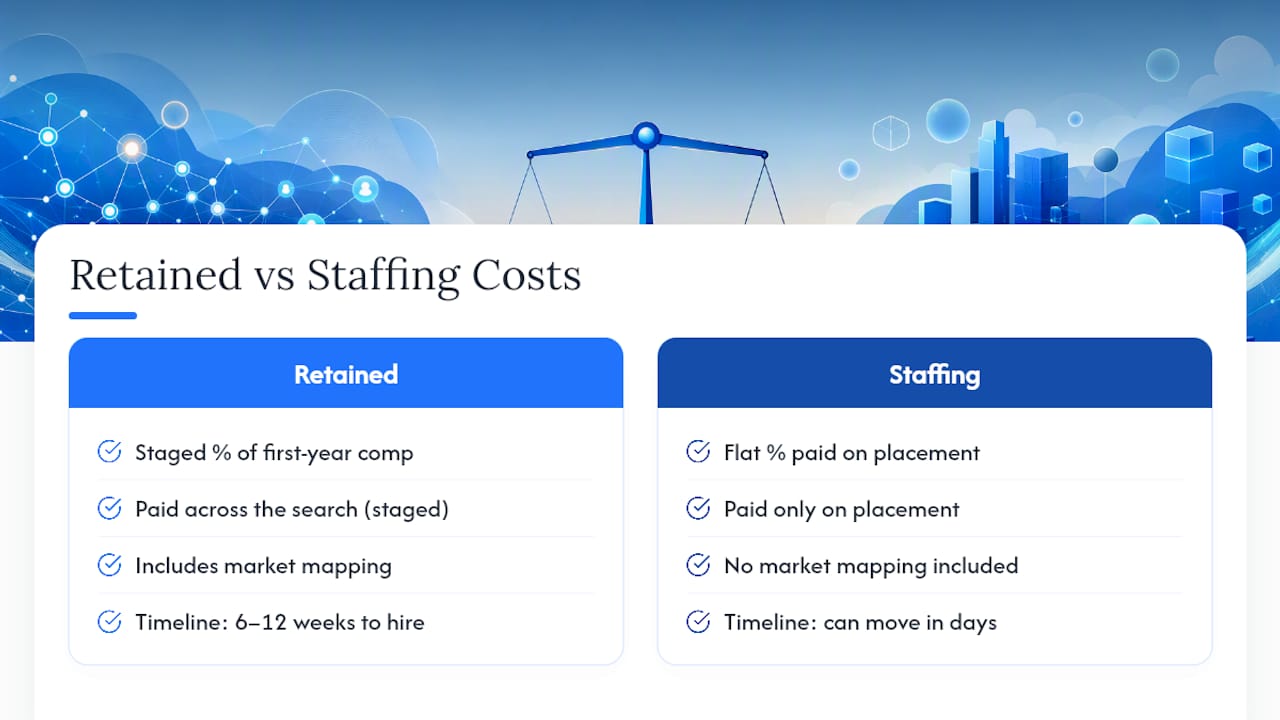
Retained search fees typically run as a staged percentage of the hire’s first-year compensation, paid across the search rather than all at the end. Contingency and staffing fees are usually a flat percentage paid only on placement, often lower per hire but with none of the market mapping baked in.
Timeline expectations differ just as much. A senior sales leadership search usually runs six to twelve weeks from kickoff to signed offer when it’s done right, because you’re courting passive talent who need convincing. Staffing placements for mid-level roles can move in days when the market’s active.
Statistic Callout: Industry benchmarking referenced by KORE1 shows executive hires cost materially more per hire than non-executive roles, and a failed executive hire carries an outsized organizational cost far beyond the recruiting fee itself. Lost quota, a demoralized sales floor, and a burned six months of pipeline don’t show up on the invoice, but they show up on the P&L.
Guarantees differ too. Many retained firms offer a replacement window if the hire leaves within an agreed period. Staffing guarantees, when they exist at all, are usually shorter and thinner.
How Do You Choose Between Executive Search and Staffing?
Run three quick questions before you sign anything with any firm.
- Define the seat. Is this role visible to the board, the market, or your competitors? If yes, retained.
- Count the market. How many qualified people could realistically do this job? If it’s a short list, retained. If it’s long, staffing.
- Check confidentiality. Does this hire need to stay quiet until it’s done? If yes, only retained search protects that.
Budget and timeline pressure will tempt you to cut corners. Don’t. If you’re told a senior search can move in two weeks for a bargain fee, ask what got skipped. Usually it’s the reference checks, the comp benchmarking, or the passive outreach that makes retained search worth the price in the first place.
Before you sign with any firm, demand four things: a documented market map, a clear shortlist format, written assessment notes on every finalist, and defined replacement terms if the hire doesn’t work out.
Pro Tip: Ask any firm pitching you a “guaranteed two-week executive search” how many passive candidates they actually contacted. If the answer is vague, they were working their existing database, not the market.
Watch for red flags: a recruiter racing to submit resumes before you’ve even finished the intake call, zero sector experience in SaaS or software sales, or resistance to putting their process in writing. Those are the firms you fire before the first shortlist even lands.
Legal and Compliance Considerations for Each Hiring Model
Retained search and staffing carry different exposure, and most HR leaders don’t think about it until something goes wrong.
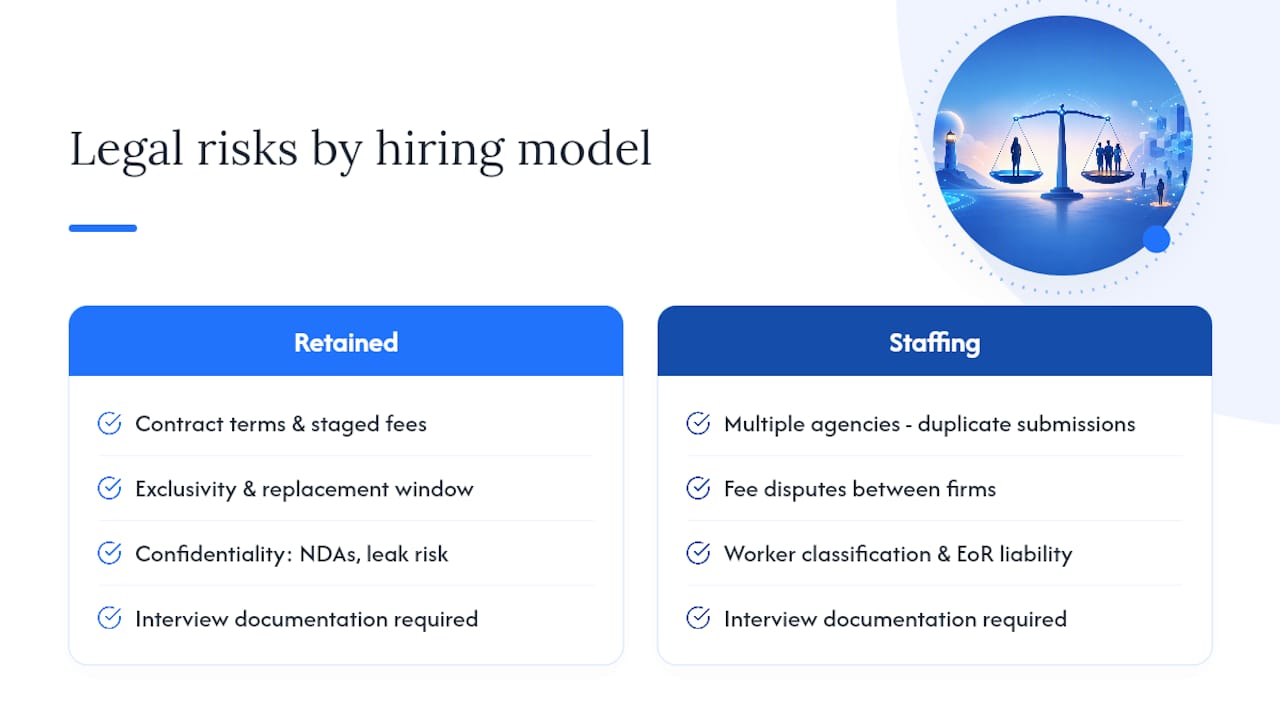
With retained search, your biggest risk is usually contractual. Staged fees mean you’re committed to a firm before you’ve seen a single candidate, so the search agreement needs clear scope, exclusivity terms, and a defined replacement window. If you’re replacing a sitting executive confidentially, you also need airtight NDAs on the search firm’s side, because a leak before you’re ready to announce a change can tank morale and trigger unwanted attrition.
Staffing and contingency carry a different set of risks. Because multiple agencies often work the same role, you can end up with duplicate submissions of the same candidate from two different firms, which creates fee disputes. Worker classification matters too if you’re bringing on contract or interim talent through a staffing firm rather than a direct hire. Get clear, in writing, on who’s the employer of record and who carries liability for that person’s work.
Both models require consistent, documented interview and evaluation practices to avoid discrimination exposure. The difference is scale: one bad process affects one senior hire and possibly a board relationship, the other affects a pipeline of hires and your consistency defense if a pattern gets challenged. Neither model removes your obligation to document why you passed on a candidate.
How Each Model Affects Candidate Experience and Your Employer Brand
A confidential retained search protects your brand in ways staffing simply can’t. When Cornerstone runs a search quietly, the market never sees the churn. Competitors don’t know you’re replacing a VP Sales. Your own sales team doesn’t spend three months speculating about who’s getting shown the door.
Contingency and staffing searches are more exposed by nature. Job postings go up, multiple recruiters may reach out to the same passive candidate on behalf of different clients, and that candidate now has a data point on how many agencies are working your account. That’s not necessarily bad. For volume hiring, an open, visible process is often the right move because you want the market to know you’re growing. But it’s the wrong move for a sensitive leadership swap.
Candidate experience differs sharply too. In a retained search, a strong candidate typically gets a real conversation, context on the company, and a defined process from a recruiter who’s spent weeks getting to know the role deeply. In a contingency race, the same candidate might get five outreach messages from five agencies about the same job in one week, all vague, all generic, all pushing for a quick resume submission before someone else beats them to it. That candidate remembers which experience felt respectful. So does everyone they talk to afterward, and in SaaS sales circles, everyone talks.
Real Scenarios: Which Model Actually Wins
Scenario one: replacing a CRO who’s underwater on the board’s confidence. The board wants a change but hasn’t told the executive yet. This is retained search only. You need discretion, deep reference work on finalists, and a firm that won’t tip off the market before you’re ready. A contingency race here would leak within a week.
Scenario two: scaling an SDR team from eight to twenty-five in a quarter. This is staffing’s home turf. The market for junior sales talent is thick, speed matters more than deep vetting on any single hire, and you need volume more than precision.
Scenario three: a Series B startup hiring its first VP Sales. This looks like a mid-level hire on paper but functions like an executive one. The person sets the entire go-to-market motion. Retained search wins here because the cost of a wrong pick isn’t a bad quarter, it’s a wasted year and a reset on your whole sales strategy.
Scenario four: a temporary sales ops lead to cover a maternity leave. Six-month term, defined scope, no confidentiality issue. Staffing wins on flexibility and speed, and retained search would be overkill.
The pattern across all four: seat visibility and market scarcity decide the model, not the org chart level alone.
How Market Conditions Change the Executive Search vs Staffing Decision
A tight labor market for sales leadership pushes more companies toward retained search, because the good candidates aren’t applying anywhere. They’re employed, hitting quota, and not scrolling job boards. Reaching them takes a firm built to court passive talent, not one waiting on inbound applications.
A loose market flips that math. When layoffs hit the SaaS sector and strong AEs and sales managers flood the market, contingency and staffing models get faster and cheaper because the supply side does the work for you. You can post a role and get twenty qualified applicants in a week.
Funding conditions matter too. A well-funded company facing board pressure to fix a broken sales motion usually can’t afford the eight-week timeline of a slow contingency race. They need the diagnostic value retained search provides: a market map that explains why the last VP Sales failed, alongside the hire itself. A cash-conscious company scaling headcount fast, on the other hand, often can’t justify staged retained fees for every mid-level seat and correctly leans on staffing for volume.
The mistake we see most: companies keep using whatever model they used last time, regardless of what the market or the seat actually calls for. Market conditions shift every few quarters. Your hiring model should shift with them.
Rich Rosen: Blunt Takeaways From Real Searches
I’ve watched companies burn six figures on a contingency race for a VP Sales seat because it looked cheaper upfront. It wasn’t. They got three resumes from active job seekers, hired the fastest option, and fired that person eight months later after missing two quarters of number. That’s the real cost nobody puts in the fee comparison.
Retained search isn’t slower because the recruiter is lazy. It’s slower because you’re courting someone who isn’t looking, which takes real work: research, warm intros, patience. That patience pays off in ramp time, retention, and quota attainment eighteen months down the road.
At Cornerstone, our average time from search kickoff to signed offer runs about 21 days for SaaS sales leadership roles. That’s not because we cut corners. It’s because we’ve placed over 1,200 sales professionals since 1996 and we know exactly where the good ones are hiding.
— Rich Rosen
Cornerstone Search: How We Run a Retained Search for SaaS Sales Leadership
Cornerstone Search is the alternative to a slow, generic search process for SaaS sales leadership hiring: we’ve placed over 1,200 sales professionals since 1996, and our average time from search kickoff to offer acceptance is just 21 days. That’s not a staffing race to submit resumes. It’s a focused, retained engagement built for one seat at a time.

Here’s what you actually get. We build a real market map of who’s out there, including passive candidates who aren’t job hunting. We run direct outreach into your competitors’ sales orgs, not a job posting and a prayer. Every finalist comes with assessment notes on sales judgment, not just a resume. And we stay involved through offer negotiation, because losing your top pick over a comp misstep in week eight is a preventable failure.
If you’re hiring a VP Sales, CRO, or building out an executive sales team at a SaaS company, start with our executive search recruitment page to see how a retained engagement works, or check out our software sales recruitment services to talk through your specific seat today.