

If your reps are hitting quota, your founder is still closing half the deals, and pipeline is growing without a playbook, hire now. Get a search moving inside 48 hours. If you’re missing two of those three signals, fix your motion first. Chasing a fractional VP Sales arrangement to stall the decision usually just delays the real hire you need.
TL;DR:
- Hiring a full-time VP of Sales is urgent when a founder spends over half their week on sales calls or when pipeline tracking exceeds one person’s capacity.
- The ideal timing depends on ARR milestones, with the most crucial period between $1M and $3M ARR, especially for enterprise motions requiring immediate leadership.
- Candidates should demonstrate a proven bench and current AI expertise, and founders must verify their ability to build repeatable motion within 90 days.
- Avoid hiring a Scaler prematurely, as it costs more than salary and can stall growth before the company has a validated sales process.
- Transition from interim to full-time leadership should occur at first signs of escalating efforts or missed milestones, using interim results to accelerate onboarding.
Table of Contents
- What “Fractional VP Sales” Really Means (And Why You Might Not Want One)
- The Signals That Say “Hire Now, Not Later”
- Match the Archetype to Your Stage, or Watch It Blow Up
- The Screening Process That Weeds Out Seat-Warmers
- Pay, Ramp, and What “Good” Looks Like at 90, 180, and 365 Days
- The First 90 Days: What the Founder Must Let Go Of
- Weighing a Fractional Arrangement Against the Real Hire
- Bringing a Part-Time Leader Into a Team Built for a Full-Time One
- What Interim Sales Leadership Typically Costs
- Making the Switch From Part-Time Help to a Full-Time Leader
- What Good Engagements Actually Look Like
- How Cornerstone Gets You a Permanent VP Sales Fast
- Three Blunt Rules for Hiring a VP Sales
- Sources
What “Fractional VP Sales” Really Means (And Why You Might Not Want One)
Let’s clear something up. A lot of founders hear “fractional VP Sales” and think it’s a cheap trial run before the real hire. It isn’t, and that’s not what we’re covering here. This article is about hiring a permanent, full-time VP of Sales or CRO, the person who owns the number, builds the team, and stays through the next three funding rounds.
Here’s the truth: most companies that dabble in part-time sales leadership end up hiring permanent anyway, six months later, after losing momentum they didn’t need to lose. A part-time exec can diagnose your pipeline. A part-time exec cannot build a bench, close your biggest deal in month two, or sit across from your board and own next quarter’s number. If you need someone who eats, sleeps, and bleeds your quota, you need a full-time hire. The rest of this piece shows you how to time it, screen for it, and not screw it up.
The Signals That Say “Hire Now, Not Later”
Forget your gut. Use operational triggers instead. Most SaaS companies hit the wall between $1M and $3M ARR, though the exact window depends on your motion. Product-led motions can wait longer. Enterprise motions with six-figure contracts need leadership sooner, because one bad quarter with a founder still running deals can sink the raise.
Here are the five signals that actually matter:
- The founder spends more than half their week on sales calls, not product or fundraising
- Two or three AEs are hitting quota without founder hand-holding
- You have a documented playbook, even a rough one, that a new hire could follow
- Pipeline volume has outgrown what one person can track in a spreadsheet
- Net revenue retention is stable, meaning you’re not just adding leaky buckets
Pro Tip: Before you hire, run a two-week experiment. Have your best AE try to close a deal with zero founder involvement. If that deal stalls, you don’t have a sales motion yet, you have a founder with a good pitch.
Hiring before these signals show up is the single biggest predictor of failure. One framework tracking first-time VP Sales hires found that a substantial majority fail within about 18 months, often because they were hired to build a motion that never existed, at a very high total cost including salary, severance, and lost quarters.
Match the Archetype to Your Stage, or Watch It Blow Up
There are three types of VP Sales. Hire the wrong one for your stage and you’ll pay for it in stalled growth, not just salary.
The Builder thrives with nothing. No playbook, no proven pitch, no repeatable deal size. They love the chaos of sub $1M ARR companies where they’re inventing the motion from scratch. Put a Builder into a company with 40 reps and a mature process and they’ll get bored and restless inside a year.
The Builder-Scaler hybrid is your sweet spot for most Series A and B companies between $1M and $8M ARR. They can tighten a rough playbook and start scaling the team that runs it. This is the archetype most SaaS companies actually need and most founders don’t know to ask for by name.
The Scaler wants an existing engine with fuel in the tank. Give them 15 reps already hitting quota and a documented process, and they’ll add rocket fuel. Give them a company still figuring out its ICP, and they’ll flail, because scaling nothing produces nothing.
- Builder: pre-seed to $1M ARR, no repeatable motion yet
- Builder-Scaler: $1M to $8M ARR, rough motion, needs tightening
- Scaler: $8M ARR+, proven motion, needs headcount and process
Hiring a Scaler too early is one of the most expensive mistakes a founder can make. It doesn’t just cost salary, it stalls product focus and burns months of runway chasing a growth curve that isn’t there yet, according to a framework on VP Sales hiring stages. Check their resume for tenure patterns. A candidate who’s jumped from Scaler role to Scaler role has probably never built a motion from zero, and that matters if that’s the job you’re hiring for.
The Screening Process That Weeds Out Seat-Warmers
Most founders screen VP Sales candidates like they’re hiring a mid-level manager. Wrong approach. This is a person who will burn six figures of your runway before you know if they’re any good. Screen like it.
Run this sequence:
- Phone screen (30 minutes): Ask them to walk you through the last sales org they built, headcount and quota attainment by quarter. Vague answers mean vague results.
- Deep interview (90 minutes): Ask them to name the two or three AEs they’d bring with them from their last role. If they can’t name anyone, that’s a real problem. Half the job of a VP Sales is recruiting, and a good one always has a bench ready, per SaaStr’s analysis of common VP hiring mistakes.
- AI and ops competence check: Ask how they’d design a sales team where AI handles top-of-funnel research and reps handle the close. If they stare blankly, they’re not current. Modern VP Sales candidates need battle-tested opinions on AI tools for prospecting, call analytics, and CRM hygiene, not theory.
- Reference checks: Call 5 to 8 references, not the two the candidate hand-picked. Score each reference conversation across five dimensions: recruiting ability, deal execution, coaching, forecasting accuracy, and cultural fit. Cornerstone built a full reference-check framework around exactly this.
Red flags: no bench of people who’d follow them, refuses to work deals personally in the first 90 days, titles that don’t match team size on LinkedIn.
Green flags: names three specific hires they’d bring, can sketch a human-plus-AI selling architecture on a whiteboard, asks you tough questions about your own pipeline math.
Pro Tip: If a candidate can’t name anyone who’d follow them to your company, that’s not a minor gap. That’s the whole job description failing the interview.
Pay, Ramp, and What “Good” Looks Like at 90, 180, and 365 Days
Compensation tells candidates what you actually expect. Get the shape wrong and you’ll either scare off real operators or overpay for someone who won’t perform.
Early-stage SaaS VP Sales roles typically run a 50/50 or 60/40 base-to-variable split, with OTE weighted heavily toward the number they own. If your OTE structure leans too far toward guaranteed base, you’ll attract managers who want safety, not hunters who want upside. Equity should reflect real ownership of the growth curve, not a token grant.
Ramp expectations should follow a clear quota-relief cadence:
- Month 1: 0% quota, full listening and diagnostic mode
- Month 2: 50% quota, first deals closing with founder support
- Month 3: 75% quota, independent pipeline building
- Month 4 onward: 100% quota, full ownership
Set measurable milestones, not vague hopes. At 90 days, expect a documented sales plan and one or two new hires identified. At 180 days, expect the first cohort of reps hitting ramped quota. At 365 days, expect a repeatable motion that survives without founder involvement. Onboarding structured this way is directly correlated with lower failure rates in first-time VP hires, because it forces clarity before it forces results.
The First 90 Days: What the Founder Must Let Go Of
The hire is only half the job. What you do in the first 90 days determines whether this works.
- Days 1 to 30, listening mode. The VP shadows calls, reviews the CRM, and interviews every rep. No org changes yet.
- Days 31 to 60, diagnostic and plan. The VP presents a written plan: what’s broken, what to keep, who to hire first. This is also when founder deal authority needs to transfer. Retained founder control past this point is a documented failure pattern, per research on VP Sales onboarding.
- Days 61 to 90, operationalization. First hires get made, usually a senior AE or a sales ops hire who can build reporting infrastructure fast.
Founder handoff checklist: hand over deal authority, introduce the VP to your top five customer relationships, let them own pricing exceptions, and give them a standing seat in every board prep meeting.
Pro Tip: If you’re still the one closing your biggest deal at day 100, you didn’t hire a VP of Sales. You hired an expensive assistant.
The VP’s first hire should almost always be a rep who can prove the playbook works at scale, not another leader. Momentum beats hierarchy in the first two quarters.
Weighing a Fractional Arrangement Against the Real Hire
Some founders still consider a part-time or interim sales leader before committing to a permanent one, and it’s worth being straight about the tradeoffs. A part-time arrangement can be useful for a narrow diagnostic: auditing a broken pipeline, building a first playbook draft, or covering a gap for a quarter while you search. It’s cheaper in the short term and lower commitment.
But the drawbacks stack up fast. A part-time leader splits attention across multiple clients, which means your company isn’t the only fire they’re putting out. They rarely build the kind of bench a full-time VP builds, because recruiting takes sustained relationship investment, not a few hours a week. Boards also tend to discount part-time leadership when they’re evaluating whether your go-to-market is durable enough to fund further.
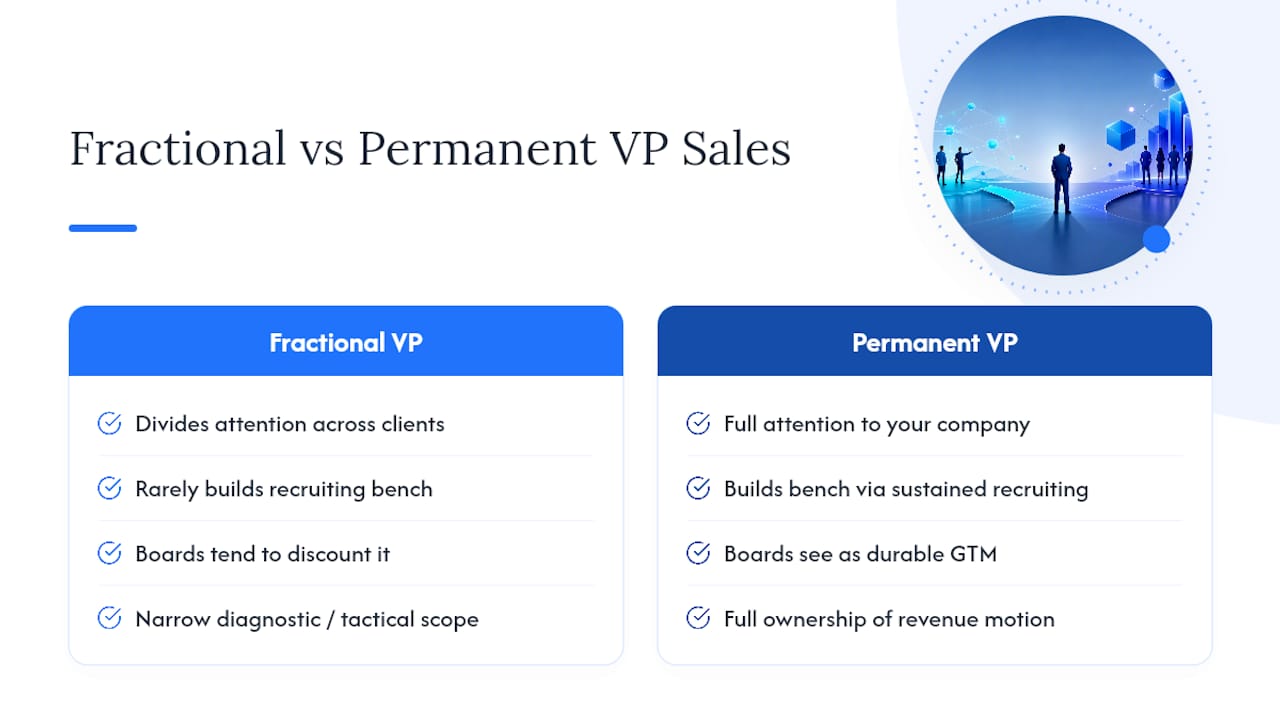
The honest read: use a part-time arrangement only as a bridge, never as a destination. If you’re using one today, set a hard date to convert to permanent, because the companies that stall in that in-between state usually lose six months they didn’t have to lose.
Bringing a Part-Time Leader Into a Team Built for a Full-Time One
If you’re running a part-time or interim sales leader alongside a team that’s expecting permanent leadership, integration friction is real. Reps don’t fully trust direction from someone they know is leaving in a few months. Deal reviews get treated as advisory rather than authoritative.
The fix is scope, not authority. Give the interim leader a narrow, defined mandate, fix the playbook, run one hiring cycle, diagnose the pipeline, rather than open-ended leadership of the whole function. Keep the founder visibly in the loop on strategic calls so the team knows who to trust for big decisions. And document everything the interim leader builds, because a poorly handed-off playbook is worse than no playbook, since it creates false confidence in a process nobody actually validated long-term.
What Interim Sales Leadership Typically Costs
Interim or part-time sales leadership is usually billed as a monthly retainer or day-rate arrangement, often running a fraction of a full-time VP’s total compensation package since there’s no equity, benefits, or severance risk. That’s the appeal.
But cheap isn’t the same as cost-effective. A part-time leader working ten hours a week for three clients isn’t giving your company the attention a $1M to $8M ARR sales motion actually needs to get unstuck. When you add up the cost of a diagnostic engagement that doesn’t convert into durable results, plus the delay before you start a real search, the “savings” often evaporate. Budget for interim help as a short, defined-scope engagement, not an open-ended alternative to the real hiring decision.
Making the Switch From Part-Time Help to a Full-Time Leader
The transition point is usually obvious before founders admit it. You’ll notice the interim leader keeps asking for more hours. Reps keep escalating decisions that should’ve been settled weeks ago. The board starts asking why there’s no permanent name on the sales org chart.
When you see two of those three, start the search immediately, don’t wait for the interim engagement to formally end. Overlap the search with the tail end of the part-time arrangement so you’re not left running the function solo for a month. Use everything the interim leader built, the playbook draft, the pipeline audit, as onboarding material for the permanent hire. It’ll cut weeks off the new VP’s ramp, since they’re not starting from a blank page.
What Good Engagements Actually Look Like
The engagements that work share a pattern: a narrow, well-defined problem, a hard end date, and a founder who stays engaged rather than checking out because they hired “help.” A company using interim leadership to fix a specific pipeline conversion problem, then converting to a permanent VP once the motion was validated, tends to preserve momentum. A company that treats interim leadership as a way to avoid making a real staffing decision tends to lose a quarter and end up back at square one, hiring under pressure instead of on their own timeline.
The lesson isn’t subtle. Part-time help works when it has a job to finish and a deadline to finish it by. It fails when it becomes a substitute for the decision you were avoiding all along.
How Cornerstone Gets You a Permanent VP Sales Fast
You don’t have months to figure this out. The company specializes in placing sales leaders at SaaS and software companies who actually perform, not just interview well. With extensive experience, they have built a process around speed without cutting corners.
They focus on minimizing the time from search kickoff to offer acceptance by leveraging deep knowledge of the SaaS talent pool. Candidates are vetted thoroughly through a rigorous reference-checking process scored across multiple dimensions and matched to the company’s stage and needs. That’s not a sales pitch, that’s the same compensation and screening framework we use on every search.
If your signals say hire now, don’t spend another quarter guessing. Start a conversation about software sales recruitment with Cornerstone this week and get a slate of vetted candidates before your competitors even finish writing the job description.
Three Blunt Rules for Hiring a VP Sales
Rule one: hire for motion match, not resume shine. A Scaler with a killer logo on their LinkedIn will fail in a company with no repeatable playbook, every single time.
Rule two: insist on a recruiting bench. If they can’t name two or three people who’d follow them, they’ve never built a real team, they’ve managed someone else’s.
Rule three: force the founder handoff by day 60. Founders who keep closing their own deals past that point aren’t protecting the business, they’re strangling their new hire’s authority before it starts.
I’ve watched two patterns kill good hires. One: a founder hires a Builder into a company that already has product-market fit, and the Builder gets bored rebuilding what already worked. Two: a founder skips references because the candidate “felt right” in the interview, then finds out three months later that felt right and performs well are different things entirely.
Here’s your sanity check: if you can’t answer why this specific person, for this specific stage, in one sentence, you’re not ready to make the offer.
— Rich Rosen