

A go-to-market executive search is a specialized retained recruiting process that identifies and places senior leaders with proven records of driving revenue through product launches, market expansion, and sales organization growth. Unlike general executive recruitment, this process targets a narrow talent pool: Chief Revenue Officers, Chief Marketing Officers, Chief Commercial Officers, and the revenue operations leaders who sit beneath them. Getting this hire wrong costs far more than a search fee. It costs market share, team morale, and months of lost momentum.
Cornerstonesearch has placed over 1,200 sales professionals since 1996, with an average time from search kickoff to offer acceptance of just 21 days. That speed and precision reflect what a well-run go-to-market hiring process actually demands.
What is a go-to-market executive search, and how does it work?
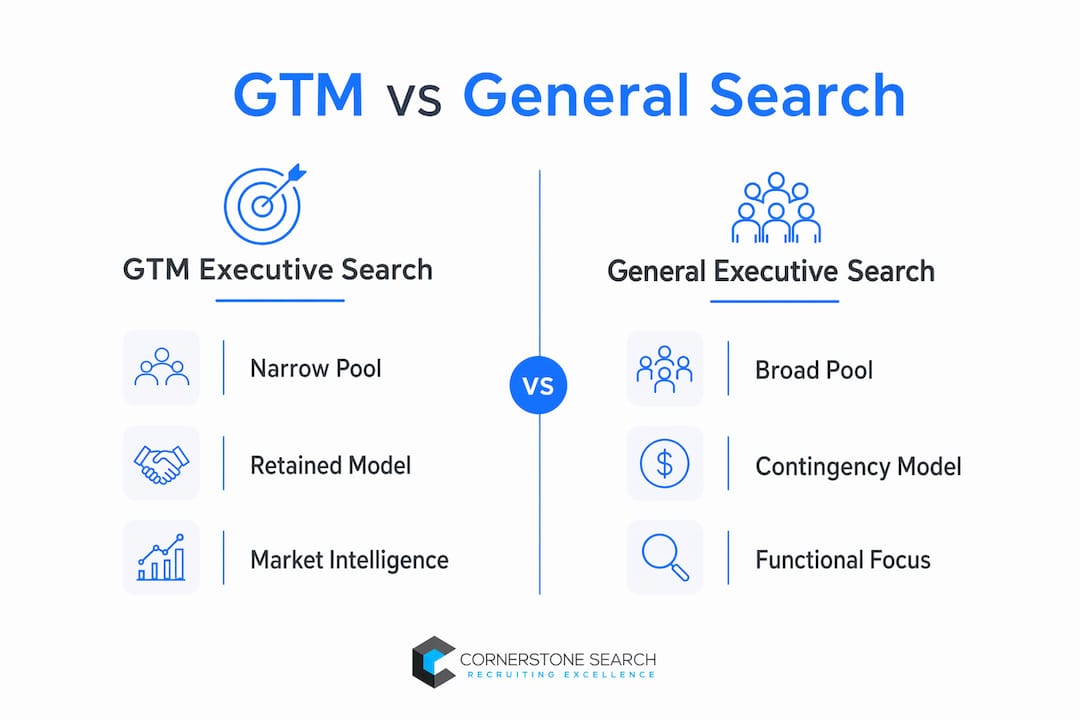
A go-to-market executive search follows a retained search model, meaning the client engages the firm exclusively before the search begins. This exclusivity matters. The retained model creates accountability that contingency recruiting cannot replicate. The firm commits its senior partners and best relationships to one client at a time.

The retained search process typically runs seven structured stages: intake and scoping, role definition and success profiling, market mapping, candidate sourcing and outreach, structured assessment, shortlist presentation, and offer management through onboarding. Each stage builds on the last. Skipping or rushing any stage compounds risk at the final placement.
Here is what each stage delivers in practice:
- Intake and scoping. The search firm meets with key stakeholders to understand the company’s growth stage, revenue targets, and leadership gaps.
- Role definition and success profiling. The firm builds a detailed profile of what success looks like in the first 90 and 180 days, not just a job description.
- Market mapping. Researchers identify the full universe of qualified candidates, including those currently employed and not looking.
- Candidate sourcing and outreach. The firm uses tools like LinkedIn Recruiter and ZoomInfo to identify passive candidates through organizational chart research and live market intelligence.
- Structured assessment. Candidates complete interviews and working sessions designed around real GTM challenges.
- Shortlist presentation. The client receives a curated slate of three to five candidates with detailed assessment summaries.
- Offer management and onboarding. The firm manages compensation negotiation and supports the first 90 days of integration.
Retained search fees run 25–35% of the placed candidate’s first-year total compensation, paid in three installments: one-third at engagement, one-third at shortlist delivery, and one-third at offer acceptance. That payment structure aligns the firm’s incentives with the client’s outcome at every stage.
The typical engagement timeline runs 90–150 days. That window allows for thorough candidate evaluation, reference verification, and compensation negotiation without cutting corners.
Pro Tip: Write the success profile before you write the job description. Defining what the hire must accomplish in the first six months forces alignment among your leadership team and gives the search firm a sharper brief to work from.
Which executive roles are critical in go-to-market leadership?
The top GTM roles share one defining trait: they own revenue outcomes, not just functional activities. Each role carries a distinct scope, and confusing them during a search leads to misaligned candidates.
The key roles in a complete go-to-market team structure include:
- Chief Revenue Officer (CRO). Owns the full revenue cycle from pipeline generation through customer retention. A strong CRO builds the systems, not just the team.
- Chief Commercial Officer (CCO). Focuses on commercial strategy, pricing, partnerships, and market positioning. Common in enterprise and international businesses.
- Chief Marketing Officer (CMO). Drives demand generation, brand positioning, and product marketing. In SaaS companies, the CMO often owns pipeline contribution targets alongside the CRO.
- VP of Revenue Operations (RevOps). Manages the data, technology, and process infrastructure that makes the sales and marketing engine run predictably.
- VP of Sales Enablement. Builds the training, content, and coaching programs that lift rep performance across the team.
- VP of Customer Success. Owns net revenue retention, expansion revenue, and churn prevention.
| Role | Primary Accountability | Key Metric |
|---|---|---|
| Chief Revenue Officer | Full revenue cycle ownership | ARR growth, net revenue retention |
| Chief Marketing Officer | Demand generation and brand | Pipeline contribution, CAC |
| Chief Commercial Officer | Commercial strategy and pricing | Deal size, market expansion |
| VP of Revenue Operations | Sales and marketing infrastructure | Forecast accuracy, tech stack ROI |
| VP of Customer Success | Post-sale revenue and retention | NRR, churn rate |
Each of these roles requires a different evaluation lens. A CRO search focuses on revenue system design and team scaling. A CMO search focuses on pipeline attribution and category creation. Treating them as interchangeable is the fastest way to make a costly hiring mistake.
How are go-to-market executives evaluated during the search process?
GTM executive evaluation goes well beyond behavioral interviewing. The assessment framework centers on a candidate’s ability to build revenue growth mechanics, not just manage people. That distinction separates high-performing GTM leaders from capable general managers.
Structured assessment for GTM roles typically covers four areas:
- Sales forecasting discipline. Can the candidate walk through a forecasting methodology they built and defend its accuracy over multiple quarters?
- Compensation plan design. Has the candidate designed incentive structures that drove the right behaviors without inflating cost of sales?
- Deal review and pipeline management. Can the candidate diagnose a stalled deal, coach a rep through it, and identify systemic patterns across the pipeline?
- Team coaching and development. Does the candidate have a documented approach to rep development, not just anecdotal success stories?
Working sessions are the most revealing part of the process. A candidate who can only talk about past wins but cannot work through a live scenario in real time is a red flag. The best GTM candidates bring repeatable, data-driven playbooks that they can articulate clearly and adapt to a new context.
Cultural and leadership style fit matters as much as functional capability. A CRO who thrives in a 500-person enterprise may struggle in a 30-person startup where they must carry a bag and build the process simultaneously. The search firm’s job is to surface that distinction before the offer stage.
Pro Tip: Ask every finalist candidate to walk you through a sales compensation plan they designed from scratch. The quality of that answer tells you more about their operational depth than any behavioral question.
What makes go-to-market executive search different from general executive search?
General executive search covers a wide range of leadership functions: finance, operations, legal, technology, and human resources. A go-to-market executive search is narrower and more commercially intense. The success of a GTM search depends more on disciplined process and market knowledge than on passive candidate volume.
| Dimension | GTM Executive Search | General Executive Search |
|---|---|---|
| Candidate pool | Narrow, revenue-focused leaders | Broad, cross-functional leaders |
| Primary evaluation focus | Revenue system design and scalability | General management and leadership |
| Market mapping depth | Deep, competitor and adjacent industry mapping | Broad functional mapping |
| Search firm specialization | Sales, marketing, and revenue leadership | Multi-functional or generalist |
| Engagement model | Exclusively retained | Retained or contingency |
GTM searches require market intelligence as the foundation of sourcing. The best candidates are rarely on the job market. They are running a sales organization at a competitor or scaling a marketing team at a company in an adjacent vertical. Reaching them requires organizational chart research, warm introductions through trusted networks, and a compelling outreach message that speaks directly to their career ambitions.
The retained model’s exclusivity means the search firm invests its senior partner relationships into one client engagement at a time. That investment shows up in the quality of the shortlist. Contingency firms spread their effort across multiple clients simultaneously, which dilutes focus on any single search.
Effective GTM executive searches treat sourcing as an intelligence exercise first and a placement exercise second. The firm must understand the competitive talent market before it can build a credible candidate slate.
Key Takeaways
A go-to-market executive search succeeds when it combines a clear success profile, disciplined retained methodology, and deep market intelligence to place revenue-driving leaders who can build scalable growth systems.
| Point | Details |
|---|---|
| Retained model drives accountability | Exclusive engagement aligns the search firm’s incentives with your placement outcome at every stage. |
| Success profile precedes job description | Defining 90-day and 180-day outcomes sharpens the brief and improves placement durability. |
| GTM assessment goes beyond interviews | Working sessions on forecasting, compensation design, and deal coaching reveal true operational depth. |
| Passive candidates dominate the best shortlists | The strongest GTM leaders are employed and not looking; reaching them requires market intelligence and warm outreach. |
| Role clarity prevents costly mismatches | CRO, CMO, and CCO searches require distinct evaluation criteria and should never be treated as interchangeable. |
Why the search brief is the most underrated part of GTM hiring
The most common failure in a retained GTM search is not a bad candidate. It is a bad brief. The intake stage is where most searches are won or lost, and most leadership teams underinvest in it.
I have seen companies spend weeks debating compensation bands and interview formats while never agreeing on what the hire actually needs to accomplish in year one. That ambiguity flows downstream into every stage of the search. The market mapping targets the wrong profile. The assessment criteria drift. The shortlist generates debate instead of decisions.
The companies that get GTM hiring right treat the search brief as a strategic document. They align the CEO, CFO, and board on the revenue targets the hire must hit, the team they will inherit, and the specific gaps the hire must close. That alignment does not happen automatically. It requires a search partner who pushes back, asks hard questions, and refuses to start sourcing until the brief is airtight.
The value of disciplined retained search is not just access to passive candidates. It is the structured process that forces organizational clarity before the first candidate conversation happens. That clarity is what makes the difference between a hire who transforms a revenue organization and one who exits after 18 months.
Onboarding is the other underrated variable. A great hire placed into a poorly structured first 90 days will underperform. The search firm’s job does not end at offer acceptance. The best firms stay engaged through the integration period to protect the placement and the client’s investment.
— Rich Rosen
How Cornerstonesearch supports go-to-market executive hiring
Cornerstonesearch specializes in placing senior sales and revenue leadership for SaaS and software companies, with a track record of over 1,200 placements since 1996. The firm runs an exclusively retained model, meaning every search gets dedicated senior partner attention from kickoff through onboarding.
For companies building or rebuilding a GTM leadership team, Cornerstonesearch’s sales recruitment resources offer a practical starting point for defining the roles and profiles you need. The firm’s software sales recruitment practice covers CRO, CMO, VP of Sales, and RevOps searches for companies at every growth stage. If you are ready to discuss a specific search, Cornerstonesearch’s senior partners are available for a direct consultation.
FAQ
What is a go-to-market executive search?
A go-to-market executive search is a retained recruiting process that identifies and places senior leaders who drive revenue through sales, marketing, and customer success functions. It targets passive, high-impact candidates who are rarely on the open job market.
How long does a GTM executive search take?
The typical retained GTM executive search runs 90–150 days from engagement to offer acceptance, allowing time for thorough market mapping, structured assessment, and compensation negotiation.
What does a retained executive search cost?
Retained executive search fees are typically 25–35% of the placed candidate’s first-year total compensation, paid in three installments tied to engagement, shortlist delivery, and offer acceptance.
What roles does a go-to-market executive search cover?
GTM executive searches cover Chief Revenue Officers, Chief Marketing Officers, Chief Commercial Officers, VP of Sales, VP of Revenue Operations, and VP of Customer Success, depending on the company’s growth stage and organizational structure.
How is GTM executive search different from contingency recruiting?
Retained GTM search firms work exclusively for one client per engagement and invest senior partner relationships into the search. Contingency recruiters work across multiple clients simultaneously and are paid only on placement, which reduces their focus and accountability on any single search.