

If you can point to a repeatable sales motion and you’re past $500K ARR, hire a player-coach now. If you can’t describe your last ten closed deals the same way twice, wait. The single best predictor of a good hire is a candidate who nails a live deal walkthrough and a forecast exercise, not one with a shiny logo on their resume. We have experience placing over a thousand sales leaders, working to minimize your time-to-offer.
TL;DR:
- Only hire a Head of Sales after confirming your sales process is repeatable with at least 10 to 15 consistent deals, and founders spend over 50% of their time selling.
- The ideal candidate at $500K to $3M ARR should be a player-coach who still closes deals and can document their sales process; larger roles require building or scaling teams.
- A rigorous, multi-stage interview process—including deal walkthroughs, forecast exercises, and deep reference checks—takes several weeks and is crucial for accurate assessment.
- Conduct thorough reference work, targeting 6 to 10 references beyond the curated list, and spend hours verifying patterns before making an offer.
- Proper onboarding follows a structured 90-day plan to evaluate diagnostics, plan, and execution, preventing early failures and turnover.
Table of Contents
- When To Hire A Head Of Sales: Measurable Readiness Signals
- Which Archetype Fits Your Stage: Player-Coach, Builder, Scaler
- Designing The Hiring Loop That Reveals Real Signal
- Interview Exercises That Separate Winners From Talkers
- Reference And Backchannel Checks: How To Do The Heavy Lifting
- Onboarding: A Non-Negotiable 90-Day Plan That Protects The Hire
- Compensation And Offer Structure: Practical OTE And Equity Guidance
- How Cornerstone Helps And When To Call A Specialist
- Legal And Compliance Considerations In The Hiring Process
- Key Skills And Competencies To Assess In Candidates Beyond Sales Experience
- Post-Hire Performance Evaluation Criteria And Feedback Loops
- How To Source Passive, Appropriate-Stage Candidates
- Aligning The Head Of Sales Role With Company Growth Strategy
- Common Pitfalls And Red Flags To Watch Out For
- Author Perspective: Blunt Dos And Don’ts From Real Searches
- Start A Search With Cornerstone
- Sources
- FAQ
When To Hire A Head Of Sales: Measurable Readiness Signals
Founders ask me this constantly: “Am I ready?” Wrong question. The right question is: “Can I describe how we win a deal, the same way, three times in a row?”
If yes, you have a repeatable motion. If no, you don’t have a sales problem. You have a product-market fit problem wearing a sales costume, and no Head of Sales hire will fix that.
Here’s the ugly truth nobody tells you upfront: about 70% of first Head of Sales and VP Sales hires fail within their first 12 months, largely because founders hire for scale before they’ve earned it. You’re paying someone six figures to guess.
Run this checklist before you post the job or call a recruiter:
- You’ve closed at least 10 to 15 deals with a consistent story: same buyer persona, similar objections, similar close pattern.
- You (the founder) are spending more than 50% of your week selling and it’s starting to choke product work.
- You have at least one full sales cycle of data on conversion rates by stage.
- You can name your ideal customer profile without hedging.
Miss two of those and you’re not ready. Wait.
Which Archetype Fits Your Stage: Player-Coach, Builder, Scaler
Stage mismatch kills more Head of Sales hires than bad references ever will. Hire a big-company executive at $2M ARR and you’ve hired someone who expects a CRM that already works, a marketing team that already feeds pipeline, and a comp plan someone else designed. They’ll flounder.
Three archetypes, three ARR bands:
- Player-Coach ($500K to $3M ARR): Still closing deals personally while building the first playbook. Deliverable: a documented sales process and the first one or two AE hires.
- Builder ($3M to $15M ARR): Not closing much anymore. Deliverable: a real team, a forecasting cadence, and a comp structure that scales past five reps.
- Scaler ($15M+ ARR): Runs a multi-segment org. Deliverable: regional leaders, a mature pipeline math, and board-level forecasting accuracy.
To validate fit in the interview, ask what team size they last managed and at what ARR. The best signal isn’t title. It’s whether they scaled through the exact revenue band you’re in right now, not two bands ahead.
Designing The Hiring Loop That Reveals Real Signal
Most hiring loops are theater. Ten interviews, zero real signal, and a decision based on who told the best story over lunch. Don’t do that.
A rigorous evaluation should take roughly a few months (https://startupfundraising.com/library/articles/the-founders-guide-to-working-with-a-head-of-sales/) and run through these stages:
- Recruiter screen (30 minutes). Filter on stage fit, comp expectations, and basic sales judgment.
- Founder deep dive (60 minutes). You test for chemistry and vision alignment, not skills.
- Deal walkthrough (60 minutes). The real test. More on this below.
- Hiring exercise (45 minutes). Have them evaluate a mock AE candidate.
- Forecast exercise (45 minutes). Give them a messy pipeline and see what they do with it.
- Team panel (45 minutes). Let your existing team poke holes.
- Deep references (5 to 8 hours across multiple calls). Never skip this. Ever.
- Founder close. You sell them as hard as they sold you.
Pro Tip: Speed is good. Skipping steps to get speed is how you end up firing someone in month four. Compress timelines between stages, never the stages themselves.
Interview Exercises That Separate Winners From Talkers
Anyone can talk a good game about “building pipeline” and “driving revenue.” Words are free. Exercises cost something, and that’s exactly why they work.
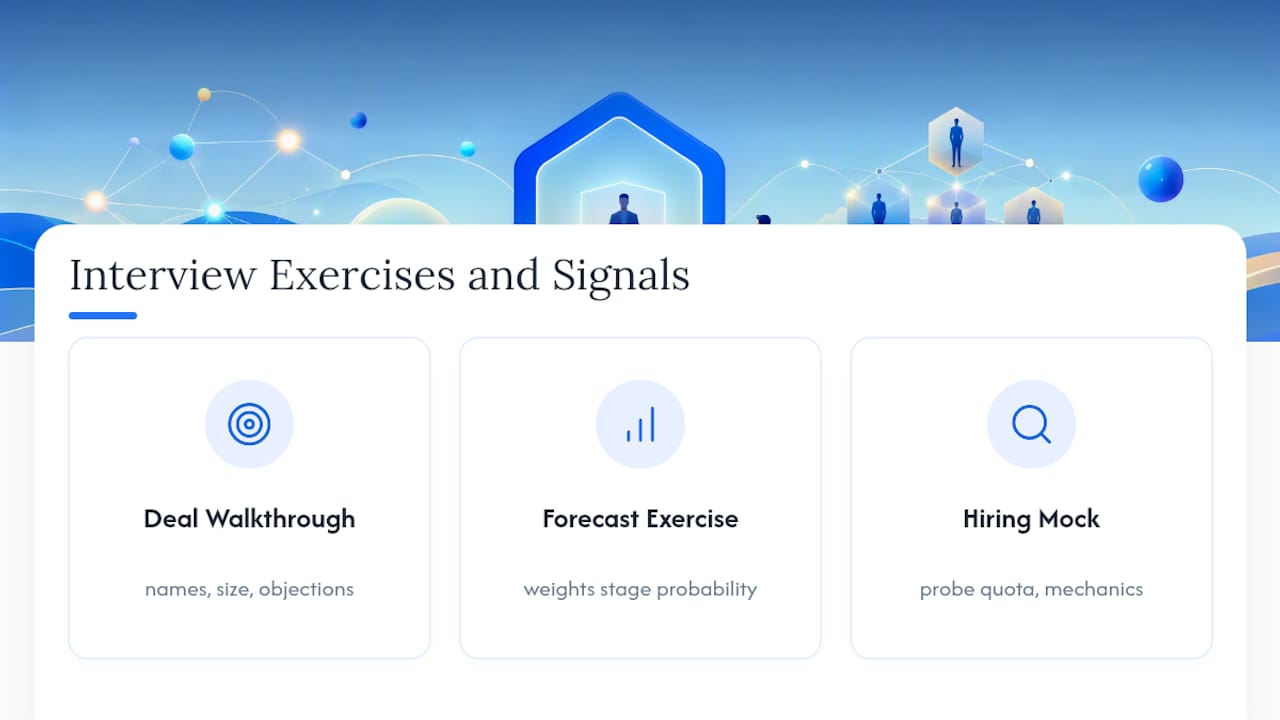
Deal walkthrough: Ask for their last three closed deals. Require specifics: deal size, buyer committee, objections raised, and exactly what they personally did to move it forward. If they can’t name the person who almost killed the deal, they probably didn’t own the win.
Forecast exercise: Hand them a messy, real pipeline (anonymized) and ask them to build a forecast in front of you. Watch for how they weight stage probability, not just whether they land near your internal number.
Hiring mock: Have them evaluate a fake AE resume and run a mock interview. Score them on whether they dig past buzzwords into actual quota attainment and deal mechanics.
One point worth repeating: hiring processes built around these operational exercises consistently beat processes built on resume pedigree and interview chemistry. Charisma gets you a second date. It doesn’t get you a repeatable sales motion.
Reference And Backchannel Checks: How To Do The Heavy Lifting
Curated references are a joke. Every candidate hands you three people who love them. That’s not due diligence, that’s a favor exchange.
Real reference work means going around the list they gave you:
- Target 6 to 10 references total: former direct reports, peers, an investor or two, and if possible a customer.
- Spend 30 to 45 minutes per call, scripted, specific: “Walk me through a deal they personally saved.”
- Backchannel to people not on their list. LinkedIn makes this easy. Former colleagues talk.
- When references conflict, look for the pattern across three or more calls, not the loudest opinion.
Budget several hours(https://underscore.vc/resources/head-of-sales/) of real reference work for this hire. That’s not optional homework. That’s the job.
Onboarding: A Non-Negotiable 90-Day Plan That Protects The Hire
Here’s where founders blow up a good hire after doing everything right up to the offer. They throw a new Head of Sales straight into quota with zero ramp and wonder why they’re gone by month five.
A proven structure runs in three clean 30-day phases:
- Days 1 to 30: Listen. No quota. They sit on calls, read every closed-won and closed-lost deal, and talk to every rep. Zero rollout yet.
- Days 31 to 60: Diagnose. By Day 30 they deliver a written diagnostic. By Day 65 they present a readiness plan to you and, if relevant, your board.
- Days 61 to 90: Execute. They roll out changes, make their first hire, and start ramping toward real quota.
Pro Tip: Set quota ramp expectations before Day 1, in writing. Anything faster is a setup for failure.
Compensation And Offer Structure: Practical OTE And Equity Guidance
Underpay this hire and you get someone mediocre who took the job because nobody better called. Overpay without structure and you get resentment when the ramp gets bumpy.
- OTE splits typically run 50/50 base to variable for early-stage hires, tilting more toward base as the role becomes more strategic and less about personal closing.
- Equity for early Head of Sales hires often falls between 0.5% and 1.5%, scaled by stage and how much of the sales motion they’re expected to build from scratch.
- Ramped quota in the first two quarters, not full quota on day one, keeps the comp plan honest.
- Accelerators past 100% attainment and a signing bonus tied to the 90-day diagnostic milestone both work better than pure cash bumps.
Role clarity matters as much as the number. Write down what “player-coach” actually means for your company before you negotiate.
How Cornerstone Helps And When To Call A Specialist
You can run this process yourself. Plenty of founders do, and some do it well. But if you’ve never screened a VP Sales candidate before, you don’t know what a good deal walkthrough sounds like versus a rehearsed one.
That’s the gap Cornerstone fills. We’ve placed over 1,200 sales professionals since 1996, and our searches average 21 days from kickoff to offer acceptance. We specialize in SaaS and software, which means we already know what a Builder looks like at $8M ARR versus a Scaler at $30M.
Bring in a specialist when the cost of a bad hire (usually six figures in comp plus a year of stalled pipeline) outweighs the fee, especially when leveraging SaaS SEO for sustainable growth. During a search, expect us to run structured screens, own the deal walkthrough process, and hand you a shortlist that’s already been through real vetting, not a resume dump.
Legal And Compliance Considerations In The Hiring Process
Sales leadership hiring carries legal exposure that a lot of founders don’t think about until it bites them.
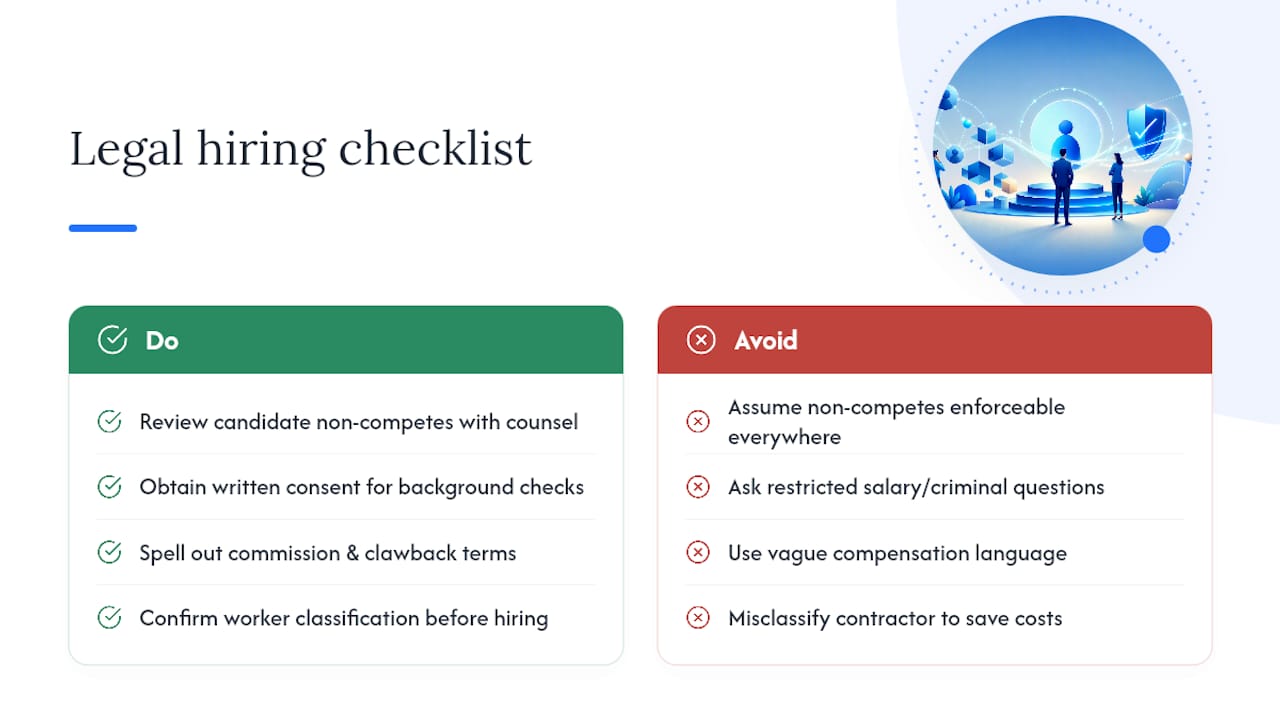
Non-compete and non-solicitation clauses are the first landmine. If your candidate is coming from a competitor, get employment counsel to review their existing agreement before you make an offer. A candidate who signed a broad non-solicit at their last company can be legally barred from touching certain accounts or even certain employees for a year or more, depending on the state. Enforceability varies widely by jurisdiction, so don’t assume what worked in one state applies in another.
Background and reference checks have limits too. Some states restrict what you can ask about salary history or criminal background, and the Fair Credit Reporting Act governs how you use third-party background reports if you order one. Get candidate consent in writing before you run anything formal.
Offer letters for sales leadership roles need precision on commission structure, clawback terms, and what happens to unvested equity or unpaid commissions if the relationship ends. Vague comp language is the single most common source of post-termination disputes I’ve seen in 30 years of doing this. Spell out the draw period, the ramp quota, and the exact formula for calculating variable pay, in writing, before day one.
Classification matters too if you’re bringing someone on as a contractor or fractional leader before converting to full-time. Misclassifying a sales executive can trigger back taxes and penalties. None of this replaces actual legal counsel, but knowing these landmines exist before you write an offer letter saves you a very expensive mistake.
Key Skills And Competencies To Assess In Candidates Beyond Sales Experience
A candidate who hit quota at their last three jobs might still be the wrong hire. Quota attainment tells you they can sell. It doesn’t tell you they can lead, think strategically, or fit your culture without wrecking it.
Leadership shows up in how they talk about their team’s failures, not their wins. Ask them to describe a rep they had to let go and listen for whether they take ownership of the miss or blame the rep entirely. The good ones own their part of it.
Strategic thinking gets tested in the forecast exercise mentioned earlier, but push further: ask how they’d change your go-to-market motion if your ideal customer profile shifted mid-year. Weak candidates give you tactics. Strong ones give you a framework for deciding.
Cultural fit is the most abused phrase in hiring, usually code for “people who remind me of me.” Test it differently: ask how they’ve operated inside a company with a founder still deeply involved in sales calls. A Builder or Scaler who’s only worked inside mature, hands-off leadership structures may struggle with a founder who wants weekly deal reviews.
One more thing worth testing directly in 2026: whether they understand how AI fits into a modern sales org, where agents handle volume prospecting and reps handle complex negotiation. A candidate who can’t articulate that split is behind, not ahead, no matter how good their resume looks. Our guide to SaaS sales executive traits covers more of these behavioral markers in depth.
Post-Hire Performance Evaluation Criteria And Feedback Loops
The hire doesn’t end at the signed offer letter.
Set evaluation checkpoints tied to the 30/60/90 plan, not just quota. At Day 30, evaluate the quality of their diagnostic, not revenue. At Day 65, evaluate whether their readiness plan actually reflects what they learned, not a generic playbook copied from their last job. At Day 90, evaluate execution against the specific plan they proposed, since that’s the fairest yardstick you have.
Beyond the 90-day mark, build a recurring feedback loop. Monthly one-on-ones between you and the Head of Sales should cover pipeline health, team retention, and forecast accuracy against actuals, not just whether the number got hit. A leader who hits quota by burning through reps every six months isn’t succeeding. They’re borrowing against next year.
Ask for a written forecast each month and track their accuracy over time. Forecasting precision, more than almost any other metric, tells you whether this person actually understands your business or is guessing with confidence. Give direct, specific feedback when the forecast misses badly, and expect the same candor back about your product, your comp plan, or your board’s unrealistic targets. If the relationship can’t handle that kind of two-way feedback, you’ve got a bigger problem than a sales hire.
How To Source Passive, Appropriate-Stage Candidates
Here’s a hard truth: the best Head of Sales candidates are not applying to your job posting. They’re employed, doing well, and not checking job boards on their lunch break.
The best hires come from investor networks, founder outreach, and passive search, not inbound applications. Your board and investors have almost certainly watched a sales leader operate at a portfolio company two stages ahead of yours. Ask them directly: “Who’s the best sales leader you’ve seen at our next stage of ARR?”
Founder-to-founder outreach works better than you’d expect. A short, honest message from one founder to another, describing your traction and the specific gap you’re filling, gets read. A recruiter cold email sometimes doesn’t.
Your own network matters more than you think, too. Former colleagues, board members’ portfolio companies, and even competitors’ second-in-command sales leaders are all fair game. The goal is finding someone who scaled through your exact revenue band recently, not someone who did it once a decade ago at a company nothing like yours.
This is also where a realistic timeline matters. A thorough search often runs 6 to 12 weeks when done through proper channels. Speed is good. Skipping the deal walkthrough or reference stage to save two weeks is how you end up rehiring for the same seat next year.
Aligning The Head Of Sales Role With Company Growth Strategy
A Head of Sales hire that isn’t tied to your actual growth plan is just an expensive org chart decoration. Before you write the job description, answer one question: what does this person need to be true about your revenue in 18 months?
If the answer is “double ARR through the same motion,” you need a Builder who can scale process without breaking it. If the answer is “expand into a new segment or geography,” you need someone who’s actually done that expansion before, not someone who’s only run a single-segment motion.
Write your sales goals into the job description in numbers, not adjectives. “Aggressive growth” tells a candidate nothing. “$3M to $9M ARR in 18 months, primarily through outbound to mid-market” tells them exactly what they’re signing up for and lets them self-select honestly.
This alignment also protects you during the interview loop. When you run the forecast exercise, you’re not just testing forecasting skill in the abstract. You’re testing whether their approach matches the specific growth motion your board expects. A candidate who’s brilliant at land-and-expand but you need pure new-logo hunting is a mismatch no matter how sharp they are.
Revisit this alignment every two quarters, not just at hire time. Growth strategy shifts, and if your Head of Sales is still executing last year’s plan while your board wants a different one, that’s a conversation to have directly, early, before it becomes a resignation letter or a termination.
Common Pitfalls And Red Flags To Watch Out For
I’ve seen the same five mistakes wreck searches for 30 years. They’re avoidable, and they keep happening anyway.
Hiring for pedigree over stage fit. A VP from a company with a household name means nothing if they’ve only ever operated inside mature systems someone else built. They won’t know how to build one from zero.
Skipping the deal walkthrough because the interview “felt great.” Charisma and competence are different skills. A candidate who’s smooth in conversation but vague on deal specifics is a walking red flag.
Accepting curated references without backchanneling. If every reference sounds like a press release, you haven’t done reference work. You’ve done a courtesy call.
Rushing quota on day one. Founders who skip the listening phase because they’re desperate for revenue almost always regret it by month four.
Vague comp language. Ambiguous commission terms or unclear clawback rules create disputes that cost more in legal fees and lost trust than the extra hour it takes to write the offer letter properly.
Watch for candidates who can’t name a specific mistake they made in their last role, too. Everyone has one. If they don’t, they’re not being honest with you, and that’s the worst possible trait in someone about to run your forecast.
Author Perspective: Blunt Dos And Don’ts From Real Searches
Three mistakes I see constantly: skipping the deal walkthrough because the interview felt good, rushing quota before Day 30, and trusting curated references. Fix each one before you write an offer.
Before you sign anything, run this: stage fit confirmed, deal walkthrough scored, references backchanneled, comp terms in writing.
Good hires aren’t lucky. They’re the result of a process that doesn’t skip steps when things feel urgent.
— Rich Rosen
Start A Search With Cornerstone
We offer specialized SaaS sales leadership recruiting designed to reduce your search timeline.
To start, tell us your ARR, your growth motion, and which archetype fits (player-coach, builder, or scaler). We take it from there: recruiter screen, deal walkthroughs, forecast exercises, and full reference work, all before a candidate ever reaches your desk. Read our sales recruitment guide for a fuller picture of how a search runs, then visit our software sales recruitment page to start a conversation about your specific stage and timeline.
Sources
For deeper reading on the frameworks referenced above, see SaaStr’s rules for VP Sales hiring, the Founder’s Guide to Working With a Head of Sales, and Cornerstone’s own SaaS sales interview questions list for building your own scorecards.
- The 10 Rules For Hiring a VP of Sales in the Age of AI | SaaStrAI
- Hiring Your First VP of Sales 2026: When, Who, How Framework
- How to Evaluate a Sales Leadership Candidate | Axe Recruiting
FAQ
When should a startup hire its first Head of Sales?
Hire once you have a repeatable sales motion, roughly $500K or more in ARR, and the founder is spending over half their week selling instead of building product.
What’s the difference between a player-coach and a builder?
A player-coach still closes deals personally and fits $500K to $3M ARR companies, while a builder has stepped back from closing to build a full team and process, fitting $3M to $15M ARR.
How long should a Head of Sales search take?
A thorough process, including deal walkthroughs and deep references, typically runs 6 to 12 weeks, though Cornerstone’s searches average 21 days from kickoff to offer.
How much equity should a first Head of Sales get?
Equity for early Head of Sales hires often ranges from 0.5% to 1.5%, depending on stage and how much of the sales motion they’re expected to build.
Why do most Head of Sales hires fail?
About 70% fail within their first year, usually because founders hire for a scale they haven’t earned yet or skip deal walkthroughs and real reference checks during the interview process.