

The role of headhunters versus in-house recruiting is defined by one core distinction: headhunters proactively target passive candidates who are not looking for jobs, while in-house recruiters manage active applicants and internal hiring processes. This difference shapes everything from cost and time-to-fill to the quality of candidates you can realistically access. For HR leaders and business executives, choosing the wrong model for the wrong role is one of the most expensive mistakes in talent acquisition. Understanding when each approach delivers results, and how to combine them, is the strategic edge most organizations still lack.
How do headhunters operate and when are they most effective?
Headhunters, also called executive search consultants, are external specialists who identify and approach candidates who are currently employed and performing well. They do not post job ads and wait. They research target companies, map organizational structures, and build a shortlist of qualified individuals before making a single call. This process typically requires 20+ days of groundwork before outreach even begins. That upfront investment is what separates a headhunter from a standard recruiter.
The passive talent market is the defining advantage here. Only 15%–20% of senior talent is actively searching at any given time. The remaining 80% is reachable only through direct outreach. If your in-house team is posting to LinkedIn and waiting for applications, you are competing for a fraction of the available talent pool. For senior sales leadership, VP-level roles, or confidential replacements, that limitation is disqualifying.
Headhunters add the most value in four specific scenarios:
- Senior or executive hires where the best candidates are not browsing job boards
- Confidential searches where advertising the role would signal internal instability
- Niche technical roles requiring deep market knowledge to identify qualified candidates
- Time-critical placements where speed to shortlist matters more than per-hire cost
The cost structure for headhunters typically runs 20%–30% of the placed candidate’s first-year compensation. That fee is high in absolute terms. For a $200,000 VP of Sales, you are looking at $40,000–$60,000. But compare that to a six-month vacancy in a revenue-generating role, and the math often favors the external search. Executive search firms justify their fees by accessing talent your internal team cannot reach.
Pro Tip: Before engaging a headhunter, define the three non-negotiable criteria for the role. Headhunters work best when the brief is tight. Vague requirements produce vague shortlists.
What defines in-house recruiting and its advantages?
In-house recruiters are company employees who manage the full hiring cycle from job posting through offer acceptance. Their scope is wide. Internal recruiters manage employer brand, ATS administration, interviews, and long-term relationships with both hiring managers and candidates. That institutional knowledge is genuinely difficult to replicate with an external partner.

The core advantages of in-house recruiting are consistency, cultural alignment, and cost efficiency at volume. An internal recruiter who has worked with your engineering team for two years understands what “culture fit” actually means in your organization. They know which hiring managers are decisive and which ones stall. They build candidate pipelines before roles open. That kind of long-term strategic value is what external agencies cannot provide, regardless of their market knowledge.
Here is where in-house recruiting delivers its strongest return:
- High-volume hiring for repeatable roles where process efficiency compounds over time
- Employer brand management including career pages, candidate experience, and social presence
- Workforce planning where internal recruiters align hiring timelines with business forecasts
- Candidate relationship management for building talent pools ahead of future openings
- Cost control for organizations with predictable, steady hiring needs
The limitations are real, though. In-house teams are built for steady-state hiring. Fixed internal recruiting overhead struggles to scale during hiring spikes. When a company doubles headcount in six months, internal teams hit capacity fast. They also lack the passive candidate networks that headhunters spend years building.
Pro Tip: Track your internal recruiter’s time allocation quarterly. If more than 30% of their time goes to administrative tasks rather than sourcing, your process has a bottleneck worth fixing before adding headcount.
Headhunters vs. in-house recruiting: cost, time, and volume compared
The financial case for each model depends heavily on your annual hiring volume and the seniority of the roles you fill. The average cost-per-hire across all positions is approximately $4,700, with an average time-to-fill of 44 days. Senior roles push both numbers significantly higher. That baseline matters when you are building a business case for either model.
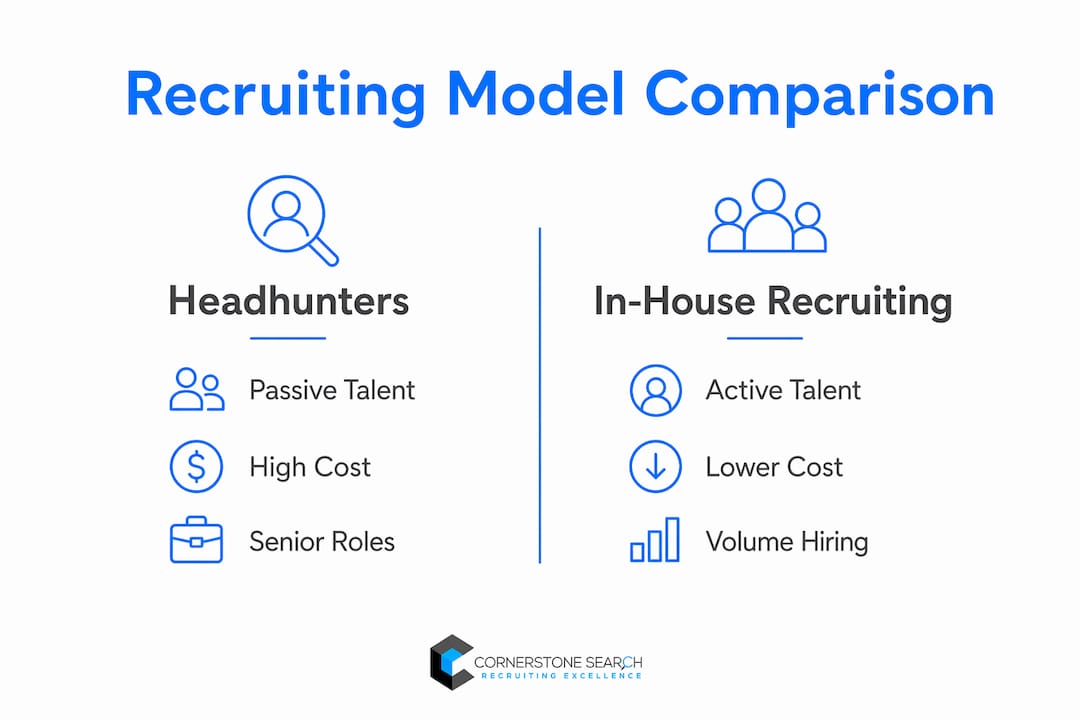
Organizations hiring fewer than 15–20 times per year often get faster, lower-cost results from external partners than from a full-time in-house recruiter. The math is straightforward. A full-time internal recruiter costs $70,000–$100,000 in salary plus benefits, tools, and management overhead. If you are making 10 hires per year, that cost per hire exceeds most agency fees. Conversely, in-house teams outperform outsourced models on cost and cultural fit once you reach 20–30 hires per year consistently.
| Metric | Headhunters | In-House Recruiting |
|---|---|---|
| Candidate pool | Passive and active talent | Primarily active applicants |
| Cost structure | 20%–30% of placed salary | Fixed annual overhead |
| Best volume threshold | Under 15–20 hires per year | Over 20–30 hires per year |
| Time to shortlist | 20+ days of market mapping | Varies by role and pipeline |
| Scalability | Flexible, scales on demand | Limited by team capacity |
| Cultural knowledge | Low at engagement start | High, built over time |
| Best use case | Senior, niche, or confidential roles | Volume, repeatable, or brand-driven roles |
The break-even point is not just about volume. Role seniority shifts the calculation. A company making 25 hires per year, but filling three C-suite roles annually, still benefits from external search for those three positions even if in-house handles the rest. The decision is not binary.
How can organizations build a hybrid talent acquisition strategy?
A hybrid recruiting model where internal teams handle repeat roles and external partners handle niche or confidential searches consistently outperforms either approach used alone. This is not a compromise. It is a deliberate division of labor based on where each model creates the most value.
The division works like this in practice:
- In-house team owns: employer branding, active candidate pipelines, high-volume roles, ATS management, hiring manager relationships, and onboarding coordination
- External partners own: passive candidate outreach, senior leadership searches, confidential replacements, market mapping for new geographies or functions, and time-critical executive placements
Organizations achieve the best results by combining internal teams’ employer branding and candidate experience strengths with external firms’ passive candidate networks. The two functions reinforce each other rather than compete. Your internal recruiter’s knowledge of what makes a great hire in your organization makes the headhunter’s shortlist sharper. The headhunter’s market intelligence helps your internal team understand what competitive compensation looks like.
Process alignment is where hybrid models fail most often. If your internal team and your external search partner are not sharing candidate feedback in real time, you lose speed and create confusion for candidates. Establish a single point of contact internally for each external search. Define who owns communication with the finalist candidates. These are operational details, but they determine whether the hybrid model actually works.
For SaaS and software companies specifically, the passive SaaS sales talent market makes external search nearly mandatory for VP and above roles. The best enterprise sales leaders are not applying to job postings. They are being recruited directly.
Pro Tip: Review your recruitment channel mix every six months. If your in-house team is spending significant time on a role category where external partners consistently outperform them, reallocate. Loyalty to a model that is not working costs you talent.
Key takeaways
The most effective talent acquisition strategy assigns headhunters to passive, senior, and confidential searches while in-house teams manage volume, branding, and active candidate pipelines.
| Point | Details |
|---|---|
| Passive market access | Headhunters reach the 80% of senior talent that never responds to job postings. |
| Volume threshold matters | In-house recruiting delivers positive ROI only above 20–30 consistent hires per year. |
| Hybrid model wins | Splitting roles by seniority and type between internal and external produces the best outcomes. |
| Cost is not the only metric | Time-to-fill and candidate quality affect revenue more than per-hire cost for senior roles. |
| Scalability gap | In-house teams cannot quickly scale during hiring spikes; external partners absorb that demand. |
Where most companies get the headhunter decision wrong
I have watched organizations make the same mistake for nearly three decades. They hire an in-house recruiter too early, burn through budget on fixed overhead, and then wonder why they still cannot fill their VP of Sales role six months later. The problem is not effort. The problem is using the wrong tool for the job.
In-house recruiting is genuinely excellent at what it does. A strong internal recruiter who knows your culture, your hiring managers, and your employer brand is worth every dollar at the right volume. But that same recruiter, no matter how talented, does not have a network of 200 passive enterprise sales leaders who trust them enough to take a call. That network takes years to build and is the core asset a specialized headhunter brings.
The other mistake I see is treating external search as a failure of internal capability. It is not. Choosing between a recruiting partner and a vendor relationship with an external firm is itself a strategic decision. The best external partners function as an extension of your talent team, not a replacement for it. They bring market intelligence your internal team cannot generate from inside the organization.
My honest recommendation: map every open role against two criteria before deciding who fills it. First, is the ideal candidate likely to be actively looking? Second, how many times will you hire for this role in the next 12 months? Those two questions will tell you more about the right channel than any framework I have seen.
— Rich Rosen
How Cornerstonesearch fills the gap your internal team cannot
Cornerstonesearch specializes in recruiting top-tier sales leadership for SaaS and software companies, precisely where the passive talent market is most competitive and most consequential. When your in-house team has the volume roles covered but needs a partner for the VP of Sales search that has been open for 90 days, that is where Cornerstonesearch delivers.
With an average time from search kickoff to offer acceptance of just 21 days and over 1,200 sales professionals placed since 1996, Cornerstonesearch operates as a true extension of your talent acquisition function. The firm’s network reaches candidates who are succeeding in their current roles and not browsing job boards. If you are building or scaling a SaaS sales team and need senior talent fast, explore the software sales recruitment services or review the sales recruitment fundamentals that have driven results for clients across the technology sector.
FAQ
What is the core difference between headhunters and recruiters?
Headhunters proactively source passive candidates who are not actively job searching, while in-house recruiters primarily manage inbound applicants and active candidate pipelines. The distinction defines which talent pool each model can realistically access.
When should a company hire its first in-house recruiter?
Companies benefit from an in-house recruiter once they consistently make 15–20 hires per year. Below that threshold, external partners typically deliver faster results at lower total cost.
How much do headhunters typically charge?
Headhunter fees generally run 20%–30% of the placed candidate’s first-year compensation. For senior roles, this cost is often offset by reduced vacancy duration and access to higher-quality candidates.
What are the main challenges of in-house recruiting?
In-house teams face two primary limitations: restricted access to passive candidates and difficulty scaling during rapid growth periods. Fixed overhead also makes in-house recruiting cost-inefficient at low hiring volumes.
What is a hybrid talent acquisition strategy?
A hybrid strategy assigns in-house recruiters to volume, repeatable, and brand-driven roles while external search partners handle senior, niche, or confidential placements. This division maximizes the strengths of both models without duplicating effort.