

If you need a proven AE who can carry real quota, go to a specialized SaaS sales recruiter, not a job board. A specialist with a real network gets you a short list of vetted closers fast; Cornerstone Search averages 21 days from kickoff to signed offer. Freelance platforms or job boards work fine for short-term coverage or junior SDR-to-AE moves, but for a mid-market or enterprise AE who has to hit number one, this is not the place to save time.
TL;DR:
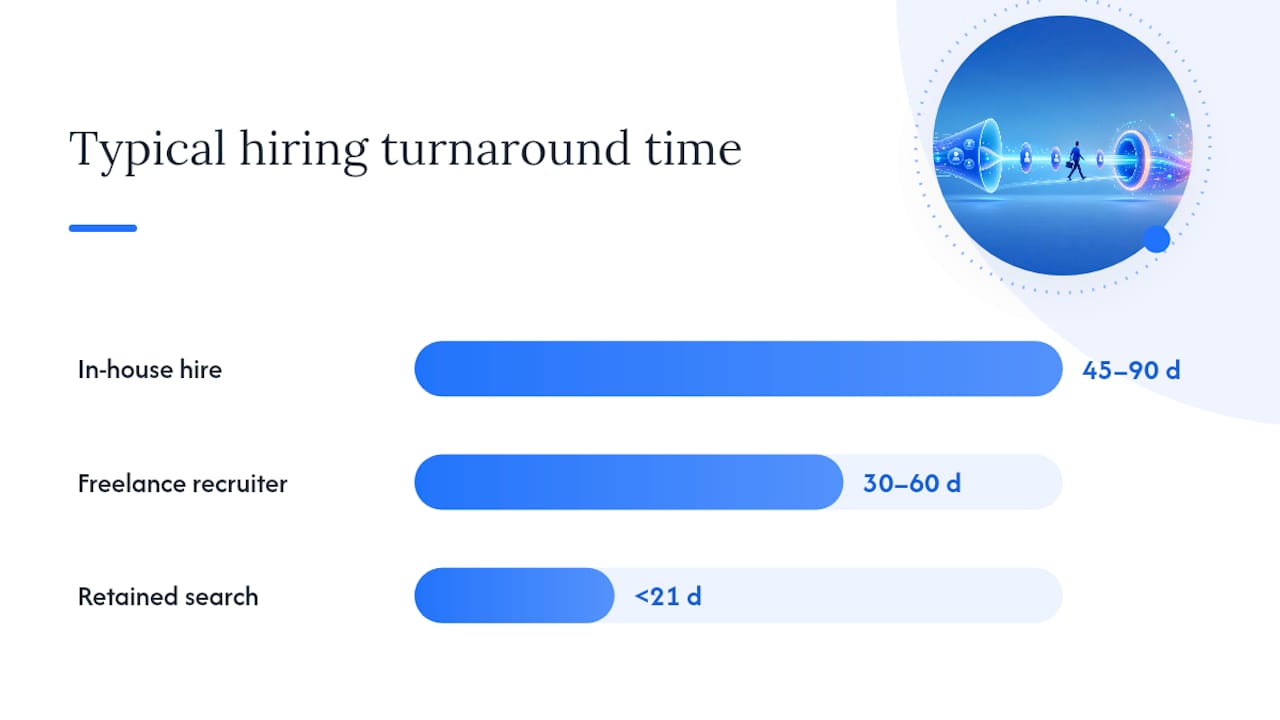
- Specialized SaaS sales recruiters can deliver a short, vetted list of top candidates in about 21 days, compared to 45-90 days for in-house hiring.
- Using job boards or freelance recruiters is suitable only for entry-level, low-risk roles; they are risky for complex, high-value enterprise positions.
- Essential candidate criteria include deal size experience, clear quota attainment history, CRM discipline, and the ability to handle the specific sales motion.
- Offer a guaranteed 100% of the OTE during ramp-up to reduce early turnover and account for the typical six-month onboarding process.
- Tailor job descriptions to specify sales motion, customer segments, deal complexity, and ramp expectations to attract qualified, self-selecting candidates.
Table of Contents
- What Are the Main Ways To Hire Account Executives?
- How Do You Choose the Right Hiring Route for an AE?
- Write the Job Profile and Comp Plan That Actually Attracts Qualified AEs
- Screening and Interviewing: The Practical Checklist
- Ramp, Onboarding, and What Success Actually Looks Like
- Why a Specialist Sales Recruiter Shortens Your Hiring Risk
- What I’d Do If I Were Hiring an AE Tomorrow
- How Cornerstone Search Gets You a Qualified AE Fast
- Sources
What Are the Main Ways To Hire Account Executives?
There are four real routes to hire account executives, and most hiring managers pick the wrong one because they’re optimizing for cost instead of risk.
In-house hiring. You post the role, your talent team screens resumes, your VP Sales runs interviews. It’s free on paper. It’s also slow, and your recruiter probably doesn’t know the difference between a transactional SMB closer and someone who can run a six-month enterprise cycle with procurement and legal in the room. Most in-house sourcing takes 45 to 90 days and leans heavily on inbound applicants, which skews toward job seekers who are actively looking, not top performers who are happily employed and quietly killing it somewhere else.
Freelance or contract recruiters. You hire an independent recruiter on a fee-per-placement or hourly basis. Cheaper than retained search, and decent for one-off roles or when you need someone fast for a defined, lower-complexity gig. The tradeoff is inconsistent quality control. You’re often getting whoever that recruiter happens to know this month, not a purpose-built bench of SaaS closers.
General job boards. Fast, cheap, and full of noise. You’ll get volume. You will not get signal. Job boards are fine when you’re hiring a high-velocity SMB AE where the deal size is small, the ramp is short, and one bad hire doesn’t sink a quarter. They’re a bad idea for a $150k-plus enterprise seat where a wrong hire costs you six figures in wasted comp, burned pipeline, and a lost sales cycle.
Specialized recruiters and retained search. A firm that only places sales talent, with a real network of AEs who have closed deals like yours, builds you a short list instead of a resume dump. You pay more upfront. You get speed, quality, and someone who will tell you honestly when a candidate is wrong for the seat instead of pushing a warm body to collect a fee.
Here’s the quick math on when each route fits:
- Speed matters most, role is entry-level: job board or freelance recruiter.
- Budget is tight, role is low-risk: in-house hiring with a strong job description checklist.
- Role is complex, deal size is large, or the seat has been open for months: specialized recruiter or retained search.
- You’ve made a bad hire before in this seat: specialized recruiter, every time.
The SaaS Jobs Resource Hub makes a point that applies no matter which route you choose: your job description has to spell out the sales motion, the customer segment, deal complexity, and ramp expectations, or you’ll get applicants who can’t self-select out of a role that isn’t right for them.
How Do You Choose the Right Hiring Route for an AE?
Stop guessing and run the numbers. Five criteria decide your route, and if you’re honest about all five, the answer usually picks itself.
- Time to hire. Do you have 90 days or 9 days? If your CRO is breathing down your neck about an open territory bleeding pipeline, you don’t have time for a six-week in-house search that ends in three mediocre finalists.
- Experience match. Does this role need someone who has closed $50k deals to SMB buyers, or six-figure enterprise contracts with a legal review? The wrong motion match is the single biggest reason AE hires fail in month four, not month one.
- Budget. Retained search fees cost more than a job board post. But a bad AE hire costs you a wasted quota, six months of ramp, severance, and a territory that goes cold. Do that math before you flinch at a recruiting fee.
- Ramp tolerance. Can your business absorb a slow ramp, or do you need someone productive in 60 days? Allston Labs recommends guaranteeing OTE for the first six months precisely because ramp always takes longer than founders hope.
- Support available. Does your sales team have a real enablement function, or is the new AE on their own from day one? A green hire with no support is a bet you’re likely to lose.
Here’s the if/then logic in practice: if you need a closer for a complex enterprise motion and the seat has been open more than 60 days, use a specialist recruiter. If you’re staffing a high-volume SMB team and speed beats precision, post the role and screen in-house. If you need someone for three to six months to cover parental leave or a territory gap, go freelance.
Pro Tip: Ask any recruiter, agency, or freelancer one question before you sign anything: “What’s your average time from kickoff to signed offer, and what happens if the hire doesn’t work out in the first 90 days?” Anyone who dodges that question is telling you something.
When you’re vetting a recruiting partner, push on three things: their actual placement history in your specific vertical, whether they guarantee replacement if a hire doesn’t stick, and how they screen for deal size and motion match, not just years of experience.
Write the Job Profile and Comp Plan That Actually Attracts Qualified AEs
Most AE job descriptions are garbage, and that’s why they attract the wrong candidates. A vague post that says “results-driven closer wanted” pulls in everyone and nobody, because top performers can’t tell if the role fits their skill set.
Your job description needs six things, and skipping any one of them is how you end up interviewing candidates who are wrong for the seat:
- Sales motion: transactional, consultative, or enterprise/complex.
- Customer segment: SMB, mid-market, or enterprise, named specifically.
- Deal complexity: average deal size, sales cycle length, number of stakeholders.
- Quota structure: annual number, how it’s measured, and how attainment is tracked.
- Ramp expectations: how long until full quota, and what support exists during ramp.
- Support model: SDR-fed pipeline, self-sourced, or a mix.
The SaaS Jobs Resource Hub is right that a strong AE job description states all of this up front so candidates can self-select. A senior AE who’s closed six-figure enterprise deals will read a vague SMB-flavored post and skip it. That’s the outcome you want if the role doesn’t fit them, but it only works if your posting is specific enough to filter correctly in the first place.
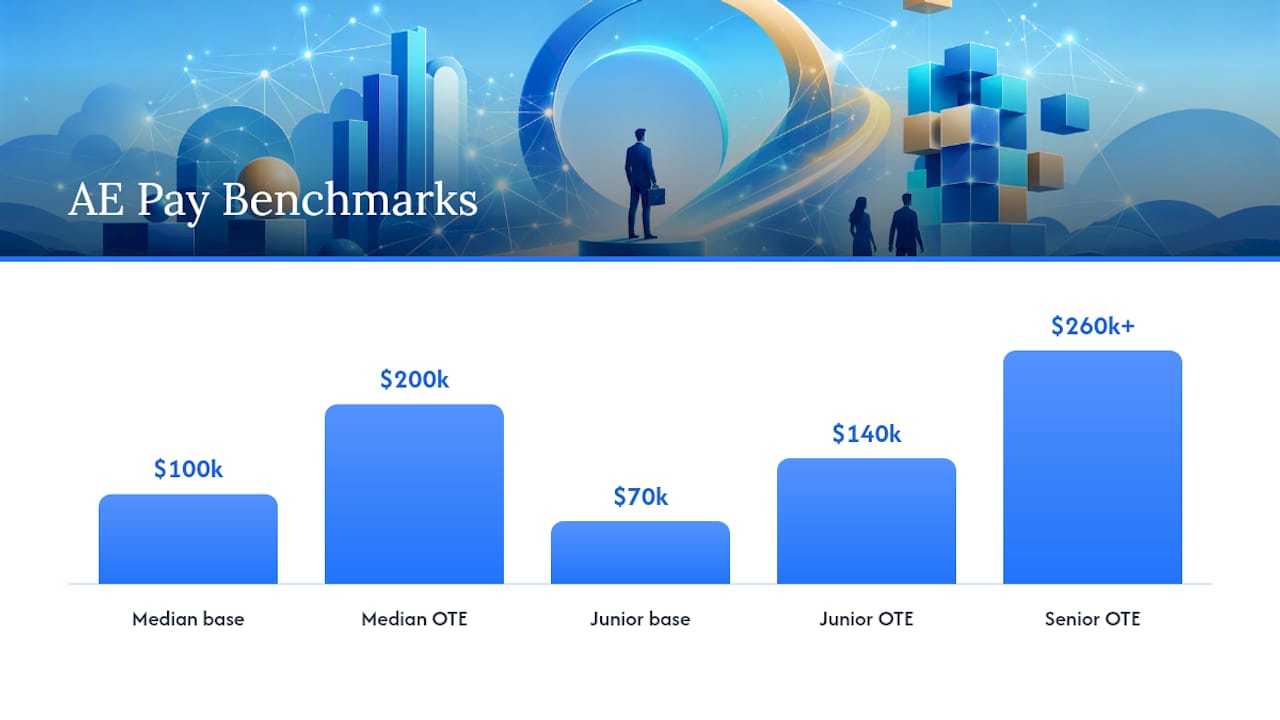
On comp, here’s the framework that actually works. Use a 50/50 base to variable split as your default. That means if OTE is $200,000, base is $100,000 and variable is $100,000, paid against quota attainment. Allston Labs recommends setting OTE at a 4x to 6x multiple of quota, so a $200,000 OTE AE should be carrying somewhere between $800,000 and $1,200,000 in annual quota depending on deal size and cycle length.
By the numbers: Median U.S. base salary for Account Executives sits around $100,000, with median OTE around $200,000, according to RepVue data from August 2026. Salary corroborates the base figure with its own June 2026 research, also landing around $100k, with ranges shifting up for enterprise reps and down for junior SMB closers.
That variance by level matters more than the median. A junior full-cycle AE selling into SMB might sit at $70k base with a $140k OTE. A senior enterprise AE carrying a $1.2 million quota with a nine-month sales cycle can command $130k-plus base and $260k-plus OTE. If your comp plan doesn’t flex for the seat you’re actually hiring, you’ll either overpay for a junior role or underpay and lose your top enterprise candidates to a competitor’s offer.
One more thing on ramp protection: guarantee 100% of OTE for the first six months. It costs you money up front. It also keeps a strong AE from bleeding out financially while they learn your product, your buyer, and your internal process. Skip the guarantee and watch good hires walk in month four when the draw runs dry and quota still hasn’t kicked in.
Screening and Interviewing: The Practical Checklist
Most interview processes test for charisma. Charm gets you nowhere on a hard renewal negotiation or a stalled enterprise deal. Screen for sales judgment, not personality.
Run this sequence:
- Phone screen (20 minutes). Ask them to walk through their last three closed deals: size, cycle length, number of stakeholders, and what almost killed each one.
- Deep-dive interview (45 minutes). Dig into quota attainment history with specifics. “What was your number last year, and what did you actually hit?” Vague answers here are a red flag.
- Role-play or take-home exercise. Give them a mock discovery call or a cold email sequence to draft. This tells you more about real skill than any resume line.
- On-site or panel interview. Bring in the hiring manager, a peer AE, and someone from customer success or product to test how the candidate handles pushback from people who aren’t buyers.
- Reference check with a real manager, not a peer they picked to make them look good.
Bullet checklist for what you’re actually evaluating:
- Evidence of closing deals at or above your target deal size, not adjacent to it.
- A track record of quota attainment they can back up with specifics, not “I usually hit my number.”
- CRM discipline: do they talk about pipeline stages and forecasting accuracy unprompted?
- Comfort discussing a deal they lost, and what they learned from it.
- Alignment with your customer segment: an SMB velocity closer rarely transitions cleanly into enterprise, and vice versa.
Ask questions like: “Tell me about the toughest deal you lost and why you lost it.” Or: “Walk me through how you’d handle a champion who goes dark two weeks before a renewal.” These reveal judgment. A candidate who blames the product, the market, or “bad timing” for every loss is telling you they don’t own outcomes.
Red flags that should end the process fast: no specifics on quota attainment, job-hopping every 10 to 12 months without a clear reason, an inability to describe their sales process step by step, and anyone who can’t name a deal they lost. Everyone loses deals. Anyone who claims otherwise is either lying or hasn’t sold enough to know better.
The skills checklist for enterprise SaaS AEs breaks down exactly what separates a real enterprise closer from someone who’s just good at SMB velocity selling, which is worth a look before you finalize your interview scorecard.
Ramp, Onboarding, and What Success Actually Looks Like
Ramp isn’t a training week. It’s a six-month runway, and if you don’t map it out in advance, you’ll have no idea whether your new hire is on track or quietly failing.
Here’s a realistic month-by-month structure:
- Month 1: Product training, CRM setup, shadowing senior AEs on live calls, no independent pipeline yet.
- Month 2: First independent discovery calls, still shadowed on demos, pipeline building begins.
- Month 3: Running full-cycle deals independently, first proposals go out.
- Month 4: First closed deals should start landing if the motion is transactional; enterprise reps may still be mid-cycle.
- Month 5: Pipeline should reflect roughly 3x to 4x quarterly quota in active opportunities.
- Month 6: Full quota carry begins, and OTE guarantee (if offered) typically ends here.
By the numbers: Roughly 42% of AEs hit annual quota according to RepVue’s dataset, which tells you attainment depends heavily on realistic quota-setting and real enablement, not just hiring talent. A great AE with bad enablement and an unrealistic number will still miss.
Guaranteeing OTE during ramp, as Allston Labs recommends, reduces early churn because it takes financial panic off the table during a period where the AE is still learning your product and buyer.
On cost and timeline by route: expect 45 to 90 days and no direct fee for in-house hiring, but real opportunity cost from an extended vacant seat. Freelance recruiters typically run a percentage of first-year comp, paid on placement, with turnaround in 30 to 60 days. Specialized retained search costs more upfront but moves fastest, often landing a signed offer inside three weeks when the firm has an existing bench of vetted candidates.
Why a Specialist Sales Recruiter Shortens Your Hiring Risk
Here’s the thing nobody tells you about hiring AEs: the resume never tells you if someone can actually close. Years of experience, logos on a LinkedIn profile, none of it predicts whether this person can carry your specific quota in your specific motion.
That’s the gap a specialist recruiter closes. Cornerstone Search has placed more than 1,200 sales professionals since 1996, exclusively in SaaS and software. That’s not a general staffing firm dabbling in tech. It’s three decades of pattern recognition on what separates a candidate who talks a good game from one who actually closes.
The proof point that matters most: a 21-day average from search kickoff to signed offer. That’s not a job board post sitting open for two months collecting resumes from people who are actively job hunting because nobody else wants them. That’s a purpose-built short list, delivered fast, from a network built specifically around software sales talent.
What that speed and precision does for you:
- Cuts vacant-seat cost, since every month a territory sits open is a month of lost pipeline.
- Reduces the odds of a bad-fit hire, because candidates are screened against your specific motion and deal size before you ever see a resume.
- Frees your VP Sales from running a resume-screening operation instead of coaching the team you already have.
Choose a specialist when the seat is complex, the cost of a wrong hire is high, or you’ve already struck out once with in-house or freelance channels. Choose in-house or freelance when the role is entry-level, low-risk, or you genuinely have the internal bandwidth to run a rigorous process yourself. Talent acquisition consulting engagements exist for teams that want the retained search model without handing over the entire process.
What I’d Do If I Were Hiring an AE Tomorrow
I’ve placed over 1,200 sales, presales, and executive candidates over three decades in SaaS recruiting. Here’s my honest take on what actually moves the needle when the pressure’s on.
First, get brutally clear on the motion. Transactional or enterprise, six-week cycle or nine-month cycle. Half the bad hires I’ve seen came from a hiring manager who couldn’t answer that question in one sentence.
Second, set comp before you write the job post, not after you meet a candidate you like. That structure protects you and the hire.
Third, pick your route based on the seat’s cost of failure, not the fee. A $130k enterprise AE who’s wrong for the motion will cost you more in six wasted months than any recruiting fee ever will.
If the seat is complex and the clock is running, call a specialist. If it’s entry-level and low-risk, run it yourself. Either way, know the difference before you post the job.
— Rich Rosen
How Cornerstone Search Gets You a Qualified AE Fast
Cornerstone Search is built for exactly the problem this article just walked through: finding a proven AE who can carry real quota, without spending three months sorting through resumes that don’t match your motion. We specialize in SaaS and software sales talent, and our average time from search kickoff to signed offer is 21 days.
Here’s what an engagement looks like. We start with a kickoff call to nail down your motion, deal size, and comp structure, the same framework covered above. From there, we build a short list from our existing network of vetted SaaS sales candidates, not a cold job-board post. You interview finalists who already match your segment and deal complexity, not generalists hoping to figure it out on the job. Then we help you structure and close the offer so you’re not losing your top candidate to a competing bid during negotiation.
If you’re staffing a broader team and want the fundamentals first, our sales recruitment playbook covers the basics. If you’re ready to move on an open AE seat right now, visit our software sales recruitment page and tell us what you need. We’ll tell you honestly, fast, whether we can help.