

Most BDR manager hires fail the same way. You take your best BDR, hand them a team, and hope. That rep proved they can hit their own number. They never proved they can make six other people hit theirs. Hire for coaching, not for quota attainment, and you avoid the most expensive version of this mistake.
I have placed more than 1,200 sales and executive people since 1996, and the BDR manager seat is one of the easiest to get wrong. At Cornerstone Search we run SaaS sales searches personally, with an average of 21 days from kickoff to accepted offer. This guide is what I would tell a founder or VP Sales over coffee.
TL;DR
- A BDR manager owns pipeline from a team of reps. The job is coaching, hiring, process and pressure management. It is not being the best caller in the room.
- Budget real money. Recent US postings run from about $100,000 to $200,000 in total pay, depending on team size, stage and equity.
- Test coaching live. Have the candidate review a real recorded call and give feedback they would use in the next meeting.
- Be careful promoting your top rep. If you do it, back them with a plan, or make it a trial period.
- A slow search costs you more than a fast one. Pipeline stays flat while the seat is empty.
Table of Contents
- What a BDR manager actually owns
- When to hire one
- What to require
- What to pay
- The promotion trap
- How to screen for coaching
- Making the offer and setting the first 90 days
- What a slow search costs
- Let us run the search
- FAQ
- Sources
What a BDR manager actually owns
Start with the job, because bad job descriptions produce bad hires.
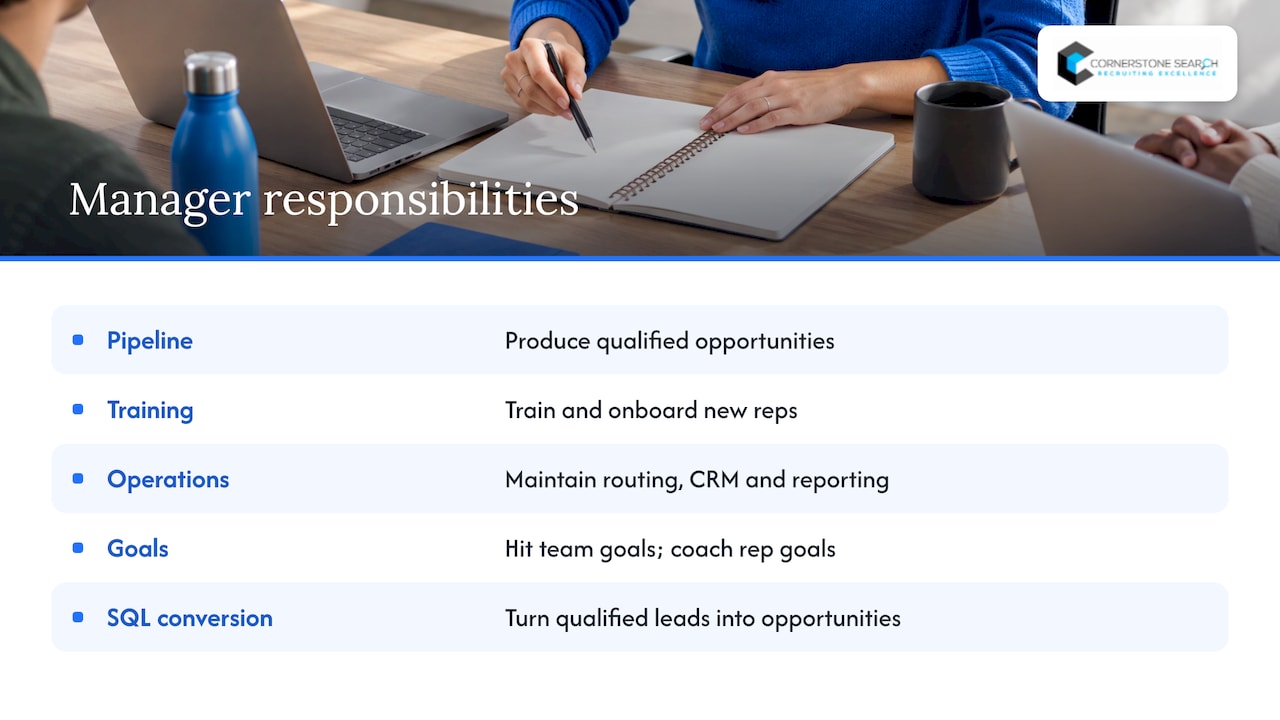
A BDR manager leads a team of business development reps whose job is to create qualified pipeline. GitLab’s handbook describes the sales development manager as the person who leads the team to produce qualified opportunities, trains and onboards new reps and handles the operational work around it. That last part matters. Someone has to keep lead routing, CRM fields and reporting clean, or your reps spend their week arguing about data.
The manager is also accountable for the number. G2’s breakdown of the role puts it simply: the BDR manager is responsible for hitting overall team goals, coaching reps toward individual goals and making sure sales qualified leads turn into opportunities.
BDR manager, SDR manager, business development manager
Titles are a mess, so check what the seat really covers before you post it.
- BDR or SDR manager: runs the outbound or inbound prospecting team. Top of funnel. This is the role in this article.
- Business development manager: often broader. Salesforce describes it as covering market research, strategic planning and client acquisition, and overseeing BDR onboarding. At some companies this person sells. At others they lead a team.
- Director of Sales Development: the next layer up. One manager under them is common at scale.
If your posting says “BDR manager” but you want someone to also close deals, you wrote two jobs. Pick one. If you are still deciding whether you need the reps themselves, our piece on what a BDR actually does at a startup helps frame the team you are asking this person to lead.
When to hire one
Hire a BDR manager when the founder or VP Sales can no longer coach the reps weekly and still do their own job. Usually that means a team of five or more reps, or a team whose output is flat even though activity is high. One real-world scope: a US posting I reviewed for a large software company has its BDR manager leading roughly seven to ten reps and owning team activity, metrics and sourced revenue targets, as listed in a hiring board posting.
Below that size, a player-coach can work. Above it, the coaching load swallows a part-time manager.
Don’t wait until the team is on fire. A leaderless BDR team doesn’t fail loudly. It just stops converting, and you find out two quarters later when the AEs have nothing to work.
What to require
Here is a sane bar for a SaaS startup. These come from live US postings, not wishful thinking.
- Years: one early-stage company wants 4+ years in SaaS sales or business development, including one to two years leading or coaching BDRs or SDRs. A larger-scale posting asks for 5+ years managing a BDR or SDR team and top-quartile quota history as a rep.
- Results: hit pipeline targets personally and through a team. Ask for numbers, not adjectives.
- Tools: hands-on with sequencing, CRM and data enrichment. The same posting wants comfort with the numbers.
- Partnership: can work with RevOps and marketing on dashboards, attribution and lead scoring. The AEs will fight the manager about lead quality. That is normal. The manager has to settle it before it reaches you.
Don’t ask for everything. A first-time team leader with a great coaching eye and two years of rep experience can beat a seasoned manager who ran a machine and never built one. Decide whether you need a builder or an operator. Builders write playbooks from scratch. Operators keep a working system tight.
What to pay
Compensation decides who answers your call, so don’t guess.
Published US postings show a wide spread:
| Posting | Pay range | Notes |
|---|---|---|
| Early-stage SaaS, US | $150,000 to $200,000 OTE, uncapped | 4+ years, 1 to 2 leading BDRs |
| Scaled SaaS, US | $100,000 to $120,000 per year plus equity | 5+ years managing, scaling from about 5 to 25 reps |
OTE means on-target earnings: base salary plus variable pay if the manager hits plan. The spread tells you something. Pay moves with team size, stage, whether the job is a first people-leader seat and how much equity is on the table. A company building from zero pays for builder skills. A company with a stable team pays less for an operator.
Three things I see founders get wrong:
- Variable tied only to personal output. The manager’s pay should follow team pipeline and SQL conversion, not their own calls.
- No clear quota math. If the manager can’t see how 100% attainment is defined, they can’t plan the team’s year.
- Lowballing to save on the seat. A $20,000 savings on salary disappears when one bad hire burns two quarters of pipeline.
Treat any posted range as a data point from one company’s own page and one point in time. Salary data moves, so check live listings for the market you are hiring in before you set a band.
The promotion trap
The internal promotion is tempting. They know your product, your buyers and your people. And sometimes it works.
But the skills are different. Salesforce’s own guidance on this makes the point with a sports comparison: the best players don’t always make the best coaches. The job asks you to work through other people.
If you promote, do it with your eyes open:
- Put it on an interim basis for a set period, so either side can step back without a demotion story.
- Give the new manager a coach of their own, such as you, a board advisor or a former sales leader.
- Take the quota off their back for the first month so they can learn the job.
- Pick one thing to fix first. Pipeline coverage, conversion or ramp. Not all three.
If you hire externally, expect a learning curve on your buyers. A good outside manager brings the craft and needs a quarter to learn the market. A good internal pick knows the market and needs help with the craft. Neither is free.
How to screen for coaching
This is where most searches go wrong. Resumes tell you titles and quota. They don’t tell you whether this person can make a nervous 24-year-old better by Friday.
What to test
For one posting, the process is three steps: a screening on motivation, a deep dive on how the candidate builds and runs a BDR team, and a chat with the founders on fundamentals and ownership. It is a clean frame. Here is how I would sharpen it.
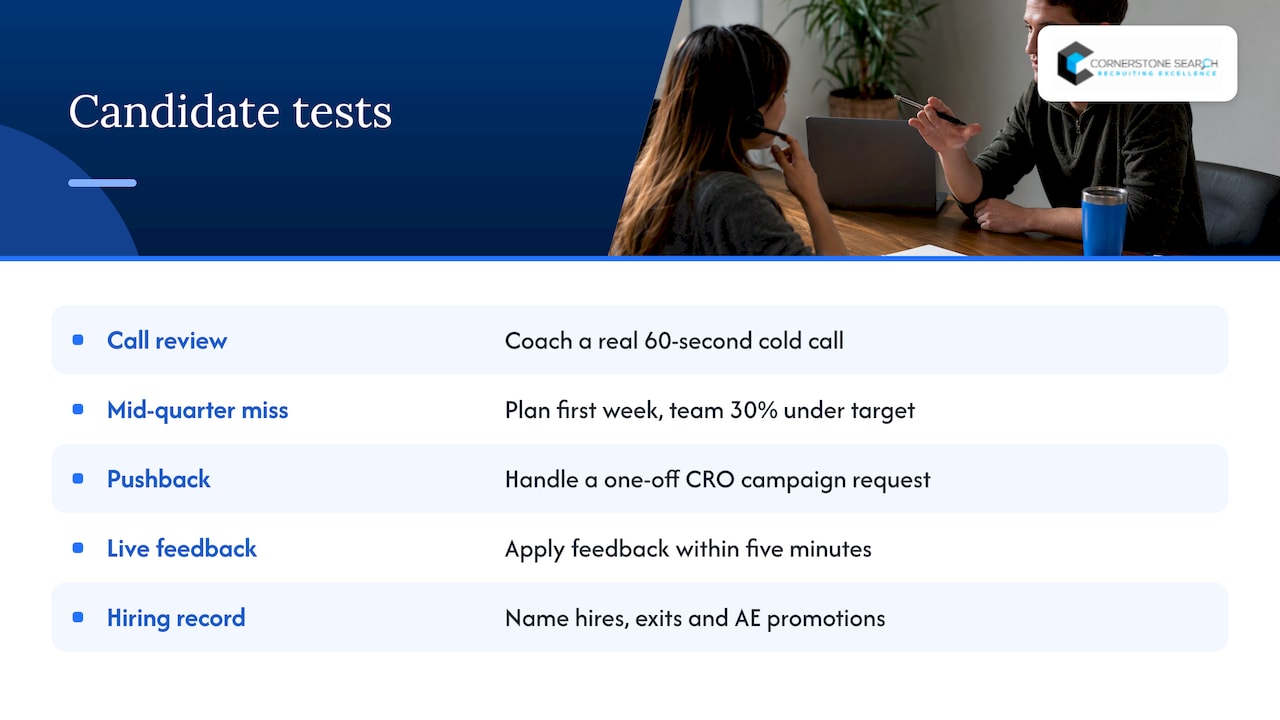
1. The call review. Give the candidate a recording of a real 60-second cold call, ideally one of your own reps. Ask them to coach it out loud. You want one or two specific changes, not a lecture. “Be more confident” fails. “Cut the first twenty seconds, ask the buyer about their current process, and stop saying ‘just’” passes.
2. The miss. Say, “Your team is 30% under target at mid-quarter. Walk me through your first week.” Weak candidates push activity. Strong ones look at the list first: who is being called, which segments reply, which message is dead. Then they change the plan.
3. The pushback. Ask how they handled a mid-quarter request from the CRO or VP Sales to run a one-off campaign. A manager who can’t say no passes every interruption straight to the reps. Part of this job is absorbing pressure.
4. The live feedback test. Mid-interview, give the candidate a small piece of feedback. Watch whether they apply it in the next five minutes. Coachability shows up in behavior. It doesn’t show up in claims. This applies to the manager too, because they will be hiring BDRs and need to spot the same trait.
5. The hiring record. Ask who they hired, who they let go and who they promoted into AE roles. A strong BDR manager can name the reps who moved up. A posting from one growth company lists a record of promoting BDRs into successful AE roles as a core requirement for good reason: it is the clearest proof the manager develops people.
Check the operations side
A manager who coaches well but lets data rot will bleed your pipeline. Ask them to describe how lead routing works in their current shop, which CRM fields they enforce and which dashboard they open on Monday morning. If you want them to have fluency with custom CRM sales automation, ask them to walk you through one automation they built and what it changed in rep behavior.
Reference checks
Talk to the people they managed, not just their boss. Ask a former BDR: “What did they teach you that you still use?” Then ask: “Tell me about a time they gave you hard feedback.” If the answers are vague, so is the manager.
Backdoor references are worth more than the list the candidate hands you. Use them carefully and respect confidentiality. A candidate who is still employed doesn’t need their boss learning about the search from a random call.
Making the offer and setting the first 90 days
Good managers have options. Don’t make the offer a slow, bureaucratic mess.
- Move fast. Strong candidates run several processes at once. A week of silence between final interview and offer loses people.
- Put the plan in writing. Base, variable, how quota is set, equity, and what “good” looks like at 90 days.
- Say what is broken. Tell them the real state of the team. Surprises in month two kill trust.
For onboarding, skip the week of slide decks. Stage it: the customer, market, product, qualification process, messaging, systems, data standards and handoff rules, with observed practice and live calls. One sales engagement guide also recommends tracking ramp on two axes, output and capability, because a single ramp number hides which one is lagging.
Set three goals for the first 90 days:
- Days 1 to 30: listen to calls, meet every rep one on one, meet the AEs and marketing, and fix one data problem.
- Days 31 to 60: run weekly coaching on one behavior per rep. Review the call afterward. Coaching without the follow-up review is just advice.
- Days 61 to 90: own the forecast, show conversion movement and present a plan to hire or restructure.
What a slow search costs
An empty BDR manager seat doesn’t just delay a hire. Reps drift. Top performers start taking recruiter calls. The AEs complain about lead quality with nobody to answer them. Every month of delay is a month of pipeline you don’t build.
That is why speed matters, as long as precision comes with it. A fast wrong hire is worse than a slow right one. The point is to compress the search without skipping the coaching tests above. If you are a founder without an HR team, our guide to sales hiring without an HR team walks through how to run it yourself. And if you want to understand the difference in how fees and commitment work, here is how retained search differs from contingency.
Perspective
We have been doing this a long time, and the pattern hasn’t changed. Founders hire BDR managers off a resume and a good vibe. Six months later the team is churning, the AEs are mad and nobody can say why.
Here is what we believe. The best BDR manager is a coach first. Quota history gets them in the door. Judgment keeps them there. We screen for the second one on purpose, because it is the one that predicts whether your reps get better.
Our searches are run personally by a recruiter with deep SaaS sales experience, and our intake is founder-led, so we understand what your team really needs before we call a single candidate. We have placed more than 1,200 sales professionals since 1996, and our average time from search kickoff to accepted offer is 21 days. We report 93% one-year retention, because a hire that leaves in six months isn’t a placement. It is a rerun.
If you are about to promote your top rep, call us first. If you are about to post the job and wait, call us first. It is cheaper to get the profile right at the start.
Rich Rosen
Let us run the search
If you need a BDR manager and can’t afford a long, noisy search, our software sales recruitment team places sales leaders for SaaS and software companies through contingent and retained search. We start with a founder-led intake, then screen on coaching, pipeline results and judgment. You can see how the pace works in fast executive search for SaaS sales leaders.
If you are comparing models, start with how executive search firms work, then get in touch with the role and the team you have today.
FAQ
How much does a BDR manager make in the US?
Published postings vary a lot. One early-stage SaaS company lists $150,000 to $200,000 OTE, and a larger one lists $100,000 to $120,000 per year plus equity. Team size, stage, location and equity drive the difference. Check live listings for your market before you set a band.
Should I promote my best BDR to manager?
Only with a plan. Hitting a personal number doesn’t prove someone can coach others. Make it an interim appointment, give them support and test their coaching early. If it doesn’t fit, they can go back to the team without a demotion.
What is the difference between a BDR manager and an SDR manager?
Often nothing, and companies use the titles loosely. Where they split, BDRs tend to own outbound pipeline creation, while SDRs tend to work inbound leads. Look at what the team actually does and write the job around that.
How long does it take to hire a BDR manager?
A self-run search often takes months because interviews pile up and candidates drop out. Our average from search kickoff to accepted offer is 21 days. A tight scorecard and fast decisions are what make that possible.
Sources
- Manager, Sales Development | The GitLab Handbook
- What Does a Business Development Manager Do? | G2
- What is a Business Development Manager | Salesforce
- BDR Manager posting, US, 2026
- BDR Manager posting, 2026
- BDR Manager hiring board posting
- BDR Manager posting, Built In Colorado
- SDR Manager Responsibilities, KPIs, Skills, and Daily Work