

You need a regional sales director. Your number is behind, or your region is about to double, and you can’t run it from your own calendar anymore. So you post the job, and you wait.
Here’s what happens next. You get a pile of resumes from people who “led teams” and “exceeded targets.” Most of them did neither. The good ones already have a job, and they are not browsing job boards on a Tuesday.
This guide covers what the role really is, what it costs, how to screen for it, and how to avoid the mistakes I have watched founders make for 30 years.
TL;DR
- A regional sales director owns a number, a territory and a team. Hire for proof they did it in a motion like yours, not for a big title.
- Budget real money. Published pay data for the title runs from the low six figures in base to well over $300K total pay at the top end.
- The best candidates are employed. You reach them by direct outreach and referrals, not by posting and praying.
- Test judgment, not charm. Make them pitch you and walk you through a lost deal.
- A bad hire costs you a year of pipeline. A focused search, run by someone who knows the market, takes about three weeks to reach an offer in our experience.
Table of Contents
- What a regional sales director actually does
- What it costs to hire one
- Experience is not the same as proof
- Where the good ones are (hint: not on the job board)
- How to screen without fooling yourself
- Sell the job back to them
- The mistakes I see most
- Should you use a search firm?
- Our perspective
- Working with us
- A simple 30-day plan
- FAQ
- Sources
What a regional sales director actually does
Strip off the title and the job is simple. You own a quota for a geography or segment. You hire and coach the managers or reps under you. You inspect pipeline. You get deals over the finish line when a rep is stuck.
Titles are a mess, though. At a 30-person startup, a “regional sales director” might be one player-coach with four AEs. At a larger company, it can be a manager of managers with a nine-figure book. Same words, different jobs.
The Bureau of Labor Statistics groups this work under sales managers. The May 2025 median wage there is $148,270, and the top 10 percent earn more than $290,540. That is all industries, including retail and wholesale. SaaS pays differently, mostly because so much of the pay sits in variable comp.
Before you write anything, answer four questions on paper:
- Is this person a player-coach or a pure manager?
- How many reps will report to them on day one, and how many in twelve months?
- What is the average deal size and sales cycle in the region?
- Why is the seat open? If the last person failed, you need to know why before you hire the next one.
That last question matters most. If you can’t answer it, the candidate will ask, and they will notice.
What it costs to hire one
Let’s talk money, because candidates will.
A Glassdoor salary page for the title shows a median total pay of $232K a year in the US, with a typical range of $181K to $305K. Base runs $106K to $164K, with $75K to $140K in additional pay. Those are self-reported numbers, so treat them as a rough guide, not gospel.
The job boards at the top of Google show lower figures for the same title, often $88K to $180K. Those listings mix in non-software roles and small companies. Don’t set your budget off them. A SaaS candidate who has carried a real number will laugh at a $100K OTE.
Some rules of thumb from my desk:
- OTE has to make sense against quota. If the OTE is high and the quota is fantasy, good candidates see it in five minutes.
- Base matters more than founders think. Strong directors have mortgages. A 50/50 split with an unproven territory is a hard sell.
- Equity is a bonus, not a salary. Early-stage candidates will weigh it, but they won’t take it in place of cash that works.
The cost of getting it wrong dwarfs the cost of paying right. The Bridge Group’s 2026 research puts median AE OTE at $200,000 on a median quota of $960,000, with average ramp time at 6.2 months, the longest in the history of that study. Now think about the person managing those AEs. If your director takes six months to ramp and then leaves at month twelve, you lost the whole year and the team underneath them.
Experience is not the same as proof
Founders love a big logo on the resume. I get it. It feels safe.
It isn’t. The same Bridge Group data shows that required experience at hire has climbed to 3.7 years from 2.7 in 2022, yet ramp time still hit a record. You are paying a premium for tenure that doesn’t buy you speed.
So stop paying for years. Pay for proof, and make it specific:
- Did they hit quota in a similar motion? Mid-market inside sales and enterprise field sales are different sports.
- Did their reps hit quota? A director who made the number alone on two huge deals is not the same as one whose team landed at 80 percent attainment or better.
- Did they hire well? Ask for names of people they hired who got promoted.
- Did they stay long enough to own the result? Eleven months at three companies tells a story.
Ask for numbers. Quota, attainment, team size, ramp, average deal size, win rate. Real directors know all of them cold. Fakers give you adjectives.
Where the good ones are (hint: not on the job board)
A posted job reaches people who are looking. Your best candidate is usually not looking. They’re hitting number and getting a bonus check.
That’s why referrals, networks and direct outreach do the heavy lifting at the senior level. SHRM’s summary of top hiring channels lists employee referrals first at 48 percent, with third-party recruiters or staffing firms at 34 percent. Job boards show up too, but they also bring the volume of unqualified applicants you will need to wade through.
Here is what direct sourcing looks like when done right:
- Build a target list of companies selling to similar buyers at similar price points.
- Find the directors who produced results there.
- Call them. Not a templated message, a real conversation.
- Ask who else is good. The best names come from this question.
It takes time and a Rolodex. It also takes the stomach for rejection, because most will say no on the first call. Some of them will say yes on the third.
If you want a deeper look at how the process works from kickoff to offer, see our breakdown of the stages of an executive sales search.
How to screen without fooling yourself
Interviews are mostly bias. You like the person who reminds you of you. They laugh at your jokes. They went to your school. Congratulations, you just hired your reflection.
Here is what works better.
Make them sell you
Ask the candidate to pitch you on joining your company. Give them ten minutes to prep. A sales leader who can’t sell the job to you won’t sell it to a recruit, and won’t sell your product to a VP of Finance either.
Practitioners at MEDDICC make the same point: use a live scenario or role-play, and watch what they do, not what they say.
Watch the questions they ask
Good sales leaders qualify you. They ask about quota, sales process, pipeline coverage, and why the role is open. If a candidate asks only about comp and title, they are not the hunter you need. If they never ask a hard question, they either don’t care or don’t know what to ask.
Dig into a lost deal
Ask for the biggest deal they lost last year. Then ask what they would do differently. Watch for blame. Strong leaders own the loss and name the specific call where they would change course.
Run the pipeline review test
Give them a mock pipeline of ten deals. Ask which three they would bet on and which three they’d kill. You will learn more in twenty minutes than from three rounds of “tell me about yourself.”
Check references the hard way
Call former reps, not only former bosses. A director’s team knows exactly how it felt to work for them. Ask a rep: would you follow this person to the next job?
Sell the job back to them
The good ones get several offers. Money gets you in the room. It doesn’t close the deal.
From what I’ve seen, senior sellers want three things: autonomy, real influence on strategy, and a plan that makes sense. A Forbes Business Development Council piece says the same: top performers stay where they are treated as partners, not as quota carriers.
So be ready to answer:
- What does the pipeline look like today, honestly?
- What can this person decide without asking you?
- Who is on the team, and which of them are keepers?
- What does the CEO expect in the first 90 days?
- Is the quota based on data or on what the board wants?
If your answers are mushy, a seasoned director will smell it. Clean those up first. For more on building the team around the hire, this guide on building a high-performing sales team is a useful read on process and structure.
The mistakes I see most
Hiring too early or too senior. A seed-stage company with six reps does not need a manager of managers. It needs a sharp player-coach who still carries a bag.
Hiring a big-company director for a startup. They come from a place with brand, marketing air cover, inbound leads and a sales engineer for every call. Drop them in your shop and they stall.
Skipping the intake. If you can’t define success in a sentence, you will hire against a vibe.
Moving slowly. Great candidates are gone in two weeks. A process with six rounds and a three-week gap in the middle loses the best person every time.
Ignoring ramp. If the director needs six months to produce, you need a plan for what happens in those six months. Interim leadership is one option. We cover it in our piece on hiring interim sales leadership.
Should you use a search firm?
Maybe. Not always.
If you have a strong network, a recruiter on staff who has filled senior sales roles, and time, run it yourself. Plenty of founders do, and some do it well.
If the seat has been open for two quarters, or the last hire flamed out, or your candidate pool is thin, outside help pays for itself. SHRM reports that executive cost-to-hire has risen 113 percent since 2017, and one of its suggestions is using a search firm strategically, because it can cost less than leaving a critical role empty.
The key word is specialized. A generalist who filled a CFO seat last month and a nurse manager the week before is not who you want calling your competitors’ sales directors. Read our take on the benefits of specialized sales recruiters, and on retained search if the role is critical.
Our perspective
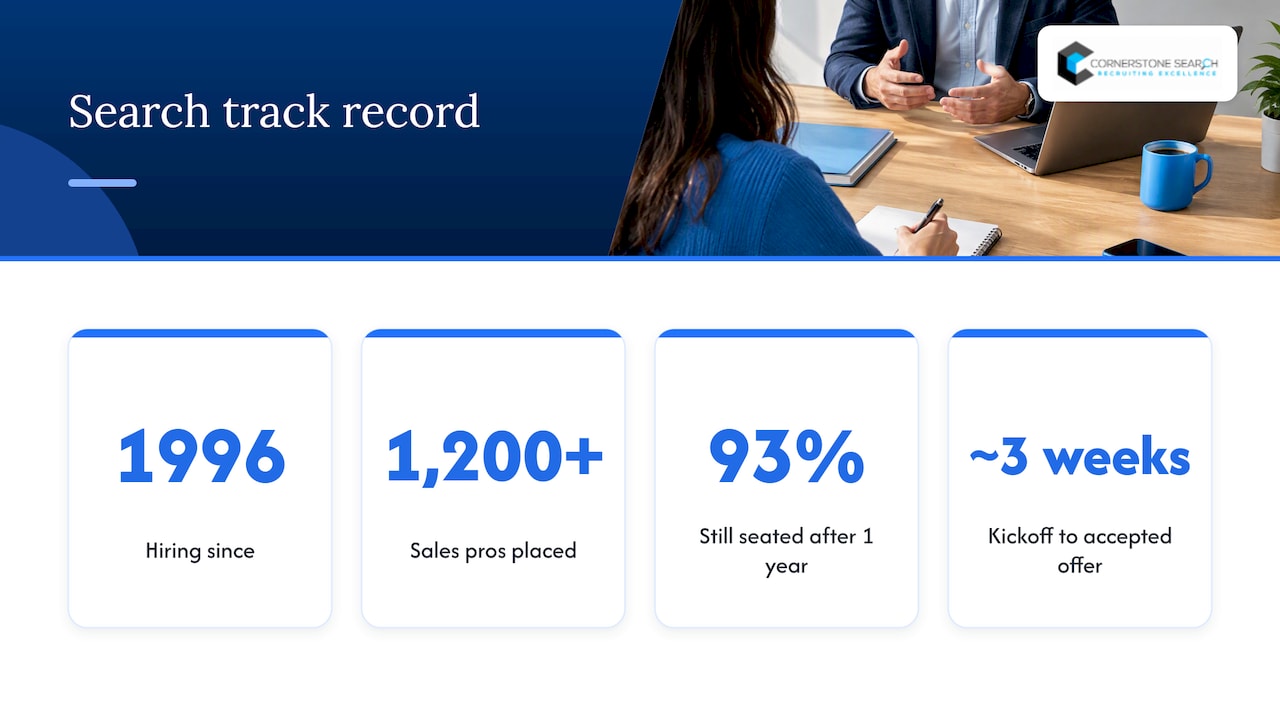
We have been doing this since 1996. We have placed more than 1,200 sales professionals in SaaS and software, and 93 percent of them were still in the seat a year later. That second number matters more than the first. Anyone can fill a chair. Keeping it filled by the right person is the job.
Here is what we believe about regional sales directors.
Most bad hires are not bad people. They are mismatches. A great enterprise closer gets hired to run a velocity team and crashes. A great manager of managers gets hired into a role that needs someone who will jump on calls. The resume looked perfect. The fit was wrong.
That is why every search we run starts with a real intake, led by the founder of the firm, not a junior coordinator. We want to know the quota, the comp plan, the sales cycle, the team, the politics, and why the last person left. Then we go find people who have done exactly that, in a similar motion, and we talk to them like humans.
We also push back on clients. If the OTE is off, we say so. If the title is inflated for the job, we say so. You can hire a candidate you can’t close, or you can fix the offer. Better to hear it in week one than week six.
Speed is a risk tool too. Every week the seat is empty, pipeline slips and your best reps start taking recruiter calls. Our searches average about three weeks from kickoff to accepted offer, because we aren’t starting from a cold list.
— Rich Rosen
Working with us
If you want to hand this search to someone who has done it hundreds of times, we run it for SaaS and software companies through software sales recruitment and executive search, on contingent or retained terms depending on the role. We don’t publish fees, because the right structure depends on the seat. Tell us about the region, the quota and the team, and we will tell you straight whether we can help. You can also read about our fast executive search approach first.
A simple 30-day plan
If you’re running this yourself, here is a plan you can start Monday.
Week 1: Define it. Write the one-page scorecard. Quota, team, territory, comp range, must-haves, deal-breakers. Get the CEO and the board to agree on it.
Week 2: Source. Build the target company list. Make the first 40 calls. Ask for referrals on every one, including the ones who say no.
Week 3: Screen. Run a 30-minute call, then a pitch exercise, then a pipeline review. Cut hard. Three strong finalists beat ten maybes.
Week 4: Close. Check references with former reps. Make the offer fast, with the comp plan in writing and the quota clear. Move before a competing offer lands.
Then plan the first 90 days before they start. Give them the data, the team context and a short list of deals to look at on day one.
FAQ
How much does a regional sales director make?
It depends on the industry and the company stage. Glassdoor’s US data shows a median total pay of $232K, with base pay of $106K to $164K. SaaS roles with real quota and a full team tend to sit toward the higher end, and the variable portion depends on attainment.
How long does it take to hire one?
Running it in-house, plan on a couple of months for a senior role, sometimes longer when the candidates are employed and slow to move. A specialized search can compress that. Ours average about three weeks from kickoff to accepted offer.
What is the difference between a regional sales director and a VP of Sales?
A regional director owns one territory or segment. A VP of Sales owns the whole revenue organization, including hiring, comp design and forecasting to the board. Many VPs started as regional directors, and a strong one is often the best internal pipeline for the bigger job.
Should I hire someone with more experience?
Not automatically. The Bridge Group’s 2026 data shows companies asking for more experience while ramp times keep growing. Look for proof of results in a similar sales motion, not just more years.
Sources
- U.S. Bureau of Labor Statistics, Sales Managers
- Glassdoor, Regional Sales Director salary
- The Bridge Group, 2026 AE Models, Motions & Metrics
- SHRM, Top channels for quality hires
- SHRM, Exec recruiting costs are surging
- MEDDICC, How elite salespeople hire
- Forbes Business Development Council, attracting and retaining top sales leaders