

Most founders hire a RevOps leader because the forecast is garbage and the CRM looks like a junk drawer. Then they write a job description about tools, hire someone who knows the tools, and wonder why nothing changes six months later. The fix is simple to say and hard to do: hire for authority, judgment and a clear first mandate, not for a software list. We run executive searches for SaaS and software companies, and we’ve placed over 1,200 sales professionals since 1996. Here’s how to run this search so the person you hire sticks.
TL;DR
- Hire a RevOps leader when cross-team revenue work has become a real system and nobody owns it. There is no magic ARR or headcount number.
- Define what the role owns, what it doesn’t, and who decides what, before you post anything.
- Screen for judgment and the ability to get sales leaders to change behavior. Dashboard skills are table stakes.
- Budget real time: published estimates run from about 52 days to several months for senior roles.
- Give the new hire a 90-day mandate with a few measurable outcomes, or they will drown in requests.
Table of Contents
- What a RevOps leader actually does
- When you need one
- Pick the level before you pick the person
- Write the role around outcomes, not tools
- What to look for in a candidate
- How to interview and test
- What it costs and how long it takes
- The mistakes that burn founders
- Set the first 90 days
- Why a specialist search beats a job post
- Work with us on your search
- FAQ
- Sources
What a RevOps leader actually does
RevOps stands for Revenue Operations. It’s the function that keeps data, systems, planning and process consistent across sales, marketing and customer success. One RevOps glossary says a leader’s core remit can include shared metric definitions, handoffs between teams, CRM and data governance, and the forecast process and reporting.
Notice what’s missing. The RevOps leader doesn’t run the sales team’s commercial decisions. The same glossary says the charter should assign cross-team processes and decision rights, and that owning the CRM doesn’t hand over every commercial or accounting call.
That line matters when you hire. If your VP Sales and your head of marketing both expect to keep their calls, but you hire a RevOps leader to “fix alignment,” you’ve hired someone for a fight. Write down who decides what first.
When you need one
Founders ask for the number. How much ARR? How many reps? Wrong question.
One startup operator’s guide puts it this way: hire when the recurring work across marketing, sales, customer success and finance has become a real operating system, and nobody has the time or authority to own it. Another post from September 2026 says the decision is driven by workload and complexity, not a single revenue or headcount threshold, and warns against hiring for a one-time cleanup.
Here are the signs I’d look for:
- Your forecast changes depending on who you ask.
- Marketing and sales argue about what counts as a qualified lead.
- Leads sit in a queue because routing is manual or broken.
- Your CRO or VP Sales spends hours a week fixing spreadsheets instead of coaching reps.
- The board asks for a capacity plan and you build it from scratch every quarter.
The Pedowitz Group’s readiness guide lists similar signals: inconsistent forecasts, slow handoffs, tool sprawl and attribution disputes, often around late Series A to Series B. SantiXS points to the move from founder-led sales to team-led sales as a common trigger.
Stage matters for the level you hire. According to a16z’s February 2025 piece, teams with 0 to 10 account executives mostly need foundational systems, clean data and basic cross-functional process. At 11 to 25 account executives, RevOps usually takes on territory fairness, forecast accuracy and automated lead-to-revenue workflows.
So a 6-rep team doesn’t need a VP who wants to design a planning engine. And a 25-rep team with a broken forecast doesn’t need a junior admin.
Pick the level before you pick the person
This is where most searches go sideways. I’ve seen it a lot: a founder wants a strategic operator but offers a builder’s job. Or wants a builder and interviews strategists.
| Your situation | What to hire | What the first year looks like |
|---|---|---|
| Founder-led sales, first reps arriving | Hands-on manager or senior individual contributor | Clean CRM, clear stages, basic reporting |
| 10 to 25 reps, forecast misses | Head of RevOps with real build and influence skills | Routing, territory design, forecast process |
| Multiple GTM teams, board scrutiny | VP-level or senior leader with a team | Planning, capacity, cross-team governance |
If a candidate sees most of their week as fixing picklists and manual workflows, a senior leader will leave. If the problem is that your executives haven’t agreed on pipeline stages, a junior person can’t solve it for you. That’s an executive alignment problem. Be honest about which one you have.
Write the role around outcomes, not tools
Skip the laundry list of systems. Any decent candidate knows them. What you want to know is whether they can make revenue data trustworthy and get people to use it.
A practical first mandate, based on what SantiXS describes, is making the basics dependable: a clean CRM structure and definitions, clear lead routing and lifecycle handoffs, trusted pipeline reporting, and less manual work.
We’ve got a deeper walk-through on defining a sales role before hiring. The same discipline applies here. Put on one page:
- The three problems this person must fix.
- What they own outright.
- What they influence but don’t decide.
- Who they report to (CRO, COO, CFO, CEO) and why.
- What success looks like at 90 days and 12 months.
Reporting line is a real decision. Report to the CRO and you get a sales-leaning role. Report to the COO or CEO and marketing and customer success take it more seriously. Pick on purpose.
What to look for in a candidate
Here’s what I screen for, from three decades of putting people in front of founders.
Judgment under pressure. Ask what they did when a sales leader refused to follow the process. Good answers have a name, a trade-off and a result. Bad answers have a framework.
Forecast credibility. Have they built or fixed a forecast process that finance and sales both trusted? What changed in rep behavior?
Comp and quota literacy. RevOps lives next to quota, OTE, ramp and territory design. If they can’t explain how a territory change affects a rep’s attainment, they will lose the sales floor fast.
Systems sense. They don’t need to be the best admin on earth. They need to know what to build, what to buy and what to leave alone.
Influence. This is the one people miss. A great builder who can’t persuade a top rep to log activity is a very expensive spreadsheet.
Stage fit. Someone who scaled a 300-rep team may hate your 8-rep mess. Someone who loves chaos may stall when you need governance.
Our revenue leader vetting process covers how we think about screening senior commercial leaders in stages. The same logic works here: don’t let one slick interview carry a candidate.
How to interview and test
Use structure. A structured interview means the same job-related questions for every candidate and one rating scale. A summary of U.S. Office of Personnel Management guidance also suggests a time-bounded, realistic work sample.
For a RevOps leader, a work sample could be:
- Give them a messy, anonymized funnel snapshot and ask for the top three problems and what they’d fix first.
- Ask for a 30-60-90 day plan for your actual situation.
- Have them walk your VP Sales through a forecast disagreement, live.
Keep it to a couple of hours. Senior candidates have options, and an unpaid homework project that takes a weekend sends the wrong message.
Then run references with specifics. Not “was she good?” Ask: “What did the sales team say about working with her? Did the forecast get better? What would you hand her next?” Talk to a sales leader, not just a former boss in operations. For more on interviewing in this world, see our SaaS sales interview questions for hiring managers.
What it costs and how long it takes
Pay varies a lot by stage, scope and location. As of November 2026, one salary aggregator showed an average of $129,482 per year for Head of Revenue Operations in the U.S., with a wide spread from about $59,500 to $215,500. That’s a published average for that month, and it moves as postings change. Live postings for lead and senior RevOps roles often show base ranges well above that, and many add bonus and equity. Compare your own offer to current postings for your stage and city before you go out.
Time is the other cost. Stealth Agents reports revenue operations manager roles averaged 52 days to fill in 2025, with 45 to 60 days for traditional recruiting. Sapwood says senior RevOps searches take three to six months.
Every month with a broken forecast is a month of bad hiring plans, missed quota surprises and board meetings you’d rather skip. The search is not the place to be slow.
The mistakes that burn founders
Hiring in a panic. RevOps hiring is often a reaction to pain, and urgency breeds sloppy decisions. Fix scope first, then hire.
Hiring a tool jockey. Tool skills are cheap to verify. Judgment is not.
Hiring too senior or too junior. See the table above. Match the person to the problem.
No decision rights. If the charter is vague, the new hire becomes a catch-all for every unwanted task. The good ones sniff that out in the first interview and walk.
Skipping the sales team. Have two or three of your best reps and a sales manager meet the finalist. Reps will tell you in ten minutes whether this person gets how they make money.
Using a one-time cleanup as the job. If it’s a three-month project, hire a project. If it’s a permanent function, hire a leader.
Doing the search on the side. You’re running a company. A senior search takes real hours: sourcing, calls, follow-ups, selling the role. It rarely survives as a Friday afternoon task.
Set the first 90 days
The best RevOps hires walk in with a short list. The Pedowitz Group recommends an initial 90-day outcome set: cleaner data and routing, a unified scorecard, defined service-level agreements between teams and prioritized process improvements.
A service-level agreement here just means a written promise between teams, like “marketing hands over a qualified lead with these fields filled, sales follows up within a set time.”
Add capacity planning that ties revenue targets to funnel performance and gets revisited monthly against actuals, as Domestique RevOps suggests. Also give the new leader access to customer voice. Understanding how customer feedback ties to revenue growth helps them build reporting that shows why deals are won and lost, not just how many.
Tell your leadership team the plan before day one. Nothing kills a RevOps hire faster than a VP who finds out about the new lead-routing rules from a Slack message.
Why a specialist search beats a job post
A posted job gets you people who are looking. The strongest RevOps leaders usually have a job, a boss who likes them and a reason to ignore recruiters. You need someone who can get a real conversation, explain your stage honestly and sell the role.
That’s where an executive search partner earns the fee. How retained search differs from contingency is worth a read if you’re deciding how to structure the engagement. If you want the mechanics, our guide on how executive search firms work lays it out.
Our take
I’ve been in this business for 30 years, and the same pattern repeats. A founder has a revenue problem, calls it a people problem, and hires fast to feel better. Then the new hire inherits a mess nobody agreed on, and everyone is shocked when it doesn’t get fixed.
We don’t treat that as a sourcing problem. We treat it as an intake problem. Our searches are personally run by a recruiter with deep SaaS sales expertise, and that starts with a real conversation about what you actually need, what the role owns and who it works with. Founder-led intake is how we get the fit right before a single candidate hears your name.
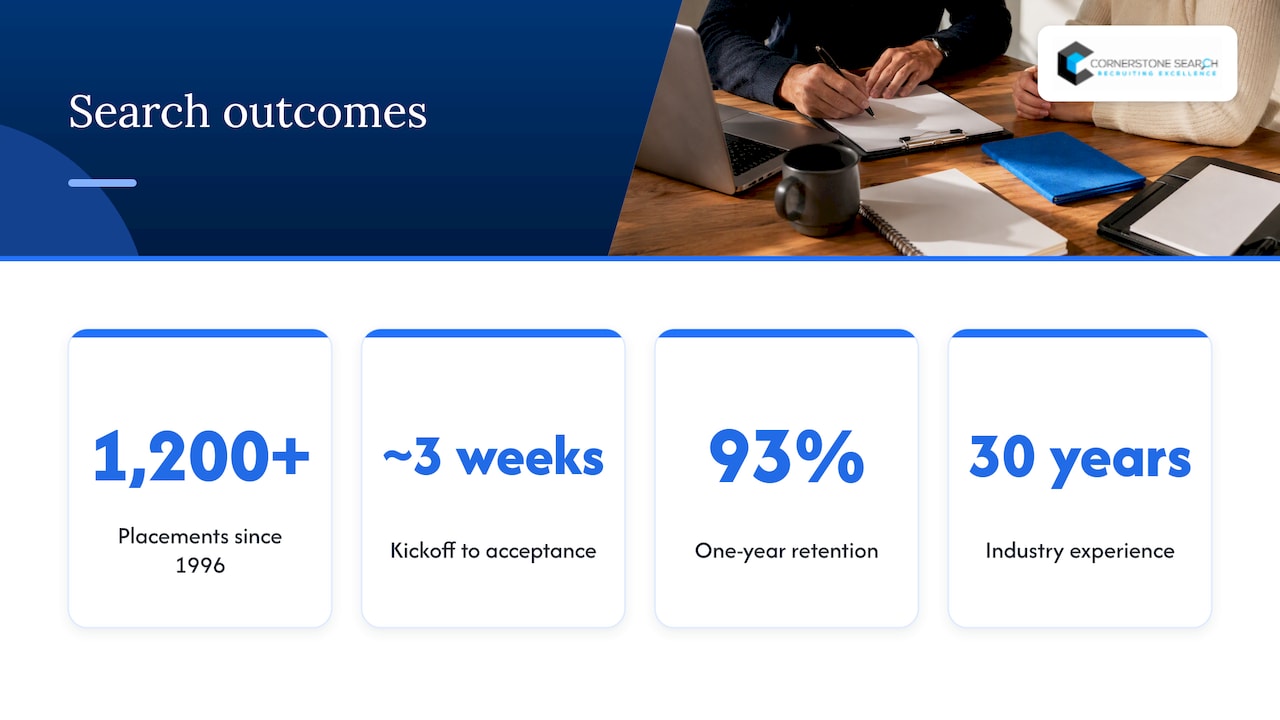
The numbers back the approach: over 1,200 placements since 1996, an average of roughly three weeks from search kickoff to offer acceptance, and 93% one-year retention. Speed without precision is just a faster way to make a mistake. We want both.
If your next hire is a revenue leader who has to work with sales, marketing and customer success, hire like it’s the most expensive decision you’ll make this year. Because it might be.
Rich Rosen
Work with us on your search
We recruit sales and executive talent for SaaS and software companies, through contingent and retained search. If you’re hiring a RevOps leader alongside a VP Sales, a CRO or a sales team, our executive search recruitment service is built for exactly that kind of senior, high-stakes hire.

If you’re still shaping the role, our talent acquisition consulting can help you scope it before you go to market. And if you need leadership in place while you search, read about interim sales leadership.
FAQ
What does a RevOps leader do?
A RevOps leader aligns data, systems, planning and processes across sales, marketing and customer success. Typical ownership includes shared definitions and metrics, handoffs, CRM governance and the forecast process. Functional leaders keep their own commercial decisions.
When should a startup hire its first RevOps leader?
Hire when recurring cross-team revenue work needs an accountable owner with real capacity and nobody has it. Common triggers are a move from founder-led to team-led sales, unreliable reporting and unclear handoffs. There’s no single revenue or headcount cutoff.
How long does it take to hire a RevOps leader?
Published estimates put revenue operations manager roles at about 52 days on average, and senior searches at three to six months. Your timeline depends on how sharp the role definition is and how fast your team interviews. Slow feedback loses good candidates.
What should I ask in the interview?
Ask for specific stories: a forecast they fixed, a sales leader they persuaded, a process change that stuck. Use the same questions and one rating scale for every candidate, then add a short, realistic work sample tied to your own funnel.
Sources
- Revenue Operations (RevOps) glossary
- When a Startup Actually Needs RevOps
- When should a startup hire its first revenue operations person
- When to Establish Revenue Operations: Readiness Guide
- When Should Founders Hire RevOps?
- How Much Should I Invest In RevOps?
- Startup Hiring Strategy: A Practical Process
- Head of Revenue Operations salary, United States
- RevOps Manager Cost 2026
- What a RevOps hire costs in 2026
- Scaling Revenue Operations for Hyper-Growth SaaS Startups
- Customer feedback drives revenue growth