

Most bad sales engineer hires look great in the interview. They demo clean, they talk fast, and they use the right acronyms. Then they hit a real deal with a skeptical security lead and a messy integration, and they go quiet. You lose the deal. Then you lose six months.
Here’s how to hire sales engineers who hold up in a live deal: define the job first, pay the market rate, test them on real work, and check what they did, not what their title said.
TL;DR
- Decide what kind of SE you need before you post anything. A demo machine, a technical closer, and a solutions architect are three different hires.
- Budget for the market. The BLS puts the 2025 median pay for sales engineers at $124,900, and good SEs at software companies often sit above that once variable pay is in.
- Test candidates on a real scenario from your product. Canned answers prove nothing.
- A bad hire costs far more than a search fee. Slow, sloppy hiring costs you even more.
- If you need the seat filled fast, a specialist recruiter who knows SaaS sales can cut weeks off the process.
Table of Contents
- What a sales engineer does, and why you’re hiring one
- Pick the archetype before you write the job post
- What to pay a sales engineer
- Where good sales engineers come from
- Screening: what to look for in the first call
- The interview process that works
- Look for people who can work with modern tools
- Ramp time is the hidden cost
- What a bad sales engineer hire costs
- Perspective: why SE hires fail, and how we avoid it
- Should you use a recruiter?
- Common mistakes when you hire sales engineers
- FAQ
- Sources
What a sales engineer does, and why you’re hiring one
A sales engineer sits next to your account executive and handles the technical half of the sale. Discovery, demos, proof of concept, security reviews, RFPs, and the awkward moment when the buyer’s architect asks something your AE can’t answer.
The BLS defines the work as selling goods or services that need a technical background. In SaaS, that translates to this: your AE owns the relationship and the number. Your SE owns the technical win. Neither works without the other.
So why are you hiring one? Usually one of these:
- Your AEs are stuck doing demos they can’t handle, and deals stall in technical review.
- Your founder is still doing every demo and can’t scale.
- You moved upmarket and now buyers have committees, security questionnaires, and integration questions.
- An AE team doubled and the one SE you have is drowning.
Know which one it is. It changes who you hire.
Pick the archetype before you write the job post
I’ve placed a lot of presales people over the years. The failures almost always trace back to a fuzzy brief. The founder says “we need a sales engineer,” and three people in the building picture three different humans.
Here are the main types:
| Archetype | Best for | Strength | Watch out for |
|---|---|---|---|
| Demo specialist | High volume, lower deal size | Fast, polished, repeatable | Falls apart on deep technical questions |
| Technical closer | Mid-market and enterprise deals | Builds trust with buyer’s technical team | Can be expensive and hard to find |
| Solutions architect | Complex integrations, long cycles | Designs the answer for the customer | May hate the sales part |
| First SE at an early-stage company | Startups with no playbook | Builds demos, POCs, and process | Needs to be comfortable with chaos |
The first SE at a startup is the hardest hire on that list. You are not just hiring someone to run a demo. You are hiring someone to build the demo, the discovery questions, and the technical story from scratch. Most big-company SEs have never done that. They had a team and a template.
We wrote a deeper walkthrough on this in our sales engineer hiring playbook. Start there if you are building the role from zero.
What to pay a sales engineer
Pay is where founders get burned. They anchor on a salary number from a job board and then wonder why nobody good replies.
The BLS reports a 2025 median of $124,900 per year for sales engineers across all industries. The top 10% earn $195,270 or more. That is a government wage survey covering every sector, so treat it as the floor of the conversation, not the ceiling.
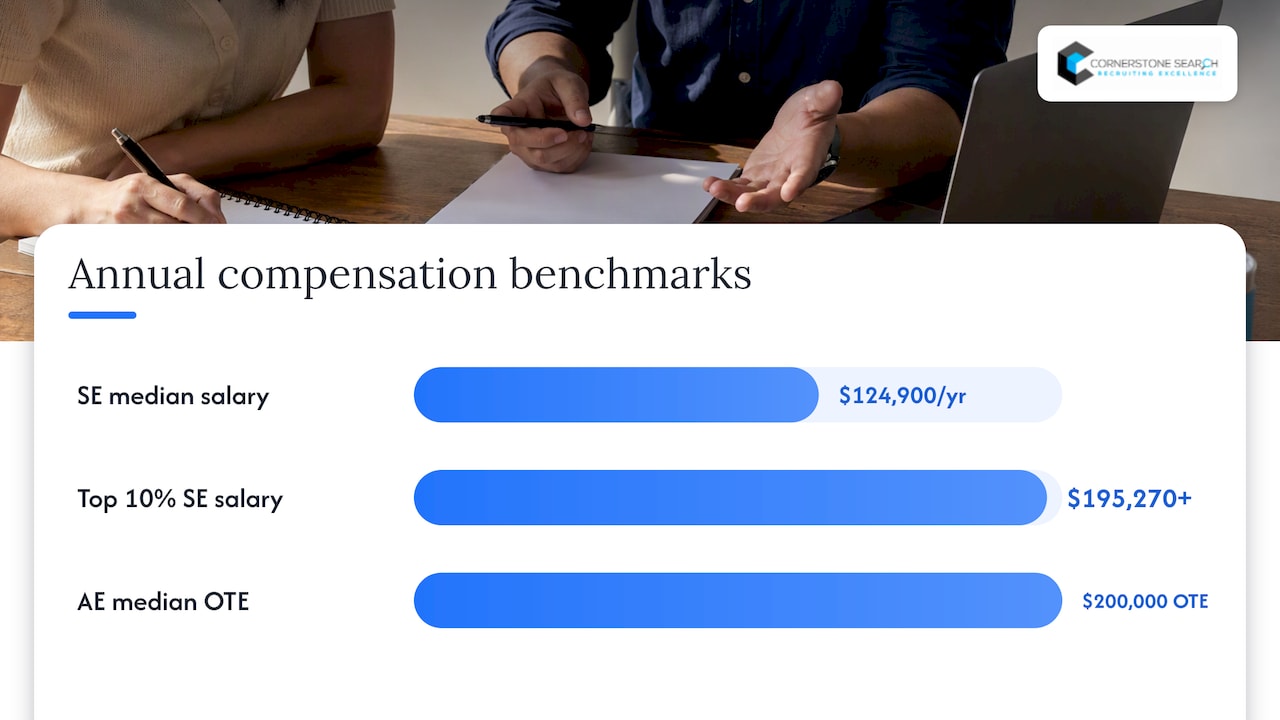
SaaS is its own market. SEs here carry variable comp tied to team or territory quota, and the best ones know exactly what they’re worth. Compare that with the benchmark for the AE they support: The Bridge Group’s 2026 research shows median AE OTE at $200,000. Your SE will not be paid like your AE, but if the gap is huge, expect your best candidates to ask why.
A few practical rules:
- Publish a range. Candidates skip posts without one.
- Split base and variable honestly. An SE with 50/50 split and no clear quota link will smell a trap.
- Don’t lowball because “it’s a support role.” It isn’t. Strong SEs move win rates.
- Cash is not the only lever. Equity matters at a startup. Explain it in plain terms, not buzzwords.
Where good sales engineers come from
The best SEs are usually employed, happy enough, and not looking at job boards. Posting and praying gets you applicants. It rarely gets you the person who just crushed a complex enterprise POC at your closest competitor’s neighbor.
Four sources that actually work:
- Companies that sell something like yours. Same buyer, same technical depth, same sales motion.
- Your own customers. Someone who used your product as an admin or engineer already knows where it breaks.
- Support and implementation teams. Some of your best SEs are hiding in solutions engineering, consulting, or customer support.
- Referrals from your top AEs. Ask who they wish they had on every deal. Then go find that person.
A referral is a lead, not a verdict. Check the work.
Screening: what to look for in the first call
You have thirty minutes. Skip the résumé tour. Ask these:
- “Walk me through your last deal you helped win. What was your actual role?” Listen for “I” and “we” and which one dominates. Real SEs can say exactly what they built, ran, or fixed.
- “Tell me about a deal you lost. Why?” If they blame the AE, the pricing, or the market every time, pass. Good SEs own their piece.
- “What’s the hardest technical objection you’ve handled?” You want a story with a buyer, a problem, and an outcome.
- “How do you split time between demos, POCs, and paperwork?” This shows if they understand the job or just the stage.
- “Who’s your best AE partner and why?” The answer tells you how they work with sales.
One more thing. Verify the track record. A title is not a number. Ask what the team hit, what the AEs they supported hit, and what the deals looked like. Only 48% of sales reps hit annual quota in 2026, down from 51% in 2024. Half the floor is missing quota. Find out which half your candidate stood on.
The interview process that works
Informal chats feel friendly and tell you almost nothing. SHRM’s guidance on executive hiring points to consistent interviews and standard assessments as a route to a more productive process and faster decisions. That holds for SEs too.
Keep it to four or five stages, and give each one a job:
- Recruiter or founder screen. Motivation, comp, basics.
- Hiring manager deep dive. Past deals, technical depth, judgment.
- Live demo or scenario. More on this below.
- Panel with AEs and one technical teammate. Would they want this person on their deals?
- Founder or CRO close. Vision, fit, offer.
SHRM data shows screening and interviewing phases each average roughly 8 to 9 days for executive and non-executive roles. Beat that and you win candidates. The good ones have other offers by day ten.
The demo test
Don’t ask for a canned demo of your product. Candidates can’t know it yet, and you’ll just reward whoever prepped hardest.
Give them a scenario instead. Something like: “A VP of IT at a 2,000-person company says your product won’t pass their security review. Here’s the discovery note from the AE. You have 20 minutes. Run the call.” Use a real anonymized situation from your pipeline.
Watch for:
- Do they ask questions before they talk?
- Can they simplify a technical point for a non-technical buyer?
- Do they know when to say “I don’t know, I’ll find out”?
- Do they bring the AE in, or run over them?
That last one matters more than founders think. An SE who hogs the room loses the relationship.
Reference checks
Backdoor references are a gossip casino. Someone’s old coworker has an axe to grind, or a crush, or never worked with them. Don’t bet a six-figure hire on that.
Ask for named references: the AE they partnered with, their manager, and ideally a customer. Then ask about specifics. What deal? What did they do? What would you change about how they worked? If a reference can’t explain the how and why of a deal won or lost, you’ve learned something.
Look for people who can work with modern tools
The SE job is changing. Gartner’s March 2026 research argues that agentic sales engineers can compress new seller ramp from months to weeks by taking over repetitive demo work. You don’t need to buy that whole pitch to see the direction. Less time on the same demo for the fortieth time. More time on strategy and the hard technical conversation.
So when you interview, ask how they’ve used tools to save time. Not hype, specifics. What did they automate? What did they refuse to automate? Good SEs have opinions. Bad ones have buzzwords.
Also keep in mind that you can’t always hire your way out of a revenue gap. Gartner notes that hiring freezes and tighter budgets push sales leaders to unlock capacity from existing headcount. If an SE seat is open, make sure that seat is the real bottleneck before you spend on it.
Ramp time is the hidden cost
Hiring is the cheap part. Ramp is where the money goes.
The Bridge Group found average AE ramp reached 6.2 months in Q2 2026, an all-time high. Median tenure companies now require went up to 3.7 years, from 2.7 in 2022. Your SE’s ramp won’t match an AE’s exactly, but the pressure is the same: deals are more complex, buyers are more skeptical, and nobody gets a free pass for six months.
To shorten ramp:
- Write a 30-60-90 day plan before they start. Specific deals, specific demos, specific certifications.
- Pair them with your best AE on day one.
- Give them access to recorded calls, win/loss notes, and your product sandbox.
- Set one early win, like running a full discovery call solo by week three.
If the new SE has no plan, they’ll spend 60 days wandering.
What a bad sales engineer hire costs
We’ve seen this over and over. The bad hire doesn’t blow up on day one. It bleeds. AEs start avoiding the SE. Deals slip. The founder jumps back on demos. Three months later everyone knows, nobody says it.
SHRM’s 2025 benchmarking found executive hires cost nearly 7x more per hire than non-executive ones, at $35,879 compared with $5,475. An SE is not an executive, so that’s not your exact number. But the lesson holds. Senior technical hires cost real money to find, and cost more when you miss. We break down the math in our piece on how a bad sales hire can cost $150,000.
A search fee is a known number. A wrong hire is a guess, and the guess is usually bigger.
Perspective: why SE hires fail, and how we avoid it
We’ve placed more than 1,200 sales professionals since 1996. Sales engineers are some of the hardest searches we run, because the role sits between two worlds. Too much sales and the person can’t handle a technical deep dive. Too much tech and they can’t read a buyer.
Here’s what we’ve learned:
- The intake call decides the search. If we don’t sit down with the founder or sales leader and nail the archetype, comp, and dealbreakers, nothing else matters. Our searches are founder-led at intake for exactly this reason.
- Résumés lie by omission. “Supported $20M in pipeline” can mean they ran the deals or sat on the call. We ask for the story, then ask again.
- Speed beats polish. The best SEs get picked up fast. Our average time from search kickoff to offer acceptance is 21 days, and we keep the process tight so good people don’t drift.
- Retention is the real scorecard. A placement that quits in six months isn’t a win. Our one-year retention is 93%.
If you want the longer view on timelines, see how long a SaaS sales search takes.
— Rich Rosen
Should you use a recruiter?
Sometimes yes, sometimes no.
Do it yourself if you have a recruiter in-house, a strong network, and time. Founders with two weeks of calendar space and a big referral pool can pull it off.
Bring in outside help if:
- The seat has been open for more than 60 days and deals are suffering.
- Your founder is still the SE and every hour on hiring is an hour not selling.
- You need a particular profile, like someone from a specific vertical or tech stack.
- You’ve already missed on one SE hire and can’t afford a second miss.
We do this for SaaS and software companies through both contingent and retained search. If you want the SE seat filled by someone who has been vetted against real deals, see our software sales recruitment service, or read how our fast executive search runs in 21 days. Not sure about the model? Our guide on retained versus contingency search lays it out.
Want to talk about your open SE seat? Start at Cornerstone Search.
Common mistakes when you hire sales engineers
- Hiring a warm body. Any technical person who can talk is not a sales engineer.
- Skipping the AE panel. Your AEs live with this person. Let them vote.
- Overweighting the demo. A perfect demo is easy to rehearse. Discovery is not.
- Ignoring comp reality. If the offer is low, the best candidates will just say “no thanks” and you’ll never hear why.
- Dragging the process. Three weeks of silence kills offers.
- No ramp plan. You hired a pro, then left them alone.
- Hiring for today’s product only. Your product will change. Hire someone who learns.
FAQ
What qualifications do you need to be a sales engineer?
The BLS lists a bachelor’s degree as the typical entry-level education, usually in engineering, computer science, or a related field. In SaaS, hands-on experience often counts as much as the degree. Look for technical depth, deal experience, and clear communication.
How much does it cost to hire a sales engineer?
Three buckets: salary and variable pay, recruiting cost, and ramp time. The BLS median pay is $124,900 per year across industries. Recruiting fees depend on whether you run it in-house or use search, and ramp can run months. Add the three before you decide the seat is cheap.
How long does it take to hire a sales engineer?
SHRM puts the median time to fill around 1.5 months for both executive and non-executive roles. A tight process with a focused recruiter can be quicker. Our average from kickoff to offer acceptance is 21 days.
How many sales engineers do I need per account executive?
It depends on deal size and product complexity. Small, simple deals can run with one SE for several AEs. Complex enterprise deals often need much closer coverage. Look at where deals stall in your pipeline. If it’s in technical review, you’re short.
Sources
- Sales Engineers, Occupational Outlook Handbook, U.S. Bureau of Labor Statistics
- Occupational Employment and Wage Statistics: Sales Engineers, BLS
- AE Models, Motions & Metrics: 2026 Research Report, The Bridge Group
- Exec Recruiting Costs Are Surging: 8 Ways to Slash Your Spend, SHRM
- SHRM Releases 2025 Benchmarking Reports
- Innovation Insight: Agentic Sales Engineers Fast-Track Growth by 4 Months, Gartner
- 3 Ways to Unlock Sales Capacity With Existing Headcount, Gartner