

Most bad solutions consultant hires start the same way. The AEs are drowning in demos, the founder says “we need a technical person,” and a job post goes up with a list of nice-to-haves. Three months later you own a great demo-giver who can’t run a proof of concept, or a brilliant engineer who bores the CFO to sleep.
I’ve placed 1,200+ sales, presales and executive people since 1996. The pattern holds. The company that hires well picked the job first and the person second. This guide shows how to do that, what to pay, how to test candidates, and where to get help when you can’t afford a miss.
TL;DR
- Write the charter before the job post: which deals the consultant joins, what they own, and where they hand off to the AE.
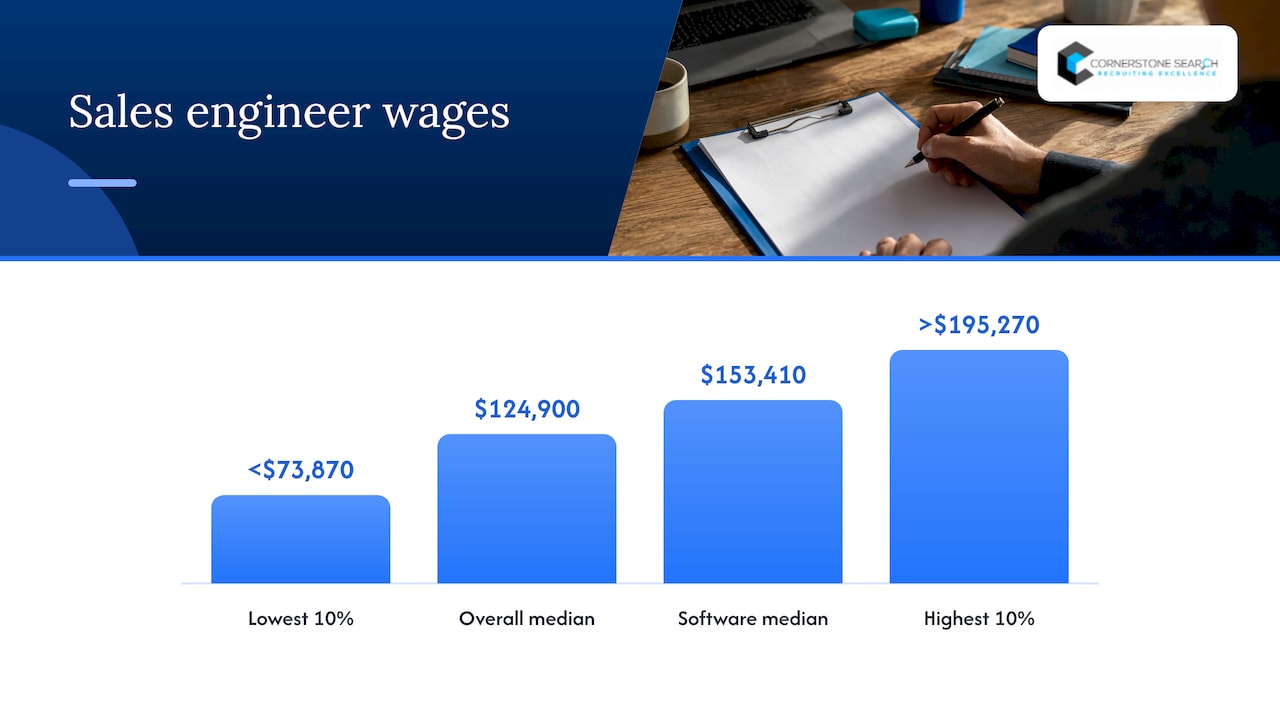
- Budget real money. The BLS puts median pay for sales engineers at $124,900, and software publishers pay more.
- Test the work, not the résumé: a live discovery call and a demo with a curveball tell you more than any interview.
- Check pay-range posting rules in your state before the job goes live.
- If a miss would hurt your quota, run the search with a specialist who works SaaS sales hiring every day.
Table of Contents
- What a solutions consultant actually does
- Write the charter before you write the job post
- What to pay a solutions consultant
- The skills that matter, in order
- Where to find them
- How to interview so you learn something
- Mistakes that cost the most
- When to bring in a specialist
- Perspective: why we start with the charter
- Hire your solutions consultant with Cornerstone
- FAQ
- Sources
What a solutions consultant actually does
Same job, many titles: solutions consultant, solutions engineer, sales engineer, presales. They sit next to the AE and handle the technical half of the sale. PreSales Collective lists the core work as technical discovery, tailored demos, solution design, value engineering, building technical champions, proofs of concept and partnering on deal strategy.
The AE owns the relationship and the number. The consultant owns the “will this actually work for us?” question. When that question gets a confident, honest answer, deals move. When it gets mush, deals stall in the evaluation stage and nobody knows why.
One thing trips up first-time hirers. This is a sales role. The best consultants I’ve placed could have been AEs. They read the room, they know when to stop talking and they care about the close. A pure engineer who hates customers will not work, no matter how sharp.
Write the charter before you write the job post
Here’s the mistake I see most. A founder describes a person (“technical, but personable, five years experience”) and never describes the job. Then every interviewer judges against a different picture.
A Rework guide on sales engineering hiring separates three charters: demo support, proof-of-concept ownership and solution design. Pick one first. Choose the candidate profile after.
Put these on one page:
- Deals in scope. All deals? Only deals over a set size? Only enterprise?
- What they own. Discovery calls, demos, POCs, security questionnaires, RFPs.
- What they don’t own. Pricing, contract terms, post-sale implementation.
- Handoff points. When does the AE bring them in, and when do they step out?
- Reporting line. To sales, to a presales lead, or to product? Each choice changes who they become.
- Technical depth. Can they stand up an integration, or just explain one?
If you can’t fill in that page, you’re not ready to interview. We cover the same ground in our charter-first playbook for sales engineer hiring.
Set the success measures now
Pick measures while the role is still on paper. Rework suggests supported-deal win rate, POC-to-close time and AE satisfaction. Those are fair. Win rate on supported deals versus unsupported deals is the one I’d start with, because it shows whether the hire changed anything.
Then make the first 90 days concrete. Who do they shadow, which demos do they own by week four, which POC do they run by week eight? A system for tracking those commitments, like this time management approach for consultants, helps the new hire keep client work and internal tasks from colliding.
What to pay a solutions consultant
Pay is where good candidates get lost. Founders anchor on an engineer’s salary and forget this person is also on the revenue team.
The closest government benchmark is the sales engineer category. The BLS reports a median annual wage of $124,900 for May 2025. The lowest 10 percent earned under $73,870 and the highest 10 percent earned over $195,270. In software publishers the median was $153,410. BLS counts commissions and bonuses in those wages.
What that means for you:
| If your hire is | Plan on |
|---|---|
| First presales hire at an early-stage startup | Toward the lower half of the range, with equity doing real work |
| Experienced consultant in a Series B or later SaaS company | Around or above the software-publisher median |
| Senior or lead who will build the team | Toward the top of the range |
Those are my rules of thumb from placements, not BLS figures. Use the BLS numbers as the floor of your thinking, then check your own market.
Split matters too. Most presales roles pay a base plus a variable tied to team quota or deal outcomes. Keep the variable meaningful. If it is token, you hire people who treat the job as support. If it is huge, you get a consultant who fights AEs for credit. Tie it to the team number and you get a partner.
Pay posting and wage rules you can’t skip
Some states require a pay range in the job posting. An ESI summary of 2026 pay transparency rules lists different employer thresholds, including California at 15 or more employees, New York at 4 or more and Washington at 15 or more. Remote roles can pull you in, so check the rules where the candidate will work, not only where you sit.
Also confirm classification. The Fair Labor Standards Act sets minimum wage and overtime beyond 40 hours a week, and exemption depends on a pay level plus a duties test, per K&L Gates’ U.S. employer guide. The same guide notes state and local rules can add requirements. Your employment lawyer should sign off on the classification and the posting before it goes out.
The skills that matter, in order
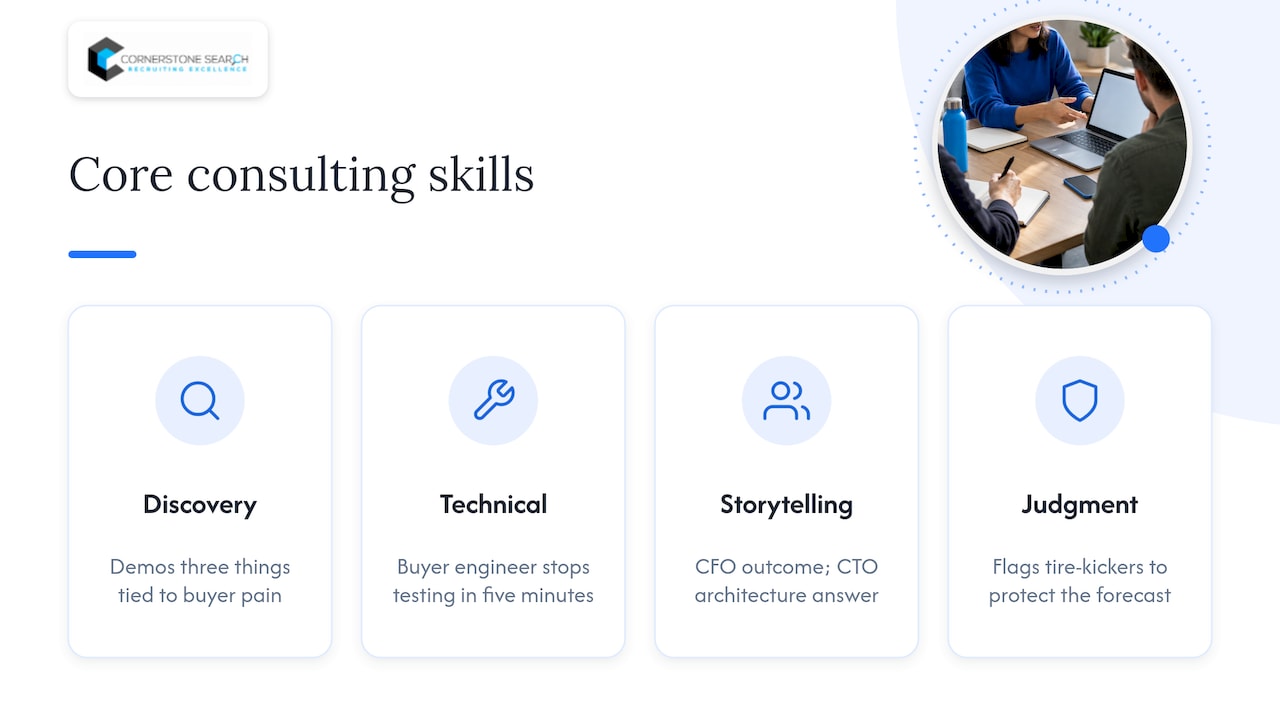
Every job post lists twenty skills. Four decide whether the person works.
1. Discovery. Can they ask questions that surface the real pain, not the stated one? A weak consultant demos the whole product. A strong one demos three things, because discovery told them those three matter.
2. Technical credibility. Not that they know everything. They know your category well enough that a buyer’s engineer stops testing them in five minutes.
3. Storytelling under pressure. Can they turn a feature into a business outcome for a CFO and into an architecture answer for a CTO, in the same meeting?
4. Judgment on deals. Do they know when a deal is real? Great consultants tell the AE the truth: “this buyer is kicking tires.” That honesty protects your forecast.
Notice what’s missing: years of experience. I’ve placed people with three years who beat people with ten. What you want is a track record in your type of sale. Selling to developers differs from selling to finance teams. An enterprise POC takes weeks, a mid-market demo takes an hour. Match the motion.
Where to find them
The best consultants are employed, doing fine and not looking. They don’t answer a job post. They answer a call from someone who understands their world.
Your real options, by type:
- Your own network and your AEs’ networks. Ask every AE who the best consultant they ever worked with was. Good lead source, small pool.
- Job postings. Fine for junior hires. For a senior consultant, you mostly attract the unemployed and the unhappy, with a few exceptions.
- A specialist search partner. This reaches the passive crowd. We go deeper on that in why the SaaS sales talent market is so competitive.
One warning on job boards. A search for this role mostly returns open jobs, including ones with a similar title in other industries. A consultant at an HR software company and a consultant at an infrastructure company have different skills. Be specific about the product category you sell.
How to interview so you learn something
Standard interviews reward talkers. This job is about talking, but about the right kind. Here’s the sequence I’d run.
Round one: a 30-minute screen
Ask them to walk through their last three deals. What did they own? What was the deal size? Where did it stall? Vague answers on specifics are a red flag. Real consultants remember the POC that blew up.
Round two: live discovery
Have an AE or the founder play a buyer with a messy problem. Give the candidate 20 minutes. Score them on questions asked, not answers given. Did they dig under the first answer? Did they find the budget owner?
Round three: the demo with a curveball
Give them a short brief a few days ahead, then change one fact in the room. The buyer cares about security, not reporting, say. Watch whether they adapt or push through the script. Scripted demos lose deals.
Round four: the AE panel
Your AEs will work with this person daily. Let them vote. Ask one question: “Would you want them on your biggest deal?” If two of three hesitate, listen.
Check references like a skeptic
Call AEs they supported, not just managers. Ask: “Did deals move faster with them on?” and “What did you have to cover for?” The second question gets the truth.
Our walk-through of the sales engineer recruiting process lays out the full sequence step by step.
Mistakes that cost the most
- Hiring for the demo. A smooth demo is the easy part. POC ownership and discovery are where deals are won.
- Hiring too early. If you have two AEs and few deals, you don’t need a full-time consultant yet. Founder-led technical selling is fine until volume says otherwise.
- Hiring too slowly. Strong candidates take other offers within days. Long loops lose the best ones.
- No ramp plan. A new consultant needs product depth, your ICP, your competitors and your deal patterns. Without a plan, ramp stretches and the AEs lose faith.
- Wrong reporting line. A consultant reporting to product drifts toward roadmap work. One reporting to sales stays close to deals.
- Mismatched comp. Pay an engineer’s salary with no variable and you’ll get engineer behavior.
Every one of those has a price: lost quota, wasted ramp, a restarted search. A mis-hire in a small team is felt for quarters, not weeks.
When to bring in a specialist
You can run this search yourself. Many founders do. It works best when you’ve hired the role before and have time for 30 first calls.
It works worst when you’re also closing deals, running a board meeting and fixing the pricing page. The search gets squeezed into evenings, interviews get sloppy and the loop drags.
That’s where a specialist earns the fee. At Cornerstone Search, the average time from search kickoff to offer acceptance is about three weeks. Every search is run by a recruiter with deep SaaS sales experience, and we’ve placed over 1,200 sales professionals since 1996 with 93% one-year retention. For help with the hiring process on your side, see how we work as a recruiting partner rather than a vendor.
Perspective: why we start with the charter
I’ve watched founders spend weeks on a search that was doomed on day one. Not because the candidates were bad. Because the company hadn’t decided what the job was.
So we start there. Our intake is founder-led. We ask which deals the consultant joins, who the AE is, what happens when a POC drags, and what a great first year looks like. That conversation takes an hour. It saves months.
Then we go find people who’ve done that exact job. Not people with a matching title. People who ran POCs for your type of buyer and closed the deals. We work SaaS sales hiring all day, so we already know many of them, or know who does.
Speed matters because strong presales people don’t sit on the market. But speed without precision is just a faster mis-hire. We screen on discovery, judgment and deal history, then we put two or three real finalists in front of you, not a stack of résumés.
If you’re about to hire your first or fifth solutions consultant, get the charter right and move fast. That’s the whole game.
Rich Rosen
Hire your solutions consultant with Cornerstone
If you want the role filled by someone who has already done it, our software sales recruitment service covers presales, sales engineers, account executives and sales leaders for SaaS and software companies. We work on contingent and retained search. For senior or team-building roles, our executive search recruitment service fits better.
Tell us about the deals, the AEs and the number you need to hit. We’ll tell you what the hire should look like. Start at cornerstonesearch.com.
FAQ
What is the difference between a solutions consultant and a sales engineer?
In most SaaS companies, very little. Titles vary by company, and the work overlaps: discovery, demos, POCs and technical questions. Some firms use “sales engineer” for more hands-on technical work and “solutions consultant” for more business-facing work. Judge the job description, not the title.
How much should I budget for a solutions consultant?
The BLS reports a median of $124,900 for sales engineers in May 2025, and $153,410 in software publishers. Budget base plus variable, and adjust for your city, stage and the seniority of the hire. Equity matters more at early stage.
When should a startup make its first solutions consultant hire?
When AEs spend a real share of their week on technical questions and demos, and deals are slowing at the evaluation stage. Before that, founder-led technical selling usually carries the load. Hire when volume and deal complexity make the founder a bottleneck.
Do I have to post a salary range?
In some states, yes. ESI’s 2026 summary lists thresholds such as 15 or more employees in California and 4 or more in New York. Rules depend on where the worker is based, so confirm with your employment attorney before posting.
Sources
- Sales Engineers: Occupational Outlook Handbook, U.S. Bureau of Labor Statistics
- What is a Solutions Consultant? A Guide to the Presales Role, PreSales Collective
- Sales Engineering Hiring: Technical Depth vs Commercial, Rework
- Pay Transparency Policy For Employers, ESI
- United States Employer Guide, K&L Gates