

Most bad VP of Sales hires are decided before the first interview. The founder hires too early, hires a big name, or hires someone who inherited a team and never built one. Then everyone spends nine months pretending it’s working. I’ve been recruiting SaaS sales leaders for 30 years, and this is how to avoid the usual mess.
TL;DR
- Hire your first VP of Sales when the founder is the bottleneck and a couple of reps are closing deals the same way, not when a board deck says so.
- Look for someone who has built a team and a pipeline from scratch, usually one level below VP at a company a couple of years ahead of you.
- Test the hiring record first. Ask who they recruited, how they found them, and whether those reps hit quota.
- Plan on months, not weeks, unless you run a focused search. Our average from kickoff to accepted offer is 21 days.
- A wrong VP costs you quota, reps and time. No hire beats the wrong hire.
Table of Contents
- Are you ready for a VP of Sales?
- What the job really is at your stage
- Who to look for
- How to vet a VP of Sales candidate
- Perspective: what 1,200 placements taught us
- Mistakes that sink a VP of Sales hire
- Timeline and pay
- Need help running the search?
- FAQ
- Sources
Are you ready for a VP of Sales?
Maybe not. That’s the honest answer for a lot of founders who call me.
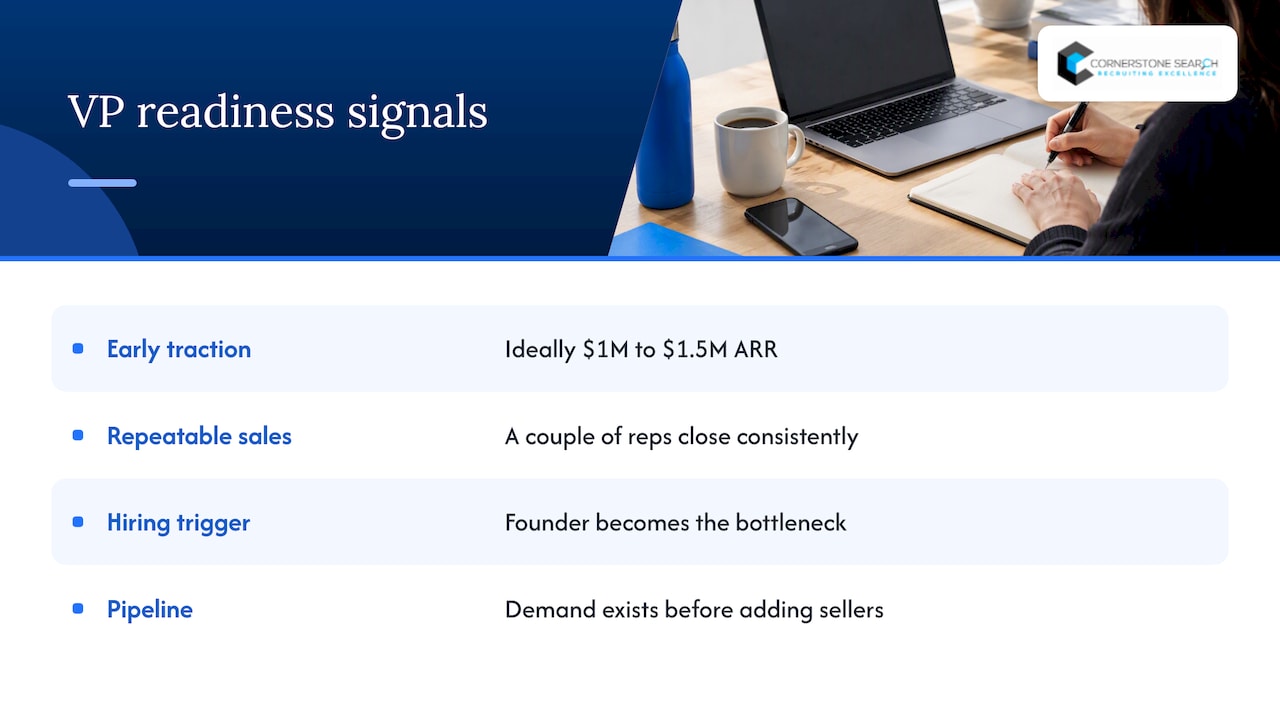
The usual guidance is that a startup is ready once it has early traction, ideally $1M to $1.5M in ARR, and a repeatable process with a couple of reps closing consistently. If nobody but you can close, a VP has nothing to scale. You’re hiring a coach for a team that doesn’t exist.
The better signal is pain. The CRO Report argues the real trigger is the founder becoming the bottleneck: deals slow down, follow-up slips, and leads go cold because you’re in three other meetings. If that’s you, you’re ready. If you’re just nervous about the number, you’re not.
One more check. Is your problem actually sales? First Round Review notes that some founders need marketing or growth leadership first, because top-of-funnel demand has to exist before you add sellers. A VP of Sales with no pipeline to work is a very expensive spectator.
We wrote a longer take on when to hire your first VP of Sales if you want the full timing breakdown.
What the job really is at your stage
Forget the glossy job description. At a startup, your first VP is a player-coach.
The first-year scorecard usually looks like this:
- Sell and learn the market personally.
- Turn the founder’s gut into a written playbook.
- Hire the first cohort of reps. SaaStr’s guidance puts the target at 8 to 10 high-performing reps in the first year.
- Install forecasting discipline and own pipeline coverage and quota attainment.
One rule I repeat to founders: at seed stage, a VP who doesn’t carry a quota and close deals in the first six months is likely to be gone by month nine. Don’t hire someone who wants to ‘manage the dashboard.’ You need hands on the phones.
That’s not a title problem. It’s a stage problem. A VP who spent a decade running managers of managers will often struggle to work close to the front line. Harness CEO Jyoti Bansal made this exact point to First Round Review: executives from organizations with six layers between them and the reps may struggle to adjust downward.
Who to look for
Here’s the pattern that works. Hire someone one level below VP at a company two or three years ahead of you in scale. Bain Capital Ventures’ field guide describes the same profile: they’ve managed small teams, closed deals, and built pipeline from scratch.
Why not the star from your biggest competitor? Because they may have taken a company from $10M to $100M, and you need $1M to $5M. Different job. Different muscles. Big logos on a LinkedIn profile prove little about what this person personally did.
A few traits I weigh heavily:
- Coachable. Egos that can’t take feedback from a founder don’t last.
- Product fluency. They have to earn the trust of your engineers and talk to buyers like they built the thing. First Round Review lists coachable, trusted by engineering, and product-fluent as critical for the first GTM leader.
- Recruiting skill. More on this below. It matters most.
- Comfort with ugly. No CRM hygiene, no enablement, no SDRs. Can they still make it work?
Keep the must-have list short. Thumbtack’s CEO told First Round Review to focus on the three most essential skills, because a laundry list gets you someone mediocre at everything. Pick three. Be ruthless.
How to vet a VP of Sales candidate
Interviews reward talkers. Sales leaders are professional talkers. So you have to dig for evidence.
Start with who they hired
Jack Altman, Lattice’s co-founder, told First Round Review that founders should focus first on whom the VP will hire. Have the candidate walk through people they recruited, how they found them, how they persuaded them, and what got in the way.
Then check the numbers. SaaStr suggests confirming the candidate hired at least 3 to 4 strong reps and finding out whether two or three of them hit quota. Separate the team they built from the team they inherited. Many can’t. That’s your answer.
SaaStr’s 2026 interview guide goes further: if a candidate can’t describe recruiting a team, especially when they only inherited one, pass.
Ask forward-looking questions
- ‘What will revenue look like 120 days after you join?’ Vague answers are a red flag. So are wildly confident ones.
- ‘What would you do in your first two weeks?’ Good answers are specific: listen to call recordings, map the CRM, book customer calls. One early-stage guide describes exactly that kind of answer.
- ‘Coach a struggling rep for me.’ Make them do it live.
- ‘Build a process from scratch on this whiteboard.’ Watch how they think.
Run a real loop
Give each interviewer a specific job and ask consistent questions. Record evaluations in the same format. First Round Review’s guidance on structured sales hiring loops says to authenticate evidence instead of accepting résumé prestige. It also flags ‘lack of conviction’ in the debrief as the root cause of many bad hires. If the room is lukewarm, believe the room.
Call the references that matter
Don’t settle for the three names they hand you. Call five to eight people, including former reps who reported to them. We built a scoring system for this: call 5 to 8 references and score a VP of Sales on 5 dimensions. A rep who quit under this leader will tell you things a former boss won’t. Backdoor calls can be a gossip casino, so keep them structured and tied to specific results.
Perspective: what 1,200 placements taught us
We started this firm in 1996, and we’ve placed more than 1,200 sales professionals since. The pattern behind failed VP hires hasn’t changed. Founders hire the résumé, not the builder.
Here’s what we do differently. Every search is run personally by a recruiter with deep SaaS sales experience, and the intake is founder-led. We sit down with you and figure out the stage, the quota reality, the ramp, and the three things this person must be great at. Then we go find people who’ve done that exact job, not people who sat near it.
Speed matters because a vacant VP seat bleeds pipeline every week. Our average from search kickoff to accepted offer is 21 days. Speed without precision just gets you a bad hire faster, so we screen on hiring record, deal history and judgment before you ever meet someone. Our one-year retention rate is 93%.
If you’re hiring your first sales leader, hire like it’s the most expensive decision you’ll make this year. It probably is.
Rich Rosen
Mistakes that sink a VP of Sales hire
I’ve seen these over and over.
- Hiring before the playbook exists. Without a repeatable process and two performing reps, SaaStr flags this as a core mistake. A VP can’t copy what doesn’t exist.
- Buying the big name too early. Great logo, wrong altitude.
- Never checking the person’s real contribution. Was it their team or the company’s brand? Dig until you know.
- Rushing. SaaStr’s playbook says it plainly: the wrong VP can cost months or years, and no hire is better than the wrong hire.
- Hiring sales when you need demand. Fix the funnel first.
- Fuzzy expectations. If you can’t write down what ‘good’ looks like at 30, 90 and 180 days, the VP can’t hit it. Milestone-based goals such as ICP meetings booked by month three or pipeline growth by month six, as BIP Ventures describes, keep everyone honest.
Not sure a permanent hire is the move yet? Read when to hire a permanent VP of Sales instead of a fractional one, or look at interim sales leadership as a bridge.
Timeline and pay
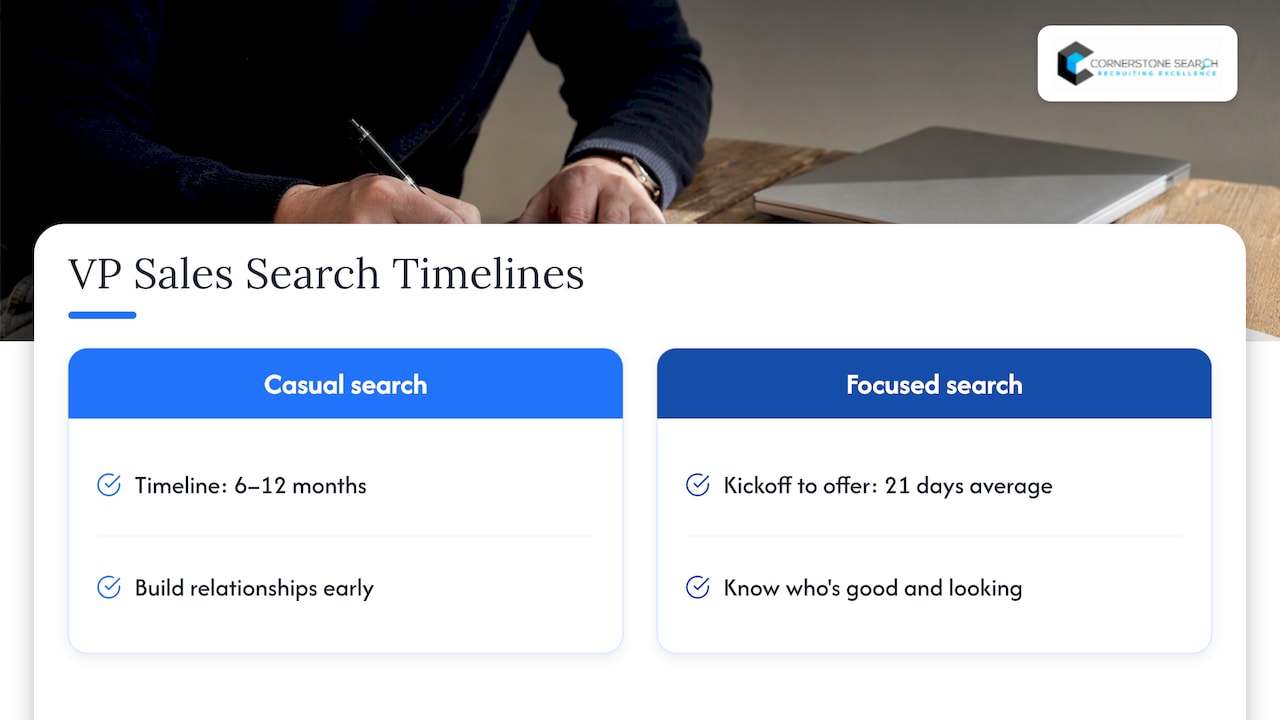
This hire is slow if you do it casually. SaaStr says it can take 6 to 12 months, so start meeting potential candidates early and build relationships before you need them. A focused search compresses that. Ours averages 21 days from kickoff to offer acceptance, because we already know who’s good and who’s looking.
On pay, expect an OTE-heavy package with an equity piece and a standard four-year vest. Ranges move with stage, location and the quota you set, so work from current numbers, not last year’s. Our VP of Sales compensation benchmarks and templates are a good place to start. Set the quota and ramp expectations before the offer, not after. Nothing sours a hire faster than a quota that was built for a company twice your size.
If you’re venture-backed, your board will have opinions. Our page on executive search for venture-backed founders covers how to keep them aligned.
Need help running the search?
We recruit sales leaders for SaaS and software companies: VP Sales, CRO, account executives, sales engineers and customer success leaders. We work on contingent and retained search, depending on the role and how fast you need it.
If you want a founder-led intake and a recruiter who has placed these roles for decades, start with our executive search recruitment service. Want to understand the difference in fee models first? Read how retained search differs from contingency. Or talk to us directly through Cornerstone Search.
FAQ
When should a startup hire its first VP of Sales?
When you have early traction, a couple of reps closing deals the same way, and you’re the one slowing deals down. Many advisors point to roughly $1M to $1.5M in ARR as a rough marker. The bottleneck signal matters more than the revenue number.
Should my first VP of Sales carry a quota?
Yes. At seed stage, a VP who doesn’t sell personally in the first six months is likely to be out by month nine, per SaaStr’s guidance. In the first 90 days, expect most of their time on selling and learning, with the rest on building systems.
How do I tell if a candidate really built a team?
Ask for names, sources and outcomes. Who did they hire, how did they find and persuade them, and did those reps hit quota? Check with the reps themselves. Someone who inherited a team will struggle to tell the recruiting story.
How long does it take to hire a VP of Sales?
Casual searches often run 6 to 12 months. A focused, specialist-run search can be much faster. Our average from kickoff to accepted offer is 21 days.
Should I hire a recruiter for this role?
If you don’t have a deep network of sales leaders, a specialist recruiter shortens the search and widens the pool. Our guide to specialized recruiters for startups explains what to expect.
Sources
- Dear SaaStr: How Do I Hire a Great VP of Sales?
- Founder-Led Sales to VP Sales: When to Make the Hire (The CRO Report)
- Dear SaaStr: I’m a Seed Stage, First Time VP of Sales
- The Playbook to Hiring Your First VP of Sales (SaaStr)
- The Top 15 Questions to Ask a VP of Sales During an Interview (SaaStr)
- BCV Field Guide: How to hire your first Head of Sales
- This GTM Leader Crowdsources Early Lessons (First Round Review)
- How Harness runs 16 startups within a startup (First Round Review)
- Assembling an Executive Leadership Team (First Round Review)
- How founders can get executive hiring right (First Round Review)
- The Anatomy of the Perfect Sales Hiring Process (First Round Review)
- Role of VP of Sales in Early Stage
- When to Transition from Founder-Led Sales to a Scalable Sales Team (BIP Ventures)