

What executive background checks actually cover
Executive background checks are not a fancier version of the standard new-hire screen. They are a different animal entirely. The stakes are higher, the scope is wider, and a miss at this level can cost you investors, customers, and your company’s reputation in one bad news cycle.
Here is what a thorough executive screen covers:
- Identity verification confirming the candidate is who they claim to be
- Criminal history including federal court records, not just state and local databases
- Employment history validation checking titles, tenure, and actual responsibilities against what the resume says
- Education and credential verification catching falsified degrees and lapsed professional licenses
- Credit history relevant for any exec with access to company funds or financial systems
- Global watchlists and sanctions because a positive match on these lists can trigger substantial fines or loss of government contracts
- Civil litigation records surfacing past business disputes, contract violations, or personal lawsuits
- Reputation and media checks including adverse media, Glassdoor patterns, and social footprint analysis
- International and cross-jurisdictional screening for candidates with global career histories
Candidate consent is not optional. Under the Fair Credit Reporting Act (FCRA), you must provide standalone written notice and get signed authorization before you run a single check. Documented policies and structured processes are not bureaucratic overhead. They are your legal protection when a hire goes sideways.
Table of Contents
- How the executive hire background check process works, step by step
- Legal requirements you cannot afford to get wrong
- Why human review beats automation for executive screening
- Best practices for SaaS companies screening executive candidates
- Cornerstonesearch places the right executive, fast
- Key Takeaways
How the executive hire background check process works, step by step
Most SaaS hiring teams treat background checks as a checkbox at the end of the process. Wrong move. By the time you are finalizing an offer, you have already invested weeks of leadership time. Get the process right from the start.
- Build your policy first. Before you screen anyone, create a written policy covering which checks apply to which roles, who handles them, and how findings get documented.
- Train your HR and legal staff. Everyone touching the process needs to understand FCRA requirements, state-level variations, and what they can and cannot ask.
- Get standalone written consent. The disclosure must be a separate document, not buried in an employment application. Get it signed before you initiate anything.
- Run identity verification first. Every other check is only as good as the identity it is attached to.
- Pull criminal records at the federal level. State and local checks alone are not enough for an executive candidate. Federal court records and international criminal history both belong in the scope.
- Verify employment history in detail. Confirm actual job titles, responsibilities, and departure reasons. Discrepancies between what a candidate reports and what former employers confirm are a red flag worth investigating.
- Validate education and credentials. Degrees, certifications, and professional licenses all need direct confirmation from the issuing institution or board.
- Run a credit check where legally permitted. For executives with financial oversight, this is standard practice. Know your state’s rules before you pull it.
- Screen global watchlists and sanctions lists. OFAC, UN, EU, and other lists apply depending on the candidate’s background and your company’s exposure.
- Conduct media and reputation checks. Adverse media, public controversies, and social footprint analysis add context no database can provide on its own.
- Review findings with your legal and hiring team together. Do not let HR make this call alone. Risk weighting requires business context.
- Follow the adverse action protocol if needed. If findings affect your decision, the FCRA requires a pre-adverse action notice with a copy of the report, a waiting period, and then a final adverse action notice.
- Document everything and retain records. Federal law requires keeping hiring records for at least one year; best practice for executives extends that to five years.
Pro Tip: Start the background check process at the conditional offer stage, not after verbal acceptance. Early checks surface conflicts like active board seats or regulatory disputes before you have burned your negotiating position.

Legal requirements you cannot afford to get wrong
FCRA compliance is not complicated, but it is unforgiving. Miss a step and you are looking at lawsuits, regulatory scrutiny, and a candidate who has every right to dispute your decision.
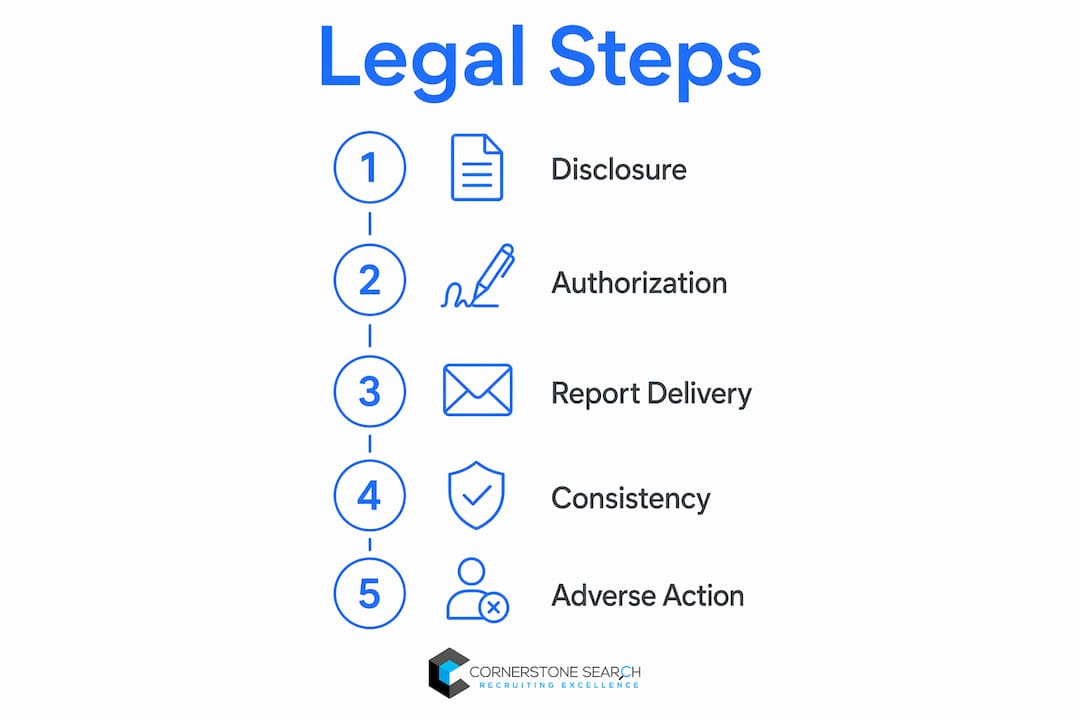
The FCRA mandates three non-negotiable steps: standalone written disclosure, signed candidate authorization, and a copy of the Consumer Financial Protection Bureau’s rights summary. These happen before the check runs, full stop.
The Equal Employment Opportunity Commission adds another layer. Your screening policies must apply consistently across all candidates. Pulling credit history on some candidates and not others based on protected characteristics is a disparate impact claim waiting to happen. The EEOC requires equal treatment regardless of race, national origin, sex, religion, disability, or age.
State law adds more complexity. “Ban the box” laws in states like California and New York prohibit criminal history inquiries until after a conditional offer. Several states also restrict credit checks to specific job categories, though executive and managerial roles typically qualify as exempt. Know your jurisdiction before you pull anything.
Adverse action has a two-step process. First, send a pre-adverse action notice with the report attached and give the candidate a reasonable window to respond. Then, if you proceed, send the final adverse action notice with the candidate’s rights under the FCRA clearly stated.
Why human review beats automation for executive screening
Automated reports are static. They pull what is in a database at a point in time and hand it back to you. For an entry-level hire, that is probably fine. For a CRO or VP of Sales who will control your pipeline, your customer relationships, and your growth narrative, it is not enough.
Candidates for senior roles often sanitize their digital footprint. Human analysts catch what automation misses: unexplained timeline gaps, board roles quietly dropped from a LinkedIn profile, employment dates that do not line up across sources. A machine takes what it reads at face value. A skilled analyst notices when the logic does not hold.
The best approach blends AI for broad data aggregation with human analysts for interpretation. AI can surface a pattern across thousands of records fast. A human decides what it means in context, including regional legal nuances and cultural differences in how risk is reported across jurisdictions. For a candidate with career history across three countries, that distinction is the difference between a defensible hire and a governance failure.
Executive screening is also a board-level governance tool, not just an HR task. Regulators and investors now expect documented due diligence on leadership appointments. A bad hire that surfaces post-close is not just an HR problem. It is a headline.
Best practices for SaaS companies screening executive candidates
SaaS executive hires carry specific risks most generic hiring guides ignore. Your CRO has access to your entire pipeline, your customer data, your pricing strategy, and your growth model. A VP of Sales with a history of channel conflicts or a CTO with undisclosed equity in a competitor is not just a bad hire. It is a liability.
- Start early and document every step as a governance record. Early screening surfaces conflicts like active board seats or regulatory disputes before you finalize terms.
- Customize the scope by role. A VP of Sales needs employment and credit checks. A CTO needs IP and technical credential verification. A CFO needs deeper financial and litigation history.
- Be transparent with candidates throughout. Executives expect the process. Silence breeds suspicion and kills deals.
- Use providers experienced with executive-level complexity, not generic consumer-grade tools. The talent due diligence process for senior hires requires a different standard.
- Train your internal team regularly. FCRA rules, state-level restrictions, and data privacy laws shift. Your process needs to keep up.
- Integrate findings into onboarding and contract negotiations. If a check surfaces a residual risk you can live with, document it and address it contractually. Do not pretend it did not happen.
- Apply consistent standards across all candidates to avoid disparate impact claims under EEOC guidance.
- Retain all records for at least five years for executive hires, given the statute of limitations for FCRA claims.
Pro Tip: For SaaS executives with international career history, require a dedicated cross-border screen with local-language analysts. Risks get lost in translation, literally, when you rely on a single English-language database.
Cornerstonesearch places the right executive, fast
Cornerstonesearch has placed over 1,200 sales professionals in SaaS and software companies since 1996. The average time from search kickoff to offer acceptance is 21 days. Speed matters, but not at the cost of getting the hire right.

Every search Cornerstonesearch runs includes the kind of candidate vetting that protects your pipeline, your investors, and your board. The network is deep, the process is documented, and the focus is exclusively on SaaS and software sales leadership. If you are hiring a CRO, VP of Sales, or senior sales executive and you need it done right the first time, start your search here.
Key Takeaways
Executive background checks require layered verification, legal compliance, and human judgment to protect a SaaS company’s pipeline, reputation, and investor confidence.
| Point | Details |
|---|---|
| Scope exceeds standard checks | Executive screens include federal criminal records, global watchlists, credit history, civil litigation, and cross-border verification. |
| FCRA compliance is mandatory | Standalone written disclosure, signed consent, and a two-step adverse action process are required before and after any check. |
| Human review catches what automation misses | Analysts identify timeline gaps, dropped board roles, and cross-jurisdictional risks that static automated reports overlook. |
| Document everything for five years | For executive hires, retain all background check and hiring records for five years, which is considered best practice to ensure compliance and risk mitigation. |
| Cornerstonesearch | Places SaaS sales executives with a 21-day average from search kickoff to offer, with vetting built into every search. |