

TL;DR:
- Board hiring focuses on governance fit and long-term strategy, not speed or immediate results.
- The process involves careful skill analysis, relationship-building, and thorough due diligence to ensure proper oversight and board chemistry.
Board-level hiring decisions are defined by governance alignment, long-term strategy, and relational candidate vetting rather than speed or transactional recruiting. Most executives understand how to hire a VP of Sales. Far fewer understand how board recruitment actually works, and the gap between those two processes is enormous. The board hiring process runs on a different clock, follows different rules, and demands a different kind of judgment. Get it wrong and you don’t just miss quota. You compromise fiduciary oversight, board chemistry, and the organization’s ability to navigate its next three to five years.
How board-level hiring decisions work: the core framework
Board hiring is not executive hiring with a fancier title. The entire framework shifts. Where traditional executive recruitment strategies focus on functional competency and near-term performance, board member selection criteria center on governance fit, strategic alignment, and the candidate’s ability to operate within a fiduciary structure.
The National Association of Corporate Directors (NACD) and governance bodies like theBoardlist define the standard: board hiring must align leadership selection with enterprise-wide risk management and the long-term strategic roadmap. That means you are not filling a role. You are shaping the oversight architecture of the organization.
Confidentiality is another defining feature. Candidates at this level do not submit resumes. They are cultivated through trusted networks, quiet conversations, and relationship-based outreach. The process requires patience and discretion that most operational hiring cultures are not built for.
What are the key phases of the board hiring process?
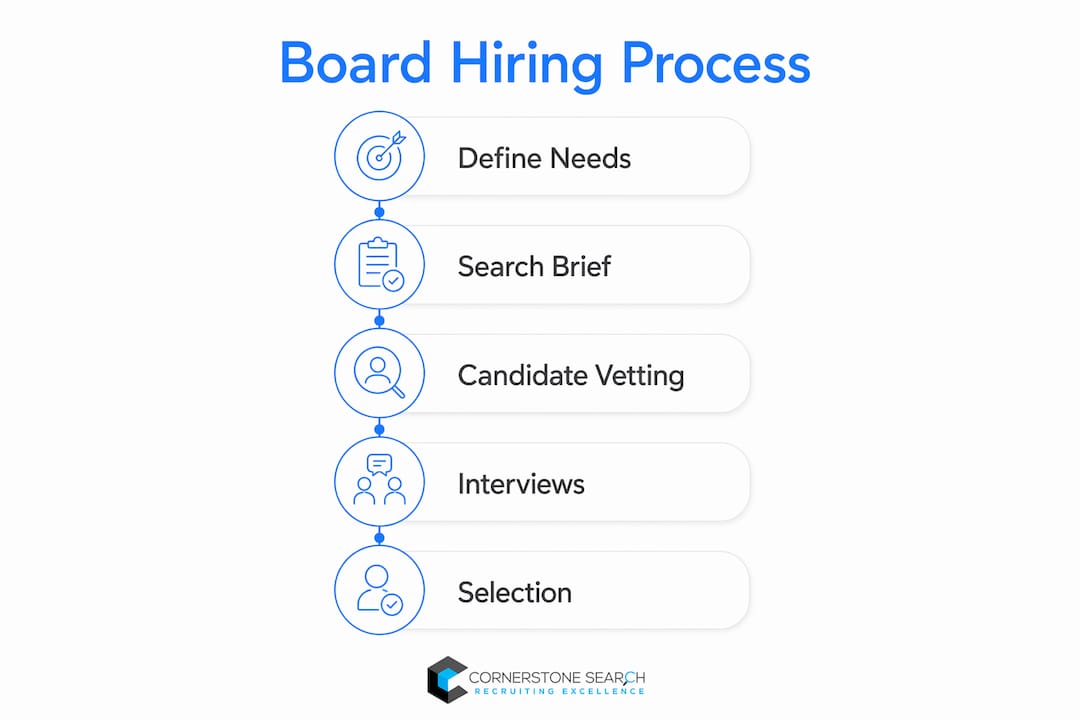
A well-run board search follows a clear sequence. Compress it and you sacrifice quality. Drag it out and you lose the best candidates to competing opportunities. A well-managed board search typically spans 10 to 16 weeks from initial brief to appointment. That timeline is not arbitrary. It reflects the number of touchpoints required to properly assess governance fit.
Here are the core phases:
-
Skills gap analysis. The board maps its current composition against a three to five year strategic plan. A skills matrix identifies capability gaps in areas like cybersecurity, ESG, international markets, or financial oversight. This step defines what you are actually looking for before anyone starts making calls.
-
Search brief development. A well-crafted board search brief defines specific experience and capability needs with clear inclusion and exclusion criteria. It covers tenure expectations, remuneration structure, diversity requirements, and the strategic context the candidate will operate in.
-
Candidate sourcing. Boards source candidates through existing director networks, executive search firm relationships, and governance organizations. 15% of board placements come through governance organizations like NACD or theBoardlist, which specialize in surfacing diverse and first-time board candidates. The rest come through trusted referrals and search firm pipelines.
-
Relational engagement. This is where board hiring diverges most sharply from traditional recruiting. Candidates are engaged through confidential, informal conversations. Dinners, one-on-ones, and low-pressure check-ins replace formal interview panels. The goal is chemistry and cultural read, not just credential verification.
-
Due diligence. Due diligence covers professional background, public disclosures, social media, and conflicts of interest. This step is non-negotiable. One missed conflict of interest can create regulatory exposure or reputational damage that takes years to repair.
-
Formal appointment and onboarding. The board votes, documentation is executed, and a structured onboarding plan begins. This is not the finish line. It is the start of integration.
Pro Tip: Build your search brief before you start any outreach. Boards that skip this step end up evaluating candidates against vague criteria and making decisions based on familiarity rather than fit.
How do boards evaluate and select candidates?
Evaluation at the board level is part science, part art, and a lot of relationship reading. The skills matrix gives you the science. The informal interactions give you everything else.
Here is what strong board evaluation actually looks like:
- Scenario-based questioning. Boards assess how candidates think through governance challenges, not just what they know. “Walk me through how you handled a CEO performance issue” reveals more than any resume line.
- Chemistry assessment through informal settings. Board candidates mostly face relational assessments such as dinners and informal conversations. Behavioral fit in board dynamics is judged through social engagements, not formal panels.
- Back-channel referencing. Boards call people the candidate did not list as references. This is standard practice at this level and it surfaces information that structured references never will.
- DEI integration from the start. Integrating DEI mandates in candidate criteria from the beginning of the search improves board composition and governance outcomes. Boards that treat diversity as an afterthought end up with homogeneous slates and weaker decision-making.
- Conflict of interest screening. Every candidate’s existing board seats, business relationships, and financial interests get mapped against the organization’s competitive and regulatory environment.
The distinction between competency and chemistry matters here. You can verify competency through credentials and track record. Chemistry only shows up in the room. That is why the informal touchpoints are not optional extras. They are the actual evaluation.
Pro Tip: Do not skip the back-channel reference. Call two or three people who served on the same board as your candidate. Ask about their listening skills, their willingness to challenge management, and how they behave when the room disagrees with them.

What are the common pitfalls in board-level recruitment?
Most board hiring failures are not caused by bad candidates. They are caused by bad process. Here is where boards consistently get it wrong:
- Reactive recruitment culture. 52% of boards recognize the need for proactive recruitment, but 19% do not treat board hiring as a priority. Boards that wait for a vacancy to appear before starting a search always end up rushing, and rushed searches produce compromised outcomes.
- Default choices and bias. When the nominating committee chair controls their own succession process, bias is almost guaranteed. Appointing an unconflicted committee leader for board succession avoids bias and improves process fairness. This is not a nice-to-have. It is a governance requirement.
- Compressed timelines. Boards that try to close a search in six weeks instead of twelve get whoever is available, not whoever is right. Quality and speed are a trade-off at this level.
- Vague role specifications. Without a clear search brief, every candidate looks plausible and none look perfect. Vague mandates produce vague decisions.
- Weak onboarding. Appointment is not integration. New directors benefit from attending board meetings as observers before their formal start date. That observation period accelerates relationship-building and helps new members understand board dynamics before they are expected to contribute.
“High-functioning boards treat recruitment as a continuous, year-round dialogue rather than episodic filling of vacancies. The boards that struggle most are the ones that only think about director recruitment when a seat opens up.” — NACD Director Recruitment Research
Annual board evaluations are the other piece most organizations skip. A structured annual review of board composition against the current strategic plan tells you where gaps are forming before they become urgent. That is how you stay ahead of the vacancy instead of reacting to it.
How do strategic risk and governance shape board recruitment decisions?
The board’s role in hiring is fundamentally different from management’s role. Management hires for execution. The board hires for oversight, governance, and long-term risk management. That distinction shapes every candidate decision.
| Strategic Consideration | How It Influences Candidate Selection |
|---|---|
| Enterprise risk framework | Candidates need experience identifying and governing systemic risk, not just operational risk |
| ESG and regulatory exposure | Boards increasingly require directors with sustainability and compliance credentials |
| Geopolitical complexity | Global organizations need directors who understand cross-border regulatory and political risk |
| Technology disruption | Cybersecurity and AI governance competencies are now baseline requirements for many boards |
| Executive compensation oversight | Directors must understand how pay structures align with long-term shareholder value |
Scenario-based assessments during the evaluation phase test whether candidates can actually think at this level. Asking a candidate how they would respond to a material cybersecurity breach, or how they would evaluate a CEO’s performance during a strategic pivot, reveals governance instincts that credentials alone cannot confirm.
Structured evaluation frameworks also reduce unconscious bias. When every candidate is assessed against the same scenario set and the same skills matrix criteria, personal familiarity carries less weight. That is how you get from a default choice to a deliberate one. Understanding executive search processes helps boards apply the same rigor to director recruitment that top-tier firms apply to C-suite searches.
Key Takeaways
Board-level hiring decisions require a structured, governance-driven process that prioritizes long-term strategic fit, relational candidate assessment, and proactive succession planning over speed or convenience.
| Point | Details |
|---|---|
| Start with a skills matrix | Map current board composition against a three to five year strategic plan before sourcing any candidates. |
| Use relational evaluation | Informal dinners and one-on-ones reveal chemistry and governance instincts that formal interviews miss. |
| Appoint an unconflicted process owner | Nominating committee chairs should not manage their own succession to avoid bias and process failure. |
| Build in a 10–16 week timeline | Compressing the search below this range sacrifices candidate quality and increases governance risk. |
| Treat onboarding as part of the search | Observer periods and structured integration plans determine whether a new director actually contributes. |
What I’ve learned about board hiring after 30 years in the room
Most boards think they have a recruiting problem. They actually have a process problem.
The searches that go sideways almost always share the same root cause: the board waited too long, rushed the brief, and defaulted to someone they already knew. That is not recruiting. That is hoping. And hope is a terrible governance strategy.
The boards I have seen get this right treat director recruitment the way a good sales organization treats pipeline. They are always building it. They are always having conversations. They know who they want before the seat opens up. When a vacancy appears, they are not starting from scratch. They are choosing from a warm list of people they have already vetted through real interactions.
The other thing I have noticed is how much the informal touchpoints matter. A candidate can look perfect on paper and completely wrong at dinner. Board dynamics are subtle. How someone listens, how they push back, how they handle disagreement in a social setting. These things matter enormously and you only see them if you invest the time. Skipping the relational phase to save a few weeks is how boards end up with directors who technically qualify but never really fit.
The dynamic executive search approach applies here too. Speed without structure is just chaos with a deadline.
— Rich Rosen
Cornerstonesearch’s approach to leadership hiring that actually works
Cornerstonesearch has placed over 1,200 sales and executive professionals since 1996, and the principles that make those searches work apply directly to board-level recruitment: clear mandates, relational candidate engagement, and a process built for quality rather than convenience.

If your organization is thinking about how to build a stronger leadership pipeline, the same rigor that governs board searches should govern every senior hire you make. Cornerstonesearch specializes in confidential, relationship-driven searches for SaaS and software organizations that need leaders who fit the culture and the strategy. Explore the specialized recruiting expertise that separates a deliberate search from a default one. When the hire matters, the process has to match.
FAQ
How long does a board-level search typically take?
A well-managed board search runs 10 to 16 weeks from initial brief to appointment. Compressing the timeline below that range risks candidate quality and governance fit.
What is a board skills matrix?
A board skills matrix maps current director competencies against the organization’s three to five year strategic plan. It identifies capability gaps that the next director appointment should address.
How are board candidates typically evaluated?
Board candidates are assessed through relational methods including informal dinners, one-on-one conversations, and back-channel references. Formal interview panels are less common at this level than chemistry-based social interactions.
Why does conflict of interest matter so much in board hiring?
Conflicts of interest at the board level create regulatory exposure and reputational risk. Due diligence covers professional background, public disclosures, social media, and existing business relationships before any appointment is finalized.
What is the biggest mistake boards make in the hiring process?
Reactive recruitment is the most common failure. Boards that wait for a vacancy before starting a search end up rushing, defaulting to familiar names, and skipping the relational vetting that determines real governance fit.