

TL;DR:
- Contract-to-hire is a structured trial where candidates work temporarily with a clear path to full-time employment. It best suits uncertain or high-turnover sales roles and should rely on explicit, written evaluation criteria. Avoid using it for core leadership positions or to mask poor screening processes.
Contract-to-hire is a structured trial where a candidate works on your team, usually on the agency’s payroll, for a fixed period with a pre-agreed path to permanent hire. Typical trials run 3–6 months. The conversion decision is defined before day one, not improvised at the end.
The verdict for SaaS leaders: use it to de-risk uncertain roles and new market bets. Do not use it for core leadership hires. And never use it to paper over a broken screening process.
Quick facts:
- Trial length is typically a few months for ICs (AEs, SDRs), and longer for strategic or leadership roles
- Who pays: the client pays a bill rate during the trial; a conversion fee is due at hire
- Biggest success factor: written conversion criteria agreed before the contractor starts
Table of Contents
- When does contract-to-hire make sense for sales roles?
- How does the contract-to-hire process work, step by step?
- What does contract-to-hire actually cost in North America?
- How do you set conversion milestones that actually hold up?
- What mistakes kill contract-to-hire for sales teams?
- What KPIs should drive the convert-or-release decision?
- How Cornerstonesearch runs contract-to-hire for SaaS sales teams
- Key Takeaways
- The part most founders get wrong
- Cornerstonesearch can start your search in 21 days
- Useful sources for classification and contract-to-hire benchmarks
When does contract-to-hire make sense for sales roles?
Use it surgically. Contract-to-hire works best for new roles with unclear scope, market tests, budget-bridge situations, and positions with historically high turnover. It is a poor fit for anchor leadership roles.
| Scenario | Right Model |
|---|---|
| New ICP or market segment, role scope unclear | Contract-to-hire |
| Interim quota coverage while searching for a permanent AE | Contract-to-hire |
| Headcount approval pending, need capacity now | Contract-to-hire |
| VP Sales or CRO, long-term ownership required | Direct hire or retained search |
| First sales hire at a seed-stage startup | Direct hire |
Senior candidates, especially VP and CRO-level, tend to self-select out of contract roles. Forcing a leadership search into a contract-to-hire model shrinks your candidate pool and signals instability to exactly the people you want most. For those hires, go executive search.
Pro Tip: If you are reaching for contract-to-hire because your last three direct hires washed out, stop. The model is not the fix. Your screening is broken. Fix the process first, then decide on the structure.
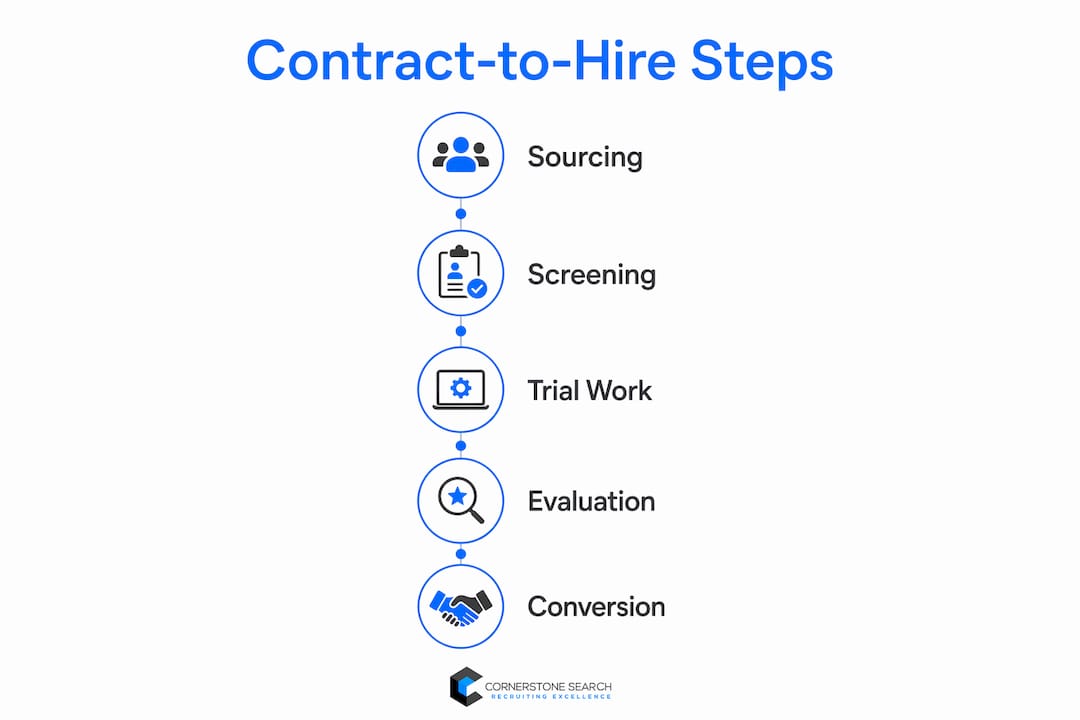
How does the contract-to-hire process work, step by step?
Run it like a structured evaluation, not a vibe check.
- Sourcing and vetting. Require the recruiter to screen for sales judgment and SaaS motion fit, not just resume keywords. Skills are table stakes. Work style, autonomy level, and pipeline discipline matter more for quota-carrying roles.
- Contract setup. Nail down payroll classification (W-2 via the agency is standard and cleaner than 1099 for ongoing roles), trial length, conversion fee language, and early-buyout terms before anyone signs.
- Onboarding. Give the contractor CRM access, territory assignment, and a 30/60/90-day milestone document on day one. Treat them like a future employee from the start.
- Cadence. Weekly check-ins for the first month, biweekly after. A formal mid-point calibration at day 45 or 60. A documented decision meeting at the contract end.
- Conversion. Both parties sign the offer. The agency receives the conversion fee. The contractor moves to your direct payroll. Done.
The client owns day-to-day supervision and the conversion decision. The staffing partner handles sourcing, background checks, payroll, and compliance when acting as Employer of Record. Keep those lanes clean.
Pro Tip: Write the 30/60/90-day success criteria in a format you could hand to the contractor on day one without embarrassment. “They fit in well” is not a criterion. Specific pipeline targets and activity metrics are.

What does contract-to-hire actually cost in North America?
Budget this before you start, not after you fall in love with the candidate.
| Cost Element | Typical Range |
|---|---|
| Agency bill rate markup typically runs 40%–60% above base pay | |
| Contractor hourly premium is often 1.4–1.7x the equivalent salaried rate | |
| Conversion fees for agency-placed candidates usually range 10%–20% of first-year salary | |
| The break-even point compared to direct hire often occurs between 9 and 14 months |
Choose 3 months for measurable IC roles where you can see pipeline and activity data fast. Choose 6 months for leadership or strategic roles where ramp is longer. Anything past 6 months starts creating co-employment exposure and candidate frustration.
W-2 vs. 1099: Agency W-2 is the standard and the safer path. The agency handles payroll taxes, workers’ comp, and employer-side compliance. You pay the bill rate. A 1099 arrangement for an ongoing, supervised sales role is a misclassification risk. Consult your HR counsel before going that route.
Pro Tip: Negotiate the conversion fee structure in the initial agreement, before anyone starts working. Ask whether bill hours paid during the contract period credit against the fee. Ask what happens if conversion happens in month two versus month five. You have zero leverage after you decide you want the person.
How do you set conversion milestones that actually hold up?
Ambiguity at the conversion decision is the most common failure mode. Fix it in writing before day one.
KPI examples by role:
- AE: ARR pipeline created, meetings held with qualified accounts, win rate on late-stage deals, forecast accuracy
- SDR: Meetings set per week, sequence reply rates, pipeline sourced, conversion to AE-accepted opportunities
- Sales leadership: Hiring plan progress, pipeline coverage ratio, team ramp velocity, CRM hygiene standards
Written conversion criteria, KPIs, and an explicit timeline are the single biggest success factor for contract-to-hire programs. Not the recruiter. Not the candidate’s resume. The written criteria.
Conversion clause elements to include: trial end date, salary at conversion, benefits start date, equity preview or vesting credit, and whether the conversion fee is paid by the company or credited against prior bill hours.
Internal alignment checklist:
- One named owner for the conversion decision (usually the hiring manager or CRO)
- Mid-point calibration documented and shared with HR
- Candidate informed of their standing at the mid-point, not at day 89
Pro Tip: Offer an equity preview during the trial. Startups can use equity previews or vesting credit to reduce conversion friction and signal long-term intent. It costs nothing during the contract phase and keeps strong candidates from entertaining competing direct offers.
What mistakes kill contract-to-hire for sales teams?
Most failures are self-inflicted.
- Using it to hide a broken process. Contract-to-hire only reduces risk when conversion criteria and governance exist. Without them, you are just delaying the cost of a bad hire.
- No written conversion criteria. Verbal agreements evaporate. Put the KPIs, timeline, and conversion terms in the contract.
- Treating contractors as second-class. No CRM access, no territory, no team inclusion. You get disengaged performance and lose the candidate to a direct offer before the trial ends.
- Over-indexing on short-term metrics. A 60-day pipeline number does not tell you much about a rep’s long-term win rate. Weight leading indicators (activity, pipeline creation) alongside early lagging ones.
- Misclassification. Running a supervised, ongoing sales role as 1099 is a legal risk. Use agency W-2 or an Employer of Record.
Check your red flags in SaaS sales candidates before the trial starts. The contract period is for confirming fit, not discovering it.
What KPIs should drive the convert-or-release decision?
Score the contractor on leading and lagging indicators. Weight them by role and ramp stage.
| KPI | Role | Pass Threshold (90-day trial) |
|---|---|---|
| ARR pipeline created | AE | At or above 2x quota target |
| Meetings set per week | SDR | Consistent with team average by week 6 |
| Win rate on late-stage deals | AE | Within industry standard range |
| Forecast accuracy | AE/Leadership | Within reasonable variance of called number |
| Ramp velocity | All | On track per 30/60/90 plan |
Leading indicators (activity, pipeline sourced) matter most in weeks 1–6. By week 8, you should have enough lagging data to make a confident call. If you do not, the evaluation framework is the problem, not the candidate.
Decision rules:
- Green on 4 of 5 KPIs: convert, move fast
- Mixed (2–3 green): remediation plan with a 30-day extension and specific targets
- Red on 3 or more: release at the defined end date, no extension
How Cornerstonesearch runs contract-to-hire for SaaS sales teams
Cornerstonesearch has placed over 1,200 sales professionals since 1996, with an average time from search kickoff to offer acceptance of 21 days. That speed matters in contract-to-hire because every week of an open territory is pipeline you are not building.
| What Cornerstonesearch Delivers | Detail |
|---|---|
| Sourcing speed | Average 21 days from kickoff to offer |
| Vetting standard | Sales judgment screening, not just skills matching |
| Payroll/EOR options | W-2 agency payroll or EOR partner during trial |
| Replacement commitment | Replacement guarantee if conversion does not proceed |
General staffing firms screen for skills. Cornerstonesearch screens for SaaS sales fit: pipeline discipline, SaaS motion fluency, ramp history, and the ability to sell without heavy air cover. Those are different filters, and they produce different outcomes.
Pro Tip: Ask any recruiting partner for their contract-to-hire conversion rate before you engage. A firm placing contractors who never convert is not saving you money. They are running a temp agency with a fancier pitch.
Key Takeaways
Contract-to-hire works for SaaS sales roles when you define conversion criteria in writing, pick the right roles, and budget the full cost before you start.
| Point | Details |
|---|---|
| Define the role first | Contract-to-hire does not fix unclear scope; write the role definition before sourcing. |
| Written conversion criteria | Put KPIs, timeline, and conversion terms in the contract before day one. |
| Pick the right roles | Use for ICs and new market tests; go direct hire for VP/CRO and anchor leadership. |
| Budget the full cost | Agency markups plus conversion fees add up fast. |
| Cornerstonesearch | 21-day average time to offer, 1,200+ placements, SaaS-specific vetting for contract and direct searches. |
The part most founders get wrong
Contract-to-hire is a precision tool. Most founders reach for it when they are scared, not when it is the right call. They have burned two direct hires, the board is watching, and contract-to-hire feels like a hedge. It is not. If your screening is broken, a trial period just delays the reckoning by 90 days and costs you more money.
The model works when you use it for what it is actually good at: testing a new ICP motion with an AE before you build a team around it, covering a territory gap while you run a parallel direct search, or evaluating a mid-market rep in a segment you have never sold into before.
Hard rules I would not bend on:
- Never contract-to-hire a VP of Sales or CRO. The best ones will not take it, and the ones who will are telling you something.
- Always put the conversion criteria in the contract. Verbal agreements are worth exactly nothing at day 89.
- Treat the contractor like a future employee from day one. If you would not give a full-time hire CRM access and a real territory, fix that before you bring anyone in.
The benefits of specialized sales recruiters show up most clearly in contract-to-hire because the vetting has to be right before the trial starts. A bad screen going into a 90-day trial wastes three months and a conversion fee. Get the sourcing right first.
Cornerstonesearch can start your search in 21 days
Cornerstonesearch runs contract-to-hire searches for SaaS and software sales teams across North America. The process is fast and specific: sourcing, sales-judgment vetting, W-2 payroll or EOR options during the trial, and conversion management from offer to close.

What you get on engagement: a scoping call to define the role and conversion criteria, a sample conversion clause you can take to legal, and candidates in motion within days, not weeks. The average time to offer is 21 days. Over 1,200 placements since 1996 back that up.
Ready to fill a territory or test a new sales motion without rolling the dice on a permanent hire? Start the conversation with Cornerstonesearch today.
This article is general information, not legal or tax advice. Consult qualified HR counsel or a payroll specialist for classification decisions specific to your jurisdiction and situation.
Useful sources for classification and contract-to-hire benchmarks
- Direct Hire vs Contract-to-Hire: Which Model Is Right? — Covers role-fit guidance, bill rate markup ranges, and conversion fee benchmarks for North America.
- Contract-to-Hire vs Direct Hire: Which Model Fits Your Hiring Need? (Artech) — Defines EOR responsibilities, co-employment risk, and SLA governance for contract placements.
- How Startups Can Leverage Contract-to-Hire Staffing (Quickly Hire) — Practical startup-focused guide covering trial lengths, equity previews, and conversion clause structures.
- Direct Hire vs Contract Conversion Economics (Engaged Headhunters) — Break-even analysis showing the 9–14 month window where contract-to-hire exceeds direct hire cost.
- What Is a Contract-to-Hire Position? A Founder’s Guide (CloudDevs) — Covers common misuse patterns and why vetting rigor must match direct hire standards.
- Job Board Integration for Recruitment Teams (Easy CV) — Practical sourcing workflow guidance for structuring rapid contract-to-hire pipelines.
For jurisdiction-specific worker classification questions, consult the IRS guidelines on worker classification or a qualified employment attorney in your state.