

Executive search, formally known as retained executive search, is a specialized recruitment practice where a firm is exclusively engaged to identify, assess, and place senior leadership candidates on behalf of a client organization. Understanding how executive search firms work is the difference between filling a seat and making a hire that actually moves the business forward. These firms focus almost entirely on passive candidates, people who are not actively looking, and they operate under a structured, confidential process that general recruiting simply cannot replicate. For founders, HR leaders, and CEOs making high-stakes leadership hires, the mechanics behind this model matter enormously.
How does the executive search process work?
The executive search process begins with a detailed intake session, not a job description review. The search firm works directly with the hiring organization to define the role’s scope, the leadership competencies required, the cultural environment, and the business outcomes the new hire must drive. This phase often takes several days and produces a position specification document that guides every subsequent step.

From there, the firm conducts market mapping. This means systematically identifying every qualified candidate in the relevant sector, regardless of whether those individuals are looking for a new role. The firm then builds a target list and begins direct, confidential outreach.
The structured process typically follows these steps:
- Role definition and intake: Align on scope, competencies, compensation, and success metrics.
- Market mapping: Research and identify the full universe of qualified candidates in the target sector.
- Candidate outreach: Direct, confidential contact with passive candidates through trusted relationships.
- Screening and assessment: Competency-based interviews, cultural fit evaluation, and sector knowledge review.
- Shortlist presentation: Deliver a curated slate of three to five candidates with detailed profiles and assessments.
- Client interviews: Facilitate structured interviews between the client and shortlisted candidates.
- Reference and due diligence: Conduct thorough background and reference checks.
- Offer and negotiation: Advise on executive compensation and manage the offer process.
- Onboarding support: Stay engaged through the candidate’s first 90 days.
This process contrasts sharply with contingency recruiting, which focuses on active job seekers and prioritizes speed of placement over depth of fit. Contingent search models prioritize speed and placement over performance, often increasing hiring risk and compromising confidentiality. Retained search inverts that priority: thoroughness comes first.
Pro Tip: Ask any search firm you evaluate to walk you through their market mapping methodology. A firm that cannot describe a specific, research-led process for identifying passive candidates is operating more like a contingency recruiter than a true executive search partner.
Why passive candidates are the core of executive recruitment strategy
Approximately 85% of qualified executive candidates are passive, meaning they are not actively searching for new roles. That single fact explains why executive search firms exist. If your best potential hire is not on any job board, you cannot find them through traditional recruiting channels.
Executive search firms build networks and relationships over years, unlocking access to high-caliber professionals who are not visible in standard recruitment channels. This is not a database search. It is a relationship-driven process where a trusted consultant reaches out directly to a senior leader, explains the opportunity with specificity, and earns enough credibility to start a conversation.
Engaging passive candidates requires a different approach than recruiting active applicants:
- Confidentiality: The firm contacts candidates without disclosing the client’s identity until trust is established.
- Tailored messaging: Outreach is customized to each candidate’s career trajectory and motivations, not a generic pitch.
- Sector-specific credibility: Consultants who specialize in a vertical, such as SaaS or software sales, can speak the candidate’s language and reference relevant context.
- Relationship continuity: Many placements come from candidates the firm has known for years, not weeks.
- Discretion for the client: Confidential search preserves organizational discretion during sensitive leadership transitions, such as replacing an underperforming executive before a public announcement.
Pro Tip: When briefing a search firm on a passive candidate outreach campaign, share context about why this role is a genuine career opportunity. Consultants who can articulate a compelling narrative to candidates will generate a stronger response rate than those leading with compensation alone.
What are the benefits and guarantees of retained executive search?
Retained executive search firms achieve a replacement failure rate of only 5%–15%, compared to a 30%–50% failure rate seen in general or ad hoc recruiting. That gap is not accidental. It reflects the depth of assessment, the quality of the candidate pool, and the accountability built into the retained model.
The table below compares retained executive search against contingency recruiting across the dimensions that matter most to leadership hiring decisions.
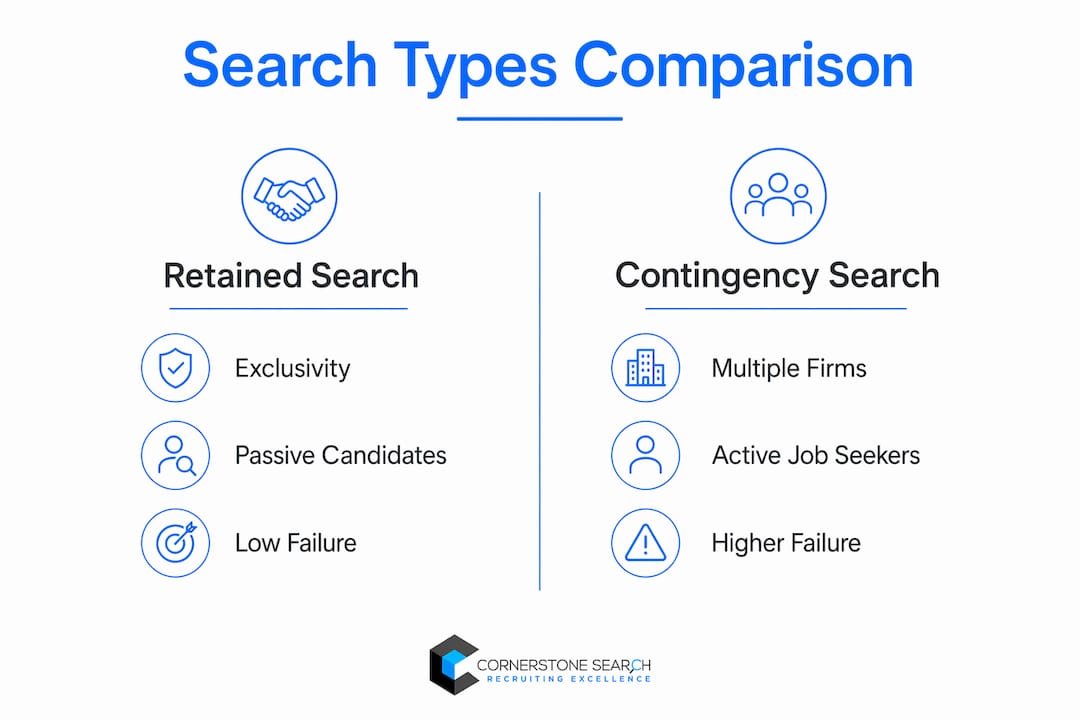
| Dimension | Retained executive search | Contingency recruiting |
|---|---|---|
| Candidate pool | Primarily passive, research-identified | Primarily active job seekers |
| Client exclusivity | Exclusive engagement | Non-exclusive, multiple firms |
| Guarantee period | Typically 12 months | Often 90 days or less |
| Confidentiality | High, structured discretion | Variable, often limited |
| Failure rate | 5%–15% | 30%–50% |
| Post-placement support | Onboarding engagement through 90 days | Minimal after placement |
Retained searches feature exclusivity and 12-month guarantees aligned with leadership performance cycles. That longer guarantee period matters because leadership performance rarely reveals itself in 90 days. A new VP of Sales or Chief Revenue Officer needs at least two quarters before their real impact is measurable.
Boards often misprice hiring risk by accepting short guarantees. C-suite and revenue-critical roles warrant exclusive retained search to align hiring risk with board-level governance expectations. Exclusivity also creates accountability. When one firm owns the search, they are fully invested in the outcome. When three contingency firms are racing to fill the same role, speed wins and quality suffers.
Post-placement guarantees and follow-up consultations help identify early challenges, supporting faster executive productivity and better integration. That ongoing engagement is not a courtesy. It is a structural feature of the retained model that protects the client’s investment.
How do search firms support evaluation and onboarding?
The assessment phase of an executive search is where retained firms earn their fee most visibly. Structured, competency-based evaluation aligns with EEOC guidance and improves candidate fit. This means every candidate on the shortlist is evaluated against the same framework, covering leadership style, sector knowledge, cultural alignment, and role-specific competencies.
The evaluation and onboarding support process typically includes:
- Structured interviews: Each candidate faces consistent, competency-based questions tied directly to the role’s success criteria.
- Cultural fit assessment: Consultants evaluate how a candidate’s working style aligns with the client’s leadership culture, not just their resume credentials.
- Reference checks: Deep reference conversations with former colleagues, direct reports, and supervisors, not just the names a candidate provides.
- Due diligence: Background verification, compensation history review, and in some cases, board-level credential checks.
- Offer negotiation: Search firms advise on executive compensation structures, equity, and benefits to close offers efficiently without overpaying.
- Onboarding engagement: Search firm involvement continues through the candidate’s start date and first 90 days, with check-ins designed to surface integration challenges early.
That last point separates executive search from transactional recruiting. A firm that disappears after the offer letter is signed has not delivered a complete service. The first 90 days are when new executives are most vulnerable to misalignment, and proactive engagement during that period reduces early turnover significantly.
The role of search firms in this phase is part consultant, part mediator. They help both sides communicate expectations clearly, which reduces the friction that causes otherwise strong hires to fail.
Key Takeaways
Retained executive search delivers measurably better leadership outcomes than contingency recruiting by combining passive candidate access, structured assessment, and extended post-placement support.
| Point | Details |
|---|---|
| Passive candidates dominate the pool | 85% of qualified executives are not actively job seeking, requiring proactive outreach. |
| Retained model reduces failure rates | Retained search achieves a 5%–15% failure rate versus 30%–50% in general recruiting. |
| Exclusivity drives accountability | One firm, one search: exclusivity produces deeper vetting and stronger candidate quality. |
| Guarantees should match performance cycles | A 12-month guarantee aligns with realistic leadership assessment timelines. |
| Post-placement support protects the hire | Onboarding engagement through the first 90 days reduces early turnover and integration failures. |
What most companies get wrong about working with search firms
After watching hundreds of leadership searches play out across SaaS and software companies, one pattern stands out: most organizations underinvest in the briefing phase and then wonder why the shortlist misses the mark.
The intake conversation is not a formality. It is the foundation of the entire search. When a client says “we need a VP of Sales” without articulating the stage of the business, the go-to-market motion, the existing team dynamics, or the specific outcomes expected in year one, the search firm is flying blind. The best consultants will push back and ask the hard questions. But if you walk into that first meeting unprepared, you will slow down a process that should move fast.
The second mistake is treating retained search like contingency recruiting. Companies that pressure a retained firm to deliver candidates in two weeks are misunderstanding the model. A disciplined and exclusive retained search process not only raises candidate quality but compresses hiring timelines significantly. The compression comes from doing the work correctly upfront, not from skipping steps.
The third mistake is ignoring the difference between a recruiting partner and a vendor. A vendor fills a role. A partner challenges your assumptions about the role, tells you when your compensation is below market, and flags cultural risks before they become expensive problems. That distinction is worth paying for.
Leadership hiring is not a procurement exercise. The cost of a wrong hire at the VP or C-suite level, factoring in salary, severance, lost revenue, and team disruption, far exceeds any search fee. Treat the process with the rigor it deserves.
— Rich Rosen
How Cornerstonesearch helps you hire the right sales and executive leaders
Cornerstonesearch has placed over 1,200 sales professionals since 1996, specializing in SaaS and software firms that cannot afford a wrong hire at the leadership level. The firm’s average time from search kickoff to offer acceptance is 21 days, a result of deep market knowledge and a network built over decades in the sector.

If you are building a sales leadership team or replacing a critical revenue role, Cornerstonesearch brings the same retained search discipline described in this article to every engagement. Explore the software sales recruitment service for specialized leadership hiring, or review the SaaS recruitment approach for high-growth technology companies. For a broader foundation on building winning teams, the sales recruitment guide is a practical starting point.
FAQ
What is an executive search firm?
An executive search firm is a specialized recruitment partner engaged exclusively to identify and place senior leadership candidates, focusing on passive talent through a structured, confidential process.
How do executive search guarantees work?
Retained executive search firms typically offer 12-month replacement guarantees, aligned with realistic leadership performance cycles, compared to the 90-day guarantees common in contingency recruiting.
What is the difference between retained and contingency search?
Retained search is exclusive, research-led, and focused on passive candidates with a low failure rate of 5%–15%. Contingency search is non-exclusive, faster, and draws primarily from active job seekers with a failure rate of 30%–50%.
How long does the executive search process take?
A well-run retained executive search typically delivers a qualified shortlist within three to six weeks. Firms with deep sector networks and established candidate relationships can compress that timeline further.
Why do executive search firms focus on passive candidates?
85% of qualified executive candidates are not actively looking for new roles. Accessing that talent pool requires proactive outreach and trusted relationships, not job postings.