

TL;DR:
- Market mapping executive talent involves continuously identifying and analyzing senior leaders to understand market availability. It supports strategic decisions like compensation benchmarking, succession planning, and proactive talent engagement. Regular updates and broad research methods improve hiring speed and quality, preventing reactive recruitment crises.
Market mapping executive talent is the practice of systematically identifying, evaluating, and tracking senior leaders across industries before a vacancy ever appears. It is not reactive recruiting. It is intelligence work. Done right, it gives you a real picture of who is out there, what they earn, how they are wired, and whether they are likely to move. Most HR teams and executives skip this step entirely, then wonder why their searches drag on for months. The firms that get this right treat it as an ongoing discipline, not a one-time project triggered by a resignation letter.
How does the market mapping executive talent process work?
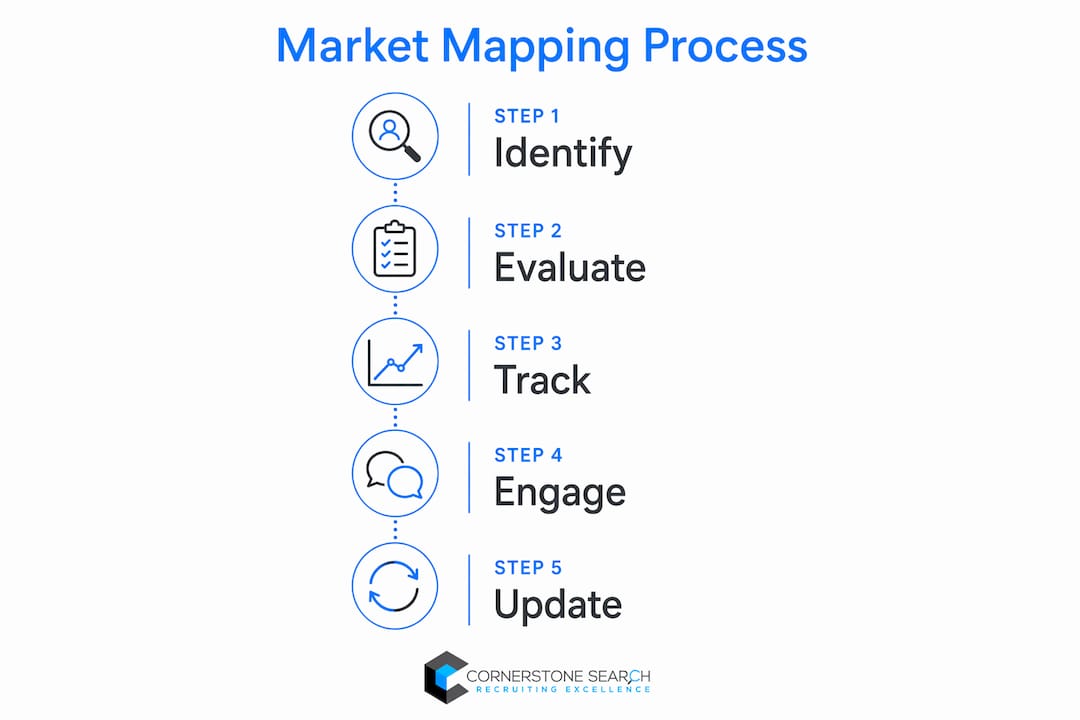
The executive talent mapping process starts broad and gets narrow fast. Elite search firms typically begin market research in weeks 3–6 of a search, starting with an initial list of 50–100 potential candidates before cutting it down systematically. That starting number sounds big, but it reflects the reality of a serious talent universe sweep.
Here is how the process actually unfolds:
-
Define the talent universe. Set the scope by industry, company size, geography, and functional role. You are not looking for anyone with a VP title. You are looking for leaders who have operated at the right level of complexity.
-
Research beyond LinkedIn. The best executive talent maps pull from org charts, board memberships, conference speaker lists, patent filings, and alumni networks to surface passive candidates who never applied for anything. If your research stops at LinkedIn, you are missing half the market.
-
Profile each candidate in depth. This means evaluating leadership competencies, career progression, cultural fit, and performance signals. Deep candidate profiling differentiates the people worth calling from the people who just look good on paper.
-
Segment the list. Categorize candidates by qualification level, availability likelihood, and career phase. Some are ready to move now. Some are 18 months away. Some are never leaving their current seat. Knowing which is which changes your outreach entirely.
-
Narrow to a shortlist. Apply criteria-based evaluation to cut from 50–100 names down to the 8–12 people worth a real conversation. Every cut should be deliberate and documented.
Pro Tip: Never rely on a single data source for candidate identification. Cross-reference org charts with conference speaker lists and board filings. The best candidates rarely show up in the obvious places.
What strategic advantages does market mapping deliver?

Market mapping gives you something most hiring processes never produce: real market data before you make a decision. You can benchmark your internal leadership team against what is actually available externally. You can see what competitors are paying, who they are promoting, and how fast they are building out their leadership bench.
The strategic benefits go well beyond filling a single role:
- Compensation benchmarking. Continuous market mapping enables firms to benchmark compensation, understand mobility patterns, and anticipate talent shortages before they become crises.
- Succession gap identification. You see where your leadership pipeline is thin before someone quits or gets poached.
- Flight risk signals. Tracking competitor hiring velocity tells you when your own leaders might be getting calls.
- Role clarity. When you walk into a hiring conversation armed with market data, the discussion shifts from gut feel to evidence. You know what the role should pay, what profile actually exists in the market, and what trade-offs you will need to make.
Elite search firms productize market mapping as a separate, billable strategic asset to prove deep market fluency before a mandate even starts. That is not a sales tactic. It is proof that they know the market better than you do. When a firm hands you a visual heat map of your competitor’s leadership structure, the conversation changes immediately.
How do elite firms use technology and continuous intelligence?
The best firms combine human judgment with AI-powered candidate identification. The AI finds patterns across large data sets fast. The human decides what those patterns actually mean. Neither works as well alone.
The real edge comes from tracking trigger events. Trigger events like board departures, passed-over promotions, or sudden org restructurings signal when an executive might be open to a conversation. A VP who just got passed over for the CRO job is not going to post “open to work” on LinkedIn. But if you are watching the right signals, you know to call.
| Approach | What it tracks | Best use case |
|---|---|---|
| Passive candidate monitoring | Career moves, promotions, departures | Ongoing pipeline building |
| Trigger event tracking | Board changes, org restructures, funding rounds | Timely outreach to ready-to-move leaders |
| Compensation benchmarking | Pay bands, equity trends, OTE shifts | Offer structuring and retention planning |
| Diversity gap analysis | Representation across leadership tiers | Succession planning and DEI hiring goals |
Market mapping as a continuous discipline significantly improves search timing and candidate engagement. It is not a one-time project. It is an operating rhythm. Firms that run it quarterly instead of annually find candidates faster and close offers with less friction.
Pro Tip: Set calendar alerts for key trigger events at your top 10 target companies. A leadership change at a competitor is your best recruiting window. Most teams miss it because they are not watching.
What is the difference between role-based and landscape mapping?
These two mapping types serve different purposes, and most organizations only do one of them. That is a mistake.
Role-based mapping focuses on filling a specific vacancy. You define the role, set the criteria, and build a candidate list targeted at that exact need. It drives immediate shortlists and outreach prioritization. It is what most people think of when they hear “executive search.”
Landscape mapping is broader. It documents competitor org charts, tracks market leadership across a sector, and captures talent availability at a macro level. It supports long-term succession planning and market entry strategies. If you are expanding into a new vertical or preparing for a leadership transition 18 months out, landscape mapping is what you need.
Organizations that neglect landscape mapping limit their succession planning effectiveness. They end up scrambling when a key leader leaves because they never built a picture of who else exists in the market. The two approaches are complementary. Role-based mapping answers “who do we hire now?” Landscape mapping answers “who should we be watching for the next three years?”
The firms that assess leadership operating range rather than just matching titles get more from both mapping types. Operating range means the ability to handle enterprise-wide complexity, lead through ambiguity, and scale with the business. A candidate with the right title but a narrow operating range will fail in a bigger seat. Focusing on operating range creates higher success rates in executive placements than title matching alone.
Key Takeaways
Market mapping executive talent works because it replaces reactive hiring with continuous intelligence, giving organizations a real picture of who is available, what they cost, and when they are ready to move.
| Point | Details |
|---|---|
| Start broad, cut fast | Begin with 50–100 candidates and narrow systematically using documented criteria. |
| Research beyond LinkedIn | Use org charts, conference lists, and alumni networks to find passive leaders. |
| Track trigger events | Board changes and passed-over promotions signal when executives are ready to move. |
| Use both mapping types | Role-based mapping fills vacancies; landscape mapping builds long-term succession pipelines. |
| Assess operating range | Match leaders on complexity and change capacity, not just job titles. |
What I have learned after 30 years of watching companies get this wrong
Here is the uncomfortable truth: most companies do market mapping exactly once, right after a key leader walks out the door. That is the worst possible time to start. You are panicked, you are reactive, and you are about to make a hire based on whoever happens to be available rather than whoever is actually best.
The firms and HR teams I respect treat market mapping as a standing agenda item, not an emergency response. They know who the top 20 leaders in their target market are before they ever post a job. They have already had informal conversations. They know who is happy, who is restless, and who just got passed over for a promotion they deserved.
The other thing I see people get wrong is obsessing over titles. A candidate who was VP of Sales at a 50-person startup is not the same as a VP of Sales who scaled a team from 30 to 300 at a Series C company. The title is identical. The operating range is completely different. When you map talent without assessing operating range, you are just collecting names. That is not intelligence. That is a spreadsheet.
The best market maps I have seen treat the data as a living document. They get updated when a competitor announces a reorg. They get updated when a target candidate gets promoted or changes companies. They get updated when compensation benchmarks shift. That kind of continuous intelligence is what separates a firm that fills a search in 21 days from one that is still interviewing three months later.
If your market map is more than six months old, it is already wrong. Start treating it like a product, not a project.
— Rich Rosen
Cornerstonesearch and the market intelligence edge
Cornerstonesearch has placed over 1,200 sales and executive professionals since 1996. That history is not just a number. It is a continuously updated picture of who is in the market, what they earn, and when they are ready to move.
Every search Cornerstonesearch runs is backed by real market intelligence, not recycled candidate lists. If you are hiring a sales leader for a SaaS or software company, you need a firm that already knows the talent pool before the search kicks off. Explore the executive sales search process or dig into SaaS recruitment expertise to see how continuous market mapping translates into faster, better leadership hires.
FAQ
What is market mapping in executive talent?
Market mapping in executive talent is the process of identifying, profiling, and tracking senior leaders across a target market before a vacancy opens. It combines candidate research, compensation benchmarking, and competitive intelligence into a single, ongoing discipline.
How long does the executive talent mapping process take?
Elite search firms typically begin market research in weeks 3–6 of a search, starting with an initial list of 50–100 candidates. The time to build a usable shortlist depends on role complexity and market depth.
What is the difference between role-based and landscape mapping?
Role-based mapping targets candidates for a specific open position. Landscape mapping documents competitor leadership structures and talent availability across a broader market, supporting succession planning and long-term workforce strategy.
Why does operating range matter more than job titles?
Operating range measures a leader’s ability to manage complexity, ambiguity, and organizational change. Two candidates with identical titles can have vastly different capacities to succeed in a larger or more complex role.
How often should a talent map be updated?
A talent map should be treated as a living document and reviewed at least quarterly. Leadership changes, compensation shifts, and trigger events at competitor companies can make a six-month-old map unreliable.