
Non-compete agreements can quietly wreck a hire you thought was a slam dunk. You find the perfect candidate, they’re excited, the hiring manager loves them, and then someone asks the question nobody asked early enough: “Do you have a non-compete?” Suddenly you’re staring at a sit-out period lasting over a year and a legal review that could blow up your timeline and your budget.
Here’s the short version of how non-compete agreements affect recruiting:
- They shrink your candidate pool, especially at the senior level in SaaS and tech sales.
- They expose your company to litigation risk if you hire someone still bound by an active agreement.
- They slow down searches, complicate offer letters, and can push your best candidate to a competitor who moves faster.
- Top candidates often walk away from companies that require non-competes, reading them as a sign of weak culture or low trust.
- Navigating them without legal counsel is how you end up in court.
Knowing this going in changes how you run a search. Let’s get into it.
What non-compete agreements actually are and why companies use them
A non-compete agreement is a contract, usually signed at hire or as a condition of a promotion or bonus, that restricts an employee from working for competitors or starting a competing business for a defined period after leaving. The typical terms cover duration (often six to twenty-four months), geographic scope, and the specific activities or roles that are off-limits.

Companies use them to protect real business interests: trade secrets, client relationships, proprietary pricing models, and product roadmaps. In SaaS, where a VP of Sales might carry the entire go-to-market playbook in their head, that concern is legitimate. The problem is that non-competes are frequently overused, applied to roles where no genuine trade secret is at stake, and written so broadly they function more as golden handcuffs than actual protection.

Non-competes are distinct from non-solicitation agreements (which restrict poaching clients or colleagues) and confidentiality agreements (which restrict sharing information). All three often appear together in the same employment contract, which is why you need to read the whole document, not just the paragraph with “non-compete” in the heading.
How enforceability varies wildly by state and at the federal level
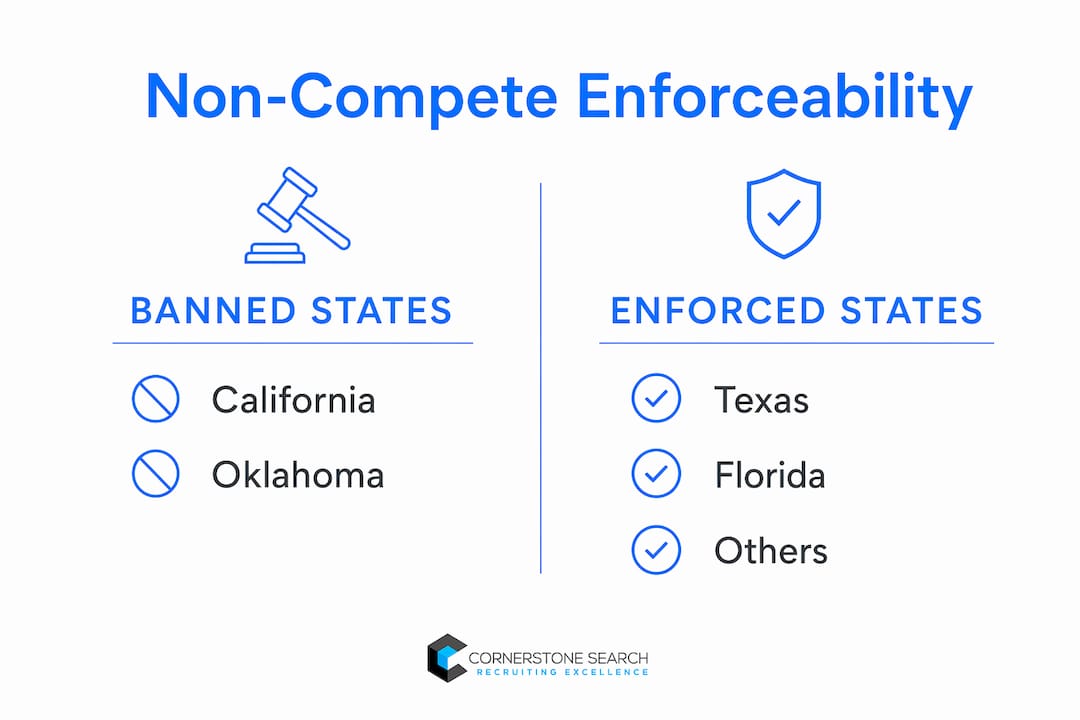
There is no national standard for non-compete enforcement. The rules depend entirely on where the employee works, and the differences are stark.
| State | Enforceability Status | Key Notes |
|---|---|---|
| California | Banned | California Business and Professions Code § 16600 voids nearly all non-competes |
| Oklahoma | Banned | Statute prohibits non-compete enforcement for most employees |
| Illinois | Limited | Enforceable only above salary thresholds; low-wage workers are exempt |
| Maine | Limited | Requires advance notice and a seven-day review period before signing |
| Texas | Enforceable | Must be ancillary to an otherwise enforceable agreement and reasonable in scope |
| Florida | Enforceable | Courts favor enforcement; broad agreements routinely upheld |
| New York | Evolving | Governor vetoed a ban recently; enforcement still active but under pressure |
At the federal level, the FTC issued a final rule banning noncompetes with all workers, including senior executives for new agreements. That rule faced immediate legal challenges and its status has remained contested in courts. The FTC has continued enforcement actions against specific employers, including ordering Rollins, Inc. to stop enforcing non-competes against more than 18,000 employees. The direction of federal policy is clearly toward restriction, but the day-to-day legal reality still depends on state law.
The practical takeaway: enforceability varies sharply by jurisdiction, and there is no universal rule. You need legal counsel in the specific state where your candidate works, not a general opinion.
How non-competes create real recruiting and hiring challenges
This is where the rubber meets the road. Non-competes don’t just create legal paperwork. They actively distort your search.
The most immediate problem is pool shrinkage. When you’re recruiting a VP of Sales or a CRO from a competitor, a large portion of your best candidates are sitting under active agreements. Requiring non-competes as a hiring standard deters top talent, signals weak retention, and shrinks the candidate pool further on your own side of the equation.
Senior-level searches get hit hardest. In specialized SaaS verticals, long non-compete durations are common, effectively creating a forced garden leave. If you need a new CRO by Q3 and your top three candidates are all sitting out agreements that don’t expire until Q1 of next year, you have a problem. You either wait, settle for a weaker candidate, or pay a premium to someone who is available now because they were let go rather than recruited.
Timeline compression is another casualty. A search that should close in three to four weeks can drag to three to four months once legal review enters the picture. Every week of delay costs pipeline. In a SaaS startup where the sales team is already understaffed, a four-month search gap is not an abstraction. It’s missed quota.
The hidden cost nobody budgets for: Legal review fees, extended recruiter engagement, and the opportunity cost of a vacant territory or leadership seat add up fast. Non-compete complications are one of the most common reasons a search that looked clean at kickoff turns expensive by close.
What legal risks you take on when you hire someone with an active non-compete
Hiring a candidate who is still bound by a valid non-compete is not a victimless act. Hiring an employee with an active non-compete exposes the new employer to claims of tortious interference and, in some cases, misappropriation of trade secrets.
Here’s what that looks like in practice:
- The former employer files for a temporary restraining order, sometimes within days of the employee starting.
- A court injunction can block the new hire from working in their role while litigation proceeds.
- The new employer gets dragged into expensive discovery, depositions, and legal fees, even if the non-compete ultimately proves unenforceable.
- Ignorance of the agreement’s existence is not a defense. If you hired someone and didn’t ask, that’s on you.
The candidate’s assurance that their non-compete “won’t hold up” carries zero legal weight. Employers must independently verify enforceability before extending an offer, not after. Get the agreement in hand, send it to employment counsel in the relevant state, and get a written opinion. Skipping that step to move faster is how you end up in court.
Best practices for recruiters and hiring managers navigating non-competes
The goal is not to avoid candidates with non-competes. The goal is to know what you’re dealing with before you’re committed.
- Ask early. In the first substantive conversation, ask candidates directly about all restrictive covenants, not just standalone non-competes. Ask about equity agreements, bonus plans, and deferred compensation documents too, because restrictions are often buried there.
- Get the documents. Don’t rely on a candidate’s summary of what their agreement says. Request the actual signed documents and have counsel review them.
- Engage legal counsel before the offer. Not after. Counsel can assess enforceability, identify geographic or scope limitations, and advise on risk before you’re emotionally committed to a candidate.
- Consider forward hiring. For roles where non-competes are common, build your pipeline 12–18 months ahead of the vacancy. Cultivate relationships with candidates whose agreements will expire in the window you need them.
- Put disclosure requirements in your offer letters. Require candidates to represent in writing that they have disclosed all restrictive covenants and that accepting the offer does not violate any existing agreement.
- Be transparent about your own company’s non-compete policies. Transparency around non-compete policies early in recruiting prevents wasted effort and signals confidence in your culture.
Pro Tip: Build a long-term candidate relationship before you need to hire. A candidate you’ve known for two years will tell you about their non-compete on day one of a conversation. A cold outreach candidate might not mention it until after you’ve extended an offer.
Common misconceptions about non-compete agreements
A few things recruiters and hiring managers get wrong, repeatedly.
“If the candidate says it’s unenforceable, we’re fine.” No. A candidate’s legal opinion about their own agreement is not a legal opinion. Courts have enforced agreements that candidates were certain would never hold up. Get independent counsel.
“Non-competes don’t apply if the employee was laid off.” Sometimes true, sometimes not. Some states limit enforcement when the employer terminates without cause, but many do not. Illinois, for example, has specific rules on this. Maine requires advance notice before the agreement is even valid. The answer depends on the state and the specific contract language.
“A non-compete is void if it’s too broad.” Courts in some states will narrow an overly broad agreement rather than void it entirely, a doctrine called “blue penciling.” In Florida, courts routinely enforce narrowed versions. In California, the whole thing is void. Assuming breadth equals unenforceability is a mistake.
“Non-competes only matter for executives.” Wrong. Agreements get signed at all levels, including individual contributors in SaaS sales. A mid-market account executive with a twelve-month non-compete covering your top three target verticals is a real problem, not a theoretical one.
“We can just wait for the agreement to expire and then hire.” Sometimes the right call, but not always simple. Expiration dates can be extended by certain actions, and some agreements include tolling provisions that pause the clock if the employee violates the agreement.
Real-world recruiting situations where non-competes caused serious problems
These scenarios play out regularly in SaaS and tech sales recruiting.
The CRO who couldn’t start. A growth-stage SaaS company recruits a CRO from a direct competitor. The candidate discloses a non-compete but assures the hiring team it won’t be enforced. The former employer files for an injunction within a week of the start date. The new company spends six figures in legal fees, the CRO is sidelined for four months, and the sales team loses a full quarter of leadership. The agreement was enforceable in Florida. Nobody had asked for it before the offer was signed.
The VP of Sales with a hidden clause. A Series B startup hires a VP of Sales. The offer letter process goes smoothly. Three months in, the former employer’s counsel sends a cease-and-desist citing a non-solicitation clause buried in the VP’s equity grant agreement, triggered when the VP brought over two former colleagues. The startup’s legal team had never seen the equity document. The hidden restrictive covenants in stock options and bonus plans are exactly the kind of thing a fast-moving startup skips reviewing.
The candidate who walked. A well-funded SaaS company requires all sales hires to sign a twelve-month non-compete covering the entire North American market. Their top candidate, a proven enterprise AE with a strong book of relationships, declines the offer. The candidate’s feedback: the non-compete signals the company doesn’t trust its own people. The company fills the role three months later with a less experienced hire. Candidate reluctance toward firms requiring non-competes often stems from perceived lack of freedom and trust, and it shows up in offer acceptance rates.
How to negotiate or revise non-compete terms with candidates
Sometimes the right candidate has a non-compete, and the right move is to work through it rather than walk away. Here’s how to approach it.
Narrow the scope. Non-competes are often written broadly and enforced narrowly. If a candidate’s agreement covers “all software companies,” but your company operates in a specific vertical the former employer doesn’t touch, that’s a negotiating point. Employment counsel can help identify where the agreement’s scope is genuinely at risk versus where it’s theoretical.
Negotiate with the former employer. It happens more than people think. Former employers will sometimes release a candidate from a non-compete, particularly if the candidate is moving to a non-competing vertical or geography. This requires a direct conversation, usually between legal teams, and it works best when the new role is clearly not a competitive threat.
Adjust the start date. If the non-compete expires in four months and the candidate is worth waiting for, structure the offer with a delayed start. Agree on terms now, give the candidate certainty, and let the clock run out cleanly.
Offer indemnification. Some companies offer to cover the candidate’s legal costs if the former employer pursues litigation. This is a significant commitment and requires board-level sign-off, but for a critical hire, it can be the difference between getting the person and losing them to a competitor who moves faster.
How non-competes shape competitive intelligence and talent poaching tactics
Non-competes don’t just affect individual hires. They shape how companies think about talent strategy at a macro level.
Companies in states with strong enforcement, like Florida and Texas, use non-competes as a deliberate competitive moat. They know that a competitor can’t easily poach their top performers without triggering litigation. That changes how aggressively competitors recruit from them and which candidates they target first.
In California, where non-competes are essentially void under Business and Professions Code § 16600, the talent market moves faster and more openly. Companies in Silicon Valley have long competed on culture, compensation, and equity rather than contractual restrictions, partly because they have no choice. The result is a more fluid talent market where competitive intelligence travels with people rather than being locked up in agreements.
For recruiters working in enforcement-heavy states, the practical implication is this: your competitor’s best people may be legally off-limits for twelve to twenty-four months. That means your sourcing strategy needs to reach beyond the obvious targets. It means building relationships with candidates before they’re restricted, not after. And it means understanding which companies in your space use non-competes aggressively, so you can plan around them rather than get surprised mid-search.
The impact of non-compete clauses on labor market competition is well-documented: they reduce wages, slow job mobility, and depress innovation. For recruiters, the downstream effect is a talent market that moves slower and costs more to work in.
Frequently asked questions about non-competes and recruiting
Can a company get in trouble for hiring someone with a non-compete?
Yes. Hiring a candidate bound by a valid non-compete can expose the new employer to claims of tortious interference and injunctions that halt employment. Independent legal review before the offer is the only protection.
What states ban non-compete agreements outright?
California and Oklahoma effectively ban non-competes for most employees. Illinois and Maine enforce them only under specific conditions. Florida and Texas remain strongly enforcement-friendly.
Under what conditions is a non-compete void or unenforceable?
Common voiding conditions include agreements that are overly broad in scope, duration, or geography; agreements signed without consideration (no new benefit offered at signing); and agreements in states with statutory bans. Some states void agreements when the employer terminates without cause.
How serious are non-competes for restricting a candidate’s options?
Serious enough to kill a hire. An 18-month non-compete in a specialized SaaS vertical can effectively sideline a candidate from their entire career track for a year and a half. At the senior level, that’s a real deterrent.
What’s the single most important thing a recruiter can do?
Ask about restrictive covenants in the first conversation, get the actual documents, and involve legal counsel before extending an offer. Everything else is downstream of those three steps.
Key Takeaways
Non-competes affect recruiting at every stage, from sourcing to offer acceptance, and the legal risk to hiring companies is real and immediate.
| Point | Details |
|---|---|
| Ask early, ask specifically | Uncover all restrictive covenants, including those buried in equity and bonus agreements, in the first conversation. |
| State law controls enforceability | California bans non-competes; Florida enforces them broadly; there is no national standard. |
| Candidate assurances mean nothing | Employers must get independent legal counsel to assess enforceability before extending any offer. |
| Forward hiring beats reactive searching | Building candidate pipelines 12–18 months ahead bypasses sit-out periods for senior roles in restricted markets. |
| Non-competes shrink your pool and slow your search | Agreements deter top talent, reduce candidate availability, and add legal review time that causes hiring delays. |
Non-compete complexity is one of the fastest ways a clean search turns into a legal and operational mess. If you’re hiring senior sales talent in SaaS and want to move fast without stepping on landmines, Cornerstonesearch has been doing exactly this since 1996, with over 1,200 placements and an average of 21 days from search kickoff to offer acceptance. Check out our software sales recruitment practice or read through our sales recruitment essentials to see how we handle the hard parts so you don’t have to.