

Retained search is an exclusive recruitment model where a firm works solely for one client to fill a critical senior role, funded by upfront fees paid in installments regardless of outcome. This is the industry term for what hiring managers often call a “dedicated search.” Understanding how recruiter retained search differs from contingency recruiting is the clearest path to making the right call on your next senior hire. The two models share a goal but almost nothing else: different fee structures, different incentives, different levels of rigor, and very different results at the leadership level.
How recruiter retained search differs from contingency in fees and contracts
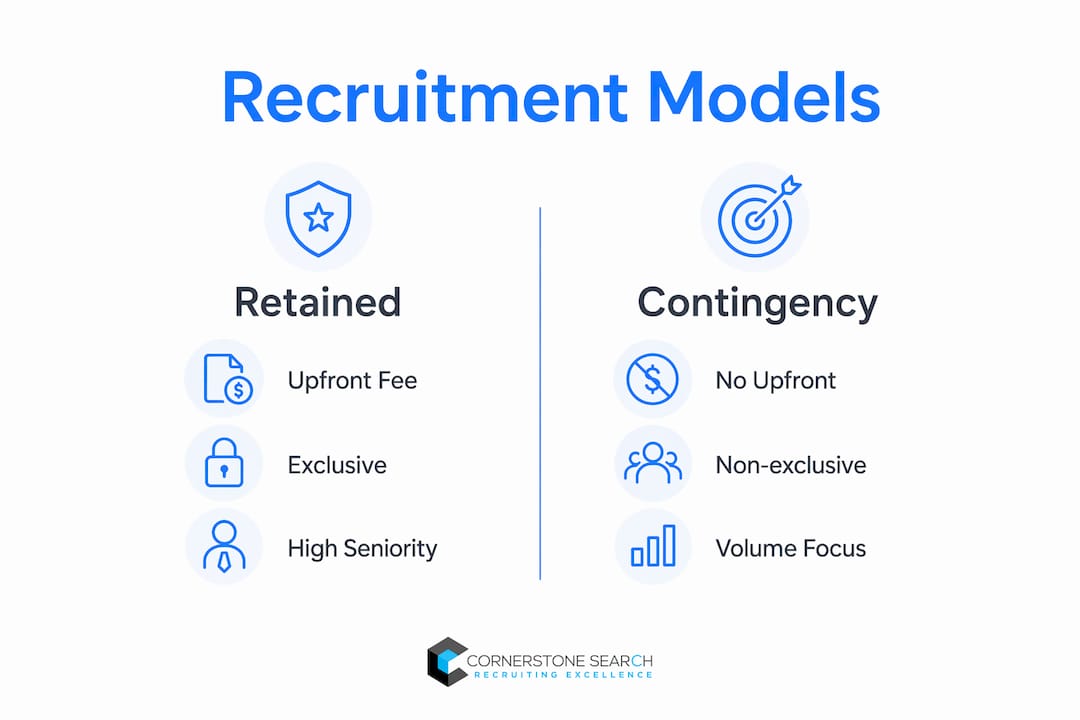
Retained search firms charge 30–33% of first-year compensation, split into three installments, whether or not a hire is made. Contingency firms collect 15–30% only after a successful placement. That gap is not just financial. It shapes everything about how each recruiter behaves from day one.
When a retained recruiter receives the first installment, they are committed. They assign dedicated resources, begin deep market mapping, and treat the search as their primary obligation. A contingency recruiter, by contrast, carries no financial risk if the search stalls. Their incentive is to move fast and submit volume, not to vet deeply.

Retainer agreements for recruiters in the retained model also typically include a 12-month placement guarantee. If the hire leaves within that window, the firm re-engages at no additional cost. Contingency agreements rarely include guarantees of that scope. That contractual accountability alone changes the dynamic of the relationship.
| Feature | Retained search | Contingency search |
|---|---|---|
| Fee structure | 30–33% of first-year comp, paid in installments | 15–30% of first-year comp, paid on placement |
| Payment timing | Upfront, regardless of outcome | Only upon successful hire |
| Exclusivity | Exclusive to one client | Non-exclusive, multiple clients |
| Placement guarantee | Typically 12 months | Rarely included |
| Search focus | Quality and fit | Speed and volume |
Pro Tip: Negotiate the second installment milestone to coincide with shortlist delivery, not just a calendar date. This keeps the retained firm accountable to output, not just time.
How do exclusivity and search approach differ between the two models?
Retained search is exclusive, meaning the firm works only for you on that role. Contingency search is non-exclusive, meaning the recruiter may be running the same search for three competing companies at once. That distinction has direct consequences for candidate quality and confidentiality.
Retained search firms conduct what the industry calls market mapping. They identify every qualified candidate in the target market, including those not actively looking. They then approach those candidates on your behalf with a prepared narrative about the role and your organization. The process is proactive, not reactive.
Contingency recruiters work from their existing database. They submit candidates quickly to multiple clients, which means the same candidate may be in play at your competitor simultaneously. Contingency recruiters prioritize speed and volume because payment depends on being first to place. That incentive structure produces a fundamentally different search experience.
The operational differences between the two models include:
- Search scope: Retained firms map the full candidate universe; contingency firms draw from active applicants and existing contacts.
- Candidate vetting: Retained searches include structured competency interviews, reference checks, and cultural fit analysis before presenting a shortlist.
- Reporting: Retained clients receive regular progress reports, market feedback, and competitive intelligence. Contingency clients typically receive resumes with minimal context.
- Confidentiality: Retained searches can be conducted discreetly, which matters when replacing a sitting executive or entering a new market quietly.
- Accountability: Retained firms are contractually tied to the outcome. Contingency firms can walk away from a difficult search with no financial consequence.
Retained recruiters invest 200–400 hours per engagement on market research, stakeholder management, and candidate vetting. That level of effort is not financially viable in a contingency model. The math simply does not work without upfront funding.
Which roles are best suited for retained versus contingency search?
Retained search is the industry standard for C-suite, board-level, and roles with first-year compensation above $200,000–$250,000. Contingency fits VP-level and below, high-volume hiring, or roles where speed matters more than precision. The right model depends on what a bad hire costs you.
The clearest way to apply this is by role type:
- Chief Revenue Officer or VP of Sales: Retained search. The wrong hire at this level can cost a SaaS company a full sales cycle and significant revenue. Cornerstonesearch specializes in exactly this category, placing senior sales leaders for software and SaaS firms.
- Board director or independent board member: Retained search. Confidentiality and network depth are non-negotiable. Contingency firms lack the access and discretion this requires.
- Mid-level account executive or sales manager: Contingency search. The role is important but not singular. Speed and volume make sense here.
- Regional sales director (confidential replacement): Retained search. When you cannot advertise the role publicly, you need a firm with the network and discipline to work quietly.
- High-volume SDR or BDR hiring: Contingency search. The economics favor a pay-on-placement model when you are hiring in batches.
Candidate seniority and compensation are the two most reliable filters for choosing between models. When both are high, retained search is the correct choice. When either is low, contingency is often sufficient.
What strategic benefits does retained search offer beyond placement?
Retained search acts as outsourced decision support, not just candidate delivery. The firm brings market intelligence, competitive analysis, and an objective read on your hiring position that most internal teams cannot generate on their own.
One underappreciated deliverable is Employer Value Proposition analysis. Retained search clients receive objective data on how target candidates perceive their company as an employer. That insight shapes how you position the role, what compensation you offer, and how you compete for talent against better-known brands. Contingency firms rarely produce this kind of analysis.
Risk mitigation is another concrete benefit. A mis-hire at the VP or C-suite level costs far more than the recruiter’s fee. Retained firms reduce that risk through structured assessment, reference verification, and a longer shortlist process. The 12-month guarantee also means the firm has skin in the game after the offer is signed.
Exclusive retained partnerships produce better candidate quality, stronger employer branding outcomes, and greater hiring efficiency than contingency models. That is not a marketing claim. It reflects the structural reality that a recruiter who is paid to find the right person, rather than the fastest person, will behave differently at every step.
Pro Tip: Ask your retained search firm for a written market map at the midpoint of the search. It should show you who was contacted, who declined, and why. That data is yours and has value beyond the current search.
How can hiring managers choose the right recruitment model?
The right model follows from an honest assessment of four factors: role complexity, strategic impact, confidentiality requirements, and your tolerance for a mis-hire. Get those four right and the choice between retained and contingency becomes straightforward.
Questions worth asking before you engage a recruiter:
- What happens if this hire fails in year one? If the answer involves significant revenue loss, customer churn, or team disruption, retained search is the appropriate model.
- Can this role be posted publicly? If not, you need a firm with the network and discretion to work without a job posting. That is a retained search capability.
- How many qualified candidates exist in the market? If the pool is small and passive, retained market mapping is the only way to reach them. Contingency firms do not invest in that outreach without guaranteed payment.
- Do you have internal bandwidth to manage a high-volume search process? If not, a retained firm’s structured reporting and shortlist process reduces the management burden on your team.
Understanding the difference between retained and contingent models also means understanding what you are buying. With contingency, you buy access to a database and speed. With retained search, you buy dedicated expertise, market access, and accountability. The distinction between a recruiting partner and a vendor is exactly this: one is transactional, the other is collaborative.
Key takeaways
Retained search is the correct model for senior, high-impact roles because its fee structure, exclusivity, and contractual accountability produce fundamentally better outcomes than contingency recruiting.
| Point | Details |
|---|---|
| Fee structure drives behavior | Retained firms collect upfront fees, so they invest deeply in quality; contingency firms chase speed. |
| Exclusivity protects quality | Retained search is exclusive to one client, preventing candidates from appearing at competing firms simultaneously. |
| Role seniority determines model | Roles above $200,000–$250,000 in first-year comp are best served by retained search. |
| Strategic deliverables add value | Retained firms provide market intelligence and employer branding analysis beyond candidate placement. |
| Accountability is contractual | Retained engagements typically include 12-month placement guarantees; contingency rarely does. |
Why I think most executives underestimate what retained search actually buys them
After decades of placing senior sales leaders in SaaS and software companies, I have watched the same mistake repeat itself. An executive needs a VP of Sales or a Chief Revenue Officer. The role is critical. The timeline feels urgent. So they engage two or three contingency firms because it feels like more coverage.
What they actually get is three firms submitting the same five active candidates from the same databases, all racing to be first. The search looks busy. It produces very little. And when it fails, the executive blames the market instead of the model.
The uncomfortable truth is that hiring managers often overvalue candidate volume and underestimate the importance of proactive market mapping. The best candidate for your VP of Sales role is almost certainly not on the job boards. They are succeeding somewhere else and not looking. A retained firm reaches them. A contingency firm does not.
The other thing I have seen executives get wrong is treating the retained fee as a risk. It is the opposite. The upfront payment is what funds the 200–400 hours of work that produces a real shortlist. Without it, you get a database search dressed up as executive recruiting. The benefits of specialized executive search come directly from that investment in depth and exclusivity.
My advice: match the model to the stakes. For a role that will shape your company’s next three years, retained search is not a premium option. It is the baseline requirement.
— Rich Rosen
Cornerstonesearch’s approach to senior sales leadership hiring
Cornerstonesearch has placed over 1,200 sales professionals in SaaS and software companies since 1996, operating exclusively as a retained search partner for senior and specialized roles. The firm’s average time from search kickoff to offer acceptance is 21 days, combining the depth of a retained engagement with a speed that most firms cannot match.

For hiring managers at SaaS and software companies filling VP, CRO, or senior sales leadership roles, Cornerstonesearch offers a dedicated executive search service built around exclusivity, market mapping, and a proven shortlist process. The firm’s SaaS recruitment practice is designed specifically for the talent dynamics of high-growth software companies. Contact Cornerstonesearch directly to discuss your current search needs and how a retained engagement works in practice.
FAQ
What is the main difference between retained and contingent search?
Retained search requires upfront fees paid in installments and operates exclusively for one client, while contingency search charges only on successful placement and is non-exclusive. The fee structure directly shapes recruiter behavior and search quality.
How does a retainer agreement for recruiters work?
A retainer agreement splits the recruiter’s fee into three installments tied to search milestones, typically search kickoff, shortlist delivery, and offer acceptance. The client pays regardless of whether a hire is ultimately made.
When should a company choose retained search over contingency?
Retained search is the right choice for C-suite, board-level, or roles with first-year compensation above $200,000–$250,000, or any role requiring confidentiality and deep market access. Contingency fits mid-level, high-volume, or time-sensitive positions where speed outweighs precision.
What guarantees do retained search firms typically offer?
Most retained search firms provide a 12-month placement guarantee, meaning they will re-engage at no additional fee if the placed candidate leaves within that period. Contingency firms rarely offer guarantees of comparable scope.
Does retained search provide value beyond finding candidates?
Retained search firms deliver market intelligence, competitive compensation benchmarking, and Employer Value Proposition analysis as part of the engagement. These deliverables inform hiring decisions well beyond the immediate search.