

SaaS pricing models directly determine sales quotas, compensation budgets, and team structure, which means how saas pricing affects sales hiring is not a secondary concern. It is the foundation of your entire go-to-market plan. Get pricing wrong and you will hire the wrong people, set the wrong quotas, and burn cash before you ever see a return. Get it right and your sales team practically builds itself around a repeatable, fundable motion.
How SaaS pricing models shape quota and compensation design
Your pricing model is the engine behind every quota number you set. If you price too low, you cannot afford the sales talent needed to grow. If you price without a clear value anchor, your reps will discount their way to mediocrity.
The benchmark that matters most is the quota-to-OTE multiplier. SaaS sales teams need a minimum 4x quota-to-OTE ratio to stay healthy. A salesperson with a $200,000 fully loaded cost should carry an $800,000 quota to maintain a 12–18 month CAC payback period. Miss that ratio and your ARR-to-cost efficiency drops below 2x, which is where companies start bleeding.

Fully loaded sales team costs are not just salary and commission. Annual fully loaded costs run $1.8M to $2.4M for a typical SaaS sales team. That number includes benefits, tools, management overhead, and onboarding ramp time. Most founders only budget for base plus variable and then wonder why the math never works.
Cost-plus vs. value-based pricing: what it means for your hiring budget
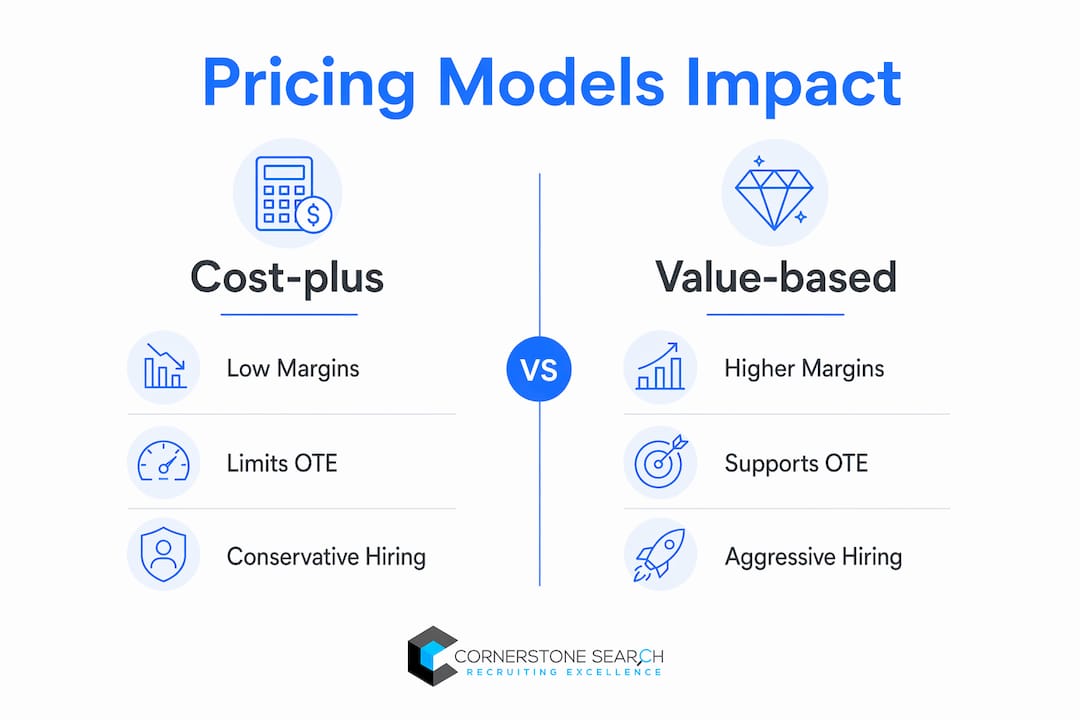
Cost-plus pricing sets your price by marking up your cost of delivery. It feels safe but it caps your margins and therefore caps your comp budgets. Value-based pricing sets price based on what the customer gains. Value-based models achieve 31% higher profit margins than cost-plus models. That margin difference is what funds competitive OTE packages and lets you hire better people.
Here is what the two models mean in practice for your sales team:
- Cost-plus pricing compresses margins, limits OTE budgets, and forces you to hire cheaper reps who often cannot close complex deals.
- Value-based pricing expands margins, supports competitive comp, and attracts AEs who can sell on ROI rather than discounting on price.
- Usage-based pricing creates variable revenue that complicates quota setting and makes it harder to size headcount with confidence.
- Flat-rate pricing simplifies quota math but limits expansion revenue, which reduces the ceiling on what your AEs can realistically earn.
Pro Tip: Before you post a single sales job description, build your quota model from your pricing. If the math does not produce a 4x multiplier at a competitive OTE, fix the pricing first.
| Pricing Model | Margin Impact | Hiring Implication |
|---|---|---|
| Cost-plus | Low margins | Limits OTE; forces cheaper hires |
| Value-based | 31% higher margins | Supports competitive comp and senior AEs |
| Usage-based | Variable revenue | Complicates quota setting and headcount planning |
| Flat-rate | Predictable but capped | Limits expansion earnings for reps |
Why value-based pricing makes sales hiring more efficient
Value-based pricing does more than pad your margins. It changes the entire sales conversation. When your price reflects what the customer actually gains, your reps spend less time defending the number and more time closing.
Aligning pricing with customer value reduces sales friction and shrinks the team size needed to hit targets. That is a big deal. Fewer reps hitting quota beats more reps missing it every single time. You do not need a 20-person sales floor if your pricing model removes the friction that requires 20 people to overcome.
“The best pricing model is the one your sales team does not have to apologize for. When reps stop explaining why you cost what you cost, they start closing.”
Value-based pricing also improves sales team productivity by attracting candidates who know how to sell outcomes. Top AEs want to work where they can win. A clear value story backed by solid pricing is a recruiting asset, not just a revenue tool.
The practical benefits for your hiring strategy include:
- Shorter sales cycles mean faster ramp time for new hires.
- Higher win rates justify higher OTE, which attracts better candidates.
- Reduced discounting pressure means reps close at full price more often.
- Leaner teams with higher productivity lower your CAC and improve payback.
What hiring mistakes come from bad pricing models
Hiring salespeople before your pricing is stable is one of the most expensive mistakes a founder can make. Premature sales hires with unstable pricing and no product-market fit produce cash burn and confusion, not growth.
Here is the sequence that kills early-stage companies. Founder closes a few deals on hustle and relationships. Founder hires two AEs to scale. AEs cannot replicate the founder’s deals because pricing is inconsistent, the ICP is fuzzy, and the sales motion is not documented. Six months later, the AEs are gone and the company is $400,000 lighter.
Before you hire your first salesperson, clear these gates:
- Pricing is documented and repeatable. Not “we negotiate case by case.” Actual tiers, actual numbers, actual guardrails.
- Your ICP is defined. You know who buys, why they buy, and what they pay.
- Objections are mapped. Your reps need a playbook, not a prayer.
- The sales motion is proven. You or someone else has closed at least five deals using the same process.
- Quota math works. Run the 4x multiplier test before you post the job.
If those gates are not cleared, hire admin or delivery roles instead. Free up founder time to fix the pricing and product fit. Sales hires on a broken foundation do not fix the foundation. They just cost more.
Pro Tip: The real cost per hire from SHRM’s 2025 data sits at $5,475 in direct costs alone, before you count manager time, onboarding, and the ramp period. A bad hire in SaaS sales costs 3x to 5x that number when you factor in lost pipeline and team disruption.
How to test pricing before you scale your sales team
Pricing is not a one-time decision. Companies that refine pricing regularly grow 30% faster than those that do not. That stat should change how you think about pricing as a growth lever tied directly to headcount planning.
The right way to test pricing without blowing up your existing revenue:
- Run cohort tests. Offer new pricing only to new signups. Track signup rate, conversion, and retention over 4–6 weeks before drawing conclusions.
- Grandfather existing customers. Protect existing revenue by keeping current customers on their original rates while you test new rates on new cohorts. This builds trust and limits churn risk.
- Watch expansion triggers. Pricing that creates natural expansion moments, like usage thresholds or seat additions, justifies quota increases for your AEs and supports headcount growth.
- Pace headcount to validation. Do not hire the next AE until your pricing test shows stable conversion at the new rate. Hiring ahead of pricing validation is rolling the dice.
| Pricing Test Signal | What It Tells You | Hiring Implication |
|---|---|---|
| Stable conversion at new price | Pricing is holding | Safe to add headcount |
| Drop in conversion | Price resistance exists | Fix pricing before hiring |
| Expansion revenue increasing | Upsell motion is working | Consider expansion-focused AE hire |
| Churn rising after price change | Value perception gap | Pause hiring; address product or messaging |
Syncing your pricing strategy with your sales hiring plan
Pricing and hiring are not separate conversations. They are the same conversation. SaaS companies maintaining ARR per employee above $150,000 show healthy go-to-market efficiency. Drop below that number and you are either overstaffed or underperforming, and usually both.
A practical readiness checklist before you scale your sales team:
- Pricing tiers are documented with clear upgrade paths.
- Quota math produces a 4x multiplier at your target OTE.
- CAC payback is modeled at 12–18 months.
- Sales motion is repeatable and written down.
- ARR per employee is at or above $150,000.
Watch out for tier-gated pricing that forces customers to assume product risk before upgrading. This creates expansion friction that stalls deals despite your reps doing everything right. Making capabilities available before asking for the upgrade shortens expansion cycles and makes your AEs more productive without adding headcount.
Comp plans must also reflect your pricing model. If you run usage-based pricing, your AEs need a comp structure that rewards expansion, not just new logos. If you run flat-rate pricing, make sure your quota ceiling is high enough to keep top performers from leaving for a competitor with a bigger upside.
Key takeaways
SaaS pricing models directly control sales team size, compensation budgets, and quota expectations, making pricing decisions inseparable from hiring strategy.
| Point | Details |
|---|---|
| 4x quota-to-OTE is the floor | A $200,000 fully loaded rep must carry $800,000 in quota to maintain healthy CAC payback. |
| Value-based pricing funds better hires | 31% higher margins over cost-plus models means more budget for competitive OTE and senior AEs. |
| Hire after pricing is stable | Premature sales hires on unstable pricing burn cash without producing repeatable growth. |
| Test pricing before scaling headcount | Cohort testing over 4–6 weeks validates pricing changes before you commit to new sales hires. |
| ARR per employee signals health | Staying above $150,000 ARR per employee confirms your hiring pace matches your revenue engine. |
What 30 years of SaaS sales recruiting taught me about pricing and hiring
I have seen this play out hundreds of times. Founder builds something real, closes the first ten deals on personality and relationships, then hires two AEs to scale. Six months later, both AEs are gone. The founder blames the candidates. I can tell you with confidence: it was almost never the candidates.
The real problem is almost always pricing. Either the price was too low to support a real quota, or the pricing was so inconsistent that reps could not build a repeatable pitch. You cannot hire your way out of a pricing problem. I have watched companies burn through three or four sales leaders trying to do exactly that.
The hidden cost of a bad sales hire in SaaS is brutal. The direct cost per hire is just the starting point. Add the ramp period, the lost pipeline, the manager time, and the morale hit on the rest of the team. Now multiply that by two or three bad hires in a row and you are looking at a serious setback.
The founders who get this right share one trait. They treat pricing as a sales infrastructure decision, not just a revenue decision. They know their quota math cold. They know their CAC payback period. They know what OTE they can support. When they call me to find them a top SaaS sales executive, the search goes fast because the role is real and the comp is fundable.
Pricing clarity also improves candidate quality. Strong AEs ask hard questions in interviews. They want to know the ACV, the quota, the ramp plan, and the pricing model. When you can answer those questions with confidence and specifics, you attract better candidates. When you fumble those answers, the best candidates walk.
— Rich Rosen
Cornerstonesearch helps you hire when pricing and quota align
Pricing clarity is the starting gun for a successful sales hire. When your quota math works and your comp is fundable, the right candidates show up fast.
Cornerstonesearch has placed over 1,200 SaaS sales professionals since 1996, with an average search time of just 21 days from kickoff to offer acceptance. The team specializes in SaaS sales recruitment for startups and growth-stage companies where pricing and quota alignment are non-negotiable. If you are ready to hire and your pricing model can support a real sales team, Cornerstonesearch can find the right people fast. Read the sales recruitment fundamentals to make sure your hiring process matches the quality of your pricing strategy.
FAQ
How does SaaS pricing directly affect sales quota setting?
Pricing determines the revenue each rep can realistically generate, which sets the ceiling on quota. A minimum 4x quota-to-OTE multiplier is the industry benchmark for healthy SaaS sales economics.
What pricing model supports the best sales compensation?
Value-based pricing produces 31% higher profit margins than cost-plus models, giving companies more budget to offer competitive OTE and attract senior sales talent.
When should a SaaS startup hire its first salesperson?
Hire only after pricing is documented, the ICP is defined, the sales motion is repeatable, and your quota math produces a 4x multiplier at a competitive OTE.
How does tier-gated pricing hurt sales team performance?
Tier-gated pricing forces customers to assume product risk before upgrading, which stalls expansion deals and puts unfair pressure on sales reps regardless of their skill level.
What is a healthy ARR per employee benchmark for SaaS companies?
SaaS companies with strong go-to-market efficiency maintain ARR per employee above $150,000. Falling below that level signals overstaffing or underperforming sales teams.