

TL;DR:
- The SaaS sales cycle consists of seven stages, each with mandatory exit criteria to keep deals progressing. Deal size and committee complexity significantly influence cycle length, with enterprise deals often taking 120 to 280 days. Improving process discipline, qualification, and team skills helps shorten cycles and increases the chances of long-term revenue.
The SaaS sales cycle is a sequence of seven distinct stages, from prospecting to customer handoff, that drives recurring revenue in B2B software sales. Understanding how SaaS sales cycles work is not optional for sales leaders. It is the difference between a pipeline you can forecast and one you are just guessing at. The median B2B SaaS cycle now runs 84–134 days, up 22–25% since 2022, driven by larger buying committees and more procurement gates. If your team does not know exactly where every deal stands and why, you are flying blind.
What are the seven stages of the SaaS sales cycle?
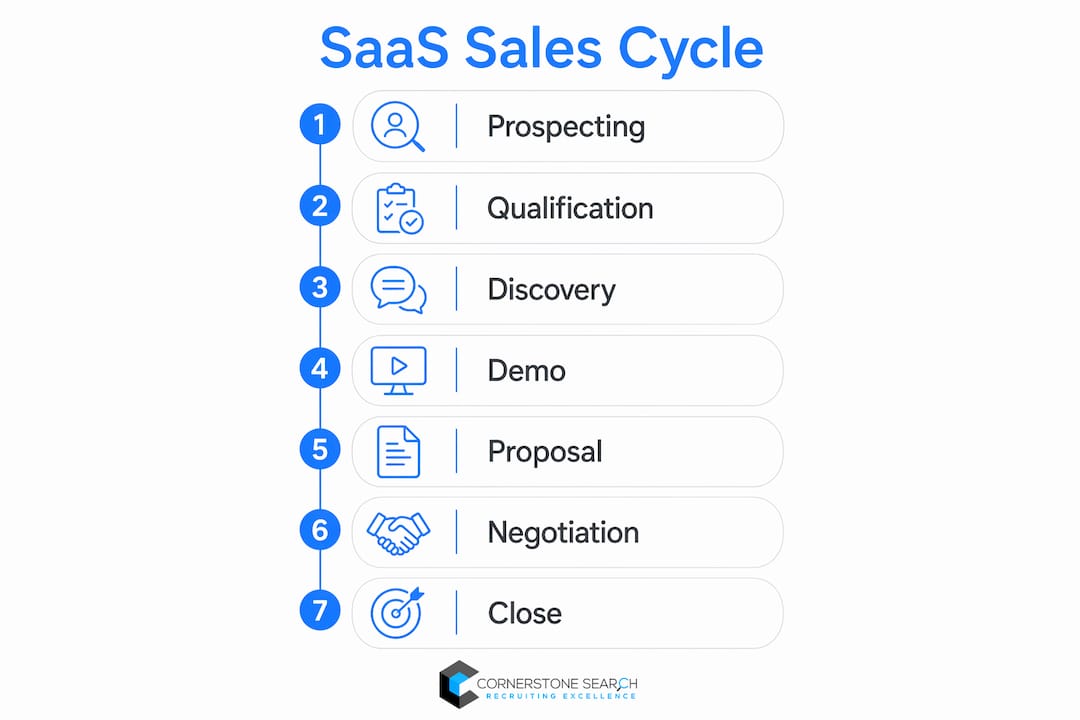
The standard SaaS sales cycle has seven stages, each with mandatory exit criteria that keep deals moving. Skip the criteria and you get zombie deals. They look alive in your CRM but they are going nowhere.
-
Prospecting. This is where you identify potential buyers through outbound outreach, inbound leads, referrals, and events. The exit criterion is simple: a confirmed interest and a scheduled next step. No next step means no stage advancement.
-
Qualification. Here you apply a framework like BANT (Budget, Authority, Need, Timeline) to determine whether the prospect is worth pursuing. The exit criterion is a documented fit score. Skipping this step forces account executives to waste time on low-quality discovery calls, which increases overall cycle length inefficiently.
-
Discovery. This is the deep-dive conversation where you uncover business pain, technical requirements, and decision-making structure. Exit criterion: a confirmed problem statement and a mapped buying committee. If you cannot name the economic buyer, you are not done with discovery.
-
Demo and evaluation. You present the product and often run a proof of concept or trial. This stage is the biggest time sink in the entire process. The evaluation stage consumes 30–35% of total cycle time. Structured 14-day POCs with defined success criteria can cut cycle length by 23%.
-
Proposal. You deliver a formal proposal with pricing, scope, and ROI justification. Exit criterion: written confirmation from the champion that the proposal is being reviewed by decision-makers.
-
Negotiation. Legal, procurement, and finance get involved. Terms, security reviews, and contract language get debated. This stage can drag on indefinitely without a documented mutual close plan.
-
Close and handoff. The contract is signed and the customer is transitioned to onboarding and customer success. A clean handoff with documented expectations sets the tone for the entire customer relationship.
Pro Tip: Require documented exit criteria at every stage. If your reps cannot produce the trigger that moved a deal forward, the deal has not actually moved.
How does deal size affect the length of SaaS sales cycles?
Deal size is the single biggest predictor of cycle length, but it is not the whole story. Deals under $5K ACV close in a median of 14 days. Mid-market deals in the $25K–$100K range take 60–90 days. Enterprise deals above $100K average 120–280 days. Every additional $10K in deal size adds roughly 5–10 days to the cycle.

The committee size compounds this. The average buying committee now involves 6.8 stakeholders. More stakeholders means more internal selling, more competing priorities, and more chances for a deal to stall at the finish line.
The real inflection point is $100K ACV. Crossing that threshold triggers formal procurement reviews in 78% of enterprise deals, adding 30–45 days to cycle times regardless of how well the sales process went. Legal, InfoSec, and vendor management all want their piece. You can run a perfect sales process and still lose 6 weeks to procurement paperwork.
| Deal tier | ACV range | Median cycle length |
|---|---|---|
| SMB | Under $5K | 14 days |
| Mid-market | $25K–$100K | 60–90 days |
| Enterprise | $100K+ | 120–280 days |
Pro Tip: Do not blame enterprise deal size alone for long cycles. Deal size explains only 27% of cycle length variance. The other 73% comes from process maturity, buyer intent, and how well your team manages committees. Fix your process before you blame the market.
What common pitfalls slow down SaaS sales cycles?
Most elongated cycles are self-inflicted. The problems are predictable and fixable. Here are the ones I see most often.
-
No exit criteria. Without documented triggers for stage transitions, deals drift. Reps advance opportunities based on optimism, not evidence. Requiring documented triggers for every stage transition prevents pipeline inflation and keeps forecasts honest.
-
Weak champion enablement. Your internal champion cannot close the deal alone. Failing to arm champions with ROI summaries, security documentation, and executive-ready business cases causes stalls during final approval. Your champion walks into a room with the CFO and has nothing to show.
-
Open-ended evaluations. A trial with no end date and no success criteria is a gift to the buyer and a nightmare for your forecast. Set a fixed 14-day window. Define what “good” looks like on day one. If you do not, the evaluation becomes a permanent state.
-
Skipping qualification. Reps who skip BANT or a similar framework end up in discovery calls with prospects who have no budget, no authority, or no real timeline. That wastes everyone’s time and inflates your pipeline with deals that will never close.
-
Poor sales-to-success handoff. A botched handoff creates churn risk before the ink is dry. Document the customer’s goals, the promises made during the sale, and the agreed-upon onboarding milestones. Customer success needs that context to do their job.
Pro Tip: Build a mutual close plan with every enterprise prospect. Put it in writing. Shared timelines create shared accountability, and they smoke out deals where the buyer has no real urgency.
How can sales leaders shorten SaaS sales cycles in 2026?
Shortening the SaaS customer acquisition cycle requires discipline, not magic. The levers are well understood. Most teams just do not pull them consistently.
-
Measure by ACV tier, not overall average. Segment your pipeline health metrics by deal size. One $500K enterprise deal skews your average cycle length and makes your SMB motion look broken when it is not. Medians by tier give you actionable data.
-
Front-load qualification. Use BANT or MEDDIC to qualify hard before you invest in discovery. A rep who spends 90 minutes on a discovery call with an unqualified prospect has just burned a slot that could have gone to a real deal.
-
Fix your POC process. Structure every proof of concept with a fixed timeline, defined success criteria, and a named executive sponsor on the buyer side. This single change can reduce cycle length by 23% in the evaluation stage.
-
Go multi-threaded early. With 6.8 stakeholders involved in the average enterprise deal, relying on one contact is a liability. Multi-threaded outreach and strong champion enablement reduce stalls caused by committee complexity and procurement hurdles.
-
Combine inbound and outbound prospecting. Modern SaaS sales favors a blended approach where inbound signals trigger targeted outbound follow-up. This allocates rep time toward discovery and closing rather than cold prospecting from scratch.
The teams that shorten cycles are not the ones with the best product demos. They are the ones with the most disciplined process from the first call to the signed contract.
How does the SaaS sales cycle extend beyond closing?
Closing is not the finish line. It is the starting gun for the revenue relationship. The sales cycle extends beyond closing into onboarding and expansion, and those stages are critical for net dollar retention and company valuation.
A customer who churns after 12 months was not a win. They were a delayed loss. Onboarding quality, time to first value, and expansion motion all determine whether a closed deal turns into a long-term revenue asset. Sales and customer success need to operate as a single handoff, not two separate departments with different goals.
Renewals and upsells are where SaaS companies build real enterprise value. A sales team that closes deals and then throws them over the wall to customer success is leaving money on the table. The best SaaS sales leaders treat the post-close cycle as part of their SaaS sales quota responsibility, not someone else’s problem.
Key takeaways
The SaaS sales cycle is a seven-stage process where deal size, committee complexity, and process discipline determine whether you close fast or bleed time.
| Point | Details |
|---|---|
| Seven stages with exit criteria | Each stage requires documented triggers to prevent zombie deals and pipeline inflation. |
| Deal size drives cycle length | SMB deals close in 14 days; enterprise deals above $100K average 120–280 days. |
| Procurement adds 30–45 days | Crossing $100K ACV triggers formal reviews in 78% of enterprise deals. |
| Process maturity matters most | Deal size explains only 27% of cycle variance; process and buyer intent drive the rest. |
| Post-close is part of the cycle | Onboarding and expansion drive net dollar retention and long-term company value. |
What I have seen after 30 years of placing SaaS sales reps
Here is the uncomfortable truth. Most elongated sales cycles are a people problem disguised as a process problem.
I have placed over 1,200 sales professionals at SaaS and software companies since 1996. The pattern I see over and over is this: a company hires a rep who looks great on paper but has never managed a multi-stakeholder enterprise deal. They get into a $200K opportunity, they find one champion, and they stop there. They do not know how to multi-thread. They do not know how to build a business case for a CFO they have never met. The deal stalls. The rep blames procurement. The CRO blames the rep. Nobody fixes the hiring criteria.
The other thing I see constantly is reps who skip qualification because they are afraid to disqualify. They would rather have a full pipeline of garbage than a lean pipeline of real deals. That is a confidence problem and a coaching problem. It shows up in cycle length before it shows up in quota attainment.
The companies that consistently run tight cycles hire people who understand the unique demands of SaaS sales hiring. They hire reps who can navigate committees, build champions, and run a disciplined POC. That is a specific skill set. It is not the same as being a good transactional seller.
If your cycles are getting longer, look at your team before you look at your process. Nine times out of ten, the process is fine. The execution is the problem.
— Rich Rosen
The right hire shortens your sales cycle
Long sales cycles often trace back to the wrong people running them. Cornerstonesearch specializes in placing top SaaS sales talent at software companies that need reps who can manage complex enterprise deals, navigate buying committees, and close without hand-holding.
With over 1,200 placements since 1996 and an average time from search kickoff to offer acceptance of 21 days, Cornerstonesearch moves fast without cutting corners. If your pipeline is stalling and you suspect the team is part of the problem, the software sales recruitment team at Cornerstonesearch is worth a conversation. The right hire pays for itself in the first quarter.
FAQ
What are the seven stages of the SaaS sales cycle?
The seven stages are prospecting, qualification, discovery, demo and evaluation, proposal, negotiation, and close with handoff. Each stage requires documented exit criteria to keep deals moving and prevent pipeline stagnation.
How long does a typical SaaS sales cycle take?
The median B2B SaaS sales cycle runs 84–134 days, though SMB deals under $5K ACV can close in 14 days and enterprise deals above $100K often take 120–280 days depending on procurement complexity.
Why do enterprise SaaS deals take so much longer to close?
Enterprise deals above $100K ACV trigger formal procurement reviews in 78% of cases, adding 30–45 days to cycle times. Larger buying committees averaging 6.8 stakeholders also create more internal selling requirements and approval layers.
What is the fastest way to shorten a SaaS sales cycle?
Fix your POC process first. Structured 14-day proofs of concept with defined success criteria can reduce cycle length by 23%. Front-loading qualification with BANT or MEDDIC also eliminates low-quality discovery calls that waste rep time.
Why do SaaS sales cycles vary so much by segment?
Deal size explains only 27% of cycle length variance. The remaining 73% comes from process maturity, buyer intent, and how well the sales team manages complex committees. Segment your pipeline metrics by ACV tier to get an accurate read on each motion.