

TL;DR:
- Structured, evidence-based assessments enable fast and reliable sales candidate evaluations by focusing on measurable traits. Implementing a standardized five-stage Signal Interview Loop produces evidence at each step and takes 10 to 14 days, significantly reducing hiring time. Using detailed scorecards and calibration sessions helps teams make objective decisions and avoid biases that slow down or impair hiring quality.
Structured, evidence-based assessment is the only reliable way to evaluate sales candidates fast without rolling the dice on gut feel. Most hiring managers at startups waste weeks on unstructured conversations, then wonder why their new rep is still ramping at month nine. The fix is not more interviews. It is better ones. Coachability correlates with a 1.7x lift in first-year quota attainment, which means the traits you measure matter more than the time you spend measuring them. Get the framework right, and you can compress a full sales hiring cycle to 10–14 days without sacrificing quality.
How to evaluate sales candidates fast: the traits that actually matter
The fastest way to screen out bad hires is to know exactly what you are looking for before the first call. Four traits predict first-year sales performance better than anything on a resume: coachability, curiosity, work ethic, and pattern recognition.

Coachability is the big one. Candidates below a 3 on a 1–4 coachability scale should be rejected regardless of their past quota numbers. A rep who cannot take feedback will not improve, will not ramp on time, and will cost you a full sales cycle’s worth of pipeline before you finally cut them loose. No amount of charm compensates for an uncoachable mindset.
Curiosity shows up in the questions a candidate asks, not the answers they give. A rep who asks sharp, specific questions about your ICP, your competitive position, or your average deal cycle is already thinking like a seller. One who asks about PTO in the first screen is telling you something too.
Pattern recognition is harder to spot but critical for SaaS. Ask candidates to walk you through how they identified a deal that looked dead but was actually winnable. The ones who can articulate a clear pattern, not just a lucky outcome, are the ones who will replicate success.
- Coachability: Ask for a time they received critical feedback and changed their approach. Score on specificity and self-awareness, not polish.
- Curiosity: Count the quality of questions they ask you. Generic questions score a 1. Specific, research-backed questions score a 4.
- Work ethic: Ask about their prospecting cadence and weekly activity numbers. Vague answers are a red flag.
- Pattern recognition: Ask them to diagnose a deal they lost. Reps who blame the product score low. Reps who identify a process gap score high.
Pro Tip: Use a 1–4 scale, not a 1–5 or 1–10. Even numbers force clear distinctions and eliminate the “safe middle” bias that makes every candidate look average.
What does a structured interview loop look like for fast screening?
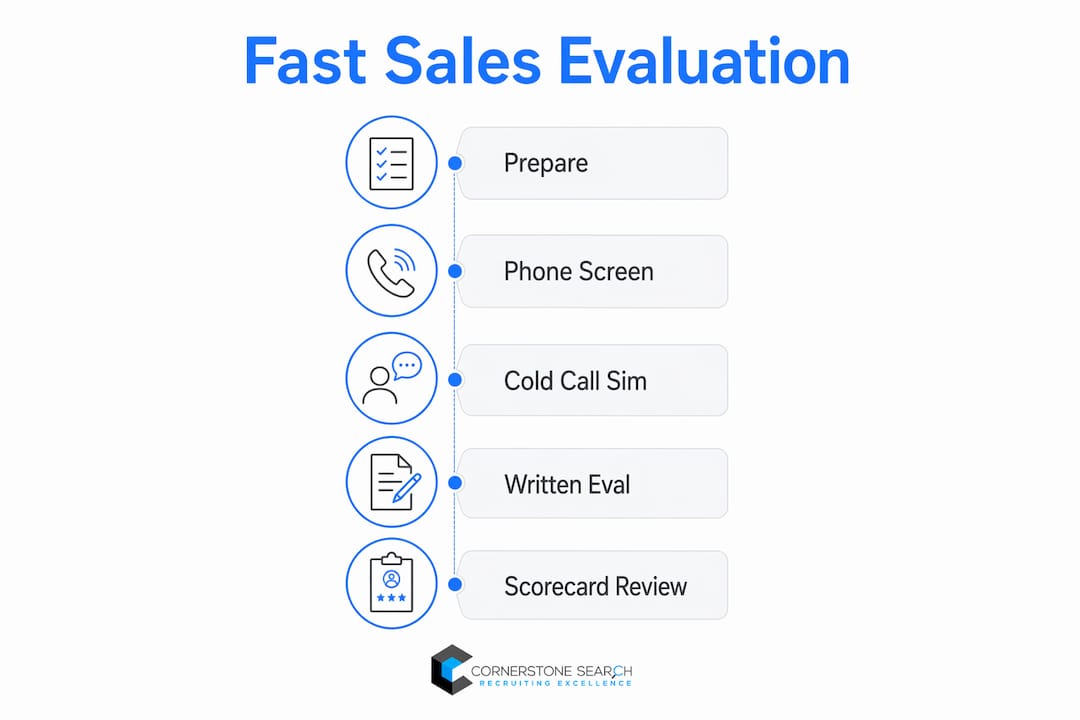
Tech companies compress hiring to a 10–14 day cycle by replacing open-ended screening calls with a five-stage Signal Interview Loop. Each stage produces a concrete artifact you can score, compare, and document. No more “I liked her energy” as a hiring rationale.
Here is the sequence:
- 20-minute phone screen. Confirm baseline fit: compensation expectations, geography, SaaS experience, and one coachability question. Score immediately after the call.
- 30-minute cold call simulation. Give the candidate a persona and a product brief 24 hours in advance. Run a live cold call. You will know within two minutes whether they can handle objections or fold.
- 24-hour outbound writing test. Send a prospect profile and ask for a cold email sequence. Work samples like this predict ramp speed better than any conversation. A charming candidate who cannot write a decent subject line will not close deals.
- 45-minute discovery roleplay. You play the prospect. They run the call. Score on question quality, listening, and ability to pivot when you throw a curveball.
- 60-minute panel debrief. Two or three interviewers share pre-submitted scores before anyone speaks. This prevents the loudest voice in the room from hijacking the decision.
| Stage | Duration | What it measures |
|---|---|---|
| Phone screen | 20 min | Fit, compensation, coachability |
| Cold call simulation | 30 min | Objection handling, presence |
| Outbound writing test | 24 hr | Written communication, creativity |
| Discovery roleplay | 45 min | Questioning, listening, adaptability |
| Panel debrief | 60 min | Aggregate scoring, decision |
This process saves 30+ minutes per candidate compared to traditional multi-round interviews. More importantly, every stage produces evidence, not impressions.
Pro Tip: Send candidates a one-page brief before the cold call simulation. It mirrors real selling conditions and gives you a cleaner read on preparation habits.
What tools and frameworks make candidate scoring objective?
The goal of any fast evaluation process is to defeat gut feel. Structured scorecards make hiring criteria explicit and force interviewers to commit to a rating before the group discussion contaminates their thinking.
A solid scorecard has three components. First, a defined set of competencies tied to the specific role. An enterprise AE scorecard looks different from an SDR scorecard. Second, a 1–4 behavioral anchor for each competency. A “1” on coachability means the candidate blamed others for every failure. A “4” means they described a specific behavior change with a measurable outcome. Third, a weighting system that reflects role priorities. Coachability might carry 30% weight for a first-hire AE at a seed-stage startup and only 15% for a senior enterprise rep joining a mature team.
Calibration sessions are the secret weapon most hiring teams skip. Ten minutes of calibration before interviews begin aligns every interviewer on what each score means. Without calibration, one interviewer’s “3” is another’s “1,” and your scorecard becomes noise.
Compare candidates dimension by dimension, not by total score. A candidate who scores 4 on coachability and 2 on pattern recognition is a different hire than one who scores 3 on both. Total scores hide the tradeoffs. Dimension-by-dimension comparison surfaces them.
- Define competencies and weights before the first interview, not after.
- Run a 10-minute calibration session with all interviewers before the loop starts.
- Submit individual scores immediately after each stage, before any group discussion.
- Compare candidates on each dimension separately to understand the real tradeoffs.
- Weight coachability highest for early-stage hires where ramp speed is the primary risk.
For hiring managers building this process from scratch, the SaaS sales interview questions library from Cornerstonesearch is a practical starting point for building behavioral anchors by role.
What mistakes slow down or wreck fast candidate evaluation?
The biggest mistake is trusting your first impression. Interviewer confidence after 60 seconds of conversation has almost no correlation with first-year sales performance. Charisma is not a sales competency. It is a distraction.
Skipping work samples is the second most expensive mistake. A candidate who aces a conversation but cannot write a cold email or handle a live objection will fail in the field. Conversation alone has low predictive validity for early-stage sales roles. You need artifacts.
Delayed scoring destroys objectivity. Hiring managers often score memory of an interview rather than the actual interview. The longer you wait to fill out a scorecard, the more your brain rewrites what happened. Score within 15 minutes of each stage, every time.
Ignoring coachability is the most expensive mistake a startup can make. A rep who cannot be coached will not ramp, will not improve, and will eventually poison your culture. Past quota numbers do not override a coachability score below 3.
Failing to calibrate interviewers produces inconsistent scoring that makes the debrief a mess. When one interviewer scores a “3” and another scores a “1” on the same candidate for the same competency, you do not have a data problem. You have a calibration problem.
How to implement fast evaluation in your startup hiring workflow
Getting this right takes setup time upfront, but it pays off on every search after the first. Here is how to build the process into your workflow.
- Define role-specific competencies before you post the job. List five to seven competencies and assign weights. Coachability, curiosity, work ethic, pattern recognition, and communication are a solid starting set for most SaaS AE roles.
- Train your interviewers on behavioral anchors. Run a 30-minute session where everyone scores the same hypothetical candidate response. Disagreements reveal calibration gaps before they cost you a hire.
- Schedule the Signal Interview Loop stages tightly. Aim to complete all five stages within seven business days. Candidates who are serious will keep up. Ones who ghost or delay are telling you something.
- Use pre-submitted scores in every debrief. Collect individual scorecards before the panel discussion starts. Pre-commitment to scores before group discussion leads to better hiring decisions and prevents the loudest voice from winning by default.
- Document every decision. If you pass on a candidate, write down why in scorecard terms. This builds institutional memory and helps you calibrate future searches.
For startups hiring their first or second sales rep, the stakes are especially high. A bad hire at that stage does not just miss quota. It can set back your go-to-market by six months. Leaning on specialized sales recruiters who already run structured evaluation frameworks can cut your time-to-hire significantly while reducing mis-hire risk.
Pro Tip: Send candidates a one-paragraph brief on your evaluation process before the loop starts. Transparency signals professionalism and filters out candidates who are not serious.
For additional perspective on building evaluation processes that work for early-stage companies, the team at La Fabrique à Rendez-Vous has written thoughtfully on professional service sales hiring frameworks that translate well to SaaS contexts.
Key Takeaways
Structured, scorecard-driven evaluation compresses sales hiring to 10–14 days while cutting mis-hire rates in half compared to unstructured interviews.
| Point | Details |
|---|---|
| Coachability is non-negotiable | Reject any candidate scoring below 3 of 4 on coachability, regardless of past quota. |
| Work samples beat conversation | Cold call simulations and writing tests predict ramp speed better than any interview alone. |
| Score immediately after each stage | Delayed scoring means you are rating your memory, not the candidate. |
| Calibrate before you interview | Ten minutes of calibration aligns all interviewers and makes scorecards reliable. |
| Compare dimensions, not totals | Total scores hide tradeoffs. Review each competency separately to make the right call. |
What I have learned after placing 1,200+ sales reps
After three decades placing sales talent for SaaS and software companies, I can tell you the single biggest predictor of a bad hire is not a weak resume. It is a hiring manager who trusted their gut and skipped the work sample.
I have seen candidates walk into interviews and absolutely own the room. Confident, articulate, funny. They get the offer. Then they cannot write a cold email to save their lives, and they are gone by month four. Charisma is not a sales skill. It is a social skill. The two overlap sometimes, but not as often as hiring managers think.
The candidates who actually perform are usually the ones who ask sharp questions, take feedback without getting defensive, and show up to the cold call simulation having actually prepared. Coachability is not a soft trait. It is the hardest predictor to fake and the most important one to measure.
I am also skeptical of anyone who tells you fast hiring means sloppy hiring. The Signal Interview Loop is faster than most traditional processes and more rigorous. The speed comes from eliminating the stages that produce no useful information, not from cutting corners on the stages that do. If your current process includes three rounds of “tell me about yourself,” you are not being thorough. You are wasting everyone’s time.
The startups that get this right build a repeatable evaluation process, train their interviewers, and treat every hire as a data point that improves the next one. The ones that get it wrong keep hiring on vibes and wondering why their ramp numbers are terrible.
— Rich Rosen
How Cornerstonesearch helps startups hire sales winners fast
Cornerstonesearch has placed over 1,200 sales professionals in SaaS and software companies since 1996, with an average time from search kickoff to offer acceptance of just 21 days. That speed comes from running structured evaluation frameworks on every search, not from cutting corners.
If you are building a sales team and cannot afford a six-month ramp on a bad hire, the Sales Recruitment 101 guide from Cornerstonesearch is the right place to start. It covers the full hiring process from competency definition through offer negotiation, with frameworks you can apply immediately. For startups specifically, Cornerstonesearch’s SaaS hiring expertise is built around the exact evaluation methods covered in this article.
FAQ
What is the fastest way to screen sales candidates?
Replace open-ended phone screens with a structured Signal Interview Loop that includes a cold call simulation and a written outbound test. This compresses evaluation to 10–14 days while producing scorable artifacts at every stage.
Why is coachability the most important trait to assess quickly?
Coachability predicts first-year quota attainment more reliably than past performance. Candidates who score below 3 on a 1–4 coachability scale take longer to ramp and are more likely to leave or be managed out within the first year.
How do scorecards speed up the hiring decision?
Structured scorecards reduce mis-hire rates by half compared to unstructured interviews. They force interviewers to commit to specific ratings before group discussion, which eliminates memory bias and loudest-voice dynamics in the debrief.
When should I submit my scorecard after an interview?
Submit your scorecard within 15 minutes of each interview stage, before any discussion with other interviewers. Waiting longer means you are scoring your memory of the interview, not the actual candidate performance.
How do I align multiple interviewers on scoring standards?
Run a 10-minute calibration session before the interview loop begins. Have all interviewers score the same hypothetical candidate response and discuss disagreements. This aligns everyone on what each score means and makes your scorecards consistent across the full panel.