

Speeding up the sales recruiting process means systematically cutting delays at each funnel stage without lowering the bar on candidate quality. The median time-to-fill across industries sits at 44 to 45 days, but top-performing companies in SaaS and software consistently hit 20 to 22 days. That gap is not luck. It is the result of precise job descriptions, AI-assisted screening, structured interviews, and airtight feedback loops working together. This guide breaks down each lever so HR professionals and hiring managers can accelerate sales hiring without guesswork.
How to speed up the sales recruiting process from day one
The fastest way to reduce time-to-fill is to fix the job description before you post it. Most recruiting delays do not start in the interview stage. They start when a vague posting attracts 400 applicants, 350 of whom were never qualified to begin with. That volume buries recruiters and slows every downstream step.
Write for the role, not the résumé
A strong sales job description defines three things precisely: the sales motion (inbound, outbound, or hybrid), the quota expectations in dollar terms, and the specific product or market the rep will cover. When those elements are missing, candidates self-select poorly and screening workload spikes. Compare these two openings:
Vague: “We are looking for a motivated sales professional to join our growing team.”
Specific: “You will own a $1.2M annual quota selling our DevOps platform to mid-market engineering leaders, running a full outbound cycle from cold outreach to close.”
The second version filters out candidates who have never run outbound cycles or sold to technical buyers. That filtering happens before a single résumé lands in your ATS. Sales-relevant signal gating at the top of the funnel is one of the highest-leverage moves available to a hiring team.
A precise description also sets success criteria. Include what “good” looks like at 30, 60, and 90 days. Candidates who read those benchmarks and still apply are signaling genuine confidence in their ability to perform. That signal is worth more than a polished résumé.
Pro Tip: Add a short paragraph describing your sales culture and deal cycle length. Reps who thrive in transactional, high-velocity environments rarely succeed in complex, multi-stakeholder deals. Saying this upfront cuts mismatched applications by a meaningful margin.
Key elements every sales job description should include:
- Quota amount and ramp timeline
- Sales motion type (inbound, outbound, channel)
- ICP (ideal customer profile) and buyer persona
- Tech stack the rep will use (Salesforce, Outreach, Gong, etc.)
- Clear definition of success at 30, 60, and 90 days
How does AI screening cut time-to-shortlist?
Once applications arrive, manual screening is the single biggest time sink in most recruiting funnels. Automating CV screening reduces average recruiter screening time from 23 hours to under 2 hours per role. That is a 92% reduction in one of the most repetitive tasks in the hiring process.

Platforms like Klearskill achieve 97% screening accuracy by ranking candidates against predefined criteria rather than relying on keyword matching alone. AI surfaces the top 8 to 12% of candidates in minutes, giving recruiters a shortlist instead of a pile. One documented case study showed a company reducing its required manual screeners from 150 to 70 recruiters after deploying AI screening. That is not a marginal efficiency gain. It is a structural change in how recruiting capacity is used.
| Screening method | Average time per role | Accuracy |
|---|---|---|
| Manual CV review | 23 hours | Variable |
| AI-assisted screening (Klearskill) | Under 2 hours | 97% |
| AI shortlisting (top candidates surfaced) | Minutes | Top 8 to 12% identified |
The cost case is equally strong. Fewer recruiter hours per role means more roles can run in parallel without adding headcount. For SaaS startups scaling a sales team from 5 to 25 reps in a single quarter, that parallel capacity is not optional. It is the difference between hitting and missing a growth target.
AI screening also integrates with most modern ATS platforms, including Greenhouse, Lever, and Workday. The setup investment is a one-time cost. The time savings compound across every future search.
Pro Tip: When configuring AI screening criteria, weight performance indicators over credentials. For sales roles, prior quota attainment data, deal size experience, and industry vertical match predict success far better than degree or years of experience alone.
Why do structured interviews speed up hiring decisions?
Unstructured interviews feel faster because they require no preparation. They are actually slower because they produce inconsistent data, require longer debrief conversations, and generate more second-guessing. Structured interviews carry a predictive validity of r=0.44 to 0.63 compared to r=0.20 to 0.38 for unstructured formats. Higher predictive validity means fewer bad hires and fewer re-opens, which are the most expensive delays in any recruiting process.
| Interview type | Predictive validity | Debrief time | Legal defensibility |
|---|---|---|---|
| Unstructured | r=0.20 to 0.38 | Long (inconsistent data) | Low |
| Structured with scorecards | r=0.44 to 0.63 | Short (standardized data) | High |
Building a reusable question set for sales roles takes roughly four hours upfront. That investment pays back on the first search. Questions should map directly to the competencies in the job description: prospecting behavior, objection handling, pipeline discipline, and stakeholder management. A structured SaaS interview question set gives hiring managers a repeatable framework they can run without recruiter coaching every time.
Asynchronous one-way video screening adds another speed layer. Candidates record responses to three to five structured questions on their own schedule. AI scores the responses against a rubric before a human ever watches the video. AI-scored async screening compresses what used to be a two-week phone screen stage into 48 hours.
The scorecard is the operational key. Scorecards completed immediately after each interview eliminate the feedback-chasing that adds three to five days to most hiring timelines. When every interviewer submits a score within two hours of the conversation, debrief meetings become decisions rather than data collection sessions.
Benefits of structured interviews for sales roles:
- Consistent evaluation criteria across all candidates
- Faster debrief meetings with pre-populated scorecard data
- Reduced interviewer bias and stronger legal defensibility
- Reusable question banks that scale across multiple searches
- AI scoring compatibility for async video formats
What KPIs actually reduce time-to-fill?
Many recruiting inefficiencies stem from slow feedback rather than candidate volume. Fixing the workflow yields more speed than sourcing more candidates. Stage-level KPIs make that fix measurable.
Here is a practical approach to setting and enforcing stage metrics:
-
Map your current funnel stages. Define each step from job requisition to offer acceptance. Typical stages for a SaaS sales role include: job post live, applications reviewed, phone screens completed, hiring manager interviews, final panel, offer extended, offer accepted.
-
Measure time spent at each stage. Most ATS platforms export this data. If yours does not, a simple spreadsheet tracker works. The goal is to find where candidates sit idle the longest.
-
Set SLAs for each stage. A reasonable SLA structure: shortlist delivered within 48 hours of posting, hiring manager review within 24 hours of shortlist delivery, interview feedback submitted within 2 hours of interview completion.
-
Run 30-day sprint comparisons. Stage-level KPIs with 30-day sprints can reduce time-to-fill significantly. One documented example dropped fill time from 62 to 47 days using this method alone.
-
Hold hiring managers accountable with data. When a manager sees that their average feedback time is 4.2 days versus a team benchmark of 0.8 days, behavior changes. Data makes the conversation objective rather than personal.
Pro Tip: Send hiring managers a weekly one-page dashboard showing their stage times versus team averages. Visibility alone reduces delays. Most managers are slow because they are busy, not because they are indifferent. A clear prompt with context is enough to move them.
How to close offers faster without losing candidates
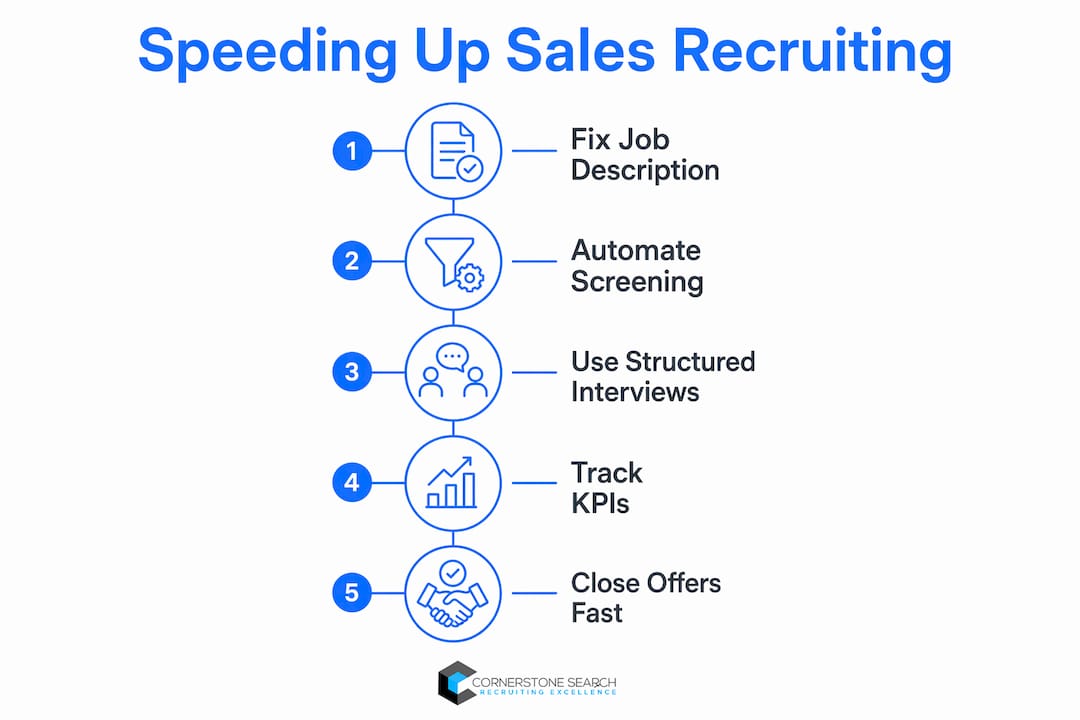
Offer stage delays are the most frustrating because the hard work is already done. The candidate is sold. The team is aligned. Then the process stalls on an approval chain or a letter that takes three days to generate. Offer process delays are common and fixable with two structural changes: pre-approved salary bands and automated offer letter generation.
Best practices for a faster offer process:
- Pre-approve salary bands by role and level before the search opens. This removes the approval bottleneck entirely. When a recruiter extends a verbal offer within a pre-approved range, no additional sign-off is needed.
- Automate offer letter generation using tools like DocuSign, Workday, or Greenhouse’s offer management module. A letter that took three days to draft and route now takes 15 minutes.
- Train recruiters to extend verbal offers on the final interview debrief call. Candidates who hear “we want to make you an offer” before they leave the conversation are far less likely to accept a competing offer while waiting for paperwork.
- Set a 24-hour offer delivery target from verbal to written. Candidates interpret delays as disorganization or cold feet. Speed signals confidence and organizational competence.
- Align offer timing with candidate pipeline. If you have two finalists, do not wait for one to decline before preparing the second offer. Parallel preparation cuts days off the contingency timeline.
The offshore hiring timelines lesson applies here too: every day between verbal and written offer is a day a competitor can move. Treat offer delivery as a competitive act, not an administrative one.
Key takeaways
Accelerating sales hiring requires fixing specific funnel stages, not just moving faster across the board. The biggest gains come from precise job descriptions, AI screening, structured interviews, stage KPIs, and a pre-approved offer process working as a system.
| Point | Details |
|---|---|
| Write precise job descriptions | Include quota, sales motion, and 30/60/90-day success criteria to cut unqualified applications. |
| Deploy AI screening | Reduce screening time from 23 hours to under 2 hours per role with platforms like Klearskill. |
| Use structured interviews | Scorecards and async video screening compress evaluation from weeks to 48 hours. |
| Set stage-level SLAs | Track time at each funnel stage and hold hiring managers to 24-hour feedback windows. |
| Pre-approve salary bands | Remove offer approval delays by setting ranges before the search opens. |
What I’ve learned about speed and quality in sales recruiting
After working in sales recruiting for SaaS and software companies for years, the pattern I see most often is this: teams that rush hiring do so because they skipped process design, not because they prioritized speed. Speed and quality are not in tension. They are both products of the same thing: a well-designed system.
The biggest mistake I see is treating the interview stage as the primary filter. By the time a candidate reaches a live interview, the job description, AI screening, and async video should have already done most of the work. When hiring managers are making decisions with incomplete or inconsistent data, they slow down. That slowdown is rational. The fix is not to pressure them. It is to give them better inputs.
Structured hiring as a foundation is not a nice-to-have. It is what makes speed sustainable and defensible. I have seen companies cut time-to-fill by 30% in a single quarter by doing nothing more than adding scorecards and enforcing a 24-hour feedback SLA. No new tools. No additional budget. Just process discipline.
The feedback loop piece is underrated. Comparing scorecard ratings with 30, 90, and 180-day performance data after hire tells you whether your interview criteria are actually predicting success. If they are not, you are moving fast in the wrong direction. Measurement is what turns a faster process into a better one.
— Rich
How Cornerstonesearch accelerates sales hiring for SaaS companies
Cornerstonesearch specializes in placing top-tier sales talent at SaaS and software companies, with an average time from search kickoff to offer acceptance of just 21 days. That figure is not a marketing claim. It is the result of a methodology built around the same principles covered in this guide: precise candidate targeting, structured evaluation, and a network of over 1,200 placed software sales professionals since 1996. For startups and established SaaS firms that cannot afford a 45-day vacancy in a revenue-generating role, Cornerstonesearch delivers speed without sacrificing fit. Explore the sales recruitment best practices that drive results, or connect with the team directly to discuss your next search.
FAQ
What is a realistic time-to-fill for a sales role?
Targeting 30 to 35 days is achievable for most sales roles by fixing specific funnel stages. Top SaaS companies with optimized processes consistently hit 20 to 22 days.
How much time does AI screening actually save?
AI screening reduces recruiter screening time from an average of 23 hours to under 2 hours per role, a reduction of approximately 92% according to Klearskill’s documented results.
What is the difference between structured and unstructured interviews?
Structured interviews use predefined questions and scorecards, producing a predictive validity of r=0.44 to 0.63. Unstructured interviews score r=0.20 to 0.38 and generate inconsistent data that slows debrief decisions.
Why do offer stage delays happen and how do you fix them?
Offer delays typically come from approval chains and manual letter generation. Pre-approving salary bands by role and automating offer letters with tools like DocuSign or Greenhouse reduces offer delivery time to under 24 hours.
How do stage-level KPIs reduce time-to-fill?
Tracking time spent at each recruiting stage reveals where candidates sit idle longest. Setting SLAs for shortlist review and interview feedback, then reviewing results in 30-day sprints, has been shown to cut fill time from 62 to 47 days in documented cases.
Recommended
- Sales Recruitment 101: Essential Tips For Building A Winning Team – Cornerstone
- Revolutionizing Sales Recruitment: Navigating The Future With Tech-Driven Strategies – Cornerstone
- Tech Recruitment 2.0: 10 Game-Changing Tools To Revolutionize Your Hiring Process – Cornerstone
- Software Sales Recruitment – Cornerstone