

Interim sales leadership, done right, means finding your permanent VP Sales or CRO through retained or contingency search, not parking a placeholder in the seat. Hire only when real triggers show up: founder-led selling that’s maxed out, a documented motion, and pipeline volume that needs a real operator. About 70% of first-time VP Sales or CRO hires fail within 18 months. If your motion isn’t ready, fix it first. If it is, move fast and get it right.
TL;DR:
- Hire a VP of Sales or CRO only when there is a documented sales motion, pipeline volume exceeds personal capacity, and founders are spending more time selling than building or fundraising.
- Focus on operational signals such as quota attainment by reps without founder involvement and warning signs like declining retention or wobbling churn before making a hire.
- Ensure the sales or revenue motion is validated with tested reps or founder-led revenue support before hiring to prevent early failure.
- The search process should be completed within three to four months, with a structured 90-day onboarding plan and clear success metrics from the start.
- Avoid hiring based solely on pedigree; prioritize evidence of archetype fit, proven recruitment outcomes, and a comprehensive reference check on team-building experience.
Table of Contents
- When Should You Hire A VP Of Sales Or CRO?
- VP Sales Or CRO: Which Role Actually Fixes Your Problem?
- What Should You Document Before You Hire?
- How Do You Screen For The Right Archetype And Catch Red Flags?
- What Should The First 90 Days Look Like?
- What Does Success Look Like, And What Kills The Hire?
- What Does Interim Sales Leadership Actually Cost?
- How Long Does A Search And Ramp Actually Take?
- How Do You Choose The Right Search Partner Or Candidate?
- Rich Rosen’s Perspective And Hard-Won Rules From 1,200+ Placements
- How Cornerstonesearch Gets You The Right Hire Fast
- Sources
When Should You Hire A VP Of Sales Or CRO?
Most founders hire too early because they’re tired of selling, not because the business needs it. That’s a bad reason. Here’s what actually tells you the timing is right.
ARR bands matter, but they’re not the whole story. Founder-led sales usually caps out around $1 million to $2 million ARR. PLG companies can stretch further, often $3 million to $5 million, before they need dedicated leadership. Past $10 million, you’re usually talking CRO territory, not VP Sales.
Beyond revenue, watch five operational signals:
- You’re spending more time selling than building or fundraising.
- You’ve got a documented motion, even a rough one, not just founder charisma.
- One or two AEs have hit quota without you closing for them.
- Pipeline volume has outgrown what you can personally manage.
- Net revenue retention or churn is starting to wobble and nobody owns it.
Statistic to sit with: the 70% first-year failure rate for first-time sales leaders isn’t about bad candidates. It’s about bad timing and bad fit. Recovery from a failed hire typically eats six to nine months. Hire before you’re ready and you pay for it twice.
VP Sales Or CRO: Which Role Actually Fixes Your Problem?
Wrong title, wrong hire. This is where founders waste six figures on comp and burn a year of runway on ramp.
Ask yourself one question: is your bottleneck execution or coordination? A VP Sales fixes execution. A CRO fixes coordination across sales, marketing, and customer success.
Hire a VP Sales when:
- Sales is the clear weak link, not marketing or CS
- You need someone building and running a team, not managing a portfolio of departments
- You’re pre-$10 million ARR in most cases
Hire a CRO when:
- Revenue is fragmented across departments that don’t talk to each other
- You need one owner accountable for the whole funnel, not just closing
- You’re scaling past $10 million and pipeline health depends on marketing-sales alignment
Choosing between VP Sales and CRO comes down to where the real bottleneck sits. Hire a CRO for an execution problem and you’ll get a strategist who can’t roll up sleeves. Hire a VP Sales for a coordination problem and you’ll watch them fight marketing all year. Get the title wrong and you’re re-hiring in twelve months, minimum.
What Should You Document Before You Hire?
Here’s the part founders skip, and it’s the part that kills the hire. You can’t hand someone a scaling job if there’s nothing to scale. Six architecture pieces need to exist before a VP or CRO walks in the door, and missing them is the leading cause of first-hire failure.
- Write down your ICP with real examples. Not “mid-market SaaS.” Name three closed-won accounts and explain why they bought.
- Map your pipeline stages with exit criteria. Every stage needs a clear “what has to be true” to move forward.
- Clean up your CRM. If your data is garbage, your new hire’s first 90 days becomes data archaeology instead of selling.
- Document the marketing-to-sales handoff and pricing governance. Who owns discounting? Who decides an MQL is sales-ready?
- Prove the motion works before you scale it. Hire one or two reps and validate they can hit quota, or show founder-led revenue with AI SDRs supporting it. Candidates should be able to test your claims in the interview, not take them on faith.
Pro Tip: If you can’t answer “why do customers buy from us and not the competitor” in one sentence, don’t post the job yet. That gap will eat your new hire’s first quarter.
How Do You Screen For The Right Archetype And Catch Red Flags?
Most bad hires aren’t bad people. They’re the wrong archetype for your stage. This is the single biggest driver of failure, bigger than comp, bigger than culture fit, bigger than years of experience.
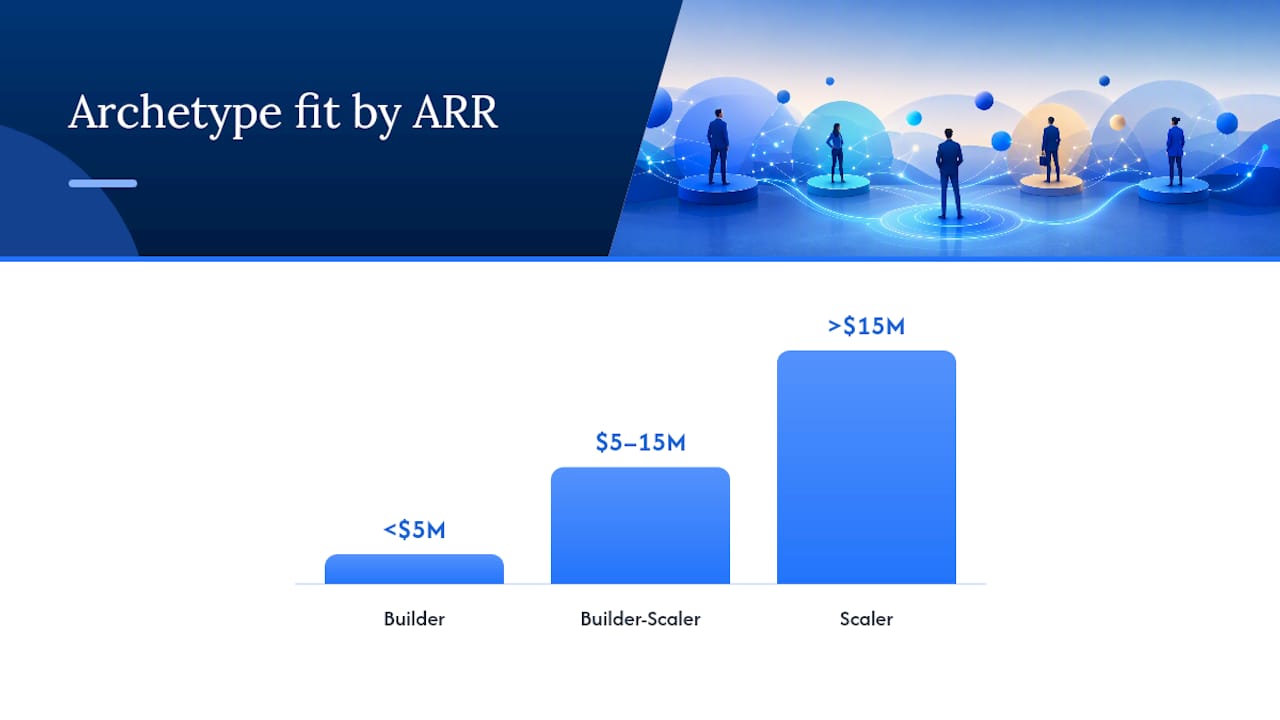
Three archetypes exist, and knowing which one you need saves you a year:
- Builder: creates process from nothing, hires the first reps, comfortable with chaos. Fits companies under $5 million ARR.
- Builder-Scaler: can build and then systematize what they built. Fits the $5 million to $15 million stretch.
- Scaler: takes an existing playbook and multiplies it. Fits mature motions past $15 million. A Scaler from a big, mature org routinely fails at a $10 million company that still needs a Builder, because they’ve never had to invent anything.
Ask these questions in every interview:
- “Walk me through your AI stack for prospecting and forecasting.” If they can’t answer specifics, they’re behind.
- “Name two or three people you’d recruit in your first 60 days.” A real builder has names ready. At least one should be an AI-native hire, not a rep who’s never touched a modern tool stack.
- “Tell me about a team you built from three reps to fifteen. What broke?”
- “How do you think about where AI agents or forward-deployed engineers fit in a complex sale?” If they draw a blank, they’re not ready for where enterprise deals are headed.
Check references hard. Ask former bosses about promotions given, reps retained after twelve months, and actual pipeline contribution, not just “they were great to work with.”
Red flags that end the process: vague answers on team-building specifics, no opinions on AI tools, defensiveness about past team turnover, and an inability to name a single hiring mistake they’ve made. Everybody’s made one. If they say they haven’t, they’re lying or they haven’t built anything real. For a structured way to run this, our six-stage vetting process walks through exactly what to verify at each step.
What Should The First 90 Days Look Like?
A realistic ramp for a new VP is 90 days minimum. Founders who expect results in 30 days are setting themselves up for disappointment, and they usually blame the hire instead of their own timeline.
Structure the first 90 days like this:
- Days 0 to 30: Observation. The new leader shadows calls, audits the pipeline, and meets every rep one-on-one. Deliverable: an AE performance map showing who’s carrying the team and who isn’t.
- Days 31 to 60: Diagnosis. They build a pipeline integrity report, flag broken stages, and start drafting a hiring plan for gaps.
- Days 61 to 90: Execution. They document the sales methodology, present findings, and start executing changes with your sign-off.
Build in a checkpoint around Day 65. Have the new hire present their full diagnosis and plan before they start pulling levers. This single meeting tells you more than the entire interview process.
Watch for these deliverables specifically:
- AE performance map with clear stack ranking
- Pipeline integrity report identifying dead deals and stalled stages
- A hiring plan tied to actual gaps, not headcount for headcount’s sake
- Written sales methodology the team can actually follow
The number that matters here: structured 30/60/90 onboarding with a Day 65 checkpoint materially improves long-term retention and success rates for new sales leaders. Skip the structure and you’re just hoping.
What Does Success Look Like, And What Kills The Hire?
Six months in, you should see forecast accuracy improve, at least one strategic hire fully ramped, win rates ticking up, and board updates that sound credible instead of hopeful.
Failure shows up in predictable patterns:
- Hiring for a big-name resume instead of the right archetype for your stage
- Founders who can’t let go of selling, so the new VP never gets real authority
- Underestimating ramp and firing someone at month four who needed month six
The fix: set a stop-loss rule before you hire, not after. If pipeline coverage hasn’t improved by month four and the Day 65 plan never materialized into action, that’s your signal to have a hard conversation, not wait another quarter hoping it turns around. Comp benchmarks and clear success metrics from day one help here. Compensation clarity up front avoids half the “are they even trying” arguments later.
What Does Interim Sales Leadership Actually Cost?
Budget for two separate costs: the search and the seat.
Retained and contingency search fees vary by scope and speed, and any specialized recruiting partner should walk you through exact terms before you sign. What most founders underbudget isn’t the fee. It’s the OTE. A qualified VP Sales at a Series A or B company typically commands a six-figure base with OTE roughly double that, and CRO comp runs higher still given the broader remit. Skimp on comp to save money and you’ll attract candidates who couldn’t get hired anywhere better, which is its own expensive mistake.
Then there’s the cost of doing it wrong. A failed hire doesn’t just cost the base salary paid during their tenure. It costs the six to nine months of rebuilding afterward, the reps who quit during the chaos, and the pipeline that went cold while nobody owned it. Run the math on a $180,000 base plus OTE for a hire who lasts eight months before failing, add the recovery period, and you’re looking at a number that dwarfs any recruiting fee you tried to avoid paying.
The smarter budget conversation isn’t “how do we spend less.” It’s “how do we spend once.” A precision search that gets the archetype and the fit right the first time costs less over 18 months than two mediocre hires strung together. Founders who’ve been through a bad hire once rarely need this explained twice.
How Long Does A Search And Ramp Actually Take?
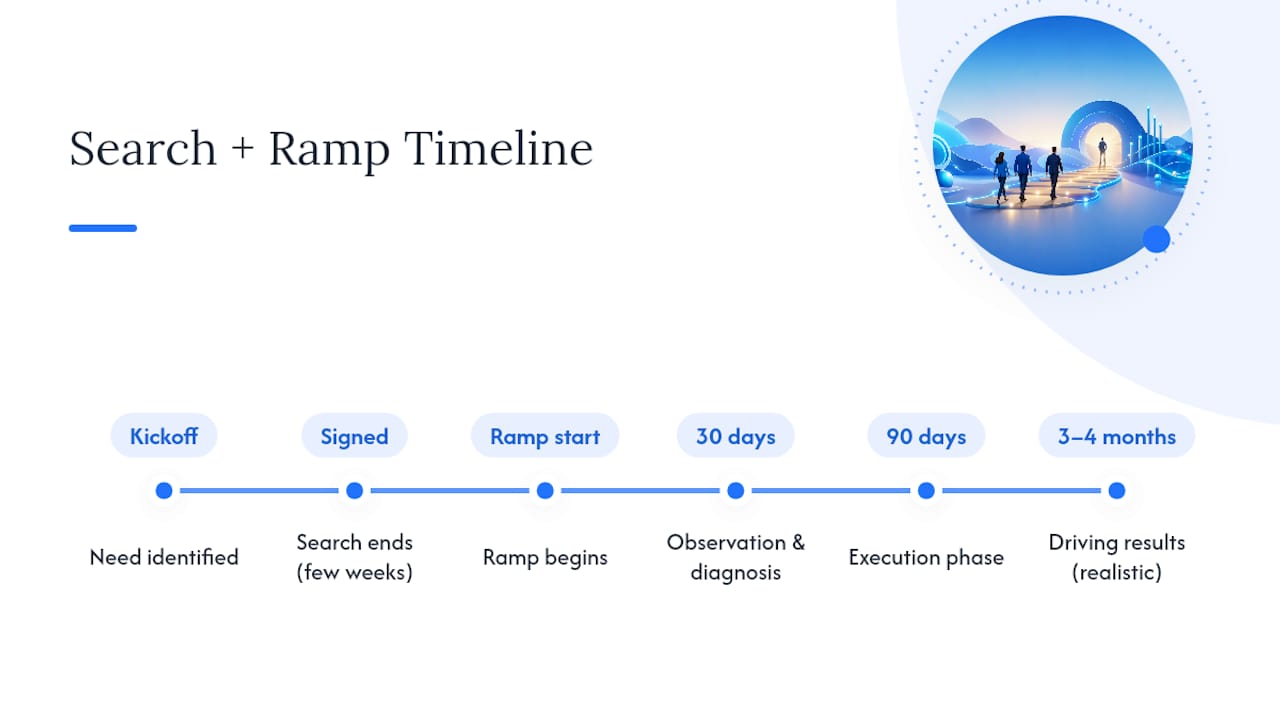
Split this into two clocks: the search clock and the ramp clock. They’re different, and conflating them causes a lot of founder frustration.
The search clock, meaning time from kickoff to signed offer, should move fast when you’re working with the right partner and a tight, well-scoped role. Drag this out past a few weeks and you risk losing top candidates to competing offers, especially in a market where AI-savvy sales leaders are getting recruited hard.
The ramp clock is the 90-day window covered earlier: observation, diagnosis, execution. Don’t compress it. A VP who’s fully productive by day 30 either inherited a perfect system or isn’t actually diagnosing anything, they’re just guessing and hoping it works.
Add them together and a realistic total timeline from “we need to hire” to “this person is driving results” runs three to four months. Founders who plan around a six week fantasy end up disappointed and blame the hire for a timeline problem that was never realistic to begin with.
How Do You Choose The Right Search Partner Or Candidate?
Whether you’re vetting a recruiting partner or a candidate directly, the questions are nearly identical. You’re looking for evidence, not promises.
Ask any search partner: what’s your average time from kickoff to offer? What’s your track record specifically in SaaS, not general sales recruiting? Can they show real placement examples with outcomes, not just logos on a slide? A partner who’s placed over 1,200 sales professionals since 1996 has patterns to draw from that a generalist recruiter simply hasn’t seen enough reps to develop.
Red flags when evaluating a partner: vague answers on placement history, no clear screening methodology, and a pitch that sounds identical for every role regardless of stage or archetype need. If they can’t articulate the difference between what a Series A SaaS company needs versus a Series C company, they’re not specialized enough to trust with this hire.
For candidates, the criteria mirror the screening section above: archetype fit for your stage, real recruiting evidence, AI fluency, and references who confirm actual pipeline contribution. Don’t let a slick interview substitute for verified results. The best predictor of future performance is still documented past performance, checked hard.
Rich Rosen’s Perspective And Hard-Won Rules From 1,200+ Placements
Founders keep hiring for brand names and getting burned. A big logo on a resume tells you nothing about whether someone can build in your chaos. Hire for archetype, not pedigree.
Three rules, no exceptions: require a 90-day plan before day one, not after. Insist on real recruitment evidence, names they’ve actually hired, not people they inherited. And never skip the reference check on team-building specifics, because that’s where the story usually falls apart.
We’ve built our placement track record on exactly this discipline. Want a fast audit of your GTM motion or a sample 90-day plan template? Ask. It’s a quick conversation that saves a slow, expensive mistake.
— Rich Rosen
How Cornerstonesearch Gets You The Right Hire Fast
Speed without precision just gets you a fast mistake. Cornerstonesearch built its whole model around avoiding that trap: specialized SaaS sales leader searches, averaging 21 days from kickoff to offer acceptance, backed by 1,200-plus placements since 1996.
Run this internally if you’ve got the network, the time, and the stomach for a bad hire that costs you six to nine months of rebuilding. Call us if you don’t. We specialize in exactly the archetype-matching and screening rigor this article just walked through, applied to real searches every week across SaaS and software companies. If you’re staring down a VP Sales or CRO hire right now and you’d rather not learn the hard way, start a search with our SaaS recruiting team and get candidates who’ve already been screened against the exact criteria you just read.