

Most bad mid-market sales hires are made before the first interview. The role is fuzzy, the segment is vague, and the candidate was picked because he sounded great on a call. Fix those three things and your hit rate jumps. This guide covers how to define the role, what to pay, how to screen, and how to interview so you stop rolling the dice.
TL;DR
- “Mid-market” has no single definition. Write yours down with numbers: employee count, deal size, sales cycle, number of buyers.
- Hire for the motion, not the title. An AE who closes $40K deals in six weeks is not automatically your person for $150K deals with a committee.
- Budget real money. Base pay for a US mid-market AE can run roughly $92,000 to $120,000, with a 50/50 base to variable split common.
- Screen for quota ownership, deal size and segment match. Then test judgment with real deal stories, not trivia.
- A bad hire costs far more than the fee. Speed matters, but so does precision.
Table of Contents
- What mid-market sales actually means
- Define the role before you post it
- What to pay a mid-market AE
- Where to find mid-market sales candidates
- Screen for proof, not polish
- Interview for judgment
- What a bad hire really costs
- Perspective: why we run searches the way we do
- Work with a recruiter who does this every week
- FAQ
- Sources
What mid-market sales actually means
Ask five people and you get five answers. That is the first problem.
One common framing, from the National Center for the Middle Market, puts mid-market companies at $10 million to $1 billion in annual revenue. The same source notes other groups draw the line differently, with McKinsey using $200 million to $2 billion. That is a huge spread.
Another popular split: small businesses have fewer than 100 employees or under $50 million in revenue, and midsize companies have 100 to 999 employees and $50 million to $1 billion. Above that, you are in enterprise territory.
Here is what matters for hiring. The buying process, not the revenue band, is what changes the job.
- SMB: One buyer, often the owner. Deals can close in a couple of weeks.
- Mid-market: Several stakeholders. A champion, a finance person, maybe IT or legal. Deals usually take weeks to a couple of months.
- Enterprise: Committees, procurement, security reviews. Many months, sometimes a year.
A mid-market rep has to do both jobs. Move fast like SMB, and multi-thread like enterprise. Plenty of reps can do one. Fewer can do both. That is why this hire is so easy to miss.
Define the role before you post it
I have seen founders post “3 to 5 years of B2B SaaS sales experience” and then wonder why the pipeline of candidates looks like a lottery. That is not a role. That is a wish.
Before anyone writes a job post, answer these in plain numbers:
- Who do they sell to? Company size, industry, title of the buyer.
- What is the average deal? ACV, not the best deal you ever closed.
- How long is the cycle? Real average from closed-won deals.
- How many people sign off? Three to five is typical in mid-market, but yours may differ.
- Where does pipeline come from? Inbound leads, outbound prospecting, expansion of existing accounts. These are three different skill sets.
- What does a good first year look like? Quota, ramp time, expected pipeline contribution.
That inbound versus outbound question kills more hires than anything else. A rep who thrived on warm leads from a big brand will often stall when he has to build territory from scratch. Same title. Different job.
We wrote a longer walkthrough in our guide to defining your sales role before hiring. Do that homework first. It is free and it saves months.
Check the foundation too
One more truth. If your wins do not look alike, you do not have a repeatable motion yet. Hiring a rep into chaos does not create a process. It creates an expensive rep sitting in chaos. If founders are still closing every deal personally, say so in the interview and hire someone who wants that environment.
What to pay a mid-market AE
Let me save you a painful round of declined offers. Candidates talk to each other and they know the market.
Per one 2026 compensation guide, a mid-market AE in the US could command a base salary between $92,000 and $120,000. The same guide puts typical OTE at $140,000 to $180,000 for an SMB AE and $250,000 to $350,000 or more for an enterprise AE, and calls a 50/50 base to variable split the industry standard.
So a mid-market role generally lands between those two OTE bands. Where you land depends on your deal size, your territory quality, and your brand. Think of it like this:
| Factor | Pushes OTE up | Pushes OTE down |
|---|---|---|
| Average deal size | Larger ACV | Smaller ACV |
| Lead flow | Outbound heavy | Strong inbound |
| Company stage | Unproven, early | Known brand |
| Territory | Open, uncapped | Crowded, capped |
| Cycle length | Longer, more stakeholders | Short, simple |
Two mistakes I see over and over:
- Setting OTE on a quota nobody hits. If your reps average 60% of quota, your OTE is fiction. Good candidates will ask what percent of the team hit plan last year. Have a straight answer.
- Lowballing the base to “keep them hungry.” Hungry people also leave. A senior closer with a family does not take a base cut to prove loyalty to a company he met last week.
Where to find mid-market sales candidates
Job boards will give you volume. Volume is not your problem. Fit is.
Search any job board for “mid market sales” and you will see thousands of postings with salary ranges all over the map. Everybody is competing for the same visible candidates, and the best reps are not browsing. They are employed, hitting number, and getting recruiter calls weekly.
Source for a match on three things:
- Company type. Similar stage, similar product complexity, similar buyer.
- Deal size. Within range of what you sell. A rep who closed $8K deals will struggle at $90K. A rep who closed $500K deals may be bored and overpriced at $60K.
- Segment. Real mid-market experience, not a title someone inflated.
This is where a specialist recruiter earns the fee. We already know who is quietly crushing it at which company, and who got lucky in a hot territory. That network is built over decades, not scraped overnight. If you want to see how we do it for software companies, look at our software sales recruitment service.
Screen for proof, not polish
The resume tells you where somebody worked. It does not tell you what they did. Read it with a skeptical eye.
Check these things on every candidate:
- Tenure pattern. Two years at three companies can be fine. Six months at four companies needs a real story.
- Quota ownership. “Contributed to team quota” is not the same as “carried a $1.2M number and hit 108%.” Ask which one it was.
- Deal size and segment. Do the claimed numbers fit your role? If somebody says mid-market, ask for a typical customer name, headcount and contract value.
- Source of pipeline. How much did they build themselves? Ask for percentages.
- Why they are leaving. And why they are leaving now.
Then do a quick call. Ten minutes. Ask them to walk you through their last closed deal start to finish. A real closer tells it with names, dates, obstacles and the dumb thing the CFO said on the third call. A faker tells it in nouns like “value” and “alignment.”
We laid out our fuller process in how to evaluate sales candidates fast and hire winners.
Interview for judgment
Good mid-market reps share a few traits. They ask before they pitch. They qualify hard. They bring more than one person into the deal. They know when to walk away.
Here is the interview loop I would run:
- Phone screen, 30 minutes. Background, motivation, comp expectations, deal history.
- Live sales simulation, about an hour. You play a skeptical buyer from your actual target market. Watch whether they open with questions or features. Watch how they handle an objection. Do they probe, or fold and discount? Do they end with a clear next step?
- Panel with the people they will work with. Product, a peer rep, marketing or sales engineering.
- Deal review. Give them a messy real pipeline scenario and ask what they would do next.
Questions that separate sellers from storytellers
- Tell me about a deal that looked great and then stalled. What happened? What did you do? How did it end?
- Who was the last person you added to a deal that you didn’t expect to need? Why?
- Walk me through a deal you lost that you should have won.
- What did your pipeline look like 90 days before your best quarter?
- Tell me about a time you told a prospect no.
Listen for diagnosis, not spin. A strong rep owns the loss. A weak one blames pricing, product or the manager. Every time.
We keep a longer set in our SaaS sales interview questions for hiring managers.
Use a scorecard
Without a scorecard, the loudest interviewer wins. With one, you compare candidates on the same things. Weight what matters for your motion: proof of results, pipeline creation, discovery and qualification, deal judgment, communication, coachability, and comp fit. Here is the rule I care about most: if somebody misses badly on a must-have, do not average it away with charm elsewhere. Pause.
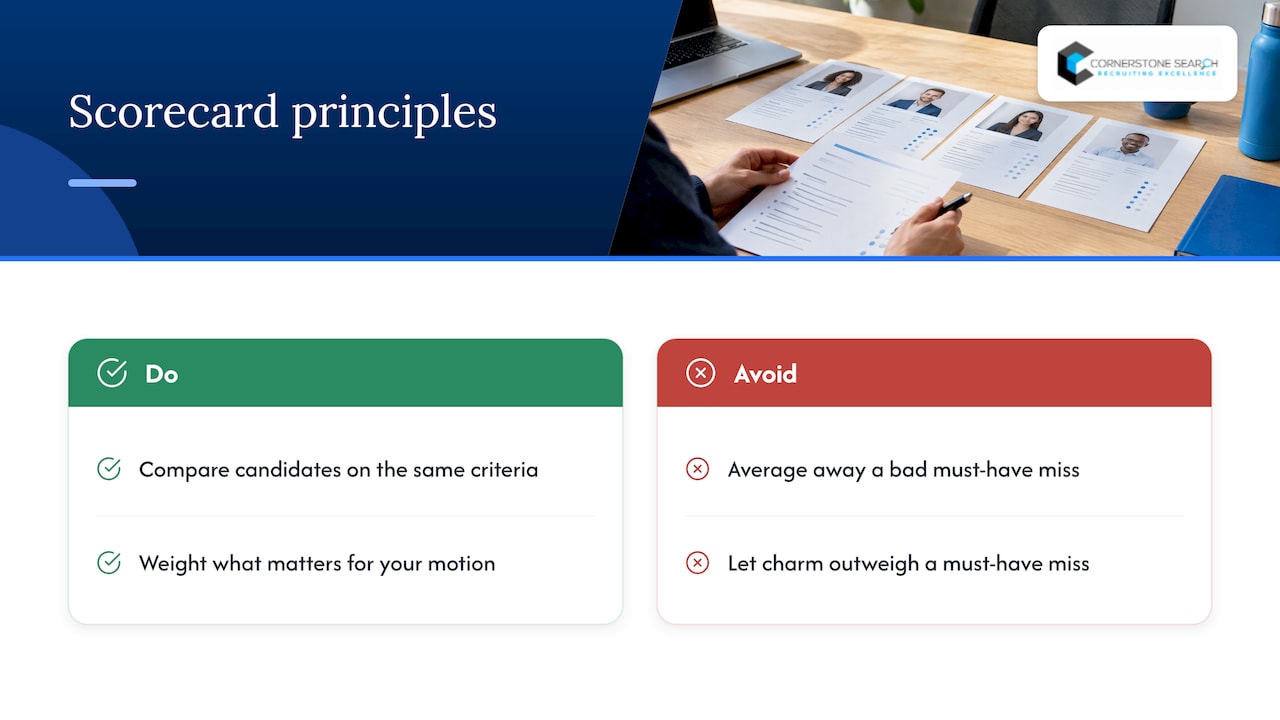
Our sales hiring scorecard is built around that idea.
Calibrate what “experienced” means
Experience is not a number of years. Two reps with four years can be miles apart. One sold into the same ten accounts and rode a hot product. The other rebuilt territory twice and lost a champion mid-deal and still closed. Ask what the job taught them, not how long they held it. Even how somebody handles leaving a job tells you something. If you want to see what a clean handoff looks like from the inside, here is a two weeks’ notice story worth a few minutes. Reps who document their accounts and hand them over well are usually the ones who ran organized pipelines.
What a bad hire really costs
People love to quote big numbers here, and most are soft estimates. Still, the pattern is real.
You pay the salary and the recruiting fee. You pay the manager’s time, which gets eaten by coaching someone who is not working out. You pay in ramp: months of partial output while you wait to see if it clicks. And you pay in the pipeline that went cold, the territory nobody worked, and the deals that slipped a quarter.
Then you do it again, because you have to restart the search. A mid-market SaaS team that misses on two AEs in a row can lose a year. For a startup, that can be the difference between hitting a funding milestone and explaining a miss to your board.
How to cut the risk:
- Define the profile against how you actually sell, not how you wish you sold.
- Use the same structured interview for every candidate.
- Run a work sample or live simulation.
- Set 30, 60 and 90 day milestones and review them honestly. Pipeline built, calls run, deals advanced. Do not wait for quarter-end to find out.
- Check references with real questions. Ask former managers directly if they would rehire the person.
Perspective: why we run searches the way we do
We have placed more than 1,200 sales professionals since 1996. The pattern is boring and consistent. Companies rarely fail because they could not find candidates. They fail because they hired the wrong kind of good.
That is why every search at Cornerstone starts with a founder-led intake. Not a form. A real conversation about your buyer, your deal size, your cycle, who failed in this seat before and why. Then we go to the people who have already done that job in a similar setting.
Our searches are personally run by a recruiter with deep SaaS sales expertise, and our average time from kickoff to accepted offer is about three weeks. Speed only matters if the person sticks, which is why we track retention. Our one-year retention rate is 93%.
If you are hiring a mid-market AE, a sales engineer, a customer success leader or a VP Sales, the job is the same. Get the profile right. Get the right three or four finalists in front of you. Let your judgment do the rest.
Rich Rosen
Work with a recruiter who does this every week
If you are a founder with a pipeline to build, you probably do not have a month to spend on sourcing. We handle mid-market and enterprise sales hires for SaaS and software companies, on contingent or retained terms depending on the role and urgency. Not sure which fits? Read how retained search differs from contingency.
Ready to talk through a role? Start with our software sales recruitment page and tell us who you need.
FAQ
How long does mid-market sales hiring take?
It depends on how clear the role is and how fast your team moves. Internal searches often drag because interviews get scheduled around everyone’s calendar. Our average from search kickoff to accepted offer is about three weeks, because we line up the intake, the shortlist and the decisions tightly.
What experience should a mid-market AE have?
Look for closed deals at a similar size, with a similar number of stakeholders, in a similar cycle. A common profile is a few years of B2B SaaS closing experience, but the match on deal size and motion matters more than the number of years. Always confirm they carried quota, not just supported a team.
Should I hire a founding AE before my process is repeatable?
Only if you want a builder and can say so honestly. If your wins look different every time and deals stall when you step out, fix that first or hire someone who expects to create the process. The mistake is putting a process-dependent rep into a process-free company.
Contingent or retained search for a sales leader?
Contingent suits well-defined roles where you want speed and several candidates in play. Retained fits senior, confidential or hard-to-fill searches such as a VP Sales or CRO, where dedicated attention matters. We run both.
Sources
- What Is Mid-Market Sales? (Intuit Blog)
- What Is Enterprise Sales? (HubSpot)
- Software Sales Compensation: Winning Pay Models, 2026 Guide (Qobra)
- Two weeks’ notice (a Kept story)