

The offer terms for a sales executive are base salary, variable pay, quota, ramp, commission mechanics, equity, territory, and what happens if it ends. Get all of them in writing before the candidate signs. Most bad sales hires don’t start with a bad candidate. They start with an offer that said “$300K OTE” and left everything else to a handshake.
We’ve placed more than 1,200 sales professionals since 1996. The deals that blow up almost always blow up over the same eight lines. Here they are.
TL;DR
- An offer is more than a number. Base, variable split, quota, ramp, accelerators, clawbacks, equity and exit terms all need to be on paper.
- OTE only means something when the quota behind it is realistic. Ask what percent of reps hit it last year.
- A new executive needs a ramp period with a draw or guarantee. No ramp plan means a bad first six months for both sides.
- Equity should come with a clear vesting schedule, strike or grant details, and acceleration terms spelled out.
- Candidates will test your numbers in diligence. Build the offer so it survives that.
Table of Contents
- Why the offer is where deals die
- The core of the offer: base, variable and OTE
- Quota: the number behind the number
- Ramp, draw and guarantee
- Commission mechanics: rates, accelerators and caps
- Equity: the part founders hand-wave
- Role, territory and reporting
- Exit terms: the clauses nobody wants to discuss
- First 90 days: put the expectations in writing
- What the offer should look like: a checklist
- Where founders go wrong
- Our perspective
- Need help structuring the offer and finding the person?
- FAQ
- Sources
Why the offer is where deals die
You found the person. They interviewed well. References were clean. Then the offer goes out, and the candidate’s spouse, lawyer or best friend reads it. Three questions come back that day. What’s the quota? What if the territory changes? What happens to my commission if I’m fired in month 14?
If your offer can’t answer those, you lose the candidate or, worse, you hire them and spend the year in arguments. Sales people read comp plans the way lawyers read contracts. They should. It’s how they get paid.
We watch this play out weekly. A founder gets excited, rushes a verbal “we’ll take care of you,” and then the written plan says something else. That gap kills trust faster than a missed number.
The core of the offer: base, variable and OTE
Start with the three numbers every candidate reads first.
Base salary is guaranteed cash. Variable is what the executive earns for hitting targets. OTE, on-target earnings, is base plus variable if the person hits 100% of quota. It is a target, not a promise.
For a sense of the vocabulary, Apollo groups sales terms into contract terms, payment terms and performance metrics, and quota is the revenue target that anchors the performance side. Your offer lives in all three buckets.
Pick a split and defend it
The base-to-variable split tells the candidate how you think about risk. A heavier base says you want judgment, hiring, and process building. A heavier variable says you want a closer who eats what they kill. Neither is wrong. A mismatch is wrong.
Here is a made-up example, for illustration only. Say you offer a VP Sales a $300K OTE split evenly. That’s $150K base and $150K variable. If the variable is tied to company bookings and the company has never booked more than the plan assumes, the candidate is really taking a bet on your forecast. Smart ones will say so.
Say what OTE is paid on
OTE paid on what? Personal quota? Team quota? Company bookings? Collected revenue or signed contracts? Each one changes who controls the outcome.
For an Account Executive, the standard is personal quota. G2 describes an account executive as a quota-carrying seller focused on closing deals. For a VP or CRO, it’s usually team or company number, which means the executive needs to know they can hire, fire, and shape the plan.
Quota: the number behind the number
Quota is where offers get dishonest, usually by accident. A founder sets a number off a board deck, not off what reps actually close.
Before you write the quota into the offer, answer these:
- What did the last three reps in this seat actually close?
- What percent of the team hit quota last year?
- How much pipeline exists today, and how much of it is real?
- What is the average sales cycle and deal size?
Pipeline coverage, as Brazn defines it, is pipeline value divided by quota. If the coverage isn’t there on day one, a quota you handed over is a quota you gave away. Good candidates run that math in the first call. Tell them the truth. We’d rather a founder say “last year two of five reps made quota” than have the candidate find it out from a former employee on LinkedIn.
Also put in writing:
- Quota period: monthly, quarterly, annual.
- Whether quota is for new logos, expansion, renewals, or all three.
- How and when quota can be adjusted, and who decides.
“At the company’s discretion” is not an answer. It’s a warning label.
Ramp, draw and guarantee
Nobody lands in a SaaS sales seat and closes at full speed on day 30. Enterprise cycles are long. A new exec needs to learn the product, the buyers, and the team.
Your offer should state the ramp plainly:
- Ramp length. How many months until full quota applies?
- Ramped quota. What percent of quota applies in month 1, 2, 3 and so on?
- Draw or guarantee. A draw is an advance against future commission. A guarantee is paid regardless. Say which one it is.
- Recoverable or non-recoverable. If it’s recoverable, what happens to the balance if the person misses? Does it carry forward or get forgiven?
The recoverable draw is where we see the most grief. A candidate takes the job thinking they have a safety net. Six months later they owe the company money. That’s a lawsuit waiting for a lawyer.
For senior hires, a common and fair setup is a guaranteed non-recoverable draw for the first few months, then a step to the standard plan. Your numbers will differ. The point is that they’re written down.
Commission mechanics: rates, accelerators and caps
This section makes or breaks trust, so give it room.
Rate and what triggers payment
Write the commission rate, what counts as a commissionable deal, and when it’s paid. Signed? Invoiced? Collected? Payment terms matter here. Apollo points out that Net-30 or Net-60 defines invoice timing. If your customers pay in 60 days and your commission pays on collection, your rep waits two months after a close to see a dime. Say so up front.
Accelerators
An accelerator raises the commission rate once the rep passes a threshold, typically 100% of quota. It rewards overperformance. If you have them, show the tiers. If you don’t, don’t pretend.
Caps
A cap is a limit on what can be earned. Top sellers hate caps. If you have one, say it in the first conversation, not in the offer letter. A candidate who finds a cap on page four of the plan will ask what else you buried.
Clawbacks and chargebacks
A clawback lets the company take back commission if a customer cancels, doesn’t pay, or churns early. Reasonable ones exist. The terms need a window, a trigger, and a limit. Thirty to ninety days after the close is easier to defend than “any time the customer leaves.”
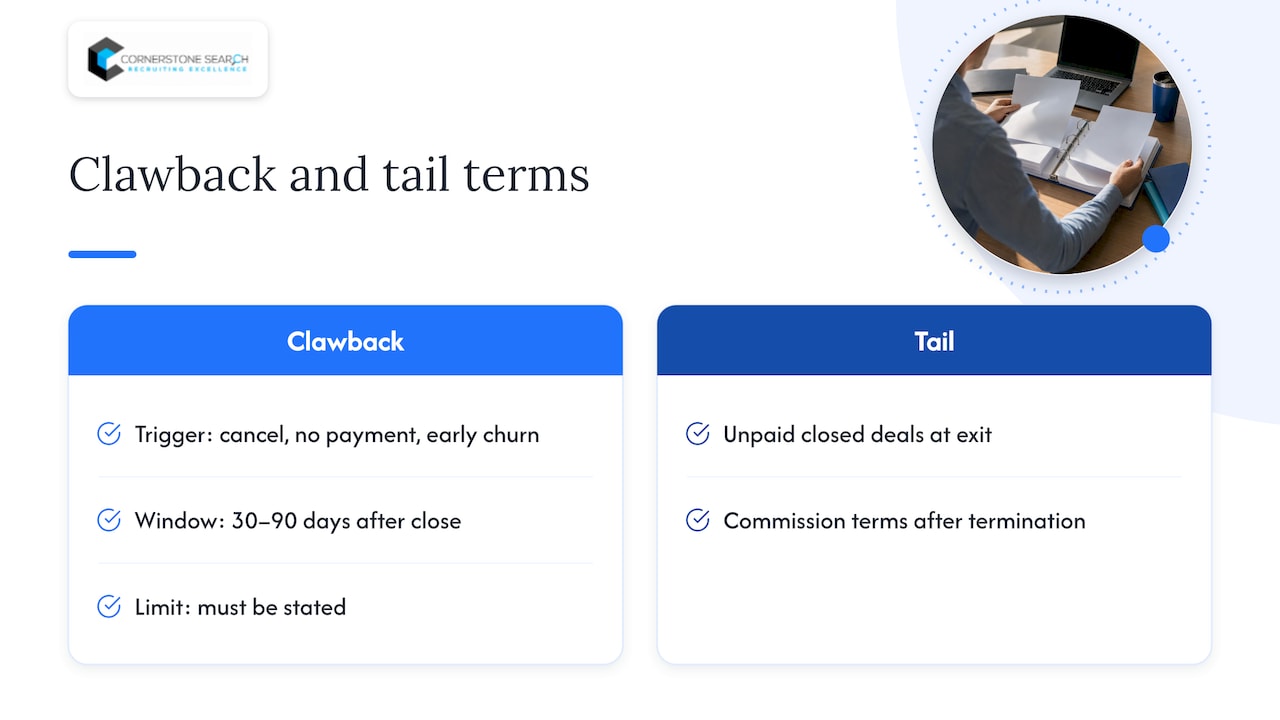
Also write down what happens to commission on deals the exec closed but that haven’t paid when they leave. This is the “tail” and it is where most post-termination fights start.
State law matters
Commission rules vary by state. California employers face strict requirements on written commission agreements and pay, and this write-up on California commission pay rules is worth handing to whoever drafts your plan. Whatever state you’re in, have employment counsel review the plan before it goes out. That’s not a formality. It’s cheaper than a dispute.
Equity: the part founders hand-wave
Senior sales hires at startups often take lower cash for equity. That’s a real trade. Treat it like one.
Put in the offer:
- Number of shares or options, and the percent of fully diluted shares that represents.
- Grant type and, for options, the strike price.
- Vesting schedule and cliff.
- What happens on a sale of the company or a termination without cause (acceleration).
- Exercise window after leaving.
“We’ll figure out equity after you start” is how you lose a CRO candidate in the final round. Candidates are shrewder about this than they used to be. We wrote a full breakdown of how to structure equity for sales executives if you want specifics.
Role, territory and reporting
Money isn’t the only thing candidates fight over. They care about the job they signed up for.
- Title and scope. VP Sales or CRO? Does marketing or customer success report in?
- Reporting line. CEO, founder, president? Do they have a seat in board meetings?
- Territory or segment. Named accounts, geography, vertical. Can it change mid-year? If so, how is quota adjusted?
- Hiring authority. Can they hire and fire their team? What’s the headcount budget?
- Tools and support. Sales engineering help, marketing spend, a working CRM, a real pipeline.
When a new exec learns in month three that they don’t actually control hiring, they start looking. We’ve seen it. It’s the most common reason a VP Sales is gone in a year, and the offer could have prevented it.
If you’re deciding what kind of leader the seat needs, our post on traits of top SaaS sales executives lays out what we screen for.
Exit terms: the clauses nobody wants to discuss
Anyone hiring at this level should talk about the ending at the beginning.
- Severance. Common for executives: a few months of base if terminated without cause. Say whether commission continues.
- Notice period. How long the exec gives, how long you give.
- Non-solicit and non-compete. Enforceability depends on the state and the facts, so run these past your lawyer rather than copying a template. A non-solicit on customers and employees is more common than a full non-compete.
- Confidentiality and IP. Standard, but make sure it’s there.
- Post-termination commissions. See the tail above.
Candidates read these as a signal. A fair exit clause says you plan to treat them well if it doesn’t work out. A harsh one says you’ve already planned for it not to work.
First 90 days: put the expectations in writing
Not always inside the offer letter, but attached to it. Pipeline expectations, hiring goals, process changes, and what a good first quarter looks like.
Salesforce’s growth guidance for sellers recommends ending every pitch with agreed next steps. Same rule applies to hiring. End every offer conversation with agreed next steps and a date. It keeps the process alive and tells the candidate you run a tight shop.
A simple 30-60-90 plan works. Thirty days: learn the product, meet customers, audit the pipeline. Sixty: fix the biggest process hole and make the first hiring call. Ninety: own the forecast. Nothing fancy.
What the offer should look like: a checklist
| Term | What to write down |
|---|---|
| Base | Annual amount, review date |
| Variable | Dollar amount at 100% of quota, what it’s paid on |
| OTE | Base plus variable, labeled as target |
| Quota | Number, period, scope, adjustment rules |
| Ramp | Length, ramped quota by month |
| Draw or guarantee | Amount, duration, recoverable or not |
| Commission | Rate, trigger, payment timing |
| Accelerators and caps | Tiers or “none” |
| Clawback | Window, trigger, limit |
| Equity | Shares, vesting, acceleration, exercise window |
| Role | Title, reporting line, hiring authority, territory |
| Exit | Severance, notice, restrictive covenants, commission tail |
If any row is blank, the candidate will fill it in with their worst assumption.
Where founders go wrong
Same mistakes, again and again.
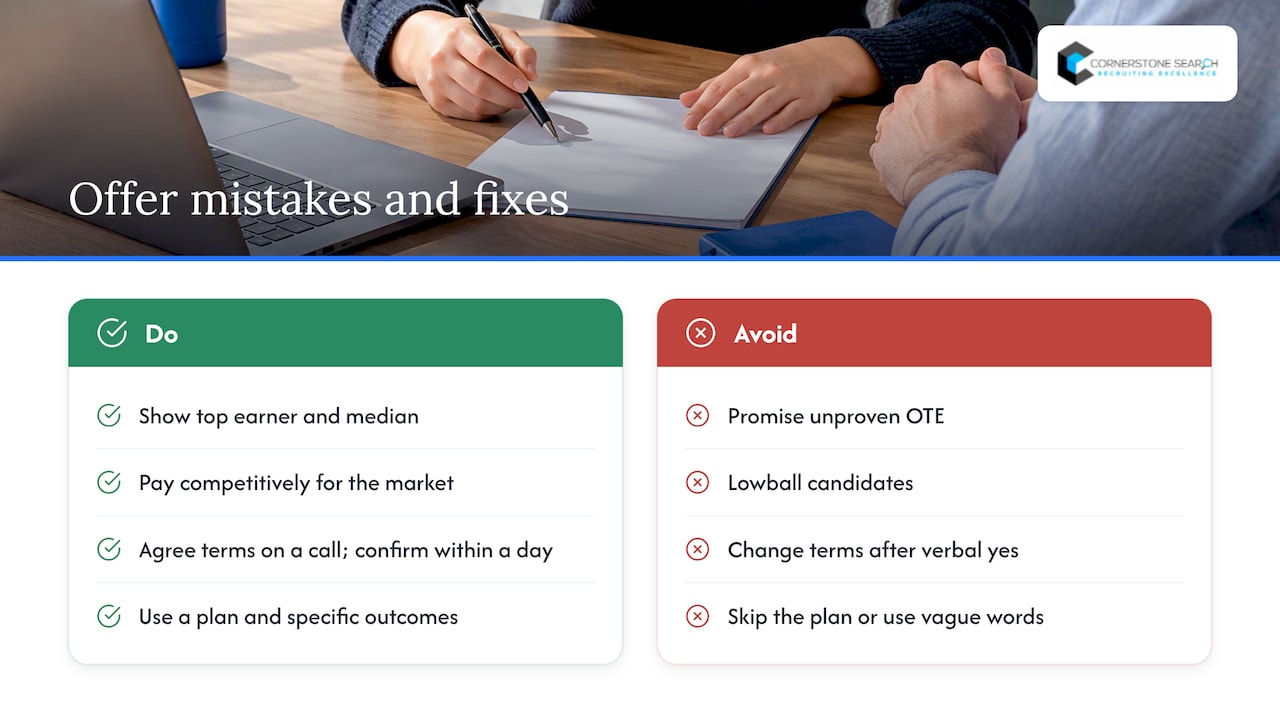
Offering OTE with no proof. “You’ll make $400K” means nothing if nobody has ever made it. Show the top earner’s number and the median. Both.
Underpaying then expecting an A player. Great sellers know their market. A lowball offer doesn’t save money. It filters out the people you wanted.
Changing terms after the verbal yes. This is how an accepted offer becomes a counteroffer and then a no. Get the terms agreed in a call, then confirm in writing within a day.
Skipping the plan document. The offer letter says “see commission plan.” The commission plan doesn’t exist yet. Don’t do this.
Using vague words. Salesforce advises replacing vague buzzwords with specific outcomes. Your offer is the one document where that advice is non-negotiable.
The cost of getting this wrong is high. A failed VP Sales hire burns quarters, not weeks. That’s pipeline lost, reps leaving, and a board asking questions.
Our perspective
We’ve sat on both sides of thousands of offers. Here’s what we’ve learned.
The best offers are boring. Every number is explained, every term is written down, and nothing is a surprise. The founders who close the best candidates aren’t the ones who pay the most. They’re the ones who answer the hard questions before they’re asked.
We also push clients to be honest about quota history and ramp. A candidate who takes a job knowing the real picture stays. A candidate who finds out later leaves, and usually takes two good reps with them. Our one-year retention on placements is 93%, and a big reason is that the offer conversation happens early and plainly, not after the candidate has already quit their old job.
If the candidate is great and your offer is vague, the vague offer wins the argument. Fix the offer.
— Rich Rosen
Need help structuring the offer and finding the person?
We run executive search and software sales recruiting for SaaS and software companies, from Account Executives and Sales Engineers to VP Sales and CRO. Our average time from search kickoff to offer acceptance is 21 days, and every search is run personally by a recruiter with deep SaaS sales experience. We work on both contingent and retained searches, and we help clients shape the offer so it closes.
If you’re hiring a sales leader, see how our executive search and software sales recruitment work, or read how retained search differs from contingency.
FAQ
What is OTE in a sales executive offer?
OTE stands for on-target earnings: base salary plus variable pay if the executive hits 100% of quota. It’s a target, not a guarantee. Always ask what quota it assumes and how many reps hit it last year.
How long should a ramp period be for a sales executive?
It depends on your sales cycle and deal size. A longer enterprise cycle needs a longer ramp. Whatever you choose, state the number of months and the ramped quota in writing, along with any draw or guarantee.
Should a new VP Sales or CRO get equity?
At venture-backed startups, usually yes. Spell out the share count, vesting schedule, cliff, acceleration and exercise window. Our guide on sales executive equity structure goes deeper.
Can the company take back commission after a deal closes?
Only if the plan says so. A clawback needs a clear window, a trigger such as cancellation or nonpayment, and a limit. Commission law varies by state, so have employment counsel review the plan.
What’s the difference between a sales lead, a prospect and an opportunity?
G2 defines a lead as a person or company that has shown interest and might become a customer. A qualified lead becomes a prospect in the pipeline, and an opportunity is a qualified deal being worked toward close. Your offer should say which of these a quota counts.
Sources
- What Are Sales Terms? Essential Language, Metrics (2026), Apollo
- 80+ Sales Terms and Definitions Every Rep Should Know, G2
- The SaaS Sales Glossary: 100 Terms Explained, Brazn
- Salesforce Small Business Growth Kit
- 70 Key Sales Terms You Need to Know, Salesforce
- Commission Pay Rules for California Employers