

OTE is the total cash a rep earns at 100% of quota: base salary plus target variable. It is a target, not a promise. If you’re building a SaaS comp plan, the job is to pick the right base-to-variable split, set a quota that matches the OTE, and then model what actually gets paid out when reps hit 60%, 100%, or 150% of goal.
TL;DR:
- The OTE calculation should strictly include base salary, target commission at full quota, and scheduled accelerators, excluding bonuses, equity, and discretionary pay.
- Most SaaS roles have a quota-to-OTE multiple of 4x to 5x, with typical median OTE around $200,000 for AEs, and these figures vary by role and sales complexity.
- Accurate modeling before rollout involves scenario planning at 0%, 80%, 100%, and 150% attainment levels to align payroll expectations and measure upside for top performers.
- Bad plan design often results from confusing OTE as a guaranteed figure, overloading metrics, or setting quota ratios outside the 4x–5x range, leading to misaligned incentives and candidate rejection.
- When hiring, clarity about quota-to-OTE ratios and accelerators signals candidate readiness, and targeted recruitment firms can help find reps who meet precise quota expectations.
Table of Contents
- What Counts as On-Target Earnings SaaS Leaders Should Track?
- How Do You Calculate OTE for a SaaS Sales Role?
- What Are Realistic OTE Benchmarks for SaaS Sales Roles?
- The 7-Step Process for Designing SaaS OTE Plans
- What Are the Biggest Mistakes in OTE Plan Design?
- How Should You Test an OTE Plan Before Rollout?
- Cornerstone’s View: Why OTE Design Decides Your Hiring Outcomes
- How Cornerstone Search Associates Helps You Hire to Your Plan
- Sources
- FAQ
What Counts as On-Target Earnings SaaS Leaders Should Track?
Most people botch this on day one. OTE is base salary plus the target variable comp a rep earns at full quota attainment. That’s it. It does not include a draw, it does not include equity, and it sure as hell doesn’t include the “stretch bonus” your VP dreamed up over drinks last quarter.
Here’s what belongs in the OTE number, and what doesn’t:
- Included: base salary, target commission or bonus at 100% quota, scheduled accelerator payouts baked into the standard plan.
- Excluded: signing bonuses, draws against future commission, unvested equity, discretionary or one-time bonuses, SPIFFs.
Plan mechanics change what a rep actually pockets versus the number on the offer letter. A quota cliff, a clawback clause on churned deals, or a payout threshold that kicks in only above 70% attainment can quietly turn a “$180K OTE” job into a $130K reality. That gap between headline OTE and realized pay is where good hires go bad and where great candidates walk. If your job post says “$200K OTE” and your average rep clears $110K, you don’t have a comp plan. You have a marketing problem.
How Do You Calculate OTE for a SaaS Sales Role?
The math isn’t complicated. Most people just skip steps because they’re in a hurry to post the job.
- Pick your OTE number. Anchor it to market data for the role, level, and segment.
- Set the pay mix. A 50/50 split (half base, half variable) is the standard default for a closing AE role.
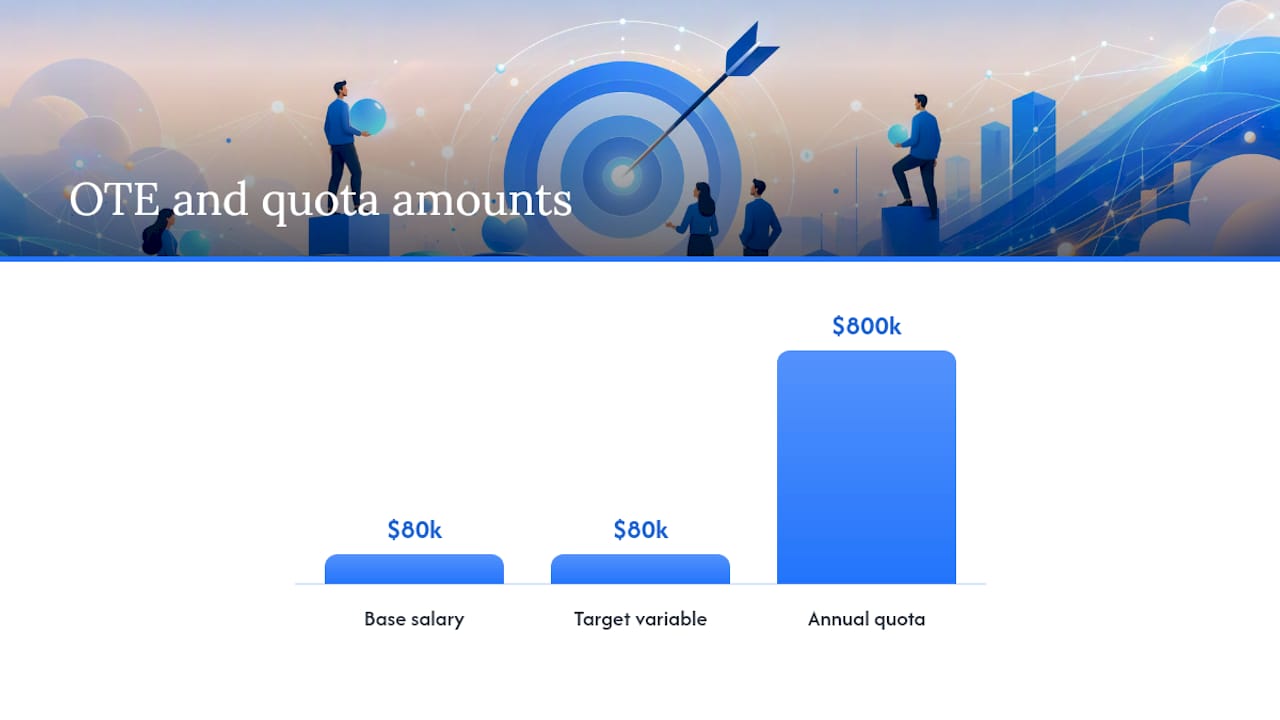
- Calculate the variable target. OTE of $160,000 at 50/50 means $80,000 base and $80,000 target variable.
- Set the commission rate. Divide the variable target by the annual quota you expect the rep to carry.
- Derive the quota. If you want a 10% commission rate and $80,000 in target variable, the quota needs to land around $800,000.
That gives you a quota-to-OTE multiple of exactly 5x, which sits right in the healthy zone for a mid-market AE. Commission rate math isn’t arbitrary. It’s the output of dividing your variable pool by quota, and if that math spits out a rate under 5% or over 20%, something in your assumptions is broken.
Statistic Callout: Attainment doesn’t cluster neatly around 100%. Most SaaS sales orgs see a wide spread, with a meaningful chunk of reps landing well below target. That’s normal. It’s also exactly why you model the curve instead of just publishing the headline number.
Accelerators change the picture fast.
What Are Realistic OTE Benchmarks for SaaS Sales Roles?
Numbers help you sanity check your own plan, not copy someone else’s homework. Recent SaaS compensation data points to a median AE OTE near $200,000, with pay mix and quota ratios that shift depending on how much control the rep has over the close, according to Visdum’s compensation benchmarking research.
Rough bands worth knowing:
- Mid-market AE: roughly $130,000 to $180,000 OTE, 50/50 pay mix.
- Enterprise AE: roughly $200,000 to $300,000+ OTE, often 60/40 base-heavy given longer cycles.
- SDR: roughly $65,000 to $90,000 OTE, 70/30 or 60/40 mix, since SDRs influence but don’t close.
- CSM (with renewal or expansion quota): roughly $90,000 to $130,000 OTE, base heavy, 75/25 or 80/20.
On the quota side, the sweet spot most SaaS orgs land in is a 4x to 5x quota-to-OTE ratio.
Treat every one of these numbers as a check on your own math, not a template to copy. Deal size, average contract value, and sales motion swing these bands hard. A company’s pricing model changes what a fair quota looks like more than most founders realize.
The 7-Step Process for Designing SaaS OTE Plans
You don’t need a comp consultant and six months to get this right. You need a Tuesday afternoon and this list.
- Pick one or two revenue priorities. New ARR, expansion, retention. Pick one, maybe two. Every metric you add past that dilutes the incentive and confuses the rep, per ARRGuide’s plan design framework.
- Set the OTE band. Use market data for the role and level, then check it against your budget.
- Choose the pay mix. 50/50 for closers. Base heavy for roles with less control over the close.
- Calculate the quota. Use a 4x to 5x multiple on OTE, then check it against actual territory potential.
- Set the commission rate and accelerators. Build in a bump above 100% so your best reps have a reason to keep pushing.
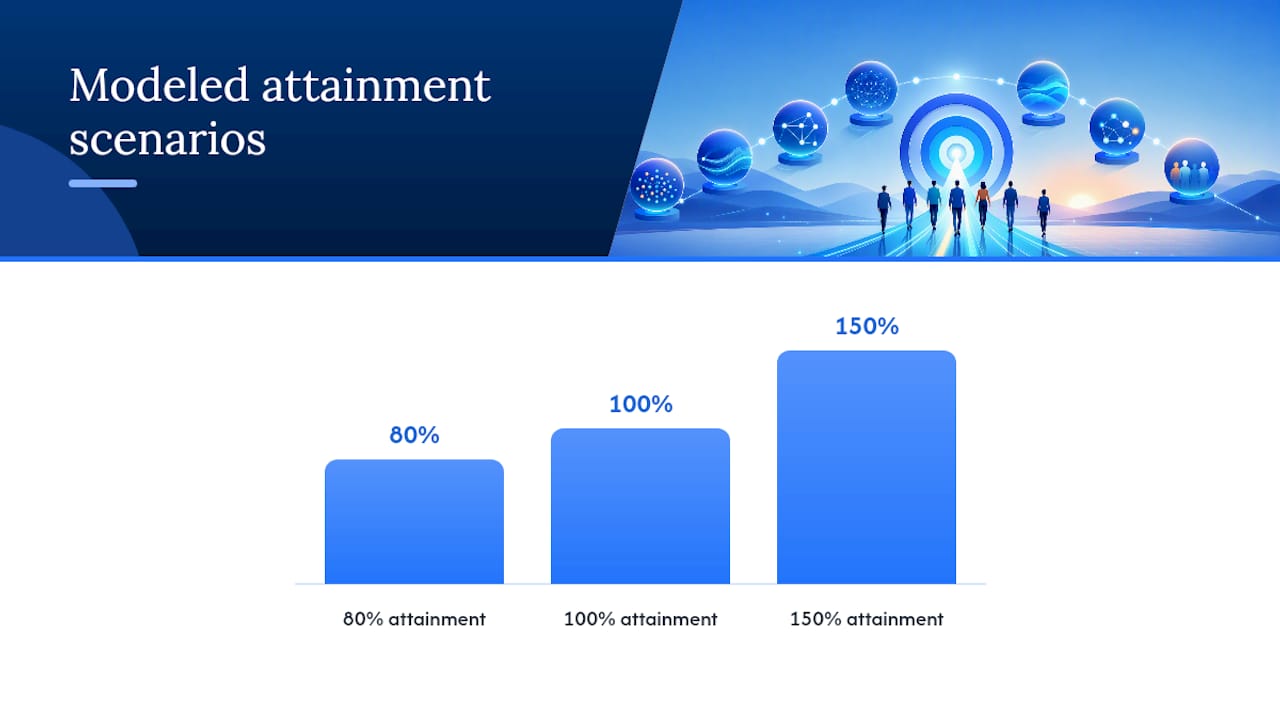
- Model the attainment scenarios. Run the plan at 0%, 80%, 100%, and 150% before you finalize anything.
- Document the rules. Ramp period, true-up mechanics, clawback terms. Write it down so nobody argues about it in six months.
Pro Tip: Before you roll out a new plan, sit down with your best rep and walk them through it. If they can’t tell you in thirty seconds how to maximize their check, your plan has too many moving parts.
If retention is one of your top priorities this year, comp needs to reflect that directly instead of hoping a renewal quota fixes itself. Building a real retention strategy into the plan, not just the roadmap, is what separates companies that keep customers from ones that just keep closing new logos to replace the ones walking out the back door.
What Are the Biggest Mistakes in OTE Plan Design?
I’ve watched more comp plans fail from bad design than from bad reps. Here’s where it usually goes wrong:
- Treating OTE as a guaranteed number instead of a target. Reps find out fast when realized pay doesn’t match the offer letter, and they leave. That’s a retention problem you built yourself.
- Stacking too many metrics. Five KPIs on one plan means zero clear priority. Reps default to whatever’s easiest to hit, not what actually moves revenue.
- Setting quota-to-OTE ratios outside the 4x to 5x range. Above 6x, nobody hits target. Below 3x, you’re overpaying for underperformance.
- Vague OTE language in job ads. “Up to $200K OTE” with no pay mix, no quota, no accelerator detail is a red flag candidates should run from, and frankly, so should you as the one writing the check.
How Should You Test an OTE Plan Before Rollout?
Never launch a comp plan cold. Run the numbers first.
- Model deterministic scenarios at 0%, 80%, 100%, 125%, and 150% attainment. See exactly what payroll looks like at each point, not just at the headline 100% mark.
- Check payroll cost at median attainment. This tells you your real cost of sale, not the fantasy number in the board deck.
- Check upside for top performers. If your best rep can’t meaningfully out-earn your average rep, you built a plan that punishes excellence.
- Pressure-test with a real AE. Hand the spreadsheet to your top closer. If they can tell you instantly how to maximize their check, ship it. If they squint and ask three follow-up questions, simplify it first.
Cornerstone’s View: Why OTE Design Decides Your Hiring Outcomes
I’ve placed over 1,200 sales and executive hires since 1996, and I can tell you the plan sells the candidate before the recruiter does. A muddy OTE structure kills offer acceptance and wrecks ramp. Sharp candidates ask about quota-to-OTE ratio and accelerator thresholds in the first call. That question alone tells you more about their judgment than three rounds of reference checks. Candidates who can’t ask it usually can’t hit quota either.
— Rich Rosen
How Cornerstone Search Associates Helps You Hire to Your Plan
Cornerstone Search Associates is the alternative to posting a job and hoping. Once your OTE and quota math is locked, the harder problem is finding reps who can actually hit that number, not just talk about it in an interview. That’s where a targeted search beats a job board every time.

Here’s what we run:
- Software Sales Recruitment for AEs, SDRs, and CSMs who need to hit the exact quota your plan is built around.
- Executive Search Recruitment for VP Sales and CRO hires who set the comp strategy in the first place.
- Talent Acquisition Consulting when you need the comp design and the hiring plan built together, not in two separate silos.
Our process focuses on rapid placements from search kickoff to offer acceptance. That’s not a slogan, it’s a track record built on 1,200+ SaaS and software placements. If your OTE plan is locked and you need reps who can actually carry that quota, start with our SaaS sales recruitment page and get the search moving this week.
FAQ
What Does an OTE of $100,000 Mean?
If the pay mix is 50/50, base and target commission split evenly, and actual pay still depends on how much quota the rep hits.
Is a High OTE a Red Flag?
Not automatically, but an unusually high OTE paired with a vague quota or a thin pay mix explanation is worth questioning. Ask about the quota-to-OTE ratio directly. If it’s above 6x, the number on the job post is mostly theoretical, per SalesCookie’s benchmarking data.
What Is a Good OTE for My Role?
It depends heavily on role, segment, and deal size, but mid-market AEs typically land between $130,000 and $180,000, while enterprise AEs often run $200,000 to $300,000 or more. Median AE OTE across SaaS sits near $200,000, according to Visdum’s benchmarking, but adjust for your own ACV and sales cycle before setting a number.
What Does “On-Target Earnings” Really Mean?
It’s a planning benchmark, not a guarantee. If you need help finding reps who can consistently hit that target, Cornerstone’s SaaS recruiting team builds searches around exactly this kind of quota fit.