

Run structured, theme based questions on every VP Sales candidate. Call 5 to 8 references, including at least three off the candidate’s list. Score every call against the same rubric. Close with the rehire question. Do that and you’ll catch what interviews hide: how they actually manage a number, coach a rep, and behave when the quarter goes sideways.
TL;DR:
- Thorough reference checks should include theme-based questions about leadership style, strategic thinking, and cultural fit, rather than relying on generic or superficial inquiries.
- Calling 5 to 8 contacts, including off-list references, improves prediction of first-year quota attainment and reveals how the candidate manages and leads under pressure.
- Scoring each reference call on five consistent dimensions with thresholds ensures objective comparison and prevents hiring based on vague vibes or charm.
- Asking detailed, specific questions about recent deals, coaching, and team ramp-up, followed by a firm rehire question, uncovers concrete performance insights.
- Hiring managers should allocate 4 to 8 hours for comprehensive reference work or delegate this to specialized recruiters for better candidate vetting.
Table of Contents
- Reference Check Questions For VP Sales: The Core Question Bank
- Who To Call And How To Run The Reference Process
- Scoring The Calls: Turning Gut Feel Into A Decision
- Scripts That Force Specifics, Not Compliments
- Why A Specialist Recruiter Runs This Differently
- The Practitioner’s Checklist
- Hire A VP Sales Who Actually Hits The Number
- Sources
Reference Check Questions For VP Sales: The Core Question Bank
Most reference calls are garbage. Three softball questions, a lot of “yeah, great guy,” and a hiring manager who feels good about a decision they already made. That’s not a reference check. That’s a formality.

A real VP Sales reference check probes theme by theme, because leadership, execution, and integrity show up in different stories. Executive reference checks work best when you target leadership style, strategic thinking, communication, and cultural fit instead of asking generic “were they a good employee” filler.
Here’s the bank, organized so you can grab what you need mid call:
- Role and context: “What was their quota and team size? Why did they leave?”
- Leadership and coaching: “Walk me through a rep they turned around. Who did they let go, and why?”
- Quota and execution: “Did they hit number four quarters in a row, or was it lumpy? How did they handle discounting pressure at quarter end?”
- Forecasting and pipeline: “What forecast method did they use? How close was their commit to actuals? Learn about AI sales forecasting methods that improve forecast discipline.”
- Strategy and GTM: “What go-to-market change did they push through, and what happened?”
- Hiring and ramp: “How fast did their AE hires ramp? Who’s still there?”
- Integrity: “Was there ever a deal, a number, or a hire they weren’t straight about?”
- The closer: “Would you hire them again, right now, for this exact role?”
That last one carries more weight than the other seven combined. A flat “no” is rare and disqualifying. A pause, a hedge, or “it depends on the role” is a signal, not an answer. A rehire question framed for the exact role you’re hiring for, followed by a probe, cuts through vague praise fast.
Pro Tip: If a reference praises “culture fit” but can’t name a specific deal, a specific rep, or a specific number, they’re protecting the candidate. Push once. If they still can’t get concrete, write that down as data, not as an accident.
Who To Call And How To Run The Reference Process
Candidates hand you their three best friends. That’s not a reference check, that’s a character witness list. You need people who owe the candidate nothing.
Here’s the mix that actually works:
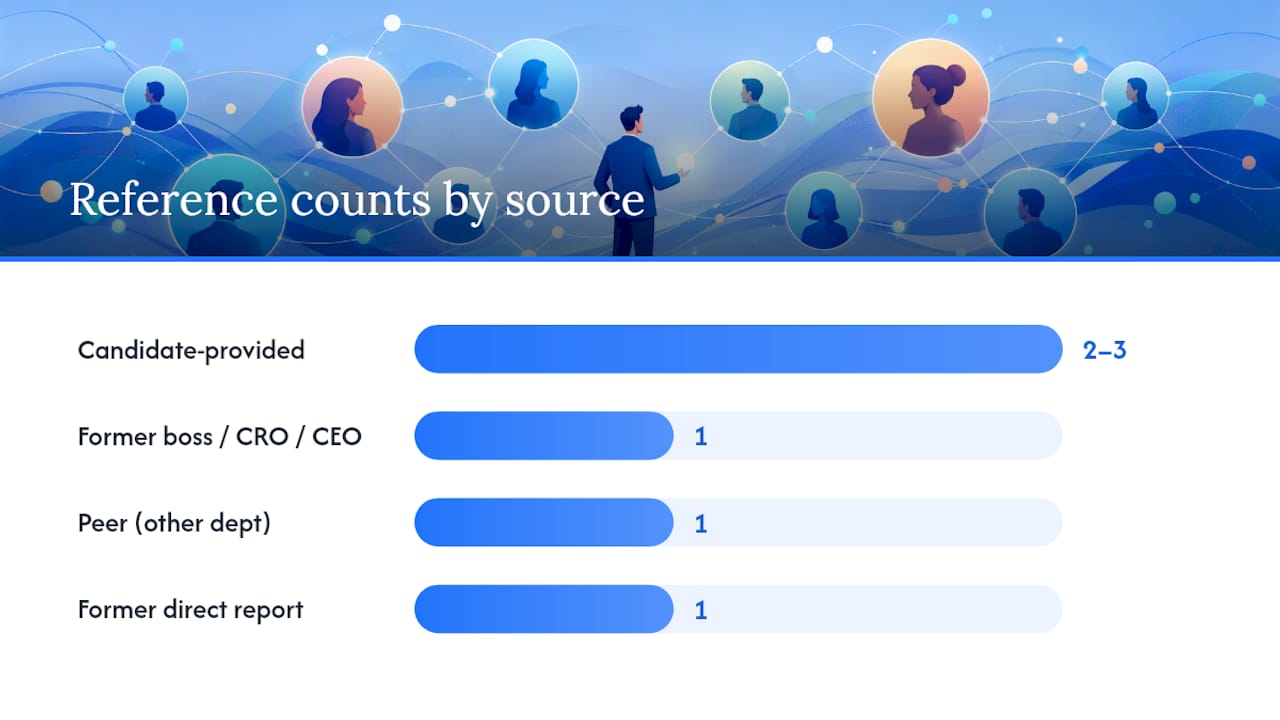
- Two or three candidate-provided references, because they still show you how the candidate wants to be seen.
- A former boss, CEO, or CRO the candidate did not offer, sourced through a mutual LinkedIn connection or a prior board deck.
- A peer from another department, sales engineering, marketing, or customer success, who watched them operate day to day.
- A former direct report, ideally an AE they hired and developed, not just managed.
Structured checks that mix candidate-provided names with back-channel and public-signal sources, run across 5 to 8 touchpoints, predict first-year quota attainment far better than the standard two-reference drive-by. And pulling in references the candidate never gave you closes most of the bad-hire risk that a friendly reference list is designed to hide.
Practical logistics:
- Run 25 to 40 minute initial calls. Anything shorter and you’re skimming.
- Book a 15 minute follow-up 48 hours later. People remember the sharp detail after they hang up, not during the call.
- Ask permission before you dig for off-list names: “I’d like to talk to a couple of people who aren’t on your list, is that fine?” Most candidates say yes. The ones who hesitate just told you something.
Budget 4 to 8 hours of real reference work for a VP-level hire. If you don’t have that time, that’s exactly when you hand it to someone who does this for a living.
Scoring The Calls: Turning Gut Feel Into A Decision
Vibes aren’t a hiring process. Score every call the same way, every time, so you can compare candidates instead of trusting your mood on a Friday afternoon.
Rate each reference on five dimensions, one to five:
- Quota consistency across their tenure, not just their best year
- Pipeline creation, meaning did they build the number or inherit it
- Forecast discipline, meaning how close was commit to actual
- Team development, meaning coaching, promotions, and who they hired
- Culture and ethics, meaning how they treated people under pressure
A consistent scorecard applied across every reference call materially improves how predictive the process is, and lets you compare candidates on the same scale instead of on how charming each reference sounded.
Set thresholds before you start calling, not after: an average above 4 is a pass, 3 to 4 means dig for one more reference, below 3 on any two dimensions is a hard stop. Red flags that override the math every time: a reference who won’t answer the rehire question directly, inconsistent quota numbers between references, or anyone who mentions a deal that “got handled” without explaining how. Weight the rehire answer heavier than any single score on the sheet.
Scripts That Force Specifics, Not Compliments
Open every call the same way: “Thanks for the time. I’d like to take notes as we go, is that fine? This should run about 30 minutes.”
- The example probe: “Walk me through a deal they closed in the last two quarters, then one they lost. What did they do differently?”
- The people probe: “Tell me about a rep who wasn’t performing. What did they do about it, and when?”
- The rehire close: “Would you hire them again for this exact role?” Follow with “What would give you pause?” and “What would make it an easy yes?”
Keep one note field per theme, score one to five, plus a line for direct quotes. That’s your entire scoring template.
Why A Specialist Recruiter Runs This Differently
Here’s the truth nobody likes: most hiring managers don’t have 8 hours to burn per VP candidate, and they definitely don’t have a bench of off-list contacts in the SaaS sales world. Cornerstonesearch does. We’ve placed over 1,200 sales professionals since 1996, averaging 21 days from search kickoff to offer, because reference work like this is built into the process, not bolted on after an offer letter is drafted. A retained search that runs structured scorecarding at scale catches what a rushed in-house process misses. If the hire is time-sensitive or your GTM is complex, that’s exactly when you bring in someone who’s already run this play a thousand times.
The Practitioner’s Checklist
Do: call the rep who reported to them. Do: demand a specific deal, name, and number. Do: ask the rehire question twice, different ways. Don’t: accept “great culture add” without a story behind it. Don’t: skip off-list calls because you’re in a hurry. Don’t: hire on vibes when the quota numbers won’t add up.
Rule of thumb: if references can’t describe how the candidate ramped their last two AE hires, assume they can’t ramp yours either.
Pro Tip: Tell candidates up front you run deep reference checks, including off-list calls. The good ones respect it. The ones who get nervous just told you something worth knowing.
— Rich Rosen
Hire A VP Sales Who Actually Hits The Number
Doing all this right, the question bank, the off-list calls, the scorecard, takes real hours you probably don’t have between board decks and pipeline reviews. Cornerstonesearch runs this exact process for a living: structured VP Sales searches built for SaaS and software companies, where a bad hire costs you two quarters you can’t get back.

If you’re staring down a time-sensitive VP Sales search, a risk-averse board, or a complex GTM motion that needs a leader who’s actually done it before, that’s our lane. Check out Sales Recruitment 101: Essential Tips For Building A Winning Team to see how we run searches from kickoff to offer, and get in touch when you’re ready to stop guessing on your next sales leader.