

Remote SaaS sales team hiring is the process of recruiting, structuring, and managing specialized sales professionals to drive predictable revenue growth without geographic limits. Done right, it gives SaaS founders and hiring managers access to a national talent pool of proven Sales Development Representatives (SDRs) and Account Executives who can generate pipeline from day one. Done wrong, it costs you six months and a quarter of missed targets. This guide covers the roles you need, the hiring process that works, the team structure that performs, and the pitfalls that sink most remote builds before they start.
What roles and prerequisites define a remote SaaS sales team?
A remote SaaS sales team is built on two core roles: SDRs and Account Executives. SDRs own top-of-funnel activity. They prospect, cold call, run LinkedIn outreach, and book qualified meetings. Account Executives own the pipeline from first demo through signed contract. Each role requires a distinct skill set, and confusing the two is one of the most expensive hiring mistakes a founder can make.
Remote SaaS sales roles typically require 2–5 years of B2B SaaS or outbound sales experience, with demonstrated proficiency in cold calling, CRM management, and full-cycle sales. That bar exists for a reason. SaaS sales cycles involve technical buyers, multi-stakeholder deals, and subscription economics that generic sales experience does not prepare candidates for. You need people who have lived inside a SaaS sales motion before.

Candidates also need to be fluent in multi-channel outreach, including cold calling, LinkedIn, and email sequences. The best remote SDRs run coordinated campaigns across all three channels simultaneously. A candidate who only knows one channel will underperform in a modern SaaS outbound motion.
The table below gives you a clear reference for role scope, experience requirements, and compensation benchmarks.
| Role | Core Responsibilities | Experience Required | Monthly Compensation |
|---|---|---|---|
| SDR | Prospecting, cold calling, LinkedIn outreach, meeting booking | 1–3 years outbound B2B | $2,000–$4,500/month |
| Account Executive | Full-cycle sales, demos, negotiation, closing | 2–5+ years B2B SaaS | $5,000–$10,000/month |
| Senior AE | Enterprise deals, 6-figure contracts, complex negotiations | 5+ years SaaS closing | $60,000–$95,000 base/year + uncapped commission |
These figures reflect 2026 market rates. Senior Account Executives at the top of the range are typically closing six-figure deals with equity components included. Budget accordingly before you open a search.
How do you effectively hire and onboard remote SaaS sales professionals?
The standard internal hiring process for a remote sales role takes 2–3 months per position and often produces a candidate who needs another 60 days to ramp. That timeline kills pipeline. Specialized staffing platforms compress that cycle to 2–4 weeks by maintaining pre-vetted, trained candidate pools ready to deploy into a SaaS sales motion immediately.
Here is the hiring process that consistently produces results:
- Define the role with precision. Write a job spec that names the specific CRM your team uses, the average deal size, the sales cycle length, and the outbound channels your SDRs will work. Vague specs attract vague candidates.
- Source from specialized networks. General job boards surface generalist candidates. SaaS-specific software sales recruitment networks surface candidates who already understand subscription models, churn metrics, and product-led growth motions.
- Evaluate on live skills, not resumes. Give SDR candidates a cold call simulation. Give Account Executive candidates a mock discovery call and a deal review. Past quota attainment matters, but live performance in your context matters more.
- Check cultural fit for remote work specifically. Ask candidates how they structure their day without a manager in the room. Ask how they handle a cold streak. Remote sales requires self-direction that office-based roles can mask.
- Onboard with a 30-day structured ramp. Assign a peer mentor, set week-by-week activity targets, and hold daily check-ins for the first two weeks. Remote onboarding fails when new hires are handed a login and left to figure it out.
Pro Tip: Working with a recruiter who maintains pre-vetted candidate pools cuts your time-to-productivity in half. You skip the sourcing and initial screening phases entirely and move straight to evaluating finalists who already meet your baseline criteria.
For a curated list of questions to use during the evaluation stage, Cornerstonesearch’s SaaS sales interview questions resource gives hiring managers a structured framework built specifically for SaaS sales roles.
What is the ideal remote SaaS sales team structure for maximum performance?
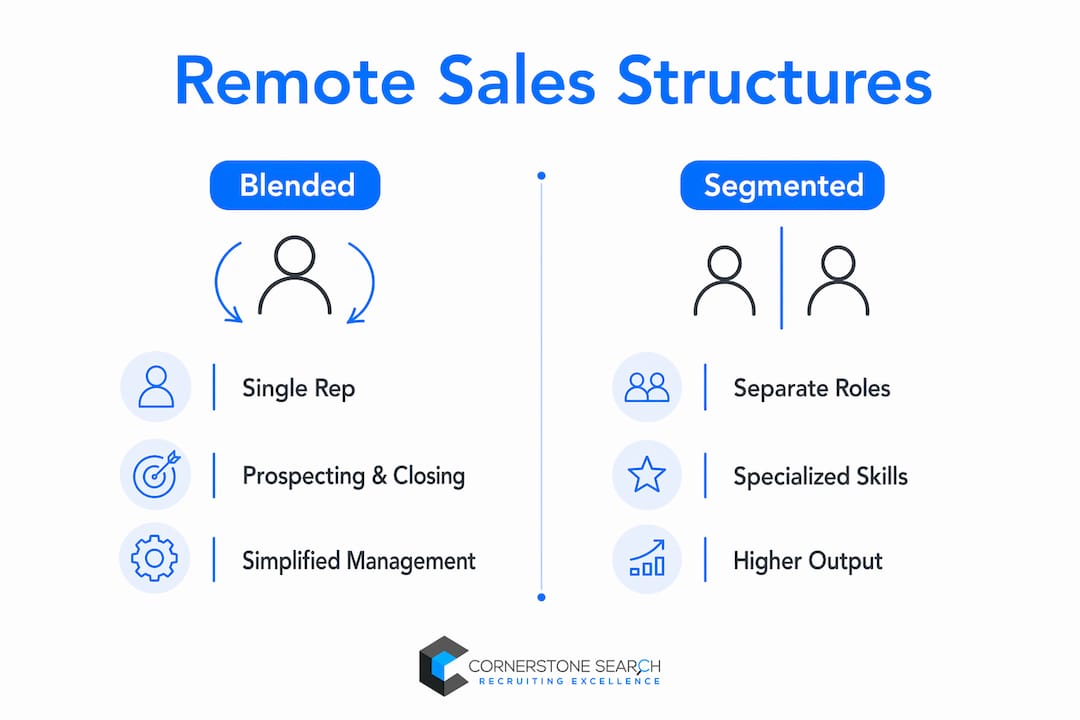
Separating prospecting from closing is the single structural decision that most improves remote SaaS team output. When SDRs own top-of-funnel and Account Executives own the close, each role develops deep competency in its function. When one person does both, neither function gets done well.
The table below compares the two primary structural models and their performance implications.
| Structure | How It Works | Performance Impact |
|---|---|---|
| Blended (one rep does all) | Each rep prospects and closes their own pipeline | Lower volume, inconsistent quality, rep burnout |
| Segmented (SDR + AE model) | SDRs book meetings, AEs run and close deals | Higher pipeline volume, faster ramp, clearer accountability |
| Pod model (SDR + AE + CSM) | Full revenue pod handles acquisition and retention | Best for enterprise SaaS with complex post-sale needs |
The segmented model is the right starting point for most SaaS companies scaling from 0 to their first $5 million in ARR. It creates clear metrics for each role, which makes remote management far simpler. You know exactly where pipeline is breaking down because you can see SDR meeting volume and AE close rates as separate data points.
Remote sales team management requires more structure than in-office management, not less. Set weekly pipeline review calls, use a shared CRM dashboard that every team member updates daily, and establish response-time expectations for inbound leads in writing. Ambiguity in a remote environment becomes missed quota.
Understanding why SaaS sales hiring differs from traditional sales hiring also shapes how you structure your team. SaaS buyers expect reps who understand product integrations, pricing tiers, and customer success handoffs. That knowledge has to be built into your onboarding program from day one.
What are the common pitfalls in remote SaaS sales hiring?
Common pitfalls in remote SaaS sales hiring include slow hiring cycles, poor candidate fit, and onboarding that leaves new hires without direction. Each one costs you pipeline and time you cannot recover. Knowing what to watch for lets you build a process that avoids them.
The most frequent mistakes hiring managers make:
- Hiring generalists for a specialist role. SaaS sales is not the same as selling insurance or real estate. Candidates without SaaS-specific experience take longer to ramp and produce lower-quality pipeline.
- Skipping structured onboarding. Remote hires who do not receive a formal ramp plan in their first 30 days take twice as long to reach quota. Structure is not optional when you cannot walk over to someone’s desk.
- Using a slow internal process when speed matters. Building a remote team internally can take six months or more before the team generates meaningful pipeline. That gap is a direct revenue cost.
- Ignoring remote work readiness. A candidate with a great track record in an office environment may struggle without the structure of a physical workplace. Assess remote work habits explicitly during interviews.
- Failing to define success metrics before day one. Every remote sales hire should know their 30, 60, and 90-day activity targets before they start. Undefined expectations produce undefined results.
Remote teams also carry real cost advantages over traditional builds. You eliminate office overhead, expand your candidate pool nationally, and can often hire strong talent in lower cost-of-living markets without sacrificing skill level.
Pro Tip: Track three metrics from every hire: time-to-first-meeting-booked, time-to-first-close, and 90-day quota attainment. Those three numbers tell you whether your hiring and onboarding process is working or where it is breaking down.
For a broader look at how specialized sales recruiters reduce these risks, Cornerstonesearch has documented the specific advantages of working with a recruiter who knows the SaaS sales market.
Key takeaways
Effective remote SaaS sales team hiring requires role clarity, a fast sourcing process, a segmented team structure, and a structured onboarding program to produce pipeline within 30 days of hire.
| Point | Details |
|---|---|
| Define roles precisely | SDRs and Account Executives require distinct skills; hiring for both in one role produces underperformance. |
| Use specialized sourcing | Specialized staffing networks cut hiring cycles from 2–3 months to 2–4 weeks per role. |
| Segment your team structure | Separating prospecting from closing increases pipeline volume and makes remote management measurable. |
| Onboard with a 30-day plan | Remote hires without structured ramp programs take twice as long to reach quota. |
| Track hiring metrics | Monitor time-to-first-meeting, time-to-first-close, and 90-day attainment to improve your process continuously. |
What i’ve learned after placing 1,200+ SaaS sales professionals
The conventional wisdom says remote sales teams are harder to manage than in-office teams. After placing over 1,200 sales professionals since 1996, my experience says the opposite is true when you hire correctly. Remote sales teams that are built on clear role definitions, strong metrics, and structured onboarding consistently outperform office teams that rely on proximity to substitute for process.
The biggest shift I have seen in the last two years is the acceleration of demand for remote SaaS sales talent. Founders who used to insist on local hires are now competing nationally for the same SDRs and Account Executives. That competition has raised the bar on how fast you need to move. A candidate worth hiring is rarely available for more than two weeks before another offer lands.
Specialized staffing is no longer a shortcut. For SaaS companies that need to build pipeline quickly, it is the only realistic path. The math is straightforward. Six months of internal searching versus three weeks with a recruiter who already knows the candidates. The revenue difference between those two timelines is not a rounding error.
The future of remote SaaS sales team building belongs to companies that treat hiring as a repeatable process, not a one-time event. Build your hiring criteria once, refine them after every placement, and work with partners who specialize in your market. That combination produces teams that perform from the first month, not the sixth.
— Rich Rosen
Build your remote SaaS sales team with Cornerstonesearch
Cornerstonesearch has specialized in SaaS sales recruitment since 1996, placing over 1,200 sales professionals with an average time from search kickoff to offer acceptance of just 21 days. That speed matters when every week without a productive sales hire is a week of missed pipeline.
Whether you are hiring your first SDR or scaling an Account Executive team across multiple territories, Cornerstonesearch connects you with pre-vetted candidates who already understand SaaS sales cycles, CRM workflows, and outbound motion. Start with the sales recruitment essentials resource to see how the process works, or contact Cornerstonesearch directly to discuss your specific hiring needs and timeline.
FAQ
What roles should a remote SaaS sales team include first?
Start with at least one SDR and one Account Executive. SDRs generate qualified meetings and AEs close them. Separating these functions from the start produces better pipeline quality and clearer accountability.
How long does remote SaaS sales team hiring typically take?
Internal hiring processes average 2–3 months per role. Working with a specialized recruiter who maintains pre-vetted candidate pools compresses that timeline to 2–4 weeks.
What experience level should i require for remote SaaS sales hires?
Require 2–5 years of B2B SaaS or outbound sales experience, with demonstrated skills in cold calling, CRM management, and multi-channel outreach including LinkedIn and email.
How do i onboard a remote sales hire effectively?
Assign a peer mentor, set weekly activity targets for the first 30 days, and hold daily check-ins during the first two weeks. Remote onboarding without structure is the leading cause of slow ramp times.
What salary should i budget for remote SaaS sales roles?
Remote SDRs typically earn $2,000–$4,500 per month. Account Executives range from $5,000–$10,000 per month, with senior AEs commanding base salaries of $60,000–$95,000 per year plus uncapped commission.