

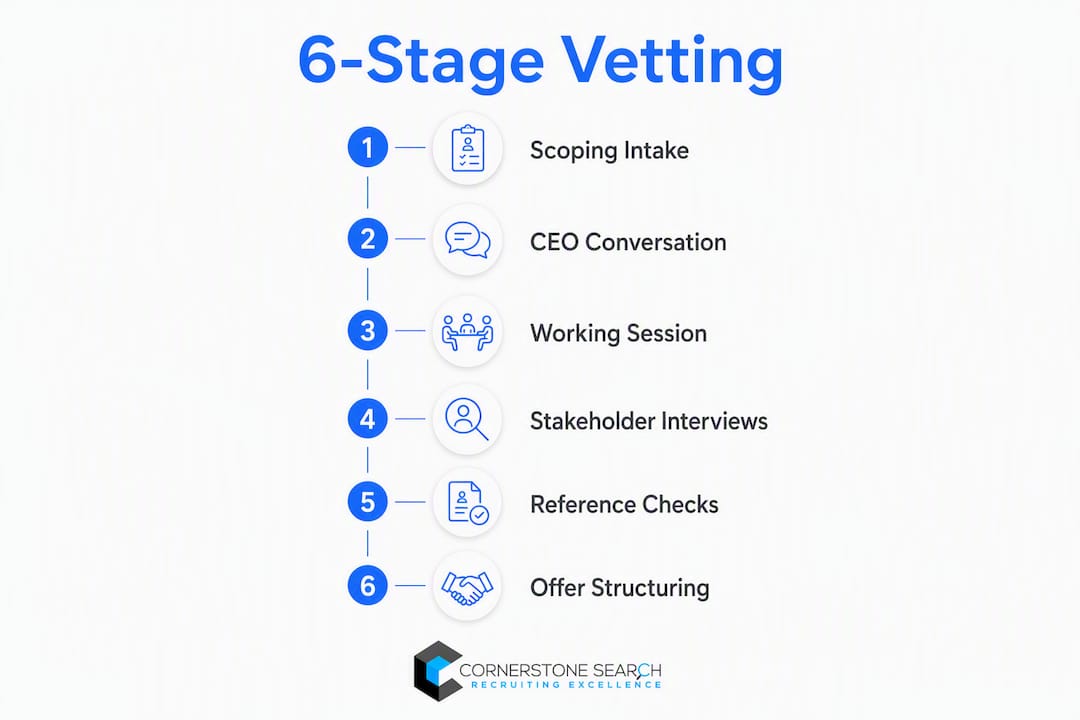
The defensible CRO interview process runs six stages: scoping/intake, a long-form CEO conversation, a real working session on the company’s revenue model, a board-chair touchpoint, recruiter-run references (including backchannels), and an offer construction phase managed by the recruiter. Running these in sequence significantly reduces mis-hire risk. Run it in that order and you cut replacement risk significantly. Skip stages or run them out of sequence and you are rolling the dice on a hire where a mis-fire costs you a year of runway.
Here is what to do this week to start the search:
- Lock the success profile before you brief anyone. No sourcing until the CEO, CFO, and board chair agree on what “winning” looks like in 12 months.
- Decide retained or contingent search before you post anything. Senior revenue roles almost always warrant retained.
- Build your scorecard now. You need it before the first candidate conversation, not after.
- Assign a single internal owner. One person runs the process. Committees without owners stall searches.
- Set a go/no-go date. If you do not have an offer out in 90 days, something in the process broke.
Timeline callout: A well-scoped executive sales search closes fastest when intake is tight and comp is pre-approved. Typical engaged searches close in 75 to 150 days; the most efficient processes close inside 75 days, while those with scope or comp changes can run up to 180 days.
Table of Contents
- Why a bad CRO hire costs more than you think
- Stage 1: How to build a success profile that actually guides the search
- Stage 2: How to source senior revenue talent without wasting 60 days
- Stage 3: What “causal fluency” means and why it separates real CROs from good storytellers
- Stage 4: Who needs to meet the finalist and what each conversation must test
- Stage 5: How to run reference checks that actually tell you something
- Stage 6: How to structure the offer and set the first 90 days up for success
- How to choose a recruiting partner and what to demand from them
- Key Takeaways
- The working session is the only interview that tells you the truth
- Cornerstonesearch runs CRO searches the way they should be run
- Useful sources and further reading
Why a bad CRO hire costs more than you think
Most founders underestimate the damage. A mis-hired CRO does not just underperform. They reorganize the sales team around their old playbook, burn your best reps, and spend six months telling the board the pipeline is “building.” By the time you admit the hire was wrong, you have lost over a year of growth and spent real money on OTE, equity, and severance.
Treating the CRO search like an individual-contributor hire is the most common mistake senior recruiters see. Founders over-index on big deals and impressive logos. They hire the person who tells the best war story instead of the person who can build a repeatable system. Those are two very different candidates.
The patterns that produce bad hires look like this:
- Hiring a closer when you need a system-builder
- Skipping the working session because the candidate “seemed sharp”
- Letting the candidate run the reference list without backchannel verification
- Moving to offer before the board chair has met the finalist
- Confusing ACV experience with stage-appropriate experience
A structured, stage-gated process forces you to slow down at the right moments. It does not add time to the search. It removes the rework.
Stage 1: How to build a success profile that actually guides the search
You cannot source the right person if you have not agreed on what “right” means. This sounds obvious. It is almost never done well.
Run a scoping session with the CEO, CFO, and board chair before you write a job description or brief a recruiter. The CEO owns the mission and the operating relationship. The CFO owns the comp band and the financial accountability model. The board chair owns the governance expectations and the investor-facing mandate. All three need to align before sourcing starts, because misalignment at this stage shows up as a stalled search six weeks in.
What the success profile must include
Document these six elements before you brief anyone:
- Mission statement: — One sentence on what this CRO must accomplish in the first 12 months. Be specific. “Grow revenue” is not a mission. “Build a repeatable outbound motion that produces $4M in net new ARR by Q4” is.
Must-have vs. nice-to-have
Must-haves are the non-negotiables above. Nice-to-haves are the things you would love but will not kill a search over. Write them down separately. When you are comparing finalists under pressure, you will thank yourself for having made this distinction in advance.
Document everything in a one-page brief. Recruiters need it. Passive candidates need it. Your own team needs it to stay aligned across a 90-day process.
Stage 2: How to source senior revenue talent without wasting 60 days
Posting a CRO role on a job board and waiting is not a sourcing strategy. The candidates you want are not browsing job boards. They are running revenue teams right now. You have to go get them.
Three sourcing channels work for senior GTM hires:
- Passive outreach: Direct, personalized outreach to mapped targets who fit the success profile. This is the primary channel for CRO searches. Requires a research map of 40 to 60 names before the first message goes out. Passive sourcing tactics for SaaS roles are different from active-candidate sourcing and require a different approach.
- Board and advisor referrals: Warm introductions from people the candidate already respects. High conversion rate, but a small pool. Use it as a supplement, not a primary channel.
- Selective posting: Useful for signaling the role is open and for catching candidates in transition. Rarely produces the finalist for a CRO search, but occasionally surfaces a strong candidate you would not have found otherwise.
Retained vs. contingent search
For CRO and VP Sales searches, retained search is the right structure in most cases. Here is why: retained search partners have skin in the game from day one. They invest in the research map, run the outreach, and manage the process. Contingent partners work multiple searches simultaneously and prioritize the roles most likely to close fast.
When you brief a search partner, demand these deliverables upfront:
- A written research map of 40 to 60 named targets within two weeks of kickoff
- Weekly pipeline updates with outreach-to-response ratios
- Candidate summaries that include a sourcing note explaining why each person was targeted
- A clear timeline with stage gates and go/no-go checkpoints
Sourcing KPIs to hold your partner to: 40 to 60 mapped targets, 20% outreach-to-conversation rate as a floor, three to five qualified candidates presented within 30 days of kickoff.
Sourcing checklist for founders:
- Success profile documented and board-approved before sourcing starts
- Comp band pre-approved, including equity
- Research map requested and reviewed by week two
- Weekly pipeline call scheduled with search partner
- Internal interview panel identified and calendared in advance
Stage 3: What “causal fluency” means and why it separates real CROs from good storytellers
Generic behavioral interview questions are weak for senior GTM roles. “Tell me about a time you grew revenue” produces polished stories. It does not tell you whether the candidate built a system or just happened to be in the room when the number went up.

Causal fluency is the ability to trace specific rep behavior to measurable outcomes. A candidate with causal fluency can tell you exactly which behavior they changed, the mechanism they used to change it, and the resulting metric shift. A candidate without it tells you the team “crushed quota” and moves on. The difference matters enormously at the CRO level, where the job is building a reproducible system, not closing individual deals.
The structured interview scorecard
Score every candidate on these five competencies, weighted by your stage and motion:
| Competency | What to listen for | Weight |
|---|---|---|
| Causal track record | Specific behavior-to-metric chains, not revenue totals | High |
| Field credibility | Can they speak to rep-level execution, not just strategy | High |
| System-building evidence | Forecast discipline, territory logic, rep development cadence | High |
| Diagnostic instinct | How fast do they identify what is broken in your funnel | Medium |
| Managing-up capability | Board presence, CFO relationship, investor communication | Medium |
Score each competency 1 to 5 with written evidence notes. This lets you compare candidates quantitatively instead of arguing about gut feel in a debrief.
The working session: your best evaluation tool
A real-time working session using your actual revenue model is more revealing than any hypothetical case study. Candidates who can only tell good stories fall apart when you put your actual funnel in front of them. Candidates who have done the real work diagnose it in 30 minutes.
How to run it:
- Share a sanitized version of your revenue model, pipeline data, and rep performance data 24 hours before the session.
- Give the candidate 60 minutes to present their diagnosis and a 90-day plan.
- Have the CEO and one board observer in the room. No more.
- Score on: accuracy of diagnosis, quality of prioritization, credibility of proposed actions, and how they handle pushback.
- Require a written deliverable within 48 hours of the session.
Pro Tip: Ask for the 30/60/90 plan in writing within 48 hours of the working session. The quality of the document tells you more about their operational discipline than anything they said in the room. A vague plan with no metrics is a red flag. A specific plan with measurable milestones is a green light.
Stage 4: Who needs to meet the finalist and what each conversation must test
Stakeholder interviews are not a formality. They are a structured evaluation with a specific job for each interviewer. If everyone is asking the same questions, you are wasting time and collecting redundant data.
Who meets the candidate and what they evaluate
CEO: Chemistry, operating style, and communication cadence. The CEO-CRO relationship is the most important working relationship in the company. If the CEO cannot see themselves having a hard conversation with this person at 8 PM on a bad quarter, the hire is wrong regardless of the resume.
CFO: Financial partnership and accountability. Ask the candidate to walk through how they have managed forecast accuracy in a prior role. Watch for candidates who blame the market or the product when the number missed. The CFO needs a CRO who owns the number, not one who explains it away.
Board chair: Investor-facing communication and governance. The board chair should ask about a time the candidate delivered bad news to a board and how they handled it. Managing-up capability is non-negotiable at this level.
Sample questions by interviewer
For the CEO:
- Walk me through how you structured your weekly operating rhythm with your last CEO. What worked and what did not?
- Describe a time you disagreed with your CEO on a go-to-market call. What did you do?
For the CFO:
- What was your forecast accuracy in your last role, measured against commit? How did you get there?
- How did you handle a quarter where you missed the number? What did you tell the board?
For the board chair:
- Describe a board presentation where the news was bad. How did you frame it and what was the outcome?
- How do you think about the relationship between the CRO and the board? Where does that line sit?
Red flags to watch for
- Candidate cannot name specific metrics from prior roles
- Blames prior CEO, CFO, or board for failures without owning any part of it
- Avoids direct answers on forecast accuracy
- Talks only about strategy, never about execution or rep-level work
- Gets defensive when pushed on a specific number
Use the same scorecard across all stakeholder interviews. Each interviewer scores the candidate on their assigned competencies. Debrief as a group within 24 hours of the final interview. Decision rule: all three stakeholders must be at a “yes” or “lean yes” before an offer goes out. One hard “no” from the board chair or CFO stops the process.
Stage 5: How to run reference checks that actually tell you something
Most reference checks are useless. The candidate picks three people who love them, you ask soft questions, and everyone says the candidate is great. You learn nothing you did not already know.

A defensible reference check for a senior GTM hire forces specifics. The five questions that produce verifiable, honest answers cover baseline revenue, trade-off behavior, board presence, CFO relationship, and real reason for leaving.
Reference question template
Run these questions with every reference:
- What was the revenue baseline when this person joined, and what was it when they left? Be specific.
- Describe a trade-off they made between short-term revenue and long-term system health. What did they choose and why?
- How did they show up in board or investor settings? Give me a specific example.
- How did they work with the CFO? Was the relationship productive? Where did it break down?
- Why did they really leave? Not the official story. What actually happened?
Backchannel checks vs. on-list references
On-list references are the people the candidate chose. They are almost always positive. Run them, but do not rely on them alone.
Recruiter-run backchannel references surface the most candid information. A good search partner has relationships with people in the candidate’s network who were not on the list. Former peers, skipped-level reports, and board members from prior companies will say things on-list references will not. Insist your search partner includes backchannels as a deliverable, not an optional extra.
Verification checklist
Before an offer goes out, verify:
- Title and tenure confirmed against LinkedIn and public filings
- Compensation history consistent with what the candidate stated
- Revenue claims cross-referenced against public data or investor reports where available
- Deal evidence: can the candidate point to a specific deal, customer, or metric you can verify independently?
- Background check completed for any finalist at the CRO level
Red flags that stop the process:
- Reference cannot confirm the revenue numbers the candidate cited
- Two or more references give inconsistent accounts of the same event
- Backchannel surfaces a pattern of burning bridges or blaming others
- Candidate misrepresented title, tenure, or comp
- Real reason for leaving involves a board conflict the candidate did not disclose
Stage 6: How to structure the offer and set the first 90 days up for success
Getting to offer is not the finish line. A poorly structured offer misaligns incentives from day one. A missing 90-day plan leaves the new CRO guessing what winning looks like.
Offer structure for CRO roles
CRO compensation in SaaS typically includes base salary, OTE, equity, and severance. The specifics vary by company stage and ARR, but the structure principles are consistent:
- Base/OTE split: — Most CRO roles run 50/50 base-to-variable. Skewing too far toward base reduces accountability. Skewing too far toward variable makes it hard to attract the system-builders who take a longer view.
Negotiation guidance
Let the recruiter run the close. This is not the moment for the CEO to negotiate directly with the candidate. The recruiter has context on the candidate’s walk-away number, their competing offers, and the right sequence for getting the deal done. Founders who negotiate directly often either overpay or create friction that poisons the relationship before day one.
The 90-day onboarding plan
The most effective first 90 days are diagnostic, not action-oriented. The new CRO’s job is to assess the engine, identify what is working and what is broken, and reconcile the board’s number against actual engine capability. Founders who push for immediate action in the first 30 days usually get a CRO who makes changes before they understand the system.
90-day template:
- Days 1 to 30: Listen and assess. Meet every rep, every customer-facing leader, and every board member. Review pipeline, forecast, and rep performance data. Deliver a written assessment at day 30.
- Days 31 to 60: Prioritize. Identify the two or three highest-leverage changes. Present a prioritized action plan to the CEO and board. No major structural changes yet.
- Days 61 to 90: Execute on the top priority. Show measurable progress on one thing. Deliver an updated forecast with the CRO’s own methodology applied.
Ramp metrics to track:
- Forecast accuracy at 90 days vs. prior baseline
- Win rate trend from the CRO’s first full pipeline review
- Reps at quota percentage at 90 days vs. prior quarter
How to choose a recruiting partner and what to demand from them
Not all search partners are built the same. A recruiter who places mid-level account executives is not equipped to run a CRO search. The network, the backchannel relationships, and the process discipline are completely different.
When to use retained vs. contingent search
Retained search is the right structure for CRO and VP Sales roles in most cases. The role is confidential, the candidate pool is small, and the process requires a partner who is fully invested from day one. Contingent search works for roles where speed matters more than depth and where the candidate pool is larger.
If you are unsure, ask the recruiter how many CRO placements they have made in the last 24 months. If the answer is fewer than five, keep looking.
Questions to ask before you sign
Use this checklist when evaluating a recruiting partner for a senior revenue search:
- How many CRO or VP Sales placements have you made in SaaS in the last two years?
- Can you show me a sample research map from a comparable search?
- How do you run backchannel references? Is it included in your process or an add-on?
- What is your average time from kickoff to offer for a role at this level?
- Who specifically will run this search? Not the firm. The person.
- What happens if the hire does not work out in the first 90 days?
Minimum service levels to expect
A serious search partner delivers these without being asked:
- Written research map of 40 to 60 named targets within two weeks of kickoff
- Weekly pipeline updates with candidate status and outreach metrics
- Recruiter-run backchannel references on every finalist
- Offer management run by the recruiter, not handed back to the client
- A replacement guarantee with a clear trigger and timeline
How to evaluate recruiter performance during the search
Track these KPIs weekly:
- Mapped targets delivered vs. committed
- Outreach-to-conversation rate
- Qualified candidates presented vs. pipeline size
- Days from kickoff to first qualified candidate presented
If the recruiter misses two consecutive weekly updates or cannot explain why the pipeline is stalling, that is a process problem, not a market problem.
Key Takeaways
A defensible revenue leader vetting process runs six stages in sequence, and skipping any one of them is where most mis-hires begin.
| Point | Details |
|---|---|
| Six stages, in order | Scoping/intake, long-form CEO conversation, real working session on the company’s revenue model, board-chair touchpoint, recruiter-run references (including backchannels), and offer construction must run sequentially. |
| Causal fluency over war stories | Score candidates on their ability to trace specific rep behavior to measurable metrics, not on deal size or logo count. |
| Working session is mandatory | A real-time session using your actual revenue data separates system-builders from storytellers; require a written deliverable within 48 hours. |
| Backchannel references are non-negotiable | On-list references are almost always positive; recruiter-run backchannels surface what actually happened. |
| First 90 days are diagnostic | The new CRO’s job in the first 30 days is to assess and listen, not to restructure. Track forecast accuracy, win rate, and reps at quota at 90 days. |
| Cornerstonesearch | Typical engaged search closes in 75 to 150 days for SaaS revenue leaders; fastest searches complete inside 75 days, with outliers running up to 180 days if scope or comp changes mid-process. Over 1,200 placements since 1996. |
The working session is the only interview that tells you the truth
Here is something I have seen play out more times than I can count. A founder falls in love with a CRO candidate in the first conversation. The candidate is polished, confident, and has a logo on their resume that makes the board light up. Everyone skips the working session because “we already know this person is great.” Six months later, the pipeline is a mess, the reps are demoralized, and the founder is calling me to start the search over.
The working session is not a nice-to-have. It is the only moment in the process where the candidate has to perform in your world, not theirs. Generic behavioral questions let candidates rehearse. A working session using your actual funnel data does not. Candidates who have done the real work diagnose your pipeline in 30 minutes. Candidates who have been managing up and telling good stories stall, get vague, and ask for more time.
The other thing founders consistently underestimate is the backchannel reference. On-list references are theater. The candidate picked those people. Of course they are going to say good things. The real information comes from former peers, skipped-level reports, and board members from prior companies who were not on the list. A recruiter with real network depth in SaaS sales can get to those people. That conversation is where you find out why the candidate actually left their last role, and whether the board relationship ended cleanly or in a scorched-earth exit.
Run the working session. Insist on backchannel references. Do not let a polished story substitute for operational evidence.
Cornerstonesearch runs CRO searches the way they should be run
If you want the six-stage process managed for you, Cornerstonesearch typically closes SaaS revenue leader searches in 75 to 150 days, with fastest engaged searches closing inside 75 days and longest searches up to 180 days depending on scope and comp clarity. Over 1,200 placements since 1996. Retained and contingent searches for CROs, VP Sales, and senior GTM leaders at SaaS and software companies across North America.
Every search includes a written research map, recruiter-run backchannel references, a working-session evaluation, and offer management handled by the recruiter. No hand-waving. No “we’ll send you some profiles.” A real process with measurable deliverables at every stage.
If you are ready to start a SaaS revenue leader search or want to talk through whether retained or contingent is the right structure for your situation, reach out directly. The first conversation is a scoping call, not a sales pitch.
Useful sources and further reading
The sources below back the process described in this article and are worth bookmarking if you are running or supervising a CRO search.
- How to Hire a Chief Revenue Officer in 2026 | Engaged Headhunters — The most detailed public breakdown of the six-stage CRO hiring process, including working-session methodology and backchannel reference guidance.
- Startup Sales Recruiter Evaluation Checklist for Founders | Cornerstonesearch — A checklist for evaluating recruiting partners before you sign an engagement.
- Stages of the Executive Sales Search Process: 2026 Guide | Cornerstonesearch — Explains search stage sequencing and realistic timelines for senior GTM roles.
- SaaS Sales Interview Questions List for Hiring Managers | Cornerstonesearch — A question bank mapped to competencies for structured CRO and VP Sales interviews.