

A startup BDR’s job is simple to state and hard to execute: run outbound to strangers and turn a fraction of them into meetings your AE can close. That’s it. No brand awareness fluff. No “building relationships” nonsense as a substitute for pipeline.
Here’s why it matters. Founder-led selling works until it doesn’t. Once you’ve closed the first 15 to 20 customers yourself, you’ve learned who buys, why they buy, and what objections kill deals. A BDR only scales that if you’ve written it down. Hire one before you’ve documented your pitch and you’re not adding a salesperson, you’re adding confusion with a laptop.
What should you actually expect in return for a paycheck? Meetings booked. A dollar value on cold-sourced pipeline. A percentage of those meetings your AE accepts as real opportunities. And a ramp that takes longer than you want, because it always does.
Key Takeaways
A startup BDR’s job is to convert disciplined outbound activity into AE-ready meetings, and that only works once the founder has documented the pitch, the ICP, and the sales path.
| Point | Details |
|---|---|
| Core job | A startup BDR runs outbound prospecting to create net-new meetings and cold pipeline, not warm handoffs. |
| Ramp takes months | Expect near-zero meetings in month one, a messy middle in months two to three, and steady output by month four to six. |
| Measure five numbers | Track touches, connection rate, meetings booked, AE acceptance rate, and cold pipeline value. |
| Hire on evidence, not energy | Require a specific self-sourced pipeline story in every interview, not general enthusiasm. |
| Bring in a specialist when speed matters | Cornerstone Search Associates delivers a vetted BDR shortlist in an average of 21 days from search kickoff to offer acceptance. |
Table of Contents
- The Role of a BDR in Startups: Daily Work and Activity Targets
- BDR vs. SDR vs. AE: Who Does What at an Early-Stage Company
- What KPIs Actually Tell You a BDR Is Working
- How to Hire a BDR Who Actually Sells
- Building a BDR Playbook and a 30-60-90 Ramp Plan
- Compensation, Quota, and Career Paths for Startup BDRs
- The Mistakes That Kill BDR Hires (And How to Fix Them)
- When It’s Time to Bring in a Specialist Recruiter
- The Ramp Everyone Underestimates
- Get a Precise BDR Hire Without Burning a Quarter on the Wrong One
- Sources
The Role of a BDR in Startups: Daily Work and Activity Targets
A BDR’s day breaks into four buckets: research, outreach, follow-up, and CRM hygiene. Skip the last one and your pipeline reporting becomes fiction.
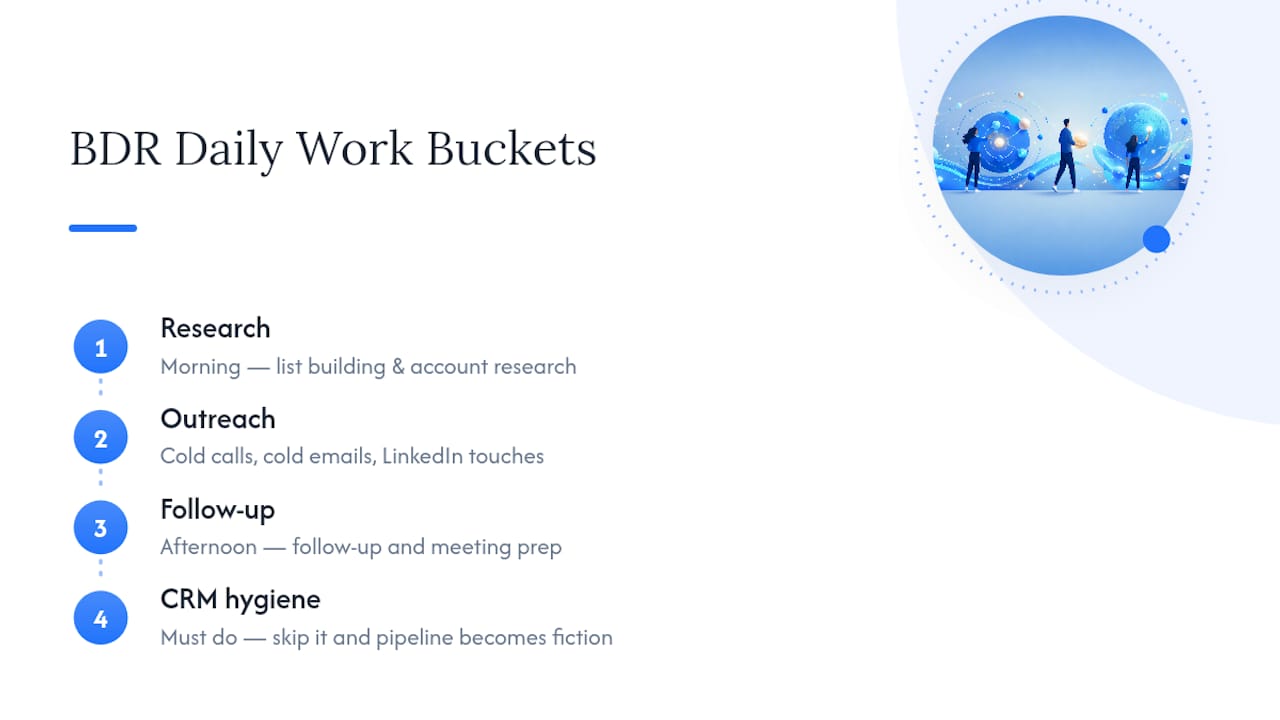
Morning usually starts with list building and account research, figuring out who at a target company actually feels the pain your product solves. Then it’s outreach: cold calls, cold emails, LinkedIn touches, sometimes all three on the same account in the same week. Afternoons are follow-up and meeting prep. Every hour not spent talking to a prospect or logging what happened is an hour you’re not getting your money’s worth.
Realistic weekly targets for an early-stage BDR usually involve dozens to low hundreds of outbound touches, a moderate number of live conversations or meaningful replies, and a few meetings booked, depending on deal size and how narrow your ICP is.
The tech stack doesn’t need to be fancy. A CRM (HubSpot or Salesforce, pick one and stick with it), a sequencing tool for email cadences, and call recording so you can actually coach instead of guessing. Some BDR/SDR guides for startups note that AI now handles a meaningful chunk of the grunt work, list enrichment, first-draft emails, sequencing logic. That’s true. But a 2026 breakdown of BDR responsibilities is clear that humans still need to own Tier 1 accounts and live calls. Don’t let anyone sell you on full automation for your best prospects.
Pro Tip: If your BDR can’t tell you which three accounts they’re prioritizing this week and why, you don’t have a strategy. You have activity.
BDR vs. SDR vs. AE: Who Does What at an Early-Stage Company
Titles get sloppy at startups, and honestly, that’s fine early on. But know the difference before you write a job post.
- BDR: Hunts cold accounts. Proactive, resilient, comfortable with rejection all day long.
- SDR: Qualifies inbound leads. Reactive, more process-driven, less thick-skinned by necessity.
- AE: Closes what the BDR or SDR hands off. Runs the demo, negotiates, signs the deal.
The temperament gap between BDRs and SDRs is real, and it’s why hiring the wrong personality for the wrong role kills a lot of first hires fast. A BDR who hates cold calling is a bad BDR no matter how sharp they are on paper.
Decision rule: if you have real inbound volume, hire SDR-first. If you have almost none, hire outbound-first. If you’re under $5 million in ARR or getting fewer than 30 inbound leads a month, most startup hiring guidance points to one hybrid rep doing both. Combine the roles and your comp plan needs to reflect blended output, not a pure outbound quota.
What KPIs Actually Tell You a BDR Is Working
Track five numbers: touches, connection rate, meetings booked, AE acceptance rate, and pipeline dollar value from cold sources.
Touches matter less than what they produce, but if the volume isn’t there, nothing downstream will be either. Connection or reply rates in the 5% to 15% range are typical depending on channel and how tight your targeting is. Meetings booked per month should land somewhere in the single digits to low double digits, commonly cited around 8 to 15 for a ramped rep, depending on deal complexity.
The Math That Matters: 80 touches a week produces roughly 15 to 20 conversations, which produces 3 to 5 meetings, which (at a 60% AE acceptance rate) produces 2 to 3 real opportunities. Multiply that by your average deal size and you’ve got a monthly pipeline number. If the math doesn’t clear your CAC targets, something upstream is broken, not just the rep.
Guardrails worth setting:
- AE acceptance rate substantially below typical expectations usually indicates bad targeting rather than a bad BDR
- A sharp drop in connection rates often signals a messaging problem rather than an effort issue
- Flat pipeline value over time typically suggests the ICP needs refinement, not problems with the rep
A KPI framework built for SaaS sales teams gives you a fuller set of benchmarks if you want to build out a scorecard beyond these five numbers.
How to Hire a BDR Who Actually Sells
Most founders hire BDRs the way they hire everyone else: gut feel, a good vibe in the interview, maybe a reference call if they’re feeling thorough. That’s how you end up firing someone in month four.

Here’s what actually predicts success. Look for evidence of self-sourced pipeline in a past role, not just “hit quota.” Anyone can hit quota with warm leads handed to them. Look for coachability, meaning they took feedback in a past job and changed behavior, not just nodded along. Look for resilience they can describe specifically, not generically. And look for commercial judgment: can they explain why a prospect said no in business terms, not just “they weren’t ready”?
Interview questions that separate real hunters from pretenders:
- “Walk me through the last cold account you turned into a meeting, start to finish.”
- “Tell me about a stretch where your numbers were bad. What did you change?”
- “How do you decide which accounts to prioritize when your list has 200 names on it?”
- “What’s the worst objection you get on cold calls, and what do you say back?”
- “Describe a time a manager gave you feedback you didn’t want to hear.”
- “How do you research a company before you call them?”
- “What does a good week look like for you, in numbers?”
Listen for specifics. Vague answers about “building relationships” or “being persistent” without a concrete story behind them are a red flag every time.
Here’s a job description snippet you can steal and adjust:
“We’re hiring a Business Development Representative to build our outbound pipeline from scratch. You’ll research target accounts, run multichannel outreach, and book qualified meetings for our Account Executive team. This is a hunter role: no inbound leads, no warm handoffs. You’ll own your list, your cadence, and your numbers.”
Build a simple scorecard before you interview anyone: rate each candidate 1 to 5 on self-sourcing evidence, coachability, resilience, and commercial judgment. A written scorecard reduces early churn because it forces you to compare candidates against criteria instead of vibes. Cornerstone’s job description templates for SaaS sales roles can save you the drafting time if you want a fuller starting point.
Pro Tip: If a candidate can’t name a single account they lost and explain exactly why, they haven’t done enough real outbound to know what failure teaches you.
Building a BDR Playbook and a 30-60-90 Ramp Plan
A playbook is not a slide deck. It’s the operating manual your BDR uses when you’re not in the room.
The skeleton needs five pieces: your ideal customer profile, written messaging templates for email and cold calls, a defined outreach cadence, an objection library with actual scripted responses, and clear handoff rules for when a meeting becomes an AE-qualified opportunity.
Here’s a realistic 30-60-90:
- Days 1 to 30: Product training, ICP study, shadow calls, CRM setup. Expect almost zero meetings booked. This is infrastructure time, and treating it as underperformance is the fastest way to lose a good hire before they’ve had a chance.
- Days 31 to 60: Live outreach begins. Messaging gets refined based on what’s landing and what isn’t. Expect a messy middle where reply rates are inconsistent and the ICP gets sharpened in real time.
- Days 61 to 90: Cadence stabilizes. Meetings become more predictable. By day 90 you should see the rep hitting 60% to 80% of steady-state activity targets.
This mirrors what a detailed guide to hiring your first BDR lays out: infrastructure first, a messy learning phase second, predictable pipeline months later, not weeks.
A sample cadence: touch 1 (email), touch 2 (LinkedIn connection), touch 3 (call plus voicemail), touch 4 (email with new angle), touch 5 (call), repeat over 10 to 14 business days. A founder playbook on scaling business development teams covers similar cadence design if you want a second reference point.
Weekly coaching checklist: review five recorded calls, check CRM notes for completeness, walk through the current week’s target account list, and ask what objection came up most.
Pro Tip: Never judge a new BDR’s success by meetings booked in month one. Judge it by whether the infrastructure work actually got done.
Compensation, Quota, and Career Paths for Startup BDRs
Pay a startup BDR too little and you get someone who leaves the moment a better offer shows up. Pay them the wrong mix and you get someone chasing activity instead of outcomes.
A common structure is a base-heavy split, something like 65% base to 35% variable, tied to meetings booked and pipeline accepted by AEs. Because a BDR controls their own prospecting activity more directly than an SDR controls inbound flow, comp design can lean more variable for BDRs than for SDRs, whose output depends on marketing’s lead flow.
Quota realism matters more than quota size. Expect near-zero output in month one, partial ramp through months two and three, and full quota expectations by month four to six. Breakeven on a first BDR hire often lands five to seven months in, not sooner.
Budget for that runway before you make the hire, not after you’re panicking about it.
The best BDRs don’t stay BDRs. Most move to AE within 12 to 18 months if they’re performing. Some move into more strategic outbound roles, others into customer success or sales ops if their strengths lean analytical. Keep top performers by giving them a visible path, not vague promises. A rep who sees no AE seat opening up will leave for one that offers it.
The Mistakes That Kill BDR Hires (And How to Fix Them)
Most bad BDR hires fail for the same handful of reasons, every time.
- Hiring for hustle, not fit. A high-energy interview isn’t evidence of self-sourcing skill. Fix: require a specific pipeline story, not just enthusiasm.
- No documented ICP. The rep is guessing who to call. Fix: write the ICP before you post the job.
- No playbook. The rep is inventing messaging on the fly. Fix: build templates and a cadence before day one.
- Misaligned comp. Paying heavily on activity instead of outcomes breeds busywork. Fix: tie variable pay to AE-accepted meetings, not raw call counts.
- Judging too early. Firing in month one because meetings are low. Fix: separate infrastructure ramp from performance ramp.
- No handoff rules with AEs. Meetings get booked, then die in a black hole. Fix: define what makes a meeting “qualified” before the first one happens.
- Skipping the scorecard. Hiring on gut feel. Fix: score every candidate against the same written criteria.
When-to-fire signals: after 90 days of full ramp, activity is consistently below 50% of target, reply rates show no improvement despite coaching, or the rep can’t articulate why a deal was lost. At that point, run a 30-day performance improvement plan with written weekly targets. If nothing moves, move on. A look at why startups struggle to hire salespeople covers more of these patterns if you want the fuller list.
When It’s Time to Bring in a Specialist Recruiter
Three signals tell you it’s time to stop doing this yourself. You need the hire fast and can’t afford three more months of a bad one. You’re hiring for a niche profile (SaaS-specific outbound experience, a particular vertical) that’s hard to source through job boards alone. Or you simply don’t have internal hiring capacity to run a real screening process on top of everything else you’re doing.
A good search does three things: delivers a vetted shortlist instead of a pile of resumes, cuts your time-to-offer dramatically, and reduces the risk of a bad hire burning your runway and your team’s trust.
That’s the specific gap Cornerstone Search Associates fills. We specialize in SaaS and software sales hiring, including BDR and outbound roles, and our process is built around speed without cutting corners on screening. Working with a specialist recruiter typically means real candidates within days, not weeks of dead air. Cornerstone’s work with venture-backed startups has shaped how we screen for exactly the traits covered above: self-sourcing evidence, resilience, and commercial judgment.
- Speed required and you can’t burn another quarter on a bad hire
- Niche profile that’s hard to source alone
- No internal recruiting capacity to run the process right
The Ramp Everyone Underestimates
Founders always underestimate how long a BDR takes to become productive. Every single time.
- The first month looks like nothing is happening. That’s normal, not a red flag.
- Cold outbound doesn’t work like inbound. Stop comparing the two.
- A rep with no playbook is not a rep, they’re a guess with a quota attached.
- The best BDRs get restless fast. Have a path to AE ready before they ask for one.
Build the system before you hire the person. That’s the whole game.
Get a Precise BDR Hire Without Burning a Quarter on the Wrong One
You’ve read what a good BDR does, what to pay them, and how to ramp them. The hard part isn’t knowing this, it’s finding someone who actually fits the profile before your runway takes the hit of a bad hire.
Cornerstone Search Associates runs SaaS sales searches with an average time from kickoff to offer acceptance of 21 days. We’ve placed over 1,200 sales professionals since 1996, and BDR and outbound hires are a core part of that track record. Instead of sorting through a stack of resumes yourself, you get a shortlist that’s already been screened against the exact traits that predict outbound success: self-sourcing history, resilience, and commercial judgment. If you’re staffing a BDR role right now, or the AE seat that role feeds into, start with Cornerstone’s software sales recruitment service and get a shortlist built around your actual ICP, not a generic template.