

Yes. Structured interviews prevent mis-hires, but only when you build them right. The evidence is not subtle. Meta-analytic research shows structured interviews deliver substantially higher corrected validity than unstructured conversations, and that gap is the difference between a VP Sales who hits number and one who torches your pipeline for six months before you admit the mistake.
What actually works comes down to four things:
- Standardized questions asked the same way to every candidate
- Behaviorally anchored rating scales (BARS) that define what a “3” actually looks like
- Independent multi-rater scoring, submitted before anyone talks
- Behavioral and situational questions tied to real job outcomes, not personality quizzes
Your next step this week: pick one open sales role and write five behavioral questions mapped to the outcomes that role needs to hit in the first six months. That is the whole starting point.
Pro Tip: A “structured” interview is not five interviewers riffing off the same job description. If your panel isn’t scoring identical questions against written anchors, you’re running a chat with extra steps. Call it what it is.
Key Takeaways
Structured interviews reduce mis-hires because standardized questions, BARS, independent scoring, and behavioral questions together produce evidence-based decisions instead of gut calls.
| Point | Details |
|---|---|
| Structure beats charisma | Corrected validity for structured interviews runs roughly 0.42 to 0.51 versus 0.19 to 0.38 for unstructured chats. |
| Four features or nothing | Standardized questions, BARS, independent scoring, and behavioral questions must all be present to get the predictive edge. |
| Score before you talk | Independent scoring before the panel debrief is the single cheapest fix for groupthink and bias. |
| Job analysis comes first | Structure without a valid job analysis just measures the wrong thing more precisely. |
| Get expert help for revenue roles | Cornerstonesearch builds and runs structured, calibrated interview loops for SaaS sales hires, with placements averaging 21 days from kickoff to offer. |
Table of Contents
- What Is A Mis-Hire And Why It Wrecks Your Numbers
- What The Research Says About Predictive Validity
- The Four Features That Deliver The Predictive Edge
- Building A Structured Interview That Actually Works
- How Structure Cuts Through Hiring Bias
- Where Structured Interviews Fail Or Backfire
- Measuring Whether Your Structured Interviews Are Working
- Copy-Paste Tools: Questions, BARS, And A Launch Checklist
- Rich Rosen’s Practical Take: What Actually Kills Sales Hires
- How Cornerstone Search Associates Helps You Avoid The Next Mis-Hire
- Frequently Asked Questions
- Sources
What Is A Mis-Hire And Why It Wrecks Your Numbers
A mis-hire isn’t just someone who quits. It’s anyone who fails to hit the performance bar, leaves inside twelve months, or drags the team down while they’re still on payroll. In SaaS sales terms, that means missed quota, blown ramp time, and a manager who now spends half their week coaching someone who was never going to make it.
I’ve watched this movie a hundred times. You hire a VP Sales who interviews like a closer. Great stories. Big logos on the resume. Six months in, the pipeline is thin, forecasts are wrong every quarter, and the reps under him are quietly interviewing elsewhere. He could talk about deals. That’s not a bad apple. That’s a bad hire, and it was preventable at the interview stage if anyone had scored him against real evidence instead of vibes.
The costs compound fast. A mis-hire in a revenue seat doesn’t fail quietly. It shows up in:
- Missed quota that ripples into board-level forecasting misses
- Longer time-to-ramp for the team around them, because a weak leader can’t coach
- Rep attrition, since good salespeople leave bad sales leaders fast
- Executive distraction, because now the CRO is managing a manager instead of the business
The cost of a bad senior sales hire routinely runs into six figures once you count recruiting spend, lost pipeline, severance, and the opportunity cost of a territory sitting dead for a quarter. That number gets worse the higher up the org chart you go, because the blast radius grows.
Watch for these signals early, before you’re six months deep and stuck:
- Ramp milestones missed in the first 60 to 90 days
- Pipeline coverage ratio dropping instead of building
- Early attrition on the team reporting to the new hire
- Forecast calls that are consistently wrong in one direction
None of this is mysterious. It’s what happens when you hire on charisma instead of evidence.
What The Research Says About Predictive Validity
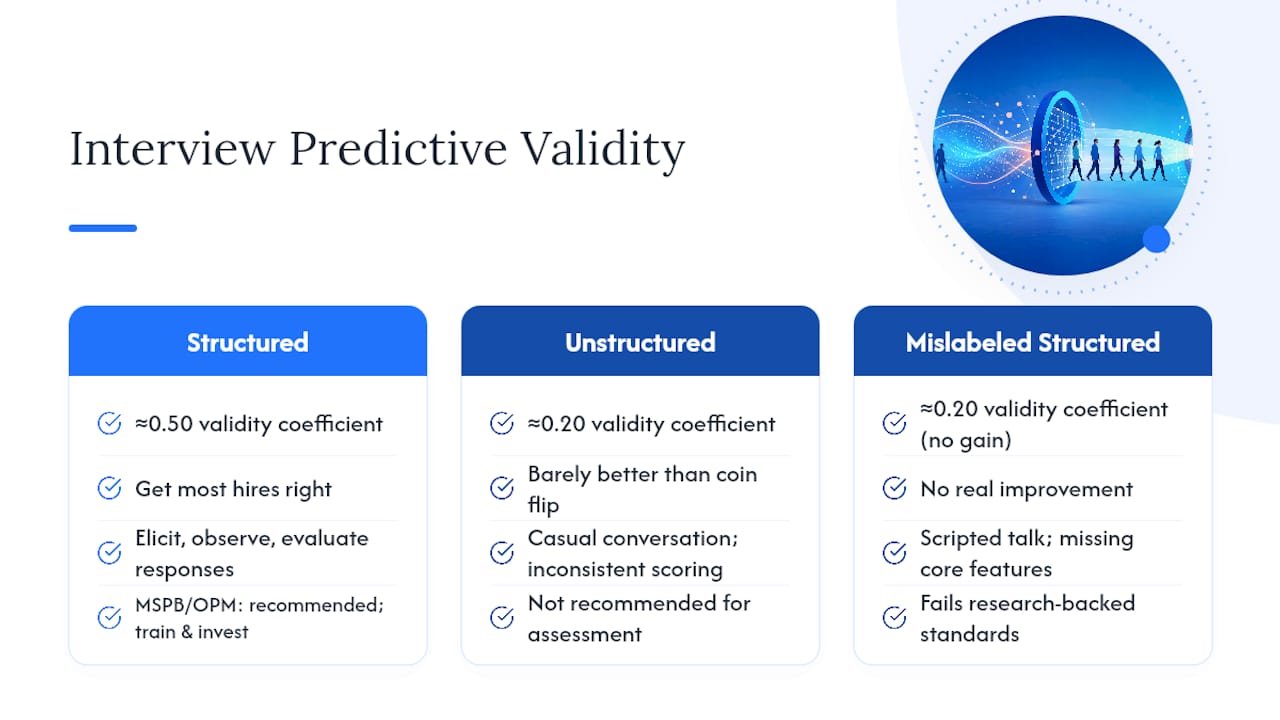
Here’s the number HR teams remember, and rightly so: structured interviews show substantially higher validity coefficients than unstructured interviews, roughly about twice as predictive of actual job performance.
Translate that into hiring math. Validity coefficients aren’t magic. They tell you how well interview performance correlates with later job performance. A coefficient near 0.50 means interview scores are doing real predictive work. A coefficient near 0.20 means you’re barely better than flipping a coin dressed up in a suit. If you’re running twenty sales hires a year, moving from unstructured to structured interviewing is the difference between guessing right on a handful of hires and getting it right most of the time.
The Merit Systems Protection Board reviewed federal hiring practices and reached a blunt conclusion: agencies should use structured interviews whenever the interview is meant to assess candidates, and they should invest in both the tool and interviewer training to get the benefit. That’s not theory from a consulting deck. That’s a government body looking at decades of hiring outcomes and telling agencies to stop winging it.
The Office of Personnel Management backs this up with a working definition: structured interviews use rules for eliciting, observing, and evaluating responses. That structure is what increases interviewer agreement and produces hiring decisions you can actually defend later, whether that’s to a CFO asking why the last VP Sales hire flopped or to a candidate who wants to know why they didn’t get the offer.
A few caveats matter here. First, McDaniel’s meta-analysis found that validity depends heavily on interview content and degree of structure. Structure isn’t a single switch. It’s a spectrum, and the studies showing the biggest gains used interviews with real rigor behind them.
Second, and this is the part people skip: a mislabeled “structured” interview that’s missing the core features doesn’t get you the research-backed advantage. Slapping a script on a conversation and calling it structured is like calling a spreadsheet an ATS. Same category, different results.
The Four Features That Deliver The Predictive Edge
Implementing one or two of these features gets you partial credit. All four together is where the real predictive gain shows up.
Standardized questions. Every candidate for the role gets the same core questions, in roughly the same order. This kills the “we just clicked” interview where one candidate gets grilled on churn math and another gets thirty minutes of golf talk. Bad version: an interviewer improvising questions based on gut feel. Good version: a fixed question bank tied to the competencies the role actually requires.
Behaviorally anchored rating scales. BARS spell out what a 1, 3, or 5 score actually looks like in observed behavior, not vague impressions. Bad version: “rate their sales acumen, 1 to 5.” Good version: a 5 anchor that reads “candidate walked through a specific deal, quantified the discovery process, and named the exact objection that almost killed it.” Anchors turn scoring from opinion into evidence.
Independent multi-rater scoring. Every interviewer scores separately, before anyone compares notes. This is the single most skipped step, and it’s the one that kills groupthink. Bad version: the panel chats in the hallway before submitting scores, so the loudest voice sets the anchor for everyone else. Good version: scores go into the system first, discussion happens after.
Behavioral and situational questions. Ask what someone actually did, or what they would specifically do in a defined scenario, not hypotheticals about their philosophy of selling. Bad version: “What’s your sales philosophy?” Good version: “Walk me through a deal you lost to a competitor in the last quarter, and tell me exactly where it slipped.”
Run this quick check on your current loop:
- Do all interviewers ask the same core questions?
- Do you have written anchors defining each score level?
- Does everyone score independently before the debrief?
- Are your questions asking about real past behavior or hypothetical opinions?
Pro Tip: If your answer to any of those is “sort of,” you don’t have a structured interview yet. You have a nicer conversation. Fix one component at a time, starting with independent scoring. It’s the cheapest fix with the biggest bias payoff.
Building A Structured Interview That Actually Works
Here’s how to build this without losing three months to committee meetings.
-
Do a tight job analysis. Sit down with the hiring manager and pin down three to five non-negotiable competencies tied to what this person must accomplish in their first six months. For a SaaS AE, that might be pipeline generation, discovery rigor, and forecast accuracy. Not “team player.” Not “self-starter.” Real, observable outcomes.
-
Write questions mapped to those competencies. For each competency, write one or two behavioral questions (“Tell me about a time you rebuilt a dead pipeline”) and one situational question (“A champion goes dark two weeks before close, what do you do?”). Keep two or three probes ready for each, like “what was the exact result” or “what would you do differently.”
-
Build your BARS. For pipeline generation, a rough five-point anchor set might run: 1, no concrete method described; 3, describes a repeatable prospecting cadence with some metrics; 5, describes a specific, quantified pipeline-building system with a track record of hitting targets across multiple roles.
-
Set panel and scoring rules up front. Every interviewer scores independently right after their interview, before talking to anyone else on the panel. The debrief happens after scores are locked. No one is allowed to say “I really liked him” before the numbers are on the table. That single rule stops more bad hires than any amount of extra interviewing.
-
Sequence with other tools. Structured interviews work better paired with a work sample, like a mock discovery call or a live deal review, especially for senior roles. Put the work sample early in the process, before candidates have had time to over-rehearse their pitch for your specific panel. Reference checks come last, after you already have a strong signal, not as your primary filter.
-
Build a simple timeline. Recruiter owns sourcing and screen scheduling in week one. Hiring manager and panel lead finalize competencies and questions in week one, run calibration in week two, and start live interviews in week three. A data owner, often someone in HR or ops, tracks scores and outcomes from day one so you have something to audit later.
-
Launch day checklist. Confirm every interviewer has the question bank and BARS in hand. Confirm scoring goes into a shared, timestamped system, not a notepad. Confirm the debrief agenda starts with reviewing locked scores, not open discussion.
One statistic worth remembering here: structured scorecards tied to specific competencies, combined with calibration sessions, measurably improve inter-rater agreement. Calibration isn’t optional overhead. It’s the step that makes your scores mean the same thing across five different interviewers.
Pro Tip: Budget 15 extra minutes per interview slot the first month you run this. Structured interviewing takes more prep than a free-flowing chat. Anyone who tells you it’s faster is selling you something.
How Structure Cuts Through Hiring Bias
Unstructured interviews are a playground for bias, and not the kind anyone admits to on purpose. Halo effect makes one strong answer color your read on everything else. Similarity bias makes you warm up to the candidate who reminds you of yourself at 28. First-impression bias locks in an opinion in the first ninety seconds, and everything after just confirms it. None of this requires bad intent. It’s just how brains work under time pressure with incomplete information.
Structure blunts all three by forcing evidence over impression. A few tactics that actually move the needle:
- Score each answer immediately against the written anchor, not against your gut read of the whole conversation
- Submit scores independently before any panel discussion happens
- Keep every probe question tied to the competency being assessed, nothing tangential
- Limit access to ancillary information (social profiles, unrelated chit-chat topics) that has nothing to do with job performance
Bias isn’t only a fairness problem. It’s a signal-quality problem. The NPR reporting on resume bias shows how names and backgrounds skew initial screening decisions long before an interview even happens. Structured interviews won’t fix a biased pipeline upstream, but paired with job-relevant controls, they stop that bias from compounding at the one stage where you actually have direct control over the questions and the scoring.
Candidates notice the difference too. Research on candidate reactions consistently shows candidates rate structured processes as fairer and more professional. That matters more in SaaS sales than almost anywhere else, because your best AEs and sales leaders are getting three other offers. A sloppy, inconsistent interview loop loses top talent to a competitor who runs a tighter process. If you want a deeper look at how gut-based decisions creep into hiring, our piece on cognitive bias in hiring decisions walks through the mechanics.

Pro Tip: Run a quarterly audit on rejection rates by interviewer. If one panelist consistently scores everyone from a certain background lower, you’ve found a bias leak, not a coincidence.
Where Structured Interviews Fail Or Backfire
Structure isn’t magic armor. It fails in predictable ways, and most of them come down to people cutting corners on the parts that don’t feel urgent.
The common mistakes I see on repeat: calling a loosely scripted conversation “structured” without real anchors behind it; skipping calibration so five interviewers score the same answer three different ways; scoring at the end of the day from memory instead of writing it down question by question; using anchors that describe personality traits instead of job behavior; and leaning so hard on canned behavioral questions that candidates who’ve simply memorized the STAR method sail through without real substance behind their answers.
Structure also isn’t a shortcut. It takes more prep time than an unstructured chat, and teams who skip that prep get a worse version of both worlds: the rigidity without the reliability. Structured interviewing takes real prep, and budgeting extra minutes per interview to probe multiple competencies properly is part of the deal, not a nice-to-have.
For senior or high-stakes hires, an interview alone, however well structured, can still let a rehearsed narrative outscore real operating capability. Pairing interviews with work samples or a live case study for VP-level and CRO-level roles catches the gap between a great story and a great operator.
The biggest false economy in structured interviewing is building beautiful scorecards on top of a job analysis nobody actually did. Structure without a valid understanding of what the job requires just gives you a well-organized way to measure the wrong thing.
Score the wrong competencies precisely, and you still hire the wrong person. Just with better paperwork to explain why.
Measuring Whether Your Structured Interviews Are Working
You don’t need a data science team to audit this. You need four or five numbers, tracked consistently, reviewed on a schedule.
Track the average score each interviewer gives across candidates, so you can spot anyone who’s systematically harsh or systematically soft. Track inter-rater reliability, meaning how closely independent scores agree on the same candidate; wide gaps mean your anchors aren’t clear enough or your calibration slipped. Track pass rates by demographic slice to catch bias creeping back in. And track the real prize: performance delta at six months for structured-interview hires versus your historical baseline before you made the change.
| What to collect per hire | Why it matters |
|---|---|
| Individual interviewer scores by competency | Shows scoring drift and calibration gaps |
| Final panel decision and rationale | Creates an auditable record for defensibility |
| Ramp milestone status at 30/60/90 days | Early signal on whether the hire is tracking to plan |
| Six-month performance vs quota or KPI | The real test of whether the interview predicted anything |
Run a 30-day quick check after any hiring loop, just eyeballing whether scores and outcomes look reasonable. Run a 90-day outcome review comparing early performance signals against interview scores. Do a full calibration refresh annually, because competencies drift as your product and market change. A resource like analytics-driven retention tracking can help extend this audit trail into what happens after the hire, connecting interview signal to actual retention outcomes.
Copy-Paste Tools: Questions, BARS, And A Launch Checklist
Here are assets you can drop into your scorecard tomorrow.
Sample behavioral stems for SaaS sales roles: “Tell me about the largest deal you closed in the last year, start to finish, including where it almost died.” “Describe a quarter where you missed quota. What did you do about it in the following ninety days?” “Walk me through how you handled a champion who lost internal power mid-deal.”
What’s your move?" “Your biggest account’s champion just left the company. What do you do in the first 48 hours?”
A compact BARS example for the competency “pipeline discipline”:
- 1: No consistent method for building or tracking pipeline; relies on inbound leads only
- 2: Some prospecting activity but inconsistent cadence, no clear metrics
- 3: Runs a repeatable outbound cadence with basic tracking of activity-to-meeting conversion
- 4: Runs a documented, metrics-driven prospecting system with clear conversion benchmarks
- 5: Built and scaled a prospecting system across a team, with a track record of consistently exceeding pipeline coverage targets
Quick launch checklist:
- Job analysis complete, competencies signed off by hiring manager
- Questions written and mapped to each competency
- BARS anchors drafted and reviewed by at least two people
- Calibration session run with the full panel using a sample transcript
- Scoring system live and tested before the first real candidate
For senior roles, add a work sample before the final round. For junior SDR or AE roles, the structured interview loop alone, done well, usually carries most of the signal you need. A SaaS sales job description template is a solid starting point for translating the job analysis step into something you can hand a panel on day one.
Rich Rosen’s Practical Take: What Actually Kills Sales Hires
Three things I tell every hiring manager who thinks they’re too busy to build a real process. Do your job analysis before you write a single interview question, not after. If you skip it, you’re scoring people against a job that doesn’t exist. Pair your interview with a work sample for anything above an AE level. Talk is cheap and closers know how to talk. Set a pass bar and actually enforce it, even when the candidate is charming and the req has been open for four months.
I’ve seen more sales leader mis-hires from “we liked him” than from any bad resume. Charisma gets people hired. Structure is what tells you whether they can actually run a number. The teams that build a real structured process stop repeating the same six-month mistake on a loop.
How Cornerstone Search Associates Helps You Avoid The Next Mis-Hire
Building a structured interview loop from scratch takes real time, and most SaaS companies don’t have a spare month to build BARS anchors while a sales seat sits empty. Cornerstonesearch runs the structured process for you: job analysis, competency-mapped scorecards, calibrated panel scoring, and work-sample loops built specifically for sales, presales, and revenue leadership roles.
That process is why Cornerstonesearch moves from search kickoff to offer acceptance in an average of 21 days, without cutting the rigor that catches a mis-hire before it costs you a territory. Since 1996, that approach has placed more than 1,200 sales professionals for SaaS and software companies who needed the right hire the first time, not the third. If you’re hiring a VP Sales, CRO, or Account Executive and want a process built on evidence instead of gut feel, check out Cornerstone’s software sales recruitment service and get a search started this week.
Frequently Asked Questions
Does the role of structured interviews in preventing mis-hires actually hold up across industries, or just for federal jobs?
The federal research is some of the most rigorous public data available, but the core mechanism (standardized, evidence-based scoring beats gut feel) applies anywhere hiring decisions get made, including SaaS sales, where deal-story charisma routinely masks weak operating skill.
How long does it take to build a structured interview loop from scratch?
Plan on two to three weeks for a single role: one week for job analysis and question writing, a few days for BARS and calibration, then launch. Rushing calibration is the step most teams regret skipping.
Can a small company without an HR team run structured interviews?
Yes. A hiring manager and one panelist can run this with a shared scorecard and written anchors. The rules matter more than the headcount running them.
Do structured interviews slow down hiring for competitive SaaS sales roles?
Prep takes longer upfront, but the loop itself doesn’t add extra rounds. Most teams find it actually speeds up decision-making because scores are already documented instead of debated from memory in a meeting.
What’s the biggest sign an interview loop is structured in name only?
Interviewers comparing notes and reaching a “consensus feeling” before anyone has submitted an independent score. That single habit undoes most of the bias-reduction benefit structure is supposed to deliver.
Sources
The evidence and measurement sections lean on four sources worth reading directly if you want to go deeper.