

A SaaS sales job description template is a structured blueprint that defines role responsibilities, success metrics, and team context to attract and evaluate high-performing sales professionals. Without a precise template, hiring managers at SaaS companies risk attracting misaligned candidates, extending ramp times, and driving early turnover. The difference between a generic sales posting and a purpose-built SaaS sales job description template is the difference between 90 applicants and 9 qualified ones. This guide covers the core roles to document, how to adapt your template to your team structure, and the mistakes that quietly sabotage SaaS sales hiring.
What core roles and responsibilities belong in a SaaS sales job description?
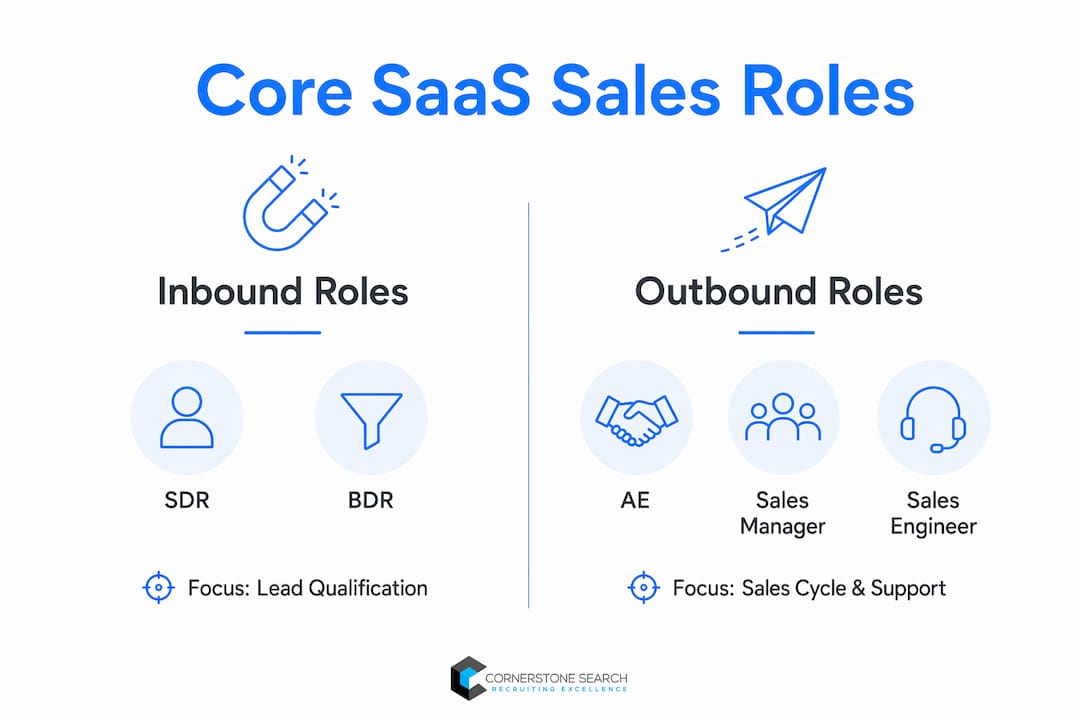
Every SaaS revenue team structure includes four primary roles, and each requires its own distinct job description. Conflating them or copying responsibilities across roles is one of the fastest ways to attract the wrong candidates.
Sales development representative (SDR) and business development representative (BDR)
SDRs focus on qualifying inbound leads and booking discovery meetings. BDRs typically work outbound, prospecting into target accounts. Both roles are measured on meetings booked, pipeline generated, and sequence activity. Your job description for either role should specify whether the motion is inbound, outbound, or blended, because candidates optimize their careers around one or the other.
Account executive (AE)
AEs own the full sales cycle from discovery through close. Their responsibilities include running product demos, managing multi-stakeholder deals, writing proposals, and negotiating contracts. Success metrics for this role center on quota attainment, average contract value, and win rate. The SaaS sales role overview for an AE must also specify the market segment, because SMB AEs close dozens of deals per quarter while Enterprise AEs may close fewer than ten.

Sales manager
Sales managers coach reps, run forecast calls, and own team quota. Their job description should include direct report spans. SDR manager spans of 6–10 reports are healthy, while Enterprise AE managers perform best with 4–7 direct reports. Exceeding these ranges reduces coaching quality and increases attrition.
Sales engineer
Sales engineers support AEs during technical evaluations. Their responsibilities include solution design, proof-of-concept management, and RFP responses. This role sits at the intersection of product knowledge and sales execution. Leaving it out of your SaaS sales team structure documentation creates confusion about who owns technical objections during a deal.
Pro Tip: List 3–5 specific outputs for each role, not just activities. “Books 15 qualified meetings per month” is more useful to a candidate than “responsible for prospecting.”
How do you tailor a SaaS sales job description template to your team structure?
The right sales position description template depends on your company’s growth stage, ARR, and the sales model you operate. A template built for a 10-person startup will misrepresent reality at a 200-person scale-up.
SaaS companies scale their structures from full-cycle reps in the island model, to specialized roles in the assembly line model, to cross-functional pods as they reach enterprise maturity. Each model carries different expectations for autonomy, handoffs, and collaboration. A candidate who thrives in an island model may struggle in a pod where they share pipeline with an SDR, a customer success manager, and a solutions consultant.
The table below maps each model to the job description elements that matter most.
| Sales Model | Best Fit Stage | Key JD Elements to Specify |
|---|---|---|
| Island | Early-stage startup | Full-cycle ownership, self-sourcing expectation, high autonomy |
| Assembly Line | Scaling (Series A–C) | Handoff protocols, SDR-to-AE ratio, defined quota by segment |
| Pod | Enterprise or mature | Cross-functional teammates, shared metrics, longer deal cycles |
Staffing ratios also belong in your job description context. SMB teams carry a median AE-to-SDR ratio of 3.0:1, Mid-Market teams run 2.5:1, and Enterprise teams run 2.0:1. These ratios tell a candidate how much pipeline support they can expect. An Enterprise AE who joins expecting a 3.0:1 ratio and finds a 2.0:1 ratio will feel undersupported from day one.
Segment differences also shape SaaS account executive duties in concrete ways. SMB AEs need speed and volume. Mid-Market AEs need discovery depth and multi-threading skills. Enterprise AEs need executive presence and the patience to manage 6–18 month sales cycles. Enterprise roles require acknowledging these longer ramp times directly in the job description to prevent premature performance judgments.
Pro Tip: Add one sentence to your job description that names your operational model. “We run a pod structure where each AE partners with a dedicated SDR and a customer success manager” tells candidates more than a full paragraph of generic responsibilities.
What is the step-by-step process for writing a SaaS sales job description?
A strong sales job description follows a repeatable structure. The sections below represent the minimum viable framework for any SaaS sales role.
-
Define your sales motion first. Before writing a single word, confirm whether the role is inbound, outbound, product-led, or channel-assisted. The motion determines every downstream responsibility.
-
Write a role overview in three sentences. State the title, the market segment, and the primary success metric. Candidates decide whether to apply within the first 30 seconds of reading.
-
List responsibilities as outputs, not activities. “Manages a pipeline of $1.2M” is more precise than “manages pipeline.” Outputs attract candidates who are accountable for results.
-
Specify qualifications by tier. Separate required qualifications from preferred ones. Requiring 5 years of SaaS experience for an SDR role will eliminate strong candidates who are two years into their careers.
-
Include success metrics for the first 30, 60, and 90 days. This section sets realistic expectations and signals that your company has a structured onboarding process. Candidates at competitive SaaS talent markets use this section to evaluate whether a company knows how to ramp new hires.
-
State reporting lines and team structure. Name the role this position reports to and list any roles it manages or collaborates with. This prevents organizational confusion after the hire starts.
-
Review for legal compliance and inclusive language. Remove gendered language, avoid age-coded phrases like “digital native,” and confirm that any physical requirements are genuinely essential to the role.
The key skills for SaaS sales vary by role, but every job description should address CRM proficiency, discovery methodology, and the ability to navigate multi-stakeholder buying committees. These three competencies separate SaaS-ready candidates from general sales applicants.
What mistakes cause SaaS sales job descriptions to fail?
Misaligned ramp expectations, unclear role distinctions, and missing operational context are the three most common causes of avoidable hiring failures in SaaS sales. Each one is preventable with better documentation.
- Over-promising on territory or pipeline support. Writing “uncapped earning potential with full SDR support” when your SDR-to-AE ratio is 1:4 creates resentment before the first deal closes.
- Skipping the operational model. Specifying your team’s operational model in the job description reduces early tenure turnover by clarifying workflow and expected handoffs. Candidates who prefer autonomy will self-select out of pod structures when you name them explicitly.
- Setting quota expectations without ramp context. Listing a $1M annual quota without explaining that the first two quarters are ramp-protected misleads candidates about short-term pressure.
- Using identical job descriptions across segments. An SMB AE description recycled for an Enterprise AE role will attract the wrong profile. The sales job responsibilities differ enough that they require separate templates.
- Omitting the tech stack. SaaS candidates evaluate employers partly on tooling. Listing Salesforce, Outreach, Gong, or ZoomInfo signals operational maturity.
“The job description is the first test of whether your company understands its own sales process. Candidates who know what good looks like will read between the lines.”
Ambiguous writing compounds all of these problems. When a job description says “responsible for growth,” a candidate cannot determine whether that means new logo acquisition, expansion revenue, or both. Precision in language is not just a writing preference. It is a hiring filter.
Key takeaways
A precise SaaS sales job description template, built around your team’s operational model and market segment, is the single most effective tool for attracting qualified candidates and reducing early turnover.
| Point | Details |
|---|---|
| Define outputs, not activities | List measurable results like pipeline value or meetings booked, not generic tasks. |
| Name your operational model | Stating your Island, Assembly Line, or Pod structure reduces candidate misfit and early attrition. |
| Match the template to the segment | SMB, Mid-Market, and Enterprise AE roles require separate descriptions with distinct expectations. |
| Include ramp-time context | Enterprise roles need 6–18 month ramp acknowledgment to prevent premature performance judgments. |
| Use staffing ratios as context | Publishing your AE-to-SDR ratio sets accurate pipeline support expectations before the first interview. |
What i’ve learned after 30 years of SaaS sales recruiting
Most job descriptions I review are written backward. They start with what the company needs and end there. The best ones are written from the candidate’s perspective: what will this person own, who will they work with, and how will they know they are succeeding?
The rise of AI-driven SDR tools has changed this calculus in ways most hiring managers have not caught up with yet. AI tools are shifting traditional staffing ratios toward leaner teams, which means AEs are being asked to do more with less pipeline support. If your job description still promises robust SDR coverage but your team has adopted AI prospecting tools, you are creating a gap between expectation and reality before the candidate even starts.
The other pattern I see consistently is the underestimation of enterprise ramp time. Hiring managers write Enterprise AE job descriptions with quota expectations that assume a 90-day ramp. Then they fire the rep at month four for missing numbers that no one in a complex enterprise cycle could have hit. Enterprise hiring managers need to integrate extended ramp expectations directly into the job description, not just into the offer letter.
The companies that get SaaS sales hiring right treat the job description as a living document. They update it after every failed hire, every early departure, and every time the team structure changes. That discipline separates the companies that build great sales teams from the ones that are always recruiting.
For a deeper look at why SaaS hiring differs from traditional sales recruiting, the SaaS-specific hiring differences article covers the structural gaps that generic job descriptions miss.
— Rich Rosen
How Cornerstonesearch helps you hire the right SaaS sales talent
Building a precise job description is the first step. Finding the candidate who matches it is where most hiring teams lose time and momentum.
Cornerstonesearch has placed over 1,200 SaaS and software sales professionals since 1996, with an average time from search kickoff to offer acceptance of 21 days. The firm’s methodology is built around the same structural benchmarks covered in this guide, including segment-specific role scoping, ramp-time alignment, and operational model fit. If you are ready to move from a template to a hire, the SaaS sales recruitment guide is a strong next step. For direct support on an active search, Cornerstonesearch’s SaaS recruitment services are built for exactly this challenge.
FAQ
What is a SaaS sales job description template?
A SaaS sales job description template is a structured document that defines role responsibilities, success metrics, reporting lines, and team context for sales positions at software-as-a-service companies. It differs from a generic sales template by incorporating SaaS-specific elements like ARR quotas, sales motion type, and CRM requirements.
How do SDR and AE responsibilities differ in a SaaS job description?
SDRs are responsible for qualifying leads and booking meetings, while AEs own the full sales cycle from discovery through close. Each role requires a separate job description because the skills, metrics, and daily workflows are fundamentally different.
What ae-to-sdr ratio should i reference in a job description?
SMB teams run a median AE-to-SDR ratio of 3.0:1, Mid-Market teams run 2.5:1, and Enterprise teams run 2.0:1. Including this context in your job description sets accurate pipeline support expectations for candidates.
How long is the ramp time for an enterprise AE?
Enterprise AE ramp times typically run 6–18 months, and job descriptions should state this explicitly. Candidates who understand the ramp timeline are less likely to leave early when pipeline builds slowly in the first two quarters.
Should i list the sales tech stack in a SaaS sales job description?
Yes. Listing tools like Salesforce, Outreach, or Gong signals operational maturity and helps candidates self-assess their fit. It also reduces onboarding friction by setting expectations about the systems a new hire will use from day one.