

SaaS sales quota benchmarks are the industry-standard targets that define how much revenue a sales rep is expected to close, and they directly shape every hiring and compensation decision your team makes. Median quota attainment across B2B SaaS dropped from 39% in 2023 to 31% in 2025, a trend that forces sales leaders and HR professionals to rethink both quota design and talent acquisition. Getting saas sales quota benchmarks hiring right means understanding attainment rates, quota-to-OTE ratios, pipeline coverage, and ramp timelines before you post a single job description. Sources including Pavilion, The Bridge Group, and Gangly publish annual surveys that give you the numbers to build from.
What are the current SaaS sales quota benchmarks for 2026?
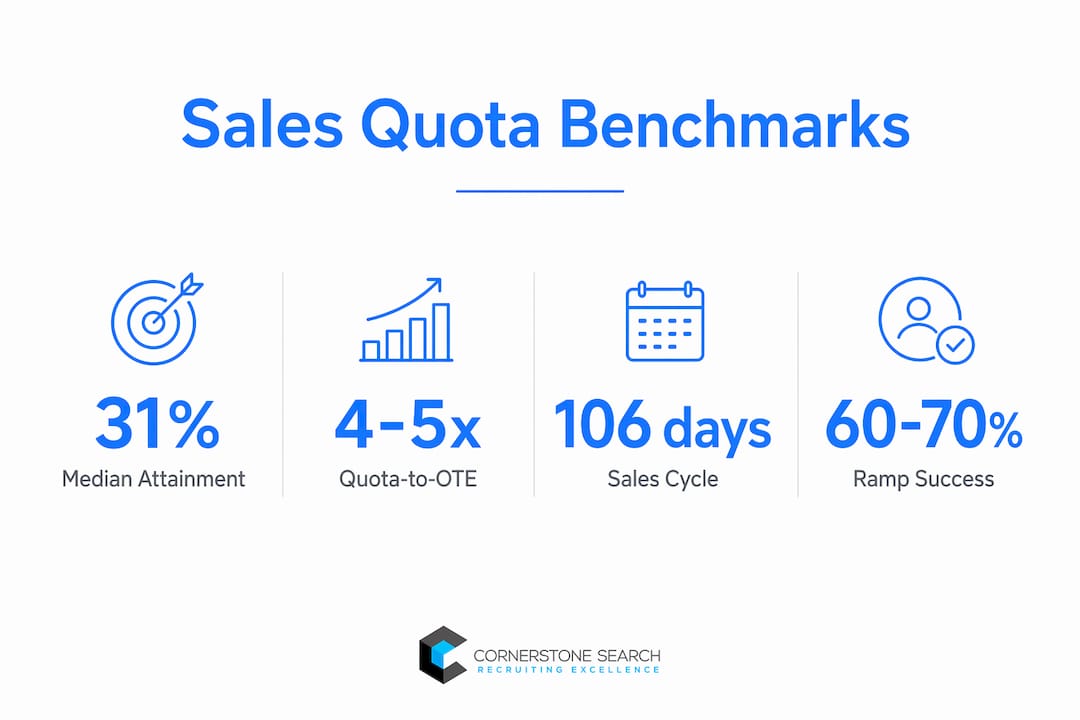
Median quota attainment across all B2B SaaS sits at roughly 31%, down from 39% just two years ago. That number tells you one critical thing: if fewer than one in three reps hits quota, the problem is often the quota itself, not the rep.
Quota-to-OTE ratios by role
The standard quota-to-OTE ratio is 4–5x for most SaaS AE roles and 5.5–6x for enterprise roles. A ratio above 6x is considered broken at median attainment levels. That means if your enterprise AE earns $200,000 OTE, a realistic annual quota sits between $1.1 million and $1.2 million. Push it to $1.5 million and you are setting that rep up to fail, which then shows up as a hiring problem when it is actually a math problem.

Sales cycle and pipeline coverage shifts
Sales cycle length increased from 92 days to 106 days between 2023 and 2025. Longer cycles mean reps carry fewer deals to close in any given quarter. Pipeline coverage requirements rose from 3x to 4x over the same period, reflecting the harder selling environment.
Segment benchmarks at a glance
| Segment | Quota-to-OTE ratio | Pipeline coverage | Avg. sales cycle |
|---|---|---|---|
| SMB AE | 4x | 3x–4x | 30–60 days |
| Mid-Market AE | 4x–5x | 4x–5x | 60–90 days |
| Enterprise AE | 5.5x–6x | 5x–6x | 90–180 days |
| SDR/BDR | Activity-based | N/A | N/A |
Pro Tip: If fewer than 60% of your reps hit quota in a given half, audit the quota design before you audit the hiring process. Low attainment is a quota signal as much as a talent signal.
How to align quota setting with SaaS sales hiring and ramp strategies
Ramp time is the period between a rep’s start date and the point when they carry a full quota. Getting this wrong is one of the most expensive mistakes in SaaS sales hiring.
Ramp time benchmarks by role break down as follows:
- SDR/BDR: 2–3 months to full productivity
- SMB AE: 3–4 months to full quota
- Mid-Market AE: 4–5 months to full quota
- Enterprise AE: 6–9 months to full quota
A graduated ramp quota structure works best. In months one and two, new hires carry no quota while they learn the product and process. Month three brings them to 25% of full quota. Month four moves to 50–67%. Month five reaches 75%. Month six and beyond means full quota. This progression reduces rep stress and builds confidence before the full target lands.
Structured onboarding accelerates ramp by 25–40% compared to unstructured programs. That is a meaningful difference. A mid-market AE who would otherwise take five months to ramp fully can be productive in three months with a well-designed onboarding program.
A healthy ramp program shows 60–70% of new hires hitting their ramp targets. If you fall below that range, the issue is either the ramp quota itself or the onboarding program, not necessarily the quality of your hires.
Pro Tip: During ramp, track pipeline build and deal progression weekly rather than waiting for closed revenue. A rep building a healthy pipeline in month two will almost always close in month four. Early indicators beat lagging ones.
Understanding why SaaS sales hiring differs from traditional sales is critical here. SaaS reps must understand product-led growth motions, subscription economics, and multi-stakeholder buying cycles. Those skills take longer to develop, which is exactly why enterprise ramp windows stretch to nine months.
How to use pipeline coverage and win rate data to set quotas
The 3x pipeline coverage rule is outdated for most SaaS teams. The correct formula is coverage = 1 divided by win rate.
Pipeline coverage should match your actual win rate, not a generic multiple. A team with a 25% win rate needs 4x coverage. A team with a 33% win rate needs 3x coverage. A team with a 20% win rate needs 5x coverage. Using the wrong multiple means your reps either burn out chasing too many deals or coast on too few.
Most quota-setting mistakes stem from applying a fixed 3x rule rather than calculating coverage from historical win rates. The fix is straightforward: pull your team’s actual win rate by segment, apply the formula, and build that number into your quota model.
Coverage needs also vary by deal complexity:
- SMB deals close faster and in higher volume, so a 3x–4x multiple is often sufficient.
- Mid-market deals involve more stakeholders and longer evaluations, pushing coverage to 4x–5x.
- Enterprise deals carry the longest cycles and lowest win rates, requiring 5x–6x coverage to hit quota reliably.
Re-calculating pipeline coverage by deal tier reduces ramp-induced quota mismatch and lowers hiring turnover. When reps know their pipeline target is grounded in real win rate data, they trust the number and work toward it.
Pro Tip: Tier your pipeline coverage targets by deal size and sales motion. A rep selling $10,000 ACV deals needs a very different pipeline than one selling $200,000 ACV deals, even if both carry the same annual quota.
What are best practices for hiring SaaS sales reps aligned to quota benchmarks?
Hiring to quota benchmarks means building your entire recruitment process around the performance expectations a rep will face on day one.
The first step is separating quota design problems from execution problems. Low median attainment around 31% signals that many SaaS companies are setting quotas too high relative to market conditions. Before concluding that a previous hire failed, verify that the quota was achievable in the first place.
Recruitment speed matters more than most sales leaders admit. The median time-to-hire for sales roles in the US is 44 days, with the application review to recruiter screen phase accounting for roughly 8 days on its own. Every week a territory sits empty costs you pipeline. Structured processes that reduce screening delays can shorten total time-to-hire by 30–50% for high-volume SDR and AE roles. Cornerstonesearch averages just 21 days from search kickoff to offer acceptance, cutting that 44-day median nearly in half.
A strong SaaS sales job description does more than list responsibilities. It communicates the quota expectation, the ramp timeline, and the OTE range. Candidates who self-select based on those numbers arrive better calibrated and are less likely to leave after six months when the full quota kicks in.
Continuous training after onboarding sustains quota achievement over time. Reps who receive regular coaching on deal qualification, objection handling, and pipeline management consistently outperform those who receive training only during onboarding.
Pro Tip: Use SaaS-specific interview questions to assess how candidates think about pipeline coverage, ramp expectations, and quota math. A rep who cannot explain their previous win rate or average deal size is unlikely to manage their pipeline effectively in your environment.
Key takeaways
SaaS quota attainment benchmarks, compensation ratios, pipeline coverage formulas, and ramp timelines must all align before a single hiring decision delivers its full return.
| Point | Details |
|---|---|
| Quota attainment is declining | Median B2B SaaS attainment dropped to 31% in 2025, signaling widespread quota design problems. |
| Use the right OTE ratio | Keep quota-to-OTE at 4–5x for most roles and 5.5–6x for enterprise to maintain realistic targets. |
| Calculate pipeline coverage correctly | Divide 1 by your actual win rate to set coverage multiples, not a fixed 3x rule. |
| Build ramp into hiring plans | Enterprise AEs need 6–9 months to ramp; factor that timeline into headcount and revenue forecasts. |
| Speed up hiring to protect pipeline | Reducing time-to-hire from 44 days to 21 days prevents territory gaps that destroy quarterly attainment. |
What I have learned from 30 years of SaaS sales hiring
The most consistent mistake I see sales leaders make is treating quota as a motivational tool rather than a mathematical output. They set a number that feels ambitious, then blame the hire when attainment falls short. The data backs this up. When fewer than one in three reps hits quota across an entire industry, the quota is the variable worth examining first.
The second mistake is underestimating ramp. An enterprise AE who needs nine months to ramp fully will not show up in your revenue numbers until month ten at the earliest. If your hiring plan does not account for that, you will be perpetually short on pipeline and perpetually blaming your recruiting process for a forecasting problem.
What actually works is building the quota model before writing the job description. Know your win rate, calculate your coverage multiple, set a quota-to-OTE ratio within the 4–6x range, and then design a ramp schedule that gives new hires a realistic path to full productivity. When you hire against that model, you attract candidates who understand the math and can execute within it.
The cross-functional piece matters too. Sales leaders who involve HR and finance in quota design from the start build more durable teams. HR understands compensation market rates. Finance understands revenue timing. Sales understands the field. All three inputs are necessary to set a quota that is both achievable and meaningful.
— Rich Rosen
How Cornerstonesearch helps SaaS teams hire to quota
Cornerstonesearch has placed over 1,200 sales professionals in SaaS and software companies since 1996, and every search is built around the quota and ramp realities the candidate will face from day one.

Sales leaders who work with Cornerstonesearch get candidates pre-qualified against the specific quota benchmarks, OTE structures, and ramp timelines their role demands. The average search closes in 21 days, which means your territory gap shrinks before it damages your quarter. For teams ready to build a winning sales recruitment process, Cornerstonesearch brings the network, the speed, and the SaaS-specific expertise to get the right rep in seat fast. Reach out to discuss your current hiring needs and quota targets.
FAQ
What is a SaaS sales quota benchmark?
A SaaS sales quota benchmark is an industry-standard revenue or activity target used to evaluate whether a rep’s assigned quota is realistic. Median B2B SaaS quota attainment sits at approximately 31%, making benchmarks a critical calibration tool for sales leaders.
What quota-to-OTE ratio is standard for SaaS AEs?
The standard quota-to-OTE ratio is 4–5x for most SaaS AE roles and 5.5–6x for enterprise AEs. Ratios above 6x are considered unrealistic at median attainment levels and typically signal a broken compensation plan.
How long does it take a new SaaS AE to ramp fully?
Ramp time ranges from 3–4 months for SMB AEs to 6–9 months for enterprise AEs. Structured onboarding programs can shorten ramp by 25–40% compared to unstructured approaches.
How should I calculate pipeline coverage for my SaaS team?
Divide 1 by your team’s actual win rate to get the correct coverage multiple. A 25% win rate requires 4x pipeline coverage, not the outdated 3x rule that most teams still use.
What is the average time-to-hire for SaaS sales roles?
The median US time-to-hire for sales roles is 44 days, with recruiter screening being the primary bottleneck. Structured recruitment processes can reduce total time-to-hire by 30–50%.