

Stop posting job descriptions. Define what this Sales Engineer will actually own before you write a single bullet point. Most sales engineer hiring goes sideways because founders write a generic spec, screen for “technical enough,” and hope. That is not a hiring plan. That is a coin flip with a paycheck attached.
Two things to do this week:
- Write a one-paragraph charter that names exactly what this SE owns: demos, POCs, or solution design.
- Schedule a demo simulation task into your interview loop before you post the job.
We have placed a large number of sales professionals since 1996, and our average time from search kickoff to offer acceptance is relatively quick. The searches that move fast are the ones where the charter got written first.
Key Takeaways
Sales engineer hiring succeeds when you define the charter first, run a demo simulation before an offer, and track AE satisfaction and POC-to-close time after the hire.
| Point | Details |
|---|---|
| Charter before job spec | Pick Demo Support, POC Ownership, or Solution Design before writing a single bullet point. |
| Four-stage interview loop | Run fit screen, technical screen, demo simulation, and objection handling in every process. |
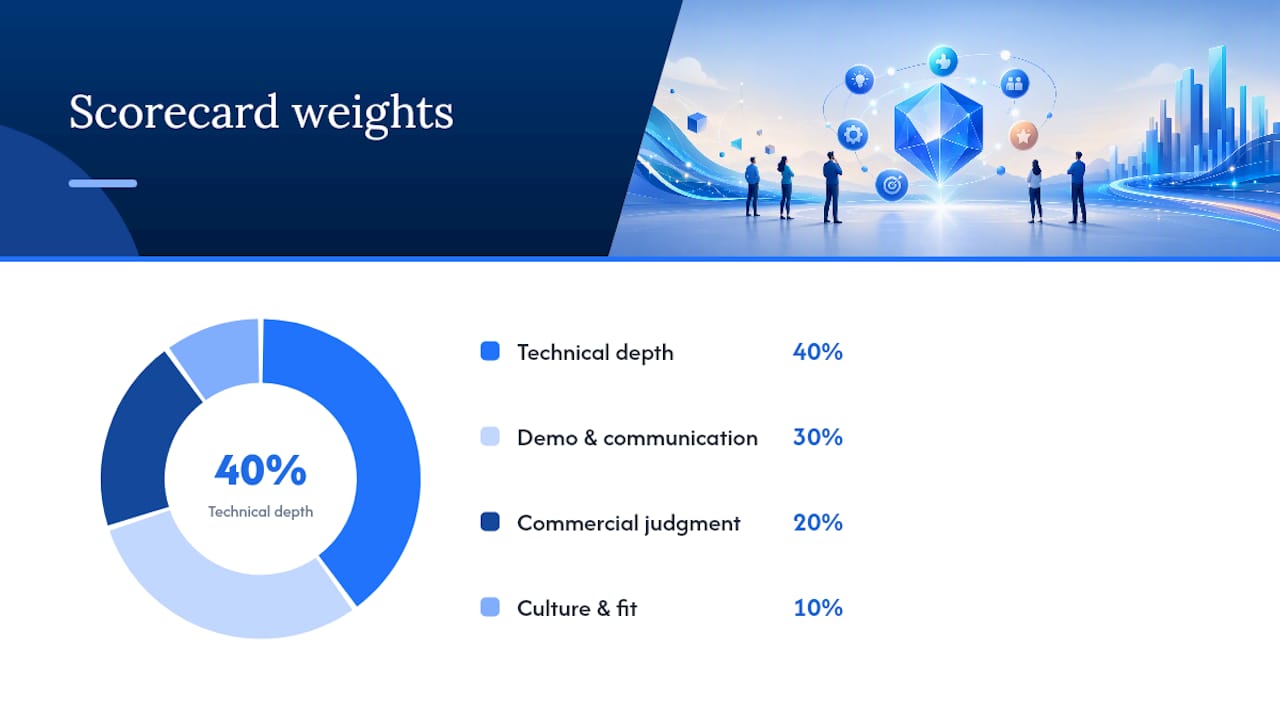
| Weight the scorecard right | Score technical depth at 40%, demo and communication at 30%, commercial judgment at 20%. |
| Match ratio to deal size | Staff several AEs per SE in mid-market and fewer in enterprise accounts. |
| Track ramp with real numbers | Watch AE satisfaction, POC-to-close time, and time to first technical win monthly. |
| Work with a specialist | Cornerstone Search Associates has placed many sales professionals since 1996 and runs searches with a typical duration of a few weeks. |
Table of Contents
- What Does Sales Engineer Hiring Actually Require to Get Right?
- How Should You Structure the Interview Loop?
- What Should Go on the Evaluation Scorecard?
- Where Should the Sales Engineer Report, and How Do You Pay Them?
- What Hiring Mistakes Kill Sales Engineer Teams?
- How Do You Onboard a New Sales Engineer Correctly?
- What’s the Biggest Blind Spot in Sales Engineer Hiring?
- Sources
What Does Sales Engineer Hiring Actually Require to Get Right?
Sales engineer hiring starts with a decision, not a job description. You have three charter options, and picking the wrong one is the single biggest reason SE hires fail in the first six months.
Demo Support SEs run polished demos and answer product questions during the sales cycle. They do not own the technical win. This fits velocity motions with short cycles and low ACV.
POC Ownership SEs run the proof of concept end to end, including scoping, technical objections, and the handoff to implementation. This fits mid-market and enterprise deals where the buyer needs to see the product work in their environment before signing.
Solution Design SEs architect custom configurations pre-sale, often for complex platforms selling into technical buyers. This is the deepest technical bar and the smallest hiring pool.
Once you pick the charter, build your technical baseline the right way. Pull the 10 hardest questions your AEs get asked in the field this quarter. That list is your floor. If a candidate cannot answer six of ten with real command, they are not ready for your product, no matter how good their resume looks.
Your job spec should include:
- Scope: which deal stages this person owns
- Must-owns and not-owns: be explicit, because vague scope creates resentment fast
- Reporting line: sales or product (more on this later)
- Required tech stack familiarity: name the actual tools, not “technical aptitude”
- Three to five must-have bullets tied directly to the charter, not copied from a competitor’s job posting
Hiring without this step is what causes misaligned expectations and early attrition. The charter dictates the technical bar, the comp band, and the reporting line. Skip it and you are guessing on all three.
Pro Tip: Ask your best AE to write down the last three technical questions that almost killed a deal. That is your interview content. Stop inventing hypotheticals.
How Should You Structure the Interview Loop?
Four stages, each with a job to do. Do not skip one because you are in a hurry. A rushed loop is how you end up firing someone in month four.
- Fit screen (30 minutes). Check goals, comp expectations, and red flags. Has this person ever disqualified a bad-fit deal? If they cannot answer that, keep moving.
- Technical screen (45 minutes). Product-context Q&A pulled straight from your hard-questions list. Test five to seven questions. This is not a trivia contest. You are checking whether they reason through unfamiliar territory or freeze.
- Demo simulation (60 minutes). Send a prep brief 48 hours ahead with a fictional customer scenario. Have the candidate run a live mock demo, then hit them with two or three integration curveballs mid-demo. This single exercise reveals bluffing and measures composure better than any resume ever will.
- Objection handling and panel (30 minutes). Rapid-fire pricing, security, and competitive objections. Three panelists score independently, then reconcile.
A checklist for your hiring team:
- Every stage has a named owner
- Scores get submitted before the panel talks to each other
- No stage gets skipped for a candidate you “just have a good feeling about”
Structured tasks beat gut-feel conversations every time. Use our SaaS sales interview questions list if you need a starting bank.
What Should Go on the Evaluation Scorecard?
Score four categories, weighted by charter. A generic 1-to-10 “how did you feel” rating is not a scorecard. It is a vibe check.
- Technical depth (40%): Can they reason through the hard-questions list without faking it?
- Demo and communication (30%): Do they simplify complexity or bury the buyer in jargon?
- Commercial judgment (20%): Do they know when to walk away from a bad-fit deal?
- Culture and team fit (10%): Will they work well with your AEs, not around them?
Set a minimum pass rule and hold it. A Demo Support hire needs roughly 7 out of 10 on technical depth. POC Ownership and Solution Design roles need higher, because they own the technical win alone once the deal advances.
Collect scores independently before anyone talks. Anchoring happens fast: the first loud opinion in a debrief room shapes everyone else’s memory of the interview, even when the notes say something different. Reconcile disagreements by comparing specific answers to specific questions, not overall impressions.
The strongest candidates show up with story-driven technical answers, real discovery instinct, and composure under pressure, including the willingness to say “this deal is not a fit” out loud in an interview. That last trait is rare and worth weighting heavily.
Where Should the Sales Engineer Report, and How Do You Pay Them?
Reporting line shapes behavior more than most founders expect. SEs reporting into sales tend to move faster and push harder to close. SEs reporting into product tend to protect technical honesty and feed real field data back to engineering. Pick the one that matches what you need protected: urgency or integrity. Most SaaS companies start with sales reporting and shift some SEs to product as the team scales past a handful of reps.

AE-to-SE ratios depend on deal complexity, generally varying from no dedicated SEs for velocity motions, to a few AEs per SE for mid-market and enterprise accounts, with closer pairing in strategic accounts.
Comp typically runs a smaller variable component than an AE, with the variable piece tied to team bookings rather than individual quota. Track ramp with three numbers: POC-to-close time, AE satisfaction with SE support, and time to first technical win. If those three numbers look good at 90 days, you made the right hiring decision.
What Hiring Mistakes Kill Sales Engineer Teams?
Four mistakes show up again and again in searches we run.
- Hiring a developer who actually wants to write code all day. They will be gone in a year, chasing an engineering role.
- Hiring a rep who talks a good technical game but bluffs under pressure. The demo simulation catches this every time.
- Skipping the live demo in your interview process entirely. If you never watch them demo, you are hiring blind.
- Launching a POC with no defined scope. Undefined POCs drag on for months and burn your SE’s credibility with the buyer.
Track AE satisfaction quarterly and watch POC-to-close time monthly. Rising POC time is your earliest warning sign of a calibration problem.
Pro Tip: If your SE keeps missing the same objection type, that is a coaching gap, not a hiring mistake. Fix it before you blame the hire.
What Does 30 Years of SaaS Recruiting Teach You About This?
I have watched companies burn six figures on a bad SE hire because nobody wrote the charter down first.
The charter is not paperwork. It is the difference between a hire who ramps in 60 days and one who limps to month nine before you quietly manage them out.
We have placed more than 1,200 sales professionals since 1996, and our average search runs about 21 days from kickoff to offer. That speed only works because the charter gets locked before we ever screen a resume.
How Do You Onboard a New Sales Engineer Correctly?
Onboarding starts before day one. Send the hard-questions list and two recorded demos in advance so the new hire studies your product story before they walk in the door.
Week one should be shadowing, not solo demos. Have the new SE sit in on five live customer calls with your strongest AE and take notes on objection patterns. Week two, they run a mock demo internally and get scored on the same categories from the interview scorecard. That continuity matters: you set a technical baseline in hiring, so hold them to it in training.
By week three, put them on a low-stakes real deal, ideally a smaller account where a stumble will not cost you a logo. Pair them with the AE for the first two calls, then let them fly solo on the third. Track time to first technical win from this point forward. That single metric tells you more about ramp health than any onboarding checklist.
Build a 30/60/90 plan tied to the charter you wrote in step one. A Demo Support SE should be running solo demos by day 30. A POC Ownership SE should be managing their first full POC by day 60. If your new hire is behind that pace at day 90, go back to the scorecard from their interview and see what got missed.
What’s the Biggest Blind Spot in Sales Engineer Hiring?
Most companies over-index on technical depth and under-index on commercial judgment. A brilliant engineer who cannot read a buyer, cannot simplify a complex answer, or cannot tell a founder “this deal will not close” is not a sales engineer. That person is a support ticket with a salary.
Conventional hiring advice tells you to check certifications and years of experience. That advice misses the point entirely. Certifications tell you nothing about composure in a live demo when the Wi-Fi drops or the buyer asks a question that was not on the script.
What I would prioritize first, every single time: the demo simulation. It is the one exercise that cannot be faked. A resume can lie. A LinkedIn profile can lie. A person running a live mock demo under pressure cannot lie for 60 straight minutes. Build your loop around that exercise, weight your scorecard toward it, and you will cut your mis-hire rate more than any other single change you make this year.
How Cornerstone Search Helps You Hire the Right Sales Engineer
Building a charter, writing the spec, running four interview stages, and scoring a panel is a full-time job on top of your actual full-time job. Cornerstone Search Associates does this work daily, specifically for SaaS and software companies, and we already know which technical baselines and demo formats predict success because we have run this exact process on more than 1,200 placements.
Here is what that means for you: instead of building a hiring loop from scratch, you get a partner who already knows the hard-questions bank for your category, already has candidates who have passed a demo simulation before, and moves from search kickoff to offer in about 21 days on average. Three things you can do right now: send us your charter draft for a gut check, ask for our SaaS sales interview question bank to build your own loop, or start a search with our software sales recruitment team this week.