

Most sales engineer searches go wrong before the first interview. Nobody agreed on what the SE is supposed to do. So the loop tests the wrong things, the best candidate gets bored by round five, and a competitor makes an offer on Friday.
Here is the process that works. Define the job, source from the right places, run a short loop built around a real demo, score everyone the same way, and close fast. I’ve spent 30 years placing sales, presales and executive people in SaaS. This is what I’d do if I were hiring for you.
TL;DR
- Write the SE’s charter first: which deals, which AE, which product surface, what “good” looks like at 90 days.
- Run four to five stages, not eight. Make one of them a prepared demo in front of a skeptical buyer.
- Score every candidate on the same scorecard, written before the first call.
- Test honesty under pressure. An SE who bluffs a customer will cost you a deal.
- Speed wins. Good SEs have options, so a slow process loses them.
Table of Contents
- Start with the job, not the job post
- Where good sales engineers come from
- The stages of the loop
- Questions that separate real SEs from talkers
- Build the scorecard before you meet anyone
- Keep the process short and organized
- Mistakes that burn good searches
- Closing the offer
- When you’d rather not run this alone
- FAQ
- Sources
Start with the job, not the job post
A sales engineer sells technical products by explaining them, scoping customer needs and fixing what breaks in the evaluation. The Bureau of Labor Statistics describes the role as technical knowledge plus people skills, and says a bachelor’s degree is typical. Fine. That tells you nothing about your seat.
An SE who thrives in a $15K mid-market motion can drown in a seven-figure enterprise deal with security reviews and six stakeholders. Different animal.
Before you post anything, get the founder, the VP Sales and the head of product in one room. Answer these:
- Which segment will this SE support? SMB, mid-market or enterprise?
- How many AEs will they cover? One? Five?
- What does the SE own: discovery, demo, proof of concept, security questionnaires, RFPs?
- What does a great first 90 days look like?
- What are the dealbreakers?
This is the charter. We wrote a full version in our charter-first playbook for sales engineer hiring, and our breakdown of what sales engineers actually do will help you stop copying generic job descriptions.
Skip this step and everything downstream is guesswork. I’ve watched companies interview twelve people and reject all of them because nobody could say what they were looking for.
Where good sales engineers come from
The best SEs are rarely sitting on job boards. They are closing deals right now at someone else’s company.
Useful pools:
- Post-sales and support engineers who are tired of cleaning up and want to be in the room before the contract.
- Solutions consultants and implementation leads who know how customers really use the product.
- SEs at adjacent vendors who already speak your buyer’s language.
- Technical customers who loved your product and know it cold.
Each pool has a catch. Support engineers may be shy in front of a CFO. Veteran SEs may want a bigger number than your seed-stage budget. Know the tradeoff before you start, not after the third interview.
Technical background matters, but it is not the whole job. Many people can build the thing. Far fewer can explain it to a nervous VP who has three minutes and a budget problem.
The stages of the loop
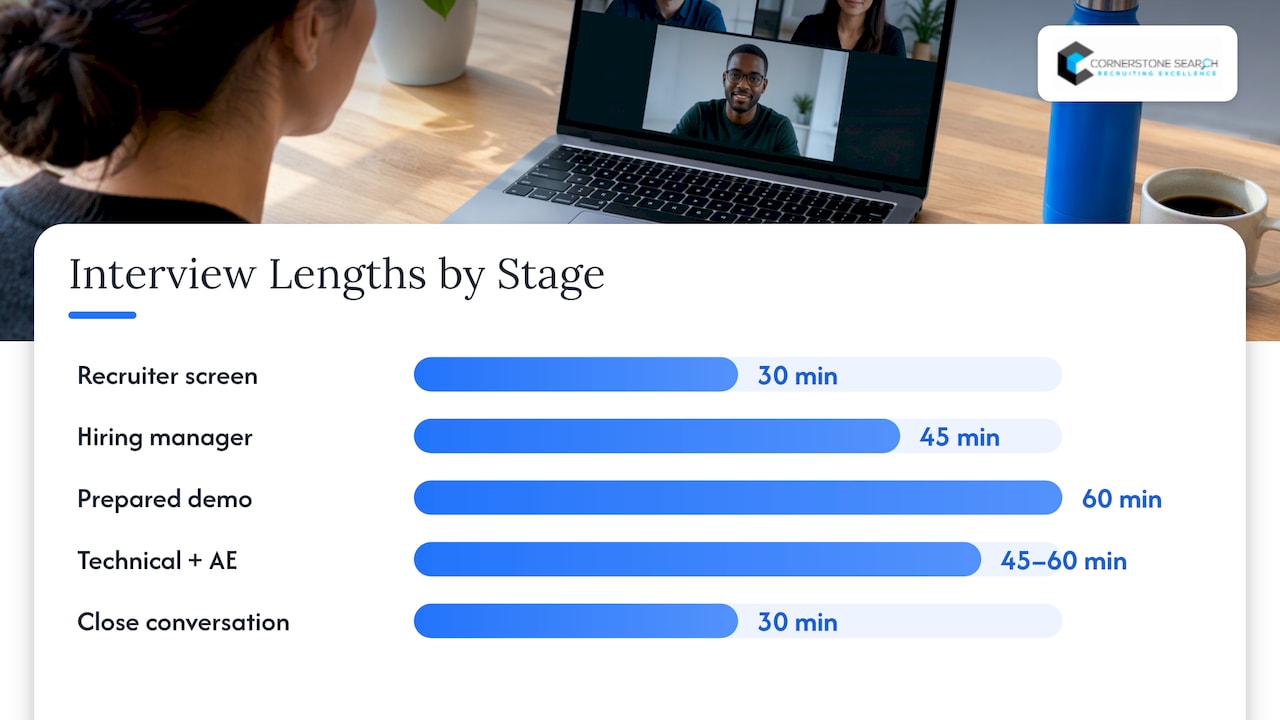
Published playbooks agree on the shape more than the details. Navattic’s survey of presales leaders reports a common order: a recruiter or talent-partner interview, a hiring-manager interview, a panel interview, and an optional follow-up or peer conversation. Rework’s 2026 framework uses a 30-minute phone screen, a 45-minute technical screen and a 60-minute demo simulation.
Here is the version I’d run.
| Stage | Length | Who | What you learn |
|---|---|---|---|
| Intake and recruiter screen | 30 min | Recruiter or talent lead | Motivation, deal size, comp expectations, communication |
| Hiring manager conversation | 45 min | SE leader or VP Sales | Experience against the charter, how they think |
| Prepared demo | 60 min | Mixed panel | Real selling ability under pressure |
| Technical and AE session | 45 to 60 min | Product lead plus an AE | Depth, objection handling, partnership |
| Close conversation | 30 min | Founder or CRO | Mutual fit, offer readiness |
That is five touches, and the first one is short. Nobody needs a sixth.
Stage 1: Intake and screen
Thirty minutes. Cover why they are looking, what they’re earning, what deal sizes they’ve supported and what they want next. Comp is not rude to ask about. It saves everybody a month.
Listen for how they talk. Do they answer the question you asked, or the one they rehearsed?
Stage 2: Hiring manager conversation
This is where you test the resume against reality. Ask for one deal they are proud of. Then dig. What was their exact role? What did the AE do? What broke? What did they do about it?
SEs who really ran the technical win give details. SEs who rode along give adjectives.
Stage 3: The prepared demo
This is the stage that matters most. Rework recommends giving the candidate a realistic product context, a prospect persona, a business problem and preparation time. Their guide sends the demo brief 48 hours ahead. Then you run it with a skeptical buyer asking hard integration questions.
What to watch for:
- Do they open with the customer’s problem, or with a feature tour?
- Do they stay calm when the buyer pushes?
- Do they tie the product to a business result?
- When they don’t know, do they say so and offer a path to the answer?
- Do they end with a next step?
That last one is sales judgment. An SE who gives a lovely demo and lets the call die has not helped the deal.
The U.S. Office of Personnel Management notes that work samples and simulations should mirror the actual job tasks. They show strong validity but cost time to run. That is the tradeoff, and for this role it is worth paying.
Keep the brief fair. Don’t ask for free consulting on your real roadmap. Give them a fictional customer and a clear time box.
Stage 4: Technical deep dive with an AE in the room
Put the SE next to the person they’ll actually work with. Run a mock discovery call or an objection session. The AE will tell you in ten minutes whether they’d want this person on a live deal.
The technical part should be product-shaped, not a generic coding test. Ask how they’d handle a customer integration with a system you don’t support, or how they’d explain your architecture to a security reviewer.
PitchNhire’s 2026 process similarly puts a prepared demo before a mixed panel, then an objection session with an AE (PitchNhire). Two sources, same conclusion. Show me the demo.
Stage 5: Close conversation
The founder or CRO talks mission, quota structure, how SEs are measured and where this role goes. This is a sales conversation as much as an interview. The candidate is interviewing you too.
Questions that separate real SEs from talkers
Skip “What’s your greatest weakness?” Nobody has ever learned anything from it. Use questions that force a candidate to show how they work.
Technical credibility
- Explain a complex concept from your last product to a buyer who isn’t technical. Go.
- Tell me about a technically messy deal. What did you do?
- A customer asks about an integration you’ve never touched. What now?
Discovery and judgment
- How do you decide whether a deal deserves a proof of concept?
- Tell me about a POC that stalled. Why, and what did you change?
- What do you do when the AE wants to demo before discovery?
Competitive and objection handling
- How do you position against an incumbent without trashing it?
- A buyer says your product is missing a feature they need. Walk me through your reply.
Honesty
- Tell me about a time you got something wrong in front of a customer.
That last one is gold. Rework treats honesty under uncertainty as a core credibility signal: an SE who admits a gap and sets up a verified answer is safer than one who bluffs. I agree. Bluffing SEs create bad implementations, angry customers and churn nobody traced back to the demo.
For behavioral answers, ask candidates to walk through situation, task, action and result. If the “result” is always vague, press for numbers: win rate, deal size, cycle length.
For more question ideas, see our SaaS sales interview questions for hiring managers.
Build the scorecard before you meet anyone
If you don’t write down what you’re scoring, you’ll hire the person you liked at lunch.
The OPM’s guidance on structured interviews says more structure improves validity and rater agreement compared with unstructured interviews. It means common job-related questions, defined probes and benchmarks for each rating. A separate OPM guide adds fairness and legal defensibility to the list.
Simple scorecard, rated 1 to 4 on each line:
| Competency | Evidence you want |
|---|---|
| Technical depth | Accurate, product-relevant answers, not trivia |
| Communication | Clear to technical and nontechnical buyers |
| Discovery | Asks before showing |
| Demo skill | Problem first, outcome framed, clean next step |
| Objection handling | Calm, specific, honest |
| AE partnership | Works as a team, shares credit |
| Integrity | Admits gaps without panic |
Have each interviewer score on their own before the debrief. Otherwise the loudest person in the room picks the winner. Our sales hiring scorecard goes deeper on weighting.
Keep notes on every candidate. If you ever have to explain why one person got the offer, “same questions, same scale” is a strong answer.
Keep the process short and organized
Navattic’s presales leaders favor roughly four interviews and warn against over-interviewing, drawn-out timelines, ghosting and ignoring candidate experience. I’ve seen all four kill searches.
Good SEs are usually employed and in demand. Every extra week gives a rival time to call. Every silent stretch tells the candidate how you’ll treat them as an employee.
Practical rules:
- Schedule the whole loop up front. Offer slots within a few days of each other.
- Combine panel members into one session rather than five separate ones.
- Tell candidates the process, the stages and the timeline on the first call.
- Give feedback within a day or two. Even a no.
- Decide in a debrief the same day as the last interview.
If your team is juggling several open roles, a shared tracker helps. Project management tools for recruiting teams can keep stage owners and deadlines visible so nobody waits on a scorecard that never arrived.
How long should all this take? It depends on role level, how clear your charter is and how fast your people move. I won’t pretend there’s one number. Ours is a client-side benchmark: the average time from search kickoff to accepted offer on our searches is about three weeks. That comes from running tight loops with decisions made quickly, not from cutting corners.
Mistakes that burn good searches
Hiring a pitch instead of an engineer. Charm is nice. Charm without technical depth gets exposed in the first hard security call.
Hiring an engineer who can’t sell. They answer every question perfectly and lose the room.
No AE in the loop. The two of them will spend 30 hours a week together. Let them meet.
Free labor disguised as an assignment. Ask for a realistic demo, not your next quarter’s roadmap.
Vague comp. Be upfront about base, variable and how SE quota or attainment works. Surprises at the offer stage kill trust.
Waiting for perfect. You will never find the SE who ticks every box and costs half the market. Decide which two traits are non-negotiable and hire against those.
Skipping references. Talk to an AE who worked with them. Ask whether they’d want that SE on their next big deal.
Closing the offer
The best SE you interview will likely hold another offer or a counteroffer. Plan for it.
- Ask early what would make them move. Money, scope, product, leader?
- Put the founder or CRO on a call before the offer lands.
- Walk through the comp structure plainly, including any variable pay and how it is measured.
- Send the written offer fast and give a reasonable decision window.
Not every candidate says yes. That’s fine. A tight process means you still have the runner-up warm.
Perspective
Here is what 1,200+ placements taught us. Companies don’t fail at SE hiring because they can’t find people. They fail because the founder, the VP Sales and the product lead each picture a different person. Then they interview for a month and wonder why nothing clicks.
That’s why every search we run starts with a founder-led intake. We sit down, define the seat, the deal profile and the AE pairing, and only then go to market. Our average time from search kickoff to accepted offer is 21 days. Our one-year retention rate is 93%. We design the process for fit first, because fit is what keeps a hire past month twelve.
If you have the bandwidth, the playbook above will work for you. If you don’t, or the seat is critical, this is exactly the work we do every day with SaaS and software companies.
Rich Rosen
When you’d rather not run this alone
Running a loop like this while also closing your quarter is a lot. That is what our software sales recruitment service is built for. We run the intake, source from the pools above, screen for technical and commercial judgment, and bring you candidates you can put in front of a panel.
For leadership roles, such as a head of presales or a VP Sales to manage the SE team, see our executive search recruitment. If you want to understand the stages before you commit, read our guide to the executive sales search process.
FAQ
How many interviews should a sales engineer process have?
Four to five touches is the sweet spot. That usually means a screen, a hiring manager conversation, a prepared demo with a panel, a technical and AE session, and a close conversation. Navattic’s presales leaders favor roughly four interviews and warn against over-interviewing.
What should I ask a sales engineer candidate to demo?
Give them a fictional customer, a clear business problem and time to prepare. Then play a skeptical buyer with hard integration questions. Watch how they frame outcomes, handle unknowns and move toward a next step.
Do sales engineers need a degree?
The Bureau of Labor Statistics says a bachelor’s degree is typical for the role, along with on-the-job training in sales techniques and product details. In practice, proven technical depth and customer-facing skill matter more than the diploma on a given hire.
Should I use a technical coding test?
Usually not. Test product-shaped reasoning: integrations, architecture questions a customer would raise, and how the candidate explains them to different audiences. A short technical lab tied to your product tells you more than a generic puzzle.
Should I hire from support, services or another SE team?
All three can work. Support and services people know real customer pain but may need coaching on presenting. Experienced SEs from adjacent vendors ramp quickly but cost more. Pick based on your deal size and how much ramp time you can afford.
Sources
- Sales Engineers: Occupational Outlook Handbook, U.S. Bureau of Labor Statistics
- How to Improve Your SE Hiring Process, Navattic
- Sales Engineering Hiring: Technical Depth vs Commercial Skill, Rework
- Work Samples and Simulations, U.S. Office of Personnel Management
- How to Hire a Sales Engineer, PitchNhire
- Structured Interviews, U.S. Office of Personnel Management
- Structured Interview Guide, U.S. Office of Personnel Management