

A sales engineer is the technical validator on complex deals. They own demos, run proof of concepts, answer the hard technical questions your AE can’t, and make sure the thing you sold actually works before it lands on a customer’s desk. Miss that role, or hire the wrong person for it, and you’ll lose deals in the technical evaluation stage, or worse, win them and watch them churn six months later.
Here’s the top of the job, stripped down:
- Technical discovery — figuring out what the customer’s environment actually needs
- Demos — showing the product in a way that answers real business problems, not a feature tour
- Proof of concept (POC) or proof of value (POV) management — running a scoped trial with a defined finish line
- RFP and security questionnaire responses — the paperwork that gets deals past procurement and infosec
- Technical documentation — leave-behind materials that survive after the SE leaves the room
- Post-sale handoff — making sure implementation doesn’t inherit a mess
Account executives get measured on revenue and close rate. Sales engineers get measured on technical win rate and whether the deal blows up in onboarding. Different scoreboard, same game. If you’re hiring for this role, or trying to figure out if the person you already have is doing it right, keep reading.
Key Takeaways
Sales engineer responsibilities center on technical validation: discovery, demos, POC ownership, RFP responses, and a clean handoff, all measured by technical win rate rather than revenue alone.
| Point | Details |
|---|---|
| Core job function | SEs validate technical fit through discovery, demos, POCs, and RFP responses before contract sign-off. |
| Scope control matters most | Unscoped POCs without exit criteria are the leading cause of wasted SE hours and stalled deals. |
| Measure differently than AEs | Track POC win rate and demo-to-POC conversion instead of quota attainment for SE performance. |
| Veto power is a hiring filter | Candidates who can’t describe a deal they killed likely lack the judgment the role requires. |
| Ramp takes time | Expect a realistic 60 to 90 day ramp before a new SE hits full technical productivity. |
Table of Contents
- What Are the Core Sales Engineer Responsibilities Day to Day?
- Who Owns What: SEs, Account Executives, and the Handoff
- Skills That Separate a Strong SE From a Resume With Buzzwords
- The Metrics That Actually Tell You If an SE Is Working
- Career Path, Titles, and What to Expect on Compensation
- How to Write a Sales Engineer Job Description That Actually Works
- What 1,200 Placements Taught Us About Spotting a Real SE
- Sales Engineer Responsibilities: What Employers Get Wrong
- Sources
What Are the Core Sales Engineer Responsibilities Day to Day?
Forget the job title for a second. Here’s what an SE actually does between Monday and Friday, and what should come out of each piece of work.
1. Technical discovery. Before anyone builds a demo, the SE has to find out what’s actually going on inside the customer’s stack. That means asking pointed questions: What’s your current architecture? What are you integrating with? Who owns the API keys? What’s your security review process? A good SE walks out of a discovery call with an architecture diagram and an integration checklist, not just notes. O*NET’s task list for sales engineers includes planning product modifications and preparing technical reports, and this is where that work starts. Skip discovery, and you build a demo for a customer that doesn’t exist.
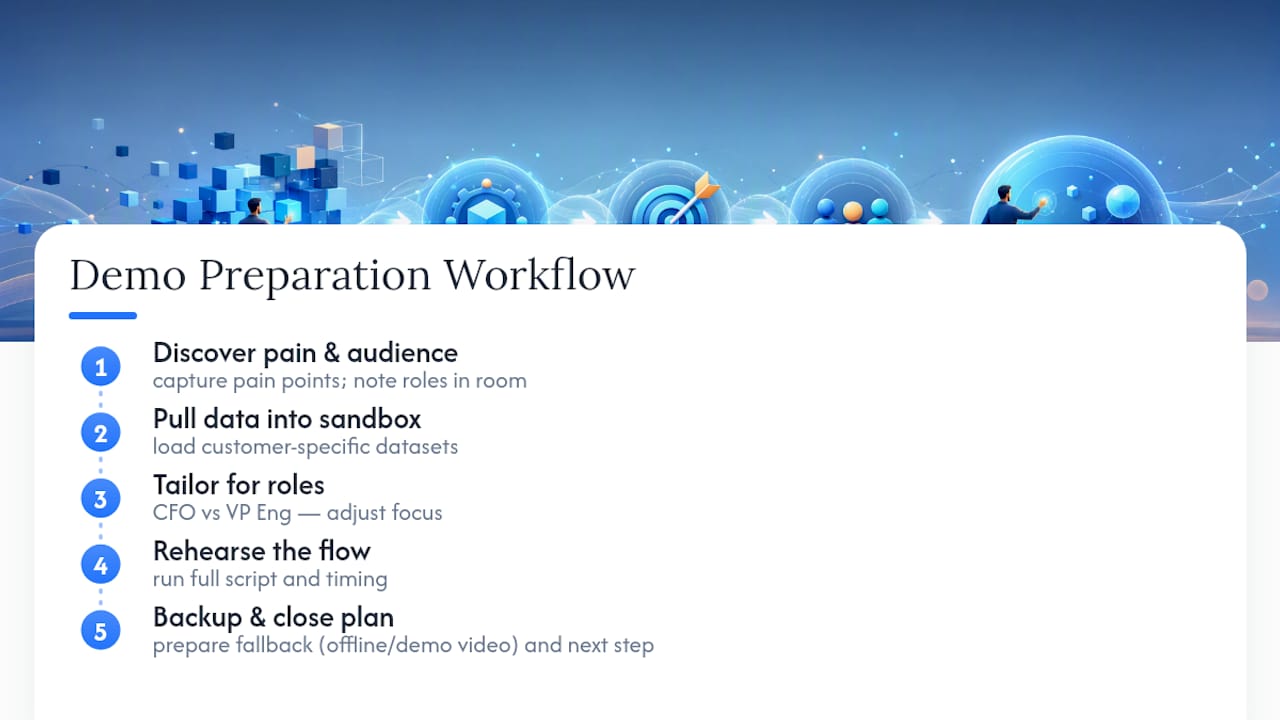
2. Demos that tell a story, not a tour. A weak demo clicks through every feature in order. A strong one opens with the customer’s specific pain, walks through how the product solves it, and closes with a clear next step. The SE has to calibrate the demo for whoever’s in the room. A CFO doesn’t care about your API’s rate limits. A VP of engineering does. Same product, different demo. The prep workflow matters more than people admit: pulling the right data into a sandbox, rehearsing the flow, and having a backup plan when the Wi-Fi dies mid pitch. It always does, eventually.
3. Running the POC or POV. This is where deals live or die, and it’s also where SEs burn the most hours for nothing if the scope isn’t locked down. A well-run POC has defined success criteria agreed on paper before it starts, a hard timeline, named stakeholders on both sides, and an exit condition. Employer guides and presales practitioners are consistent on this: without scope limits and defined exit criteria, a POC turns into an open-ended consulting engagement the vendor pays for and never gets credit for. The most common failure mode isn’t a technical one. It’s scope creep, where “let’s just test one more thing” turns a two-week trial into a two-month unpaid project.

4. RFPs and security questionnaires. Every enterprise deal eventually hits a stack of forms. Typical sections cover data security, uptime guarantees, compliance certifications, integration methods, and support SLAs. Turnaround expectations run anywhere from a few days to two weeks depending on deal size. The smart move is a reuse strategy: a maintained library of answers to the fifty questions that show up in ninety percent of RFPs, so the SE isn’t reinventing the wheel every single time. Employer-facing hiring guides for the role, including Indeed’s sales engineer job description template, flag this written-response skill as a core competency, and it’s one hiring managers routinely underweight in interviews.
5. Leave-behind materials and documentation. After the SE leaves the deal, something has to stay behind: architecture diagrams, integration guides, security summaries, a clear record of what was promised and tested. This documentation is what implementation teams use later, and it’s what prevents the classic “the sales team promised what?” fight six weeks into onboarding.
6. Post-sale support during early onboarding. The best SEs don’t disappear the second the contract is signed. They stay involved through the first weeks of implementation to make sure the technical promises made during the sale actually hold up in production. BLS notes that many sales engineers provide post-sale technical support as a standard part of the role, not an optional extra.
Pro Tip: If your SE can’t tell you the exit criteria for a POC before it starts, don’t let it start. An unscoped POC is a free consulting gig that costs you a deal cycle.
Who Owns What: SEs, Account Executives, and the Handoff
The AE runs the relationship and the commercial terms. The SE runs technical validation. Cross those wires and you get chaos: an AE promising a custom integration the product doesn’t support, or an SE going deep on a feature nobody’s going to buy because of it.
Here’s the rough division of labor that works:
- AE owns: relationship, pricing, negotiation, closing, and the overall deal timeline
- SE owns: technical discovery, demo content, POC scope, RFP responses, and the technical sign-off before contract
- Both own: the demo call itself, stakeholder mapping, and making sure technical and commercial timelines match up
SEs should join a deal the moment technical questions start showing up, usually right after the first discovery call, not after the AE has already made promises the product can’t keep. Waiting too long to loop in an SE is one of the most common and most avoidable mistakes I see in SaaS sales orgs.
The single best risk control in this whole process is a formal SE technical sign-off before the contract is signed. It sounds bureaucratic. It isn’t. It’s the moment where the person who actually knows the product says “yes, this will work for this customer’s use case,” in writing. Skip that step and you’re relying on hope. And Alexander Group’s analysis of SE performance makes the case directly: SEs are measured on POC win rates and technical readiness rather than raw revenue, precisely because their job is to catch the risk an AE is financially motivated to ignore.
That misalignment is intentional, and it’s a feature, not a bug. AEs get paid to be optimistic about a close. SEs get paid to be skeptical about whether it’ll actually work. You want both instincts in the room. A deal that only has optimism in it is a deal that churns.
Internal collaboration routines matter more than most sales orgs think. A quick prep call before every demo. A dry run before anything customer-facing goes out the door. A written handoff doc, not a verbal “yeah, it’s basically ready,” when the deal moves from sales to implementation. These take fifteen minutes and save weeks of cleanup.
Skills That Separate a Strong SE From a Resume With Buzzwords
Résumés lie. Or at least they exaggerate. Here’s what actually separates a strong SE from someone who’s good at listing tools they’ve “worked with.”
- Technical fluency, not technical trivia. They need to understand APIs, integration patterns, and basic security concepts well enough to speak credibly to an engineer, not recite documentation. If they can’t explain how OAuth works in plain English, that’s a flag.
- Demo storytelling. Can they read a room and adjust on the fly? A CFO in the room changes the demo. A skeptical IT director changes it again. Watch for candidates who run the same script no matter who’s listening.
- Commercial judgment. This is the underrated one. A great SE knows when to say no, when to push back on scope, and when a customer’s ask is a rabbit hole dressed up as a requirement. Veto power matters. If an SE can’t kill a bad deal, they’re not doing half the job.
- Written communication. RFP responses and leave-behind docs live or die on clarity. A brilliant technical mind who writes confusing documentation is going to cost you implementation headaches down the line.
- Calm under pressure and genuine curiosity. The best SEs like solving the puzzle a customer’s environment presents. The worst ones treat every discovery call like an interrogation to survive.
Pro Tip: In the interview, ask the candidate to describe a deal they killed on purpose. If they can’t think of one, they’ve never had real veto power, or they’ve never used it.
The Metrics That Actually Tell You If an SE Is Working
Quota is an AE metric. Don’t measure your SE the same way, or you’ll reward the wrong behavior.
The primary numbers worth tracking:
- POC win rate — what percent of proof of concepts convert into signed deals
- Demo-to-POC conversion — how often a demo earns the right to move to a scoped trial
- Technical validation score — an internal rating of how thoroughly the SE confirmed fit before handoff
- Handoff quality — measured by post-sale technical incidents tied back to a specific deal
Alexander Group’s research on SE performance argues that POC win rate and demo-to-POC conversion are the metrics that actually reflect an SE’s contribution, since revenue attainment is mostly an AE outcome the SE only influences indirectly.
Combine activity metrics (number of demos run, POCs staffed) with outcome metrics (win rate, post-sale incidents), but don’t let volume alone create false optimism. An SE running twenty demos a month who closes none of them isn’t performing. They’re busy. Those are different things, and sales leaders confuse them constantly.
A simple dashboard should track, per SE, per quarter: number of POCs run, POC win rate, average POC duration, post-sale technical incident count, and RFP turnaround time. Review it monthly. Quarterly reviews let bad patterns fester for three months before anyone notices.
Career Path, Titles, and What to Expect on Compensation
The title ladder in presales runs roughly: Sales Engineer, Senior Sales Engineer, Principal Sales Engineer or Solutions Architect, then Presales Leadership (Director or VP of Sales Engineering). Titles overlap a lot between companies, so don’t assume “Solutions Architect” always outranks “Senior SE.” Check the actual scope of the job, not the label on the business card.
After several years in presales, the common exit paths run in three directions:
- Into product management, since SEs already spend their days translating customer needs into product feedback
- Into implementation or customer success leadership, a natural fit given their post-sale involvement
- Into sales leadership, particularly VP of Sales Engineering or CRO-adjacent roles at technical companies
On pay, the Bureau of Labor Statistics’ occupational profile for sales engineers is the most reliable public benchmark for base salary ranges and job outlook, and it’s worth checking directly rather than trusting a random comp survey you found on a job board. Comp structure varies by company stage and deal complexity: early-stage startups often lean more on a base-heavy structure with equity, while later-stage companies with complex enterprise deals build in variable comp tied to POC outcomes or team quota attainment. The more technically complex the sale, the more comp tends to shift toward base salary, since a good SE’s value isn’t always tied cleanly to a single closed deal.
How to Write a Sales Engineer Job Description That Actually Works
Most SE job postings are garbage. They’re a copy-paste of generic “presales” language with a bulleted list of tools nobody bothered to update. Here’s a structure that actually helps you hire the right person.
Core sections your posting needs:
- What success looks like in 90 days — not a list of duties, an outcome. “Run your first POC to a signed deal” beats “collaborate with the sales team.”
- The day-to-day — discovery calls, demo prep, POC ownership, RFP responses. Be specific about volume if you can (how many demos a week, roughly).
- The KPIs they’ll be measured on — POC win rate, demo-to-POC conversion, technical validation score. Say it up front so nobody’s surprised later.
- Must-have skills — technical fluency in your specific stack, written communication samples, and commercial judgment, not just “5+ years experience.”
For evaluation, three exercises beat any resume review:
- A live demo task. Give them a fake product brief and ask them to build and deliver a five-minute demo. Watch how they structure it, not just what they say.
- A technical discovery interview. Role-play a discovery call where you’re the skeptical customer. See if they ask sharp follow-up questions or just check boxes.
- A POC scoping exercise. Ask them to write success criteria and an exit plan for a hypothetical trial. This tells you fast whether they understand scope control or whether every deal with them turns into a six-month science project.
Run reference checks focused on one question: did this person ever kill a bad deal, or did they let every deal ride to see what happens? References that dodge that question are telling you something.
Compensation bands should reflect deal complexity, not just years of experience. A ramp period of 60 to 90 days is realistic for someone learning a new product; expecting full productivity in 30 days sets candidates up to fail and sets you up to blame the wrong thing when it doesn’t work. If you want a deeper breakdown of how SaaS sales roles differ in scope and screening, our guide to the types of SaaS sales roles walks through where SE responsibilities overlap and diverge from AE and CSM functions.
What 1,200 Placements Taught Us About Spotting a Real SE
Cornerstonesearch has placed over 1,200 sales professionals since 1996, and a chunk of those were sales engineers. The average time from search kickoff to offer acceptance runs 21 days. That speed only works because we know exactly what to screen for before a candidate ever gets in front of a hiring manager.
Here’s what separates a production-ready SE from a resume full of buzzwords:
- They can describe a POC they scoped tightly, not just one they “supported”
- They talk about a deal they killed, with specifics, not vague team-player language
- They can explain a technical concept to a non-technical person without dumbing it down into nonsense
- They ask about your product’s actual failure modes before they ask about comp
If a candidate can’t do the first three in an interview, they’ll struggle to do them in front of your customers. We’ve seen this pattern hold across software sales recruiting searches for years, and it doesn’t change much company to company.
Hiring the right SE also matters for your broader team dynamics. If you’re building out a full technical sales function and want outside perspective on how quality hires reshape a team, the case made in why hiring a quality business development manager transforms a business applies almost word for word to sales engineering hires, since both roles quietly determine whether your pipeline converts or stalls.
If you’re staffing this role right now and don’t want to run the screening yourself, that’s literally what we do. Check our sales recruitment guide for building a winning team for the fuller playbook, or go straight to our software sales recruitment page if you’re ready to talk.
Sales Engineer Responsibilities: What Employers Get Wrong
Most hiring managers still evaluate SEs on charisma. They watch a demo, see a smooth talker, and assume the technical judgment comes with it. It doesn’t. The BLS and O*NET data both point to the same reality: this role is fundamentally about validation and documentation, not showmanship.
The conventional advice, “hire someone technical who can also present,” misses the harder trait: the willingness to say no to a bad deal. That’s the piece resumes never show and demos never reveal. It only comes out when you ask a candidate directly about a deal they killed, or a scope they refused to expand.
If you’re hiring for this role, prioritize commercial judgment over technical depth in the first interview round. You can train someone on your product’s architecture in a few weeks. You can’t train someone to have a spine when a big deal is on the line and the AE is pushing them to say yes anyway.
— Rich Rosen