

That’s the whole ballgame. Everything else is detail.
I’ve watched founders blow this in both directions. Some hand out equity like Halloween candy because they’re scared of losing a candidate. Others lowball so hard the exec walks in three months later, once they realize the real market rate. Neither works. The right sales exec equity compensation structure sits inside total comp, not bolted onto it, and it’s designed to reward the right kind of revenue, not just any revenue.
Here’s the quick math before we go deep:
- Seed/Series A: 0.50%–1.50% fully diluted equity, options, heavy on equity because cash is tight.
- Series B: 0.25%–0.75% fully diluted, OTE median $360K–$425K on a 60/40 base/variable split.
- Series C+ and public: 0.15%–0.50% fully diluted, shifting to RSUs with bigger absolute dollar value even as the percentage shrinks.
Vesting stays boring on purpose: four years, one-year cliff. Acceleration is where the fights happen, and double-trigger is now the standard smart founders default to.
Key Takeaways
The right sales exec equity compensation structure ties instrument choice, grant size, and vesting to company stage while gating variable pay to unit economics instead of raw bookings.
| Point | Details |
|---|---|
| Match instrument to stage | Use options at seed and Series A, shift toward RSUs by Series C and public stage. |
| Gate variable pay | Split variable pay across bookings, cash collections, and gross margin instead of paying on bookings alone. |
| Protect the exercise window | Negotiate past the standard 90-day post-termination window or secure early-exercise rights. |
| Benchmark before you offer | Use stage-specific fully diluted ranges (0.15% to 1.5%) instead of a flat percentage across every hire. |
| Put refresh grants in writing | Lock refresh cadence into the offer letter so retention doesn’t rely on a verbal promise. |
Table of Contents
- What Equity Instruments Actually Mean for a Sales Leader
- How Should Equity Fit Into Total Pay for Sales Leaders?
- What Are the Real Equity Benchmarks by Stage?
- How Do You Align Equity with Unit Economics, Not Just Bookings?
- What Should Candidates Negotiate in an Equity Offer?
- Three Sample Equity Packages You Can Use Today
- How Do Recruiters See Offers Actually Close?
- The Gap Between Comp Theory and Comp Reality
- Sources
What Equity Instruments Actually Mean for a Sales Leader
Most comp conversations get derailed because nobody defines terms. Fix that first.
Stock options (ISOs/NSOs) give the exec the right to buy shares at a fixed strike price later. ISOs get better tax treatment for the candidate if they qualify and hold the shares long enough. NSOs are simpler for the company but tax the exec as ordinary income at exercise. Most sales leaders end up with NSOs once they’re past the ISO dollar caps.
RSUs are just shares, no purchase required, taxed as income when they vest. Public and late-stage companies love RSUs because nobody has to write a check to exercise. Early-stage companies rarely use them because RSUs trigger tax at vest even without liquidity, which is brutal for an employee at a private company.
Performance share units (PSUs) tie the grant to hitting specific revenue or margin targets. Smart move for CRO-level hires where the board wants skin tied to outcomes, not just tenure.

Early exercise and the 83(b) election let an exec buy the shares right after grant, start the capital-gains clock early, and cap the ordinary income tax hit. It’s a smart move for early-stage hires who believe in the company, and it’s the kind of thing candidates find out about two years too late.
Refresh grants top up equity annually so a four-year cliff schedule doesn’t leave your exec running on fumes in year three.
Pros for the sales leader: real upside, alignment with the outcome they’re driving. Cons: illiquidity, exercise cost, and blind spots on tax timing.
For readers who will hold or trade company stock down the line, FINRA publishes plain guidance on securities rules worth a skim before exercise or sale.
Pro Tip: Read the post-termination exercise window before you sign anything. A standard 90-day window can force an exec to either write a five-figure check fast or walk away from years of vested equity. That single clause has killed more goodwill between founders and departing execs than any comp dispute I’ve seen in 30 years.
Fewer than 15% of executive job postings even disclose equity terms, which means most candidates are negotiating blind. Don’t be the company that makes them guess.
How Should Equity Fit Into Total Pay for Sales Leaders?
OTE means on-target earnings, the base plus variable a rep or exec pockets at 100% of quota. Equity rides on top of that, and how you split it tells the exec exactly what you value.
A VP Sales typically runs 50/50 or 60/40 base to variable, tilted heavier toward variable because the role is closer to the pipeline. A CRO, on the other hand, needs more base, often 60% or higher, because you want them thinking in quarters and years, not just closing this month’s number to hit their draw.
Here’s what real mixes look like:
- VP Sales, Series B: $216K–$255K base, OTE $360K–$425K, equity 0.5%–1.5% fully diluted.
- SVP Sales, growth stage: base climbing toward $300K+, OTE stretching past $500K, equity tilted lower percentage but bigger absolute grant.
- CRO, later stage: base $350K–$500K+, OTE up to $1M+, equity 0.15%–0.50% fully diluted but heavier on RSUs.
During ramp, before quota history exists, use MBOs (management-by-objectives) as a temporary bridge. Pay against pipeline built, hires made, and process installed instead of closed revenue you can’t reasonably expect yet. Swap to full variable once the rep has a real number to chase.
What Are the Real Equity Benchmarks by Stage?
Stop guessing. Here are the actual bands recruiters and comp consultants use when they build offers.
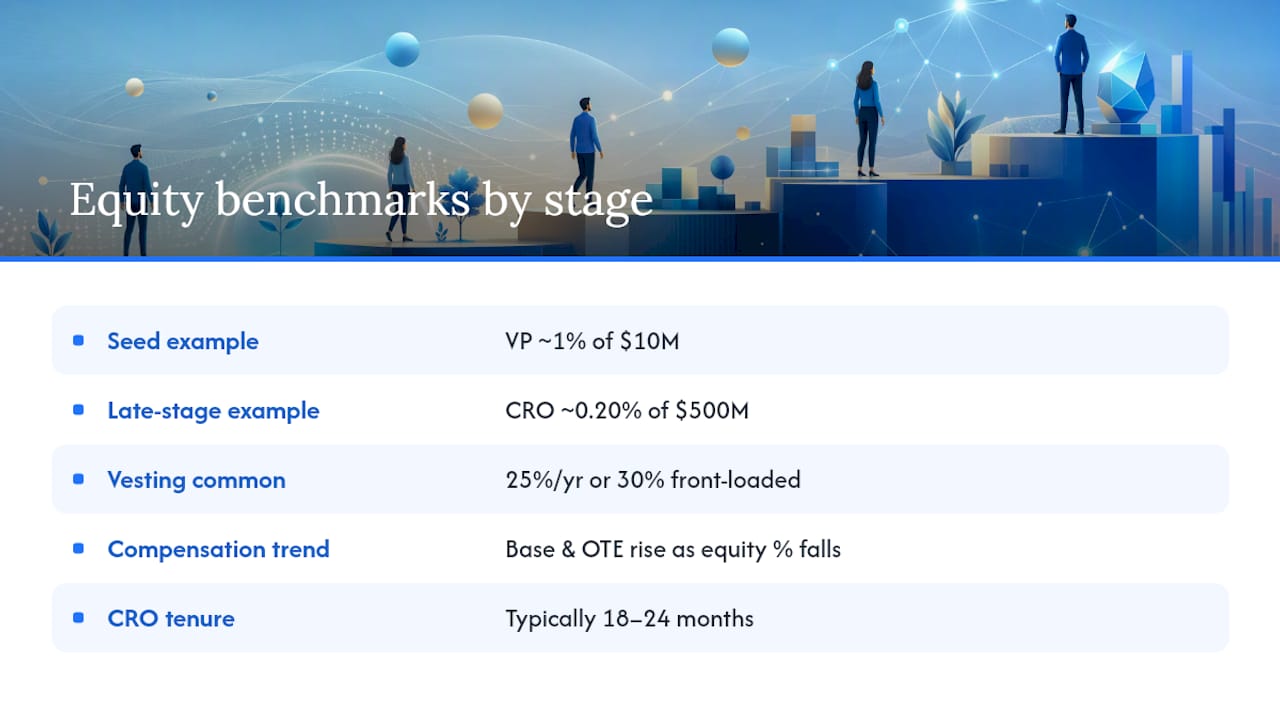
These bands come from stage-based benchmarking that Cornerstone sees confirmed across live searches, and they track with broader VP Sales salary data showing base and OTE climbing right alongside the equity shrinking as a percentage.
Notice the pattern: percentage drops as the company matures, but absolute dollar value climbs because the valuation is bigger. A CRO taking 0.20% of a $500M company is holding more real value than a VP taking 1% of a $10M seed-stage shot in the dark. Don’t let a candidate anchor on the percentage number alone. Model the dollars.
Front-loaded vesting alternatives are worth knowing too. Instead of the flat 25% per year, some companies vest 30% in year one and taper down, which helps retention for roles CROs tend to hold for only 18 to 24 months before moving on.
How Do You Align Equity with Unit Economics, Not Just Bookings?
Here’s the mistake I see constantly. The rep front-loaded discounts, promised features that don’t exist, and closed anything that would move the needle. That’s not a bad rep. That’s a bad plan.
The fix is a Unit Economics framework, splitting variable pay across gates that actually protect the business:
- 70% net-new ARR (bookings, but only counted when contracts actually stick)
- 20% cash collections (because ARR you never collect isn’t revenue)
- 10% gross margin (because a deal that costs you money to service isn’t a win)
At growth stage, add a third structural gate on top: net revenue retention and a trailing-twelve-month EBITDA or burn-efficiency floor. If any single gate fails, the variable pool shrinks or zeroes out. That’s not punitive. That’s just making sure the person closing the deal has skin in whether the deal survives.
Clawback mechanics matter just as much. Build in the right to recover commission if a deal churns inside a defined window, usually 90 to 180 days. And for new hires still ramping, use a recoverable draw, an advance against future commission that gets paid back if they don’t produce, instead of a guaranteed non-recoverable draw that has zero teeth.
Pro Tip: A recoverable draw is your best defense against a “sign and run” hire, someone who closes a flashy first-quarter number then leaves before the customer churns. Structure the draw so it converts to real earned commission only after the deal survives its first renewal cycle.
What Should Candidates Negotiate in an Equity Offer?
Forget the headline percentage. These clauses move actual dollar value more than a quarter point of equity ever will:
- Exercise window: Push for anything longer than the standard 90 days, ideally multi-year, or negotiate early-exercise rights instead.
- Strike price and 409A timing: Confirm the strike price ties to the most recent 409A valuation, not a stale one that inflates your tax bill.
- Acceleration: Double-trigger (change of control plus termination) is the market standard. Single-trigger only benefits the company in most scenarios.
- Refresh grants: Get the cadence in writing, not a verbal promise. Front-loaded refresh commitments starting year three, typically 0.10%–0.25%, keep you from running dry.
- Signing bonus: Use cash to cover equity you’re walking away from at your current job. It’s the fastest lever in the whole negotiation.
Red flags that should make you walk: a 90-day exercise window with no early-exercise option, a strike price priced above the last known 409A, zero clawback policy on either side, or refresh language that says “may be considered” instead of a real schedule. If a founder doesn’t put refresh terms in writing, that tells you something about how they’ll handle every future comp conversation too.
Three Sample Equity Packages You Can Use Today
Templates beat theory. Here are three that actually get used in offer letters.
- Seed/Series A, player-coach VP Sales. Base $150K–$180K, OTE $300K–$350K, equity 1.0%–1.5% fully diluted in ISOs, early-exercise encouraged, four-year vest with one-year cliff. Cash is tight, so the equity carries more of the weight.
- Series B VP Sales. Base $216K–$255K, OTE $360K–$425K, equity 0.5%–1.0% fully diluted, variable gated 70/20/10 on bookings, cash collections, and margin, clawback on churn inside 120 days.
- Series C+ CRO. Base $400K–$500K, OTE up to $1M+, RSUs preferred over options, refresh grant plan locked in at 0.15%–0.25% starting year three, double-trigger acceleration, and a post-termination exercise window extended beyond the standard 90 days if options remain in the mix.
Use these as starting points, not gospel. Adjust for your fundraising trajectory, your burn, and how much the role is actually worth to the business.
How Do Recruiters See Offers Actually Close?
I’ve placed over 1,200 sales, presales, and executive candidates since 1996, and here’s what I know for certain: deals die on details, not headline numbers. They walk because the exercise window is garbage, the refresh promise is verbal, or the comp committee took six weeks to approve something that should’ve taken six days.
Cornerstone’s average time from search kickoff to offer acceptance runs 21 days. That speed isn’t a gimmick. It closes deals before a competing offer shows up and scrambles the negotiation.
Three moments decide most deals: the first comp conversation (set real numbers early, don’t waste three weeks negotiating against a fantasy), the written offer (put refresh and acceleration in the letter, not a side promise), and the counteroffer window (move fast or lose the candidate to their current employer’s retention bonus).
Pro Tip: *When equity talks stall, offer cash first.
If you want a second set of eyes on an offer before you send it, Cornerstone’s software sales recruitment team benchmarks packages against live market data every week, not a stale salary guide from two years ago.
The Gap Between Comp Theory and Comp Reality
Most comp advice online reads like it was written by someone who never sat across the table from a CRO candidate turning down a term sheet. The conventional wisdom says “benchmark to market” like that’s a solved problem. It isn’t. Market data tells you a range. It doesn’t tell you whether your specific candidate will walk over a 90-day exercise window or whether your board will actually approve a refresh grant when year three arrives.
The bigger blind spot is unit economics. Founders love talking equity percentage and hate talking gates. The percentage is theater. The gate structure is the real comp plan.
If you take one thing from this, prioritize the mechanics over the headline number: exercise windows, gate weightings, and written refresh commitments.
This article is general information, not a substitute for advice from a qualified financial advisor. Consult a qualified financial professional about your own circumstances before acting on anything here.